/
/
X (Twitter) vs LinkedIn for B2B Startups in 2026
X (Twitter) vs LinkedIn for B2B Startups in 2026
5 min
read
X (Twitter) vs LinkedIn for B2B Startups in 2026
X (Twitter) vs LinkedIn for B2B Startups in 2026
Startup
Marketing

Author
Scroll down
to read more!
Summerize with ChatGPT
Summerize with Gemini
Summerize with Claude
X (Twitter) vs LinkedIn for B2B Startups in 2026
X (Twitter) vs LinkedIn for B2B Startups in 2026
Most B2B founders are trying to be everywhere at once. They're posting on LinkedIn in the morning, replying to threads on X at noon, and wondering why they are falling in both platforms. It’s not about X vs. LinkedIn, it’s X or LinkedIn, You need one; the right one executed really well. But what’s right for you?
Most B2B founders are trying to be everywhere at once. They're posting on LinkedIn in the morning, replying to threads on X at noon, and wondering why they are falling in both platforms. It’s not about X vs. LinkedIn, it’s X or LinkedIn, You need one; the right one executed really well. But what’s right for you?
The State of X and LinkedIn for B2B in 2026
Things have changed a lot in the past two years. X is not the Twitter you used to know, and LinkedIn is no longer just a resume site. Both have evolved, but in very different directions for B2B.
Here's where things stand right now:
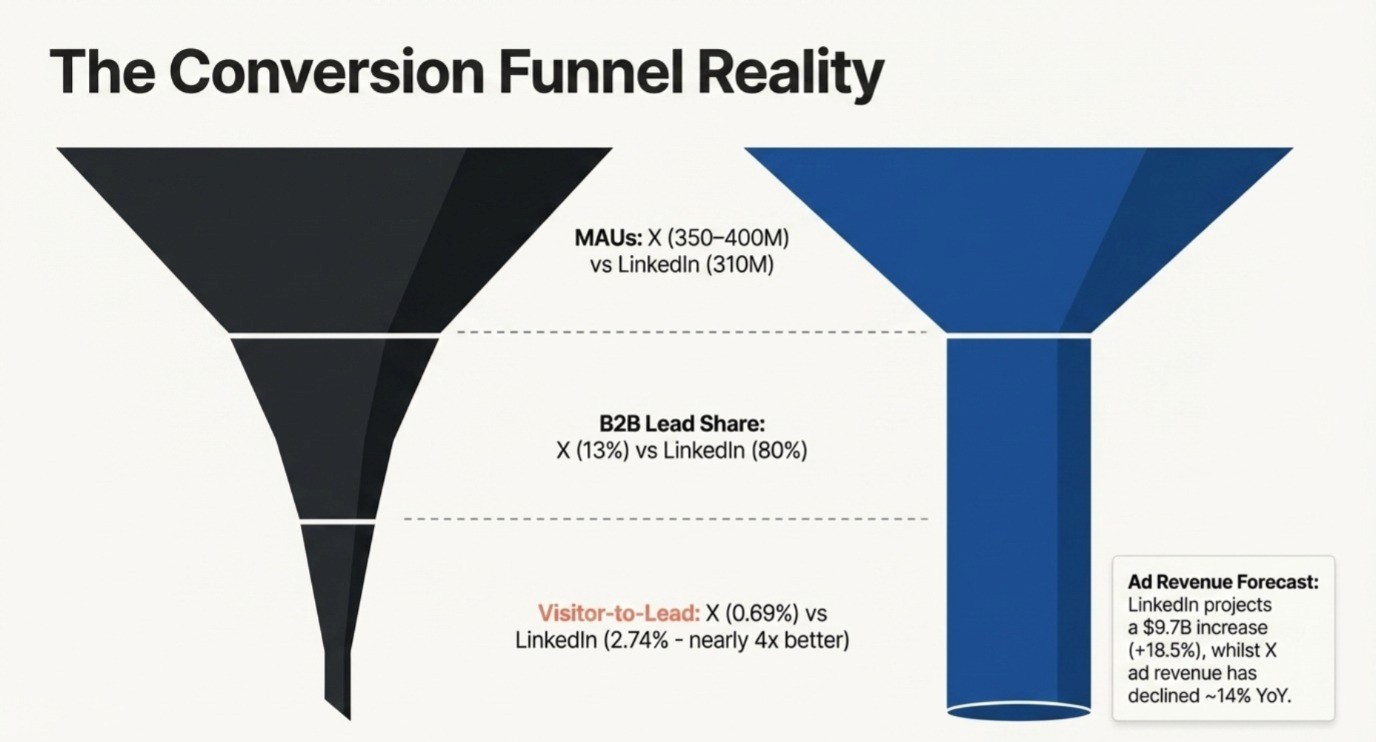
Metric | X (Twitter) | |
Monthly Active Users | 310 million (professional) | 350–400 million (general) |
B2B Social Leads Share | 80% | 13% |
Visitor-to-Lead Conversion | 2.74% | 0.69% |
Avg. Post Engagement Rate | ~1–2% (native video: higher) | 0.04% |
Ad Revenue Trend (2026) | ↑ $9.7B forecast (+18.5%) | ↓ Declined ~14% YoY |
Best For | Lead gen, decision-maker outreach | Thought leadership, community |
What LinkedIn Is Actually Good at in 2026
LinkedIn's biggest advantage is context. When someone sees you on LinkedIn, they already know you're a professional. Your job title is right there. Your company is right there. That context changes everything about how they receive your message.
Lead Generation That Actually Converts
LinkedIn's conversion rate sits at 2.74% visitor-to-lead. That's nearly 4x better than X's 0.69%. For a B2B startup, those numbers matter a lot when you're resource-constrained.
LinkedIn Lead Gen Forms, where someone can submit their info without leaving the platform, convert at around 13%. A typical landing page converts at 4%. That's a massive difference.
Direct Access to Decision-Makers
4 out of 5 LinkedIn members drive business decisions at their companies. You can target by job title, company size, seniority, industry, and even specific companies. No other social platform gives you that level of professional targeting precision.
Content That Drives Pipeline
LinkedIn posts with images or native video get 2x more comments than text-only posts. Thought Leader Ads (where your content runs from a personal profile, not a company page) are delivering a 2.68% CTR, compared to 0.42% for standard single-image ads.
That's a 6x difference just by changing the source of the ad. In 2026, LinkedIn rewards the personal brand more than the company page.
Also read: How often you should post on social media
What X Is Actually Good at in 2026
X is not dead for B2B. It's just... repositioned. It's a different kind of tool now. The platform underwent serious changes after Elon Musk's acquisition. Monthly active user numbers are still significant, around 350–400 million globally, but the B2B signal-to-noise ratio has shifted.
Thought Leadership and Real-Time Visibility
X still moves fast. If something happens in your industry, a funding round, a policy change, a product launch, X is often where the conversation starts. Journalists, analysts, and tech executives still live there.
For founders who want to be part of the conversation in their niche, X has value. Long-form threads, public debates, and fast takes still build real credibility in certain circles.
Technical and Developer Communities
If your B2B startup serves developers, engineers, or technical buyers, X still has pockets of strong engagement. The tech community on X is genuinely active, and thought leadership content there can generate real traction.
"Build in public" culture is still very much alive on X. Founders sharing their journey, metrics, and product decisions find an engaged audience there in ways LinkedIn doesn't quite replicate.
Brand Awareness at Low Cost
X's ad costs are generally lower than LinkedIn's. LinkedIn CPC can run $4.50–$12 per click. X is cheaper to experiment with. If awareness is your goal (not lead gen), X can stretch a smaller budget further.
The caveat: X's engagement rate is 0.04%, the lowest of any major platform. Impressions are cheap. Meaningful interactions are harder to come by.
Also Read: How to build a social media calendar
X vs. LinkedIn for B2B Startups: Side-by-Side Comparison
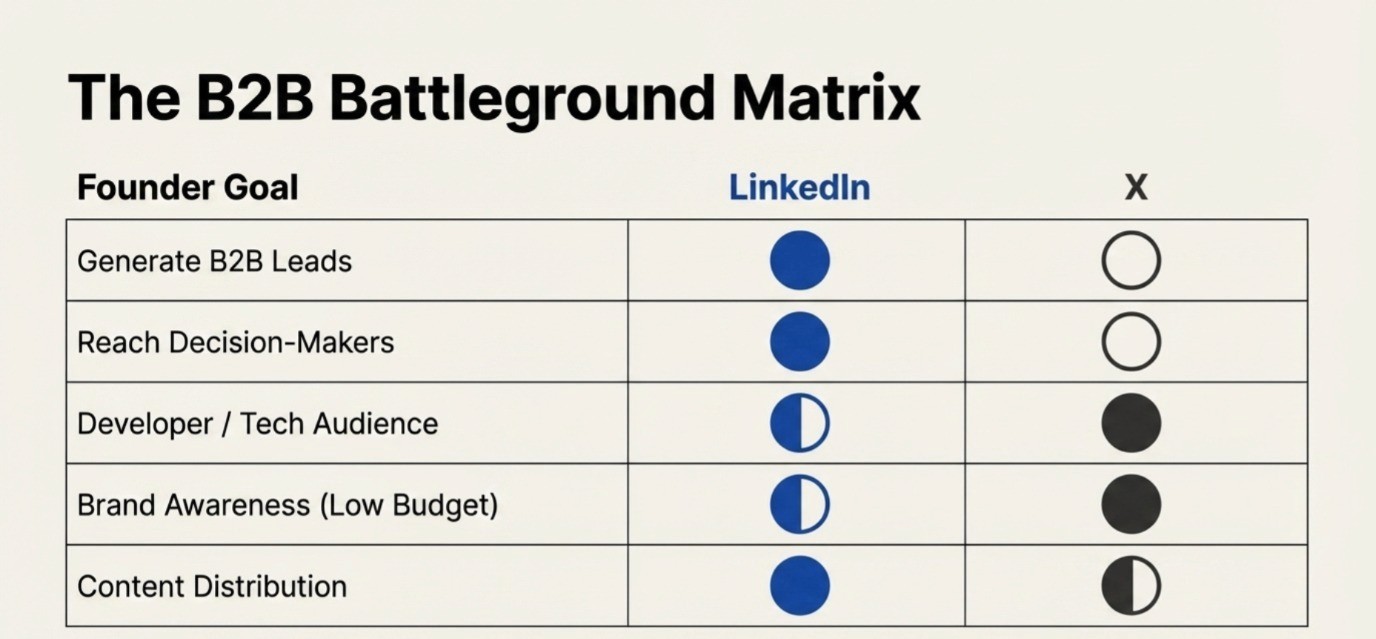
Goal | X (Twitter) | |
Generate B2B leads | Best option by far | Low conversion rate |
Reach decision makers. | Surgical targeting by role/company | Limited professional context |
Build thought leadership | Strong (Thought Leader Ads) | Good for real-time takes |
Developer/tech audience | Some presence | Strong community |
Brand awareness (low budget) | Higher CPCs | Cheaper impressions |
Content distribution | 46% of B2B social traffic | Declining reach |
Sales Navigator / CRM sync | Native integrations | Not available |
Influencer partnerships | Credible, niche B2B voices | Broader reach, tech niches |
Organic reach | Still strong for good content | Algorithm changes hit reach |
The State of X and LinkedIn for B2B in 2026
Things have changed a lot in the past two years. X is not the Twitter you used to know, and LinkedIn is no longer just a resume site. Both have evolved, but in very different directions for B2B.
Here's where things stand right now:
Metric | X (Twitter) | |
Monthly Active Users | 310 million (professional) | 350–400 million (general) |
B2B Social Leads Share | 80% | 13% |
Visitor-to-Lead Conversion | 2.74% | 0.69% |
Avg. Post Engagement Rate | ~1–2% (native video: higher) | 0.04% |
Ad Revenue Trend (2026) | ↑ $9.7B forecast (+18.5%) | ↓ Declined ~14% YoY |
Best For | Lead gen, decision-maker outreach | Thought leadership, community |
What LinkedIn Is Actually Good at in 2026
LinkedIn's biggest advantage is context. When someone sees you on LinkedIn, they already know you're a professional. Your job title is right there. Your company is right there. That context changes everything about how they receive your message.
Lead Generation That Actually Converts
LinkedIn's conversion rate sits at 2.74% visitor-to-lead. That's nearly 4x better than X's 0.69%. For a B2B startup, those numbers matter a lot when you're resource-constrained.
LinkedIn Lead Gen Forms, where someone can submit their info without leaving the platform, convert at around 13%. A typical landing page converts at 4%. That's a massive difference.
Direct Access to Decision-Makers
4 out of 5 LinkedIn members drive business decisions at their companies. You can target by job title, company size, seniority, industry, and even specific companies. No other social platform gives you that level of professional targeting precision.
Content That Drives Pipeline
LinkedIn posts with images or native video get 2x more comments than text-only posts. Thought Leader Ads (where your content runs from a personal profile, not a company page) are delivering a 2.68% CTR, compared to 0.42% for standard single-image ads.
That's a 6x difference just by changing the source of the ad. In 2026, LinkedIn rewards the personal brand more than the company page.
Also read: How often you should post on social media
What X Is Actually Good at in 2026
X is not dead for B2B. It's just... repositioned. It's a different kind of tool now. The platform underwent serious changes after Elon Musk's acquisition. Monthly active user numbers are still significant, around 350–400 million globally, but the B2B signal-to-noise ratio has shifted.
Thought Leadership and Real-Time Visibility
X still moves fast. If something happens in your industry, a funding round, a policy change, a product launch, X is often where the conversation starts. Journalists, analysts, and tech executives still live there.
For founders who want to be part of the conversation in their niche, X has value. Long-form threads, public debates, and fast takes still build real credibility in certain circles.
Technical and Developer Communities
If your B2B startup serves developers, engineers, or technical buyers, X still has pockets of strong engagement. The tech community on X is genuinely active, and thought leadership content there can generate real traction.
"Build in public" culture is still very much alive on X. Founders sharing their journey, metrics, and product decisions find an engaged audience there in ways LinkedIn doesn't quite replicate.
Brand Awareness at Low Cost
X's ad costs are generally lower than LinkedIn's. LinkedIn CPC can run $4.50–$12 per click. X is cheaper to experiment with. If awareness is your goal (not lead gen), X can stretch a smaller budget further.
The caveat: X's engagement rate is 0.04%, the lowest of any major platform. Impressions are cheap. Meaningful interactions are harder to come by.
Also Read: How to build a social media calendar
X vs. LinkedIn for B2B Startups: Side-by-Side Comparison
Goal | X (Twitter) | |
Generate B2B leads | Best option by far | Low conversion rate |
Reach decision makers. | Surgical targeting by role/company | Limited professional context |
Build thought leadership | Strong (Thought Leader Ads) | Good for real-time takes |
Developer/tech audience | Some presence | Strong community |
Brand awareness (low budget) | Higher CPCs | Cheaper impressions |
Content distribution | 46% of B2B social traffic | Declining reach |
Sales Navigator / CRM sync | Native integrations | Not available |
Influencer partnerships | Credible, niche B2B voices | Broader reach, tech niches |
Organic reach | Still strong for good content | Algorithm changes hit reach |
How to Decide: A Simple Framework for B2B Founders
Stop trying to do both equally. Use this framework to figure out where to focus.
Use LinkedIn If...
• Your buyers are mid-to-senior professionals (managers, directors, VPs, C-suite)
• You're selling a product with a $5k+ deal size or a longer sales cycle
• You're doing outbound sales or account-based marketing (ABM)
• You want to build an inbound pipeline through content over 6–12 months
• You're in SaaS, consulting, professional services, HR tech, fintech, or enterprise software
Add X as a Secondary Channel If...
• Your buyers are developers, engineers, or technical founders
• You're in a fast-moving space where real-time commentary matters (AI, crypto, fintech)
• You want to build in public and attract early adopters or press attention
• You have a founder with a strong personal voice who enjoys the format
• You want cheap brand awareness impressions while your LinkedIn engine warms up
Skip X for Now If...
• You have limited time and need leads, not awareness
• Your buyers are in traditional industries (legal, healthcare, government, manufacturing)
• You're earlier than product-market fit and need focused execution
• Your team doesn't have the bandwidth to maintain two channels with quality
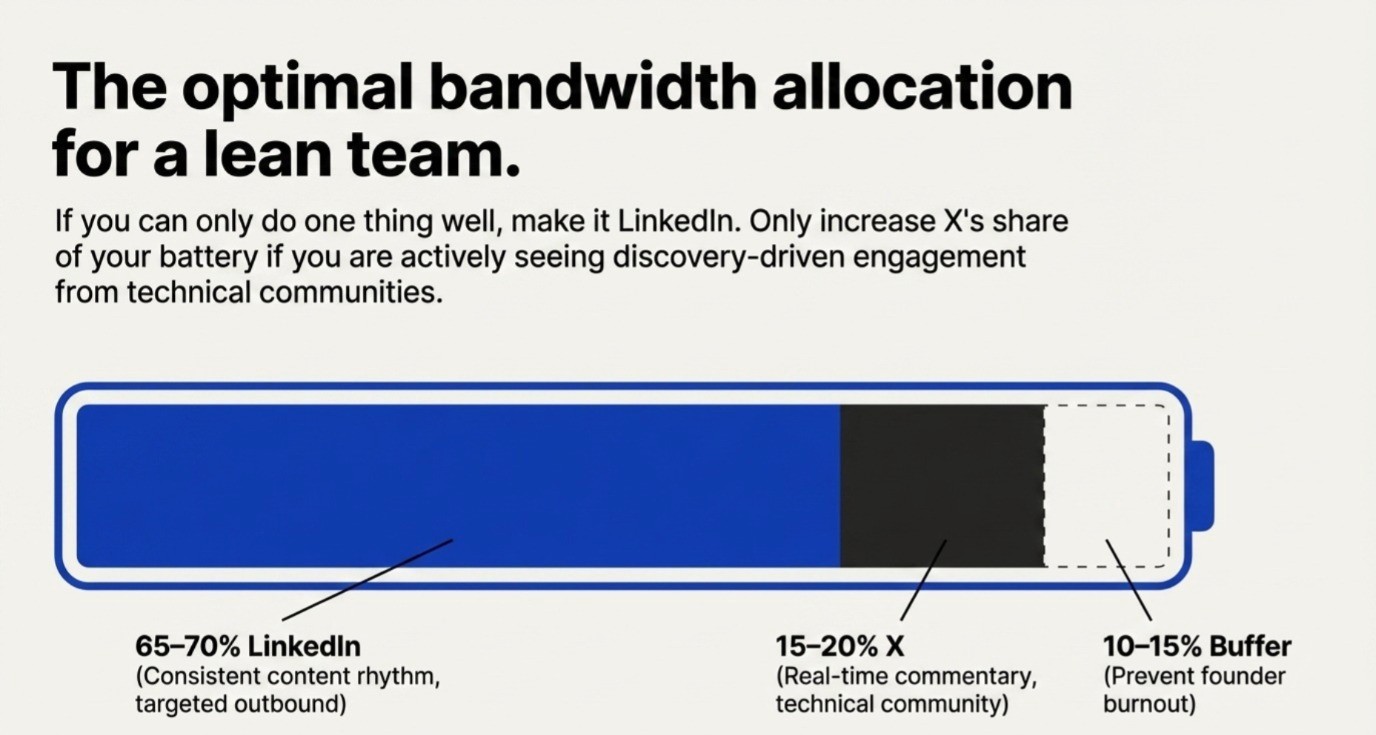
Simple Rule | If you can only do one thing well, make it LinkedIn. Then layer X in when you have extra bandwidth or specific community goals. |
What Content Works on X & LinkedIn Platform in 2026
What Performs on LinkedIn Right Now
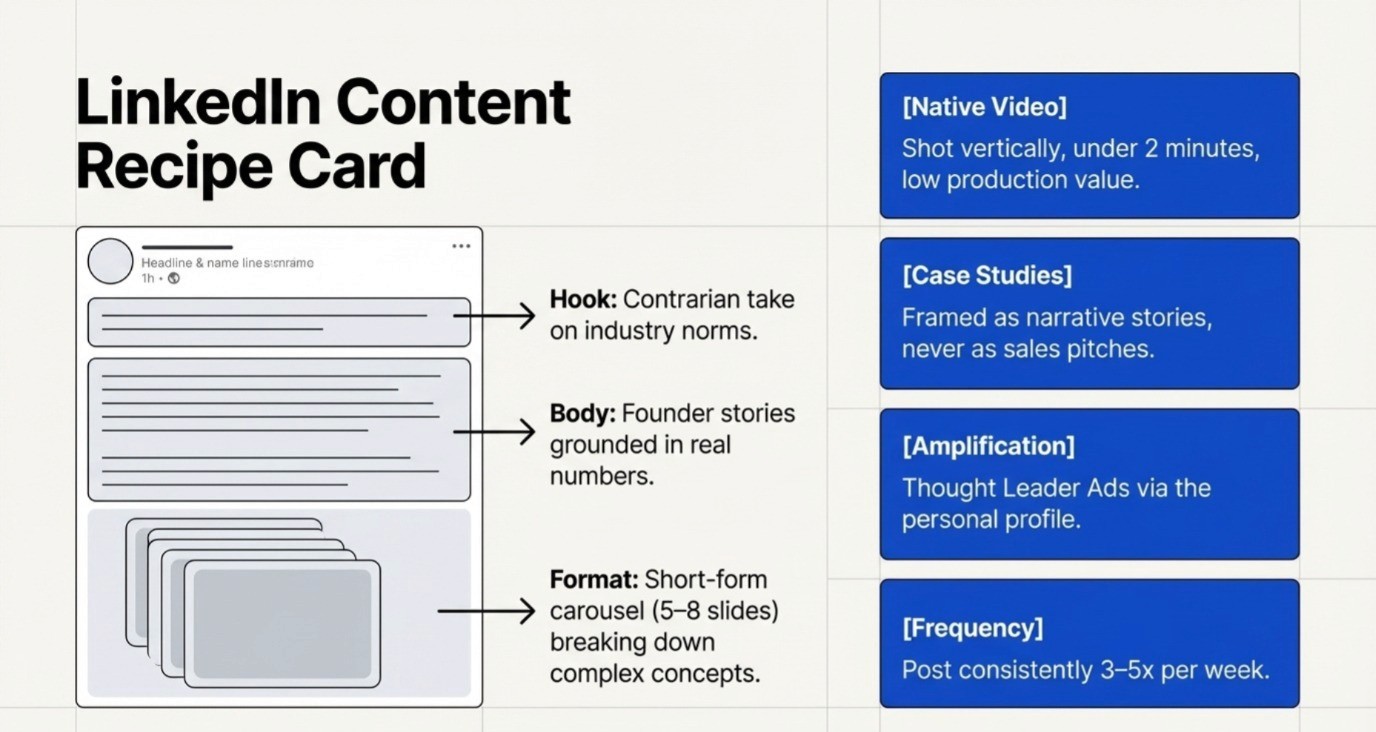
• Founder stories with real numbers; growth, failures, lessons learned
• Short-form carousel posts breaking down a complex concept in 5–8 slides
• Native video (shot vertically, under 2 minutes, no heavy production)
• Thought Leader Ads run from your personal profile, not the company page
• Case study posts framed as a story, not a sales pitch
• Contrarian takes on industry norms; these get shared and debated
What Performs on X Right Now
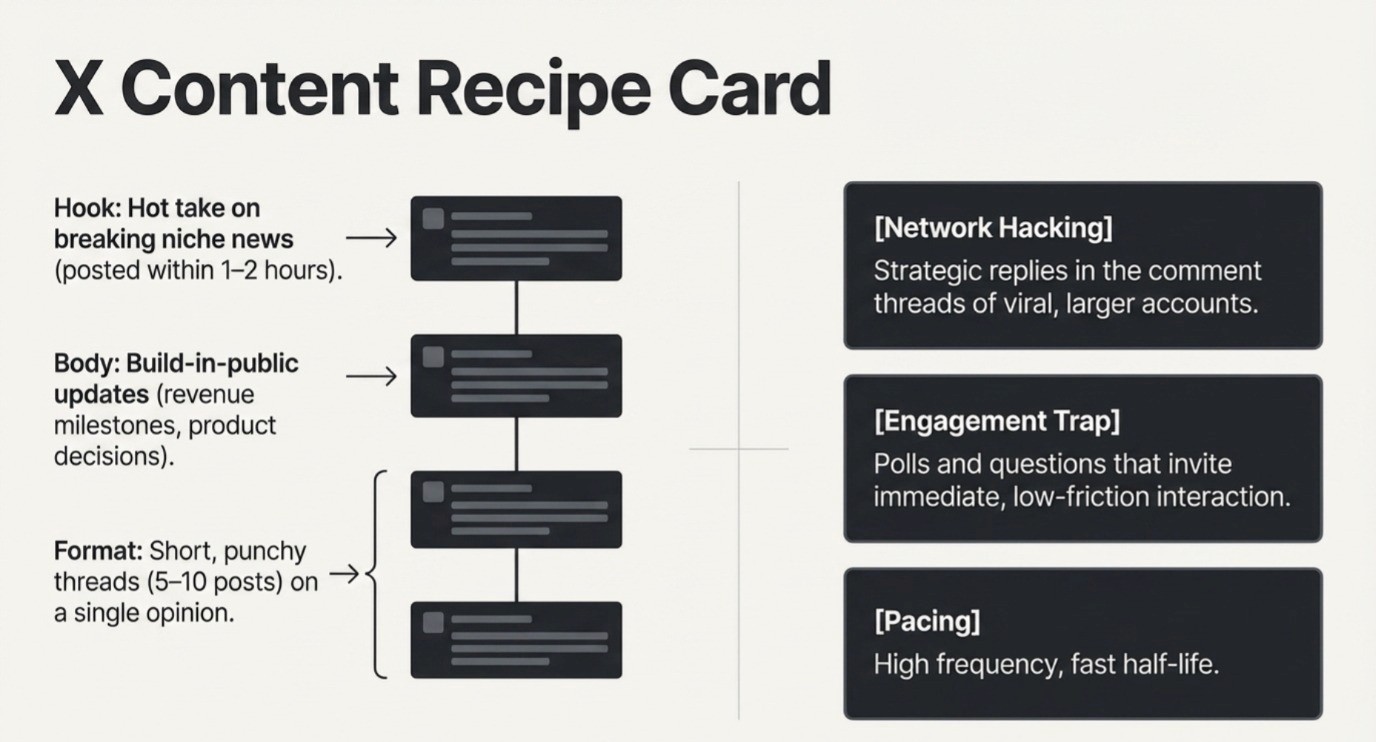
• Short, punchy threads (5–10 tweets) on a single insight or opinion
• Build-in-public updates: revenue milestones, product decisions, lessons from failures
• Hot takes on breaking news in your niche; within the first 1–2 hours
• Replies to bigger accounts; getting into the conversation thread of a viral post
• Polls and questions that invite quick engagement
One thing both platforms share: the personal account outperforms the brand account. Every time. Your company page is a supporting actor. You, the founder, are the main character.
Why B2B Influencer Marketing is the Shortcut Most Founders Ignore
Here's a faster path than trying to build your own following from scratch: borrow someone else's audience.
B2B influencer marketing has matured significantly in 2026. On LinkedIn, niche creators with 20,000–100,000 followers often drive better results than macro-influencers with millions, because their audiences are tighter and more relevant.
On X, the same is true, especially in developer, SaaS, and startup circles, where respected voices can move entire conversations.
How to Use Influencers on LinkedIn
• Sponsored posts from a creator who covers your exact ICP topic
• Thought Leader Ads: your content, delivered through their profile
• Co-created content: interviews, collaborations, data reports
• Product reviews from respected operators in your space
How to Use Influencers on X
• Sponsored threads that look and feel like genuine founder content
• Product shoutouts embedded in relevant conversations
• Technical deep-dives for developer or engineering audiences
• Community building via influential accounts in your niche
How to Decide: A Simple Framework for B2B Founders
Stop trying to do both equally. Use this framework to figure out where to focus.
Use LinkedIn If...
• Your buyers are mid-to-senior professionals (managers, directors, VPs, C-suite)
• You're selling a product with a $5k+ deal size or a longer sales cycle
• You're doing outbound sales or account-based marketing (ABM)
• You want to build an inbound pipeline through content over 6–12 months
• You're in SaaS, consulting, professional services, HR tech, fintech, or enterprise software
Add X as a Secondary Channel If...
• Your buyers are developers, engineers, or technical founders
• You're in a fast-moving space where real-time commentary matters (AI, crypto, fintech)
• You want to build in public and attract early adopters or press attention
• You have a founder with a strong personal voice who enjoys the format
• You want cheap brand awareness impressions while your LinkedIn engine warms up
Skip X for Now If...
• You have limited time and need leads, not awareness
• Your buyers are in traditional industries (legal, healthcare, government, manufacturing)
• You're earlier than product-market fit and need focused execution
• Your team doesn't have the bandwidth to maintain two channels with quality
Simple Rule | If you can only do one thing well, make it LinkedIn. Then layer X in when you have extra bandwidth or specific community goals. |
What Content Works on X & LinkedIn Platform in 2026
What Performs on LinkedIn Right Now
• Founder stories with real numbers; growth, failures, lessons learned
• Short-form carousel posts breaking down a complex concept in 5–8 slides
• Native video (shot vertically, under 2 minutes, no heavy production)
• Thought Leader Ads run from your personal profile, not the company page
• Case study posts framed as a story, not a sales pitch
• Contrarian takes on industry norms; these get shared and debated
What Performs on X Right Now
• Short, punchy threads (5–10 tweets) on a single insight or opinion
• Build-in-public updates: revenue milestones, product decisions, lessons from failures
• Hot takes on breaking news in your niche; within the first 1–2 hours
• Replies to bigger accounts; getting into the conversation thread of a viral post
• Polls and questions that invite quick engagement
One thing both platforms share: the personal account outperforms the brand account. Every time. Your company page is a supporting actor. You, the founder, are the main character.
Why B2B Influencer Marketing is the Shortcut Most Founders Ignore
Here's a faster path than trying to build your own following from scratch: borrow someone else's audience.
B2B influencer marketing has matured significantly in 2026. On LinkedIn, niche creators with 20,000–100,000 followers often drive better results than macro-influencers with millions, because their audiences are tighter and more relevant.
On X, the same is true, especially in developer, SaaS, and startup circles, where respected voices can move entire conversations.
How to Use Influencers on LinkedIn
• Sponsored posts from a creator who covers your exact ICP topic
• Thought Leader Ads: your content, delivered through their profile
• Co-created content: interviews, collaborations, data reports
• Product reviews from respected operators in your space
How to Use Influencers on X
• Sponsored threads that look and feel like genuine founder content
• Product shoutouts embedded in relevant conversations
• Technical deep-dives for developer or engineering audiences
• Community building via influential accounts in your niche
Conclusion
Most marketing guides won't tell you that for B2B startups in 2026, LinkedIn is the clear choice for lead generation and pipeline building. The data isn't even close.
X has a role, but it's a supporting one. It's where you build credibility, join conversations, and nurture awareness. It is not where you go to reliably generate leads.
If you're spread thin, and most founders are, consolidate. Master LinkedIn first. Build a consistent content rhythm, do targeted outreach, run a Thought Leader Ad or two, and watch what happens over 90 days.
Work Smarter with Motion Labs | If you are not sure where to start? Motion Labs helps B2B startups build influence on both LinkedIn and X through a curated influencer network of niche creators. |
FAQ: X vs LinkedIn for B2B Startups
Q: Is LinkedIn really worth it if I'm a very early-stage startup?
A: Yes, especially if your deal size is meaningful. Even with a small audience, one well-placed LinkedIn post or a direct outreach campaign can land enterprise meetings. LinkedIn's organic reach for thoughtful content is still strong, and you don't need a big following to start.
Q: Can I use X to generate B2B leads?
A: It's possible, but rarely efficient. X's conversion rate for B2B is 0.69%; nearly 4x lower than LinkedIn's 2.74%. You can use X to warm up awareness or build inbound interest, but for actual lead capture, LinkedIn is the better engine.
Q: What if my audience is technical, developers, or engineers?
A: Then X becomes more relevant. The developer and engineering community is genuinely active there, and thought leadership content in those circles spreads faster on X than on LinkedIn. Consider a dual approach: LinkedIn for decision-makers, X for practitioners.
Q: How much time should I allocate to each platform?
A: For most B2B startups, the recommended split is 65–70% of social effort on LinkedIn and 15–20% on X. Only increase X's share if you're actively seeing engagement or if your audience is primarily technical and discovery-driven.
Q: Do I need to run paid ads on LinkedIn, or is it organic enough?
A: Organic can work well for founders building a personal brand. Paid LinkedIn ads (especially Thought Leader Ads and Lead Gen Forms) accelerate results significantly, but they come at a cost. CPC runs $4.50–$12. Start organic, validate your message, then amplify with paid.
Q: What's the fastest way to build a presence on LinkedIn from scratch?
A: Post consistently (3–5x per week), engage meaningfully in comments on larger accounts, and share real numbers and lessons from your work. Founder-first content consistently outperforms company-page content. Personal, specific, and opinionated posts get seen.
Q: How does B2B influencer marketing work on these platforms?
A: On LinkedIn, you partner with niche creators who cover your exact buyer persona topic; they create sponsored content that feels native to their feed. On X, it's often shorter-form product endorsements embedded into relevant threads. Agencies like Motion Labs manage the vetting, matching, and campaign execution so you're not cold-emailing creators yourself.
Conclusion
Most marketing guides won't tell you that for B2B startups in 2026, LinkedIn is the clear choice for lead generation and pipeline building. The data isn't even close.
X has a role, but it's a supporting one. It's where you build credibility, join conversations, and nurture awareness. It is not where you go to reliably generate leads.
If you're spread thin, and most founders are, consolidate. Master LinkedIn first. Build a consistent content rhythm, do targeted outreach, run a Thought Leader Ad or two, and watch what happens over 90 days.
Work Smarter with Motion Labs | If you are not sure where to start? Motion Labs helps B2B startups build influence on both LinkedIn and X through a curated influencer network of niche creators. |
FAQ: X vs LinkedIn for B2B Startups
Q: Is LinkedIn really worth it if I'm a very early-stage startup?
A: Yes, especially if your deal size is meaningful. Even with a small audience, one well-placed LinkedIn post or a direct outreach campaign can land enterprise meetings. LinkedIn's organic reach for thoughtful content is still strong, and you don't need a big following to start.
Q: Can I use X to generate B2B leads?
A: It's possible, but rarely efficient. X's conversion rate for B2B is 0.69%; nearly 4x lower than LinkedIn's 2.74%. You can use X to warm up awareness or build inbound interest, but for actual lead capture, LinkedIn is the better engine.
Q: What if my audience is technical, developers, or engineers?
A: Then X becomes more relevant. The developer and engineering community is genuinely active there, and thought leadership content in those circles spreads faster on X than on LinkedIn. Consider a dual approach: LinkedIn for decision-makers, X for practitioners.
Q: How much time should I allocate to each platform?
A: For most B2B startups, the recommended split is 65–70% of social effort on LinkedIn and 15–20% on X. Only increase X's share if you're actively seeing engagement or if your audience is primarily technical and discovery-driven.
Q: Do I need to run paid ads on LinkedIn, or is it organic enough?
A: Organic can work well for founders building a personal brand. Paid LinkedIn ads (especially Thought Leader Ads and Lead Gen Forms) accelerate results significantly, but they come at a cost. CPC runs $4.50–$12. Start organic, validate your message, then amplify with paid.
Q: What's the fastest way to build a presence on LinkedIn from scratch?
A: Post consistently (3–5x per week), engage meaningfully in comments on larger accounts, and share real numbers and lessons from your work. Founder-first content consistently outperforms company-page content. Personal, specific, and opinionated posts get seen.
Q: How does B2B influencer marketing work on these platforms?
A: On LinkedIn, you partner with niche creators who cover your exact buyer persona topic; they create sponsored content that feels native to their feed. On X, it's often shorter-form product endorsements embedded into relevant threads. Agencies like Motion Labs manage the vetting, matching, and campaign execution so you're not cold-emailing creators yourself.
the call your competitor wish you would'nt take


Related Posts





Related Posts
Related Posts
Motion labs
info@motionlabs.agency


+971 55317 1706
C-1802, ONTARIO TOWER, PLOT NO. 49-0, BUSINESS BAY, DUBAI, 00000
click to meet me :)
click to meet me :)
© All Rights Reserved | 2026


Motion labs
info@motionlabs.agency
+971 55317 1706
C-1802, ONTARIO TOWER, PLOT NO. 49-0, BUSINESS BAY, DUBAI, 00000
Private policy
Terms & Conditions
© All Rights Reserved | 2026
click to meet me :)