/
/
Best UGC Platforms for Creators: Where to Find Paid Brand Work That Actually Converts
Best UGC Platforms for Creators: Where to Find Paid Brand Work That Actually Converts
5 min
read
Best UGC Platforms for Creators: Where to Find Paid Brand Work That Actually Converts
Best UGC Platforms for Creators: Where to Find Paid Brand Work That Actually Converts
Content
Marketing

Author

Scroll down
to read more!
Summerize with ChatGPT
Summerize with Gemini
Summerize with Claude
Best UGC Platforms for Creators: Where to Find Paid Brand Work That Actually Converts
Best UGC Platforms for Creators: Where to Find Paid Brand Work That Actually Converts
A working guide to the marketplaces that connect UGC creators with paying brands, what each one is good at, and how to get accepted faster. Compare the best UGC platforms for creators, what each pays for, how approval works, and how to build a portfolio brands actually book. Practical, no fluff.
A working guide to the marketplaces that connect UGC creators with paying brands, what each one is good at, and how to get accepted faster. Compare the best UGC platforms for creators, what each pays for, how approval works, and how to build a portfolio brands actually book. Practical, no fluff.
The best UGC platforms for creators are the ones that match your content style, pay on a schedule you can plan around, and put you in front of brands that reorder. For most creators starting out, that means Billo, Insense, Trend.io, JoinBrands, Collabstr, and Cohley, supported by the native marketplaces inside TikTok and Instagram. Each one solves a different problem, and joining the right two or three beats spreads yourself across ten.
We run user-generated content programs for brands across the US, UK, UAE, and Europe, which means we sit on the buying side of these marketplaces every week. This guide is written from that seat. It covers what platforms actually look for in an application, how payment structures differ, why creators get rejected, and how to turn a marketplace gig into a repeat client relationship.
Key takeaways
|
What is a UGC platform and how does it work for creators?
A UGC platform is a marketplace that sits between brands that need authentic, creator-shot content and the creators who make it. The brand posts a brief with a product, a set of talking points, a deliverable format, and a budget. Creators apply or get matched. The brand approves, ships the product, reviews the draft, and pays through the platform once the content is accepted.
The important distinction is that UGC work is not influencer work. You are not being paid for your audience. You are being paid for the footage. The brand takes your video and runs it as a paid ad, a product page asset, an email hero, or an organic post on their own channel. That difference changes everything about how you should package yourself, because a brand with no interest in your follower count is very interested in whether your kitchen has good window light and whether you can deliver a hook in the first two seconds.
That is also why the category has grown so quickly. Paid social costs keep climbing and creative fatigue sets in within days on platforms like TikTok and Meta. Brands need volume, and volume is exactly what a network of creators supplies. We built our UGC at scale service around that reality, because a single hero video does not survive a modern ad account. Twenty variations do.
The best UGC platforms for creators are the ones that match your content style, pay on a schedule you can plan around, and put you in front of brands that reorder. For most creators starting out, that means Billo, Insense, Trend.io, JoinBrands, Collabstr, and Cohley, supported by the native marketplaces inside TikTok and Instagram. Each one solves a different problem, and joining the right two or three beats spreads yourself across ten.
We run user-generated content programs for brands across the US, UK, UAE, and Europe, which means we sit on the buying side of these marketplaces every week. This guide is written from that seat. It covers what platforms actually look for in an application, how payment structures differ, why creators get rejected, and how to turn a marketplace gig into a repeat client relationship.
Key takeaways
|
What is a UGC platform and how does it work for creators?
A UGC platform is a marketplace that sits between brands that need authentic, creator-shot content and the creators who make it. The brand posts a brief with a product, a set of talking points, a deliverable format, and a budget. Creators apply or get matched. The brand approves, ships the product, reviews the draft, and pays through the platform once the content is accepted.
The important distinction is that UGC work is not influencer work. You are not being paid for your audience. You are being paid for the footage. The brand takes your video and runs it as a paid ad, a product page asset, an email hero, or an organic post on their own channel. That difference changes everything about how you should package yourself, because a brand with no interest in your follower count is very interested in whether your kitchen has good window light and whether you can deliver a hook in the first two seconds.
That is also why the category has grown so quickly. Paid social costs keep climbing and creative fatigue sets in within days on platforms like TikTok and Meta. Brands need volume, and volume is exactly what a network of creators supplies. We built our UGC at scale service around that reality, because a single hero video does not survive a modern ad account. Twenty variations do.
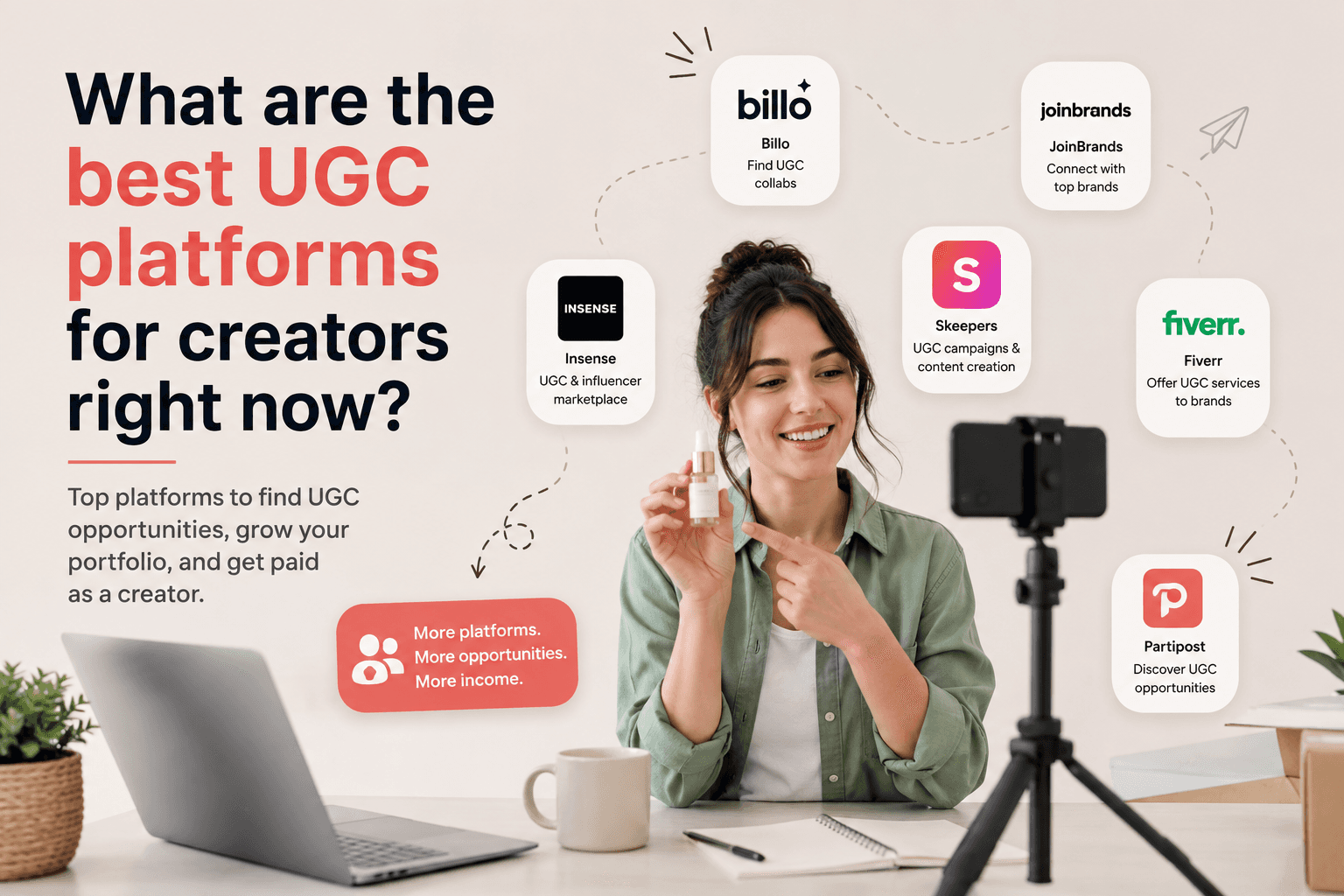
There is no single winner. There are categories, and you should pick one platform from each of the first two.
Billo
Billo is one of the most straightforward entry points. Brands post product video briefs, creators claim them, and the platform handles product shipping and payment release. The briefs are prescriptive, which is a gift when you are learning. You are told the hook, the beats, the length, and the aspect ratio. Turnaround expectations are tight, so it rewards creators who can shoot and deliver in a few days.
Insense
Insense leans toward performance marketing teams and direct-to-consumer brands running Meta and TikTok ads. Briefs are often ad-specific, which means the brand cares about hooks, retention, and whitelisting. If you are comfortable with Spark Ads and giving a brand permission to run content from your handle, Insense tends to pay better for that permission than pure content marketplaces do.
JoinBrands
JoinBrands covers UGC video, photo, and social posting jobs in one place, with a heavy Amazon and e-commerce seller base. Volume is high, briefs are simple, and it is a reasonable place to build a reel of finished work quickly. Read each job carefully because photo jobs and video jobs are priced very differently.
Trend.io
Trend focuses on lifestyle and consumer brands with a curation layer, so the application bar is higher and the creative direction is looser. Creators who have a strong visual point of view do better here than creators who only follow instructions.
Collabstr
Collabstr works more like a storefront. You build a profile, list packages, and brands book you directly. It puts pricing control in your hands, which is useful once you know what your work is worth, and less useful on day one when you have nothing to show.
Cohley
Cohley sits at the enterprise end. Campaigns are larger, approvals are slower, and the content often feeds retail and paid media at the same time. Getting in usually requires an existing body of brand work.
TikTok Creator Marketplace and Instagram Creator Marketplace
Both native marketplaces are discovery tools first. Brands search, filter, and reach out. Payment terms and briefs are less standardised than on dedicated UGC platforms, and eligibility rules change. They are worth activating, but they should not be your only channel.
How do the best UGC platforms compare on pay structure and approval speed?
Use this to decide where to spend your application energy first. Rates vary by brand, category, and usage terms, so the table compares structure rather than numbers.
Platform | Best for | How you get work | Payment structure | Approval difficulty |
|---|---|---|---|---|
Billo | First paid gigs, product video | Claim open briefs | Flat fee per accepted video | Low |
Insense | Paid ad creative, whitelisting | Apply to campaigns | Content fee plus usage or whitelisting fee | Medium |
JoinBrands | Volume, e-commerce sellers | Apply to open jobs | Per deliverable, photo and video priced separately | Low |
Trend.io | Lifestyle and aesthetic-led brands | Curated matching | Per campaign, product plus fee | Medium |
Collabstr | Setting your own rates | Direct booking from your profile | Your listed package price | Low to list, high to get booked |
Cohley | Larger brands and retail campaigns | Invite and application | Per campaign with usage terms | High |
TikTok Creator Marketplace | Discovery and inbound | Brand outreach | Negotiated per deal | Medium |
Do you need a big following to get on UGC platforms?
No. This is the single biggest misconception in the category, and it stops good creators from applying.
Most UGC platforms do not buy reach. They buy footage. A creator with 800 followers who shoots clean, well-lit, natural-sounding product video is more valuable to a performance marketing team than a creator with 80,000 followers whose content only works in their own feed. The brand is going to put media spend behind the video, so the audience is bought, not borrowed.
Where follower count does matter is whitelisting and Spark Ads, where the brand runs the ad from your handle. There, account credibility affects performance, and you can and should charge more for it.
What platforms actually screen for
|
There is no single winner. There are categories, and you should pick one platform from each of the first two.
Billo
Billo is one of the most straightforward entry points. Brands post product video briefs, creators claim them, and the platform handles product shipping and payment release. The briefs are prescriptive, which is a gift when you are learning. You are told the hook, the beats, the length, and the aspect ratio. Turnaround expectations are tight, so it rewards creators who can shoot and deliver in a few days.
Insense
Insense leans toward performance marketing teams and direct-to-consumer brands running Meta and TikTok ads. Briefs are often ad-specific, which means the brand cares about hooks, retention, and whitelisting. If you are comfortable with Spark Ads and giving a brand permission to run content from your handle, Insense tends to pay better for that permission than pure content marketplaces do.
JoinBrands
JoinBrands covers UGC video, photo, and social posting jobs in one place, with a heavy Amazon and e-commerce seller base. Volume is high, briefs are simple, and it is a reasonable place to build a reel of finished work quickly. Read each job carefully because photo jobs and video jobs are priced very differently.
Trend.io
Trend focuses on lifestyle and consumer brands with a curation layer, so the application bar is higher and the creative direction is looser. Creators who have a strong visual point of view do better here than creators who only follow instructions.
Collabstr
Collabstr works more like a storefront. You build a profile, list packages, and brands book you directly. It puts pricing control in your hands, which is useful once you know what your work is worth, and less useful on day one when you have nothing to show.
Cohley
Cohley sits at the enterprise end. Campaigns are larger, approvals are slower, and the content often feeds retail and paid media at the same time. Getting in usually requires an existing body of brand work.
TikTok Creator Marketplace and Instagram Creator Marketplace
Both native marketplaces are discovery tools first. Brands search, filter, and reach out. Payment terms and briefs are less standardised than on dedicated UGC platforms, and eligibility rules change. They are worth activating, but they should not be your only channel.
How do the best UGC platforms compare on pay structure and approval speed?
Use this to decide where to spend your application energy first. Rates vary by brand, category, and usage terms, so the table compares structure rather than numbers.
Platform | Best for | How you get work | Payment structure | Approval difficulty |
|---|---|---|---|---|
Billo | First paid gigs, product video | Claim open briefs | Flat fee per accepted video | Low |
Insense | Paid ad creative, whitelisting | Apply to campaigns | Content fee plus usage or whitelisting fee | Medium |
JoinBrands | Volume, e-commerce sellers | Apply to open jobs | Per deliverable, photo and video priced separately | Low |
Trend.io | Lifestyle and aesthetic-led brands | Curated matching | Per campaign, product plus fee | Medium |
Collabstr | Setting your own rates | Direct booking from your profile | Your listed package price | Low to list, high to get booked |
Cohley | Larger brands and retail campaigns | Invite and application | Per campaign with usage terms | High |
TikTok Creator Marketplace | Discovery and inbound | Brand outreach | Negotiated per deal | Medium |
Do you need a big following to get on UGC platforms?
No. This is the single biggest misconception in the category, and it stops good creators from applying.
Most UGC platforms do not buy reach. They buy footage. A creator with 800 followers who shoots clean, well-lit, natural-sounding product video is more valuable to a performance marketing team than a creator with 80,000 followers whose content only works in their own feed. The brand is going to put media spend behind the video, so the audience is bought, not borrowed.
Where follower count does matter is whitelisting and Spark Ads, where the brand runs the ad from your handle. There, account credibility affects performance, and you can and should charge more for it.
What platforms actually screen for
|

You need three to five finished spec pieces. Spec means you made them for products you already own, without a client. Nobody expects your first portfolio to be paid work.
One problem-solution video. Open on a relatable frustration, introduce the product, land the result. This is the format most brands buy.
One unboxing or first-impression video. Shows you can carry energy and handle a product on camera.
One testimonial-style piece. Straight to camera, conversational, no script reading. Hardest to fake, most requested.
One hook pack. Three to five different openings for the same video. Performance teams love this because it gives them variations to test.
One b-roll and product detail set. Clean close-ups, texture, hands in frame. Useful as cutaways in almost every ad.
Shoot vertical at 9:16, keep files raw where possible, and label everything clearly. On the brand side, the difference between a creator who sends a tidy folder and one who sends seven unlabelled clips through a messaging app decides who gets rebooked. Our content creation and virality team reviews hundreds of creator submissions a month, and file hygiene is a real ranking factor in who we call again.
Why do creators get rejected from UGC platforms?
Rejections are rarely about talent. They are about signals that predict a difficult project.
No sample content. An empty profile gives the reviewer nothing to approve.
Portfolio that is all lifestyle, no product. Beautiful travel footage does not prove you can sell a serum in thirty seconds.
Overproduced samples. Heavy colour grading and cinematic transitions read as ad, not as UGC. The whole point is that it looks native.
Vague niches. Listing every category makes you look unbookable. Two or three categories is stronger.
Slow response in the application chat. Platforms track responsiveness. So do brands.
Location or shipping restrictions. Some briefs are region-locked. This one is not a reflection on your work.
If you get rejected, fix the portfolio and reapply. Most platforms allow it after a cooling-off period, and reviewers are not tracking you personally.
How many UGC platforms should you join at once?
Two to three, chosen deliberately. Pick one high-volume marketplace to build reps and cashflow, one performance-oriented platform where rates are higher, and one profile-based storefront where inbound can find you.
Joining ten platforms produces ten half-finished profiles and no momentum. Every marketplace ranks creators partly on activity and acceptance rate, so concentrated effort compounds and scattered effort does not.
How do you turn UGC platform gigs into direct brand deals?
Platform work is lead generation. The margin is in the relationship that comes after it.
Overdeliver on the first order. Send the deliverable plus two extra hooks. It costs you ten minutes and it is the most reliable way to get remembered.
Ask what performed. A short message asking which variation had the best hold rate positions you as a partner, not a vendor.
Offer a monthly package. Brands want predictable creative volume. A recurring set of videos per month is easier to approve than repeated one-off orders.
Respect the platform terms. Most marketplaces prohibit circumventing them on the same job. Build the direct relationship for future work, not by pulling a live order off-platform.
Invoice properly. A clean invoice, a rate card, and clear usage terms are what separate a hobby from a business.
If you want to see how the buying side structures this, it is worth understanding how brands think about creative volume and channel strategy. Ninjapromo has a useful breakdown of how content programs get planned and budgeted, and Copyblogger covers the fundamentals of writing that converts, which is exactly the skill gap most UGC creators have.
What is changing about UGC as AI search and AI shopping grow?
Two things are shifting at once, and both work in favour of creators who adapt.
First, discovery is moving. AI Overviews and AI shopping assistants are increasingly the first surface people see when researching a product, which changes what brands need from content. Search Engine Land has covered how SEO priorities are being reshaped by AI shopping experiences, and the practical effect is that brands now want creator content that answers real questions clearly, not just content that looks good.
Second, AI-generated presenters are entering the mix. That sounds like a threat, and for generic script reading it is. But it also raises the value of genuine human delivery. We use AI avatars and AI video production for volume, localisation, and rapid variant testing, and we use human creators for the pieces that need lived-in credibility. The creators who lose work are the ones who were only ever reading a script into a phone. The creators who gain work are the ones with a point of view.
What do brands look for when they hire UGC creators directly?
Once you are past marketplaces, the evaluation changes. Brands stop assessing individual videos and start assessing whether you can be part of a system.
What brands evaluate | What weak creators show | What gets you booked repeatedly |
|---|---|---|
Speed | Two-week turnaround with no updates | Confirmed delivery date and a mid-point check-in |
Variation | One video, one hook | One concept delivered as several testable openings |
Brief fidelity | Ignores mandatory claims and legal lines | Hits every required beat and flags anything unclear early |
Rights clarity | No stated usage terms | A simple rate card with content fee and usage tiers |
Communication | Goes quiet during revisions | Short, clear updates without being asked |
If you are a brand reading this from the other direction, the same checklist is how you should evaluate an agency partner. Consistency of output beats any single viral moment.
What else should a serious UGC creator set up?
Treat this like a small business, because it is one.
A simple portfolio site with your reel, categories, packages, and a contact form. It does not need to be complex. If you want a reference for what a conversion-focused site looks like, our website design and development work is built on the same principle: one clear promise, proof, and a single next step.
A consistent visual identity across your profiles. Same handle, same headshot, same category language. Branding and design is not vanity for a creator, it is what makes you look like a supplier rather than a hobbyist.
A rate card that separates content fee, usage rights, exclusivity, and revisions. Ambiguity here is where creators lose money.
A backup of every raw file for at least a year. Brands come back asking for alternate cuts more often than you would expect.
A repeatable shooting setup so lighting and sound are consistent from job to job.
Which UGC platform should you start with?
If you have never been paid for UGC, start with Billo or JoinBrands. The briefs are structured, the barrier is low, and you will have finished work in your portfolio within weeks.
If you already have three or more brand videos, add Insense, because ad-focused briefs pay better and teach you the metrics that matter. If you have a distinct aesthetic and an engaged niche audience, add Collabstr or Trend and start setting your own prices.
Then stop adding platforms and start compounding. Deliver well, ask what performed, and convert the brands that reorder into direct clients. That is the whole game.
Frequently asked questions
What is the best UGC platform for beginners with no experience?
Billo and JoinBrands are the most beginner-friendly because briefs are prescriptive and acceptance does not depend on follower count. Both give you finished brand work for your portfolio quickly, which is what unlocks the higher-paying platforms later.
Do UGC platforms require you to have a large Instagram or TikTok following?
Most do not. UGC work is paid for the footage, not the audience, because the brand runs the content as an ad on their own channels. Follower count only becomes a pricing factor when a brand wants to run the ad from your handle through whitelisting or Spark Ads.
How do UGC creators get paid on these platforms?
Payment is released through the platform once the brand accepts the deliverable, usually as a flat fee per video or per content package. Usage rights, exclusivity, and paid amplification are typically charged as separate line items, so always check what the brief includes before accepting.
Can you use the same UGC video for more than one brand?
No. Once a brand buys the content, they hold the agreed usage rights to it. You can reuse the format, the setup, and the style, but the specific footage belongs to that campaign under the terms you accepted.
How long does it take to get accepted on a UGC platform?
Low-barrier marketplaces often approve profiles within a few days. Curated platforms take longer and may require an existing body of brand work. If you are rejected, the fastest fix is adding three to five spec videos that show face-to-camera delivery and product handling.
Are UGC platforms better than pitching brands directly?
They are better for starting. Platforms remove the hardest part, which is finding brands with approved budget who are actively looking. Direct pitching becomes more effective once you have proof of work, because you keep the full fee and control the relationship.
Will AI-generated video replace UGC creators?
It replaces generic script reading, not credible human delivery. Brands increasingly run both: AI-generated presenters for volume, localisation, and fast variant testing, and human creators for content that needs authentic lived experience. Creators with a clear point of view and reliable delivery are not the ones at risk.
Need creator content at real volume? We build and run UGC programs for brands across the US, UK, UAE, and Europe, from creator sourcing and briefing through to ad-ready variant testing. If you need consistent creative output instead of one-off videos, we can help. |
You need three to five finished spec pieces. Spec means you made them for products you already own, without a client. Nobody expects your first portfolio to be paid work.
One problem-solution video. Open on a relatable frustration, introduce the product, land the result. This is the format most brands buy.
One unboxing or first-impression video. Shows you can carry energy and handle a product on camera.
One testimonial-style piece. Straight to camera, conversational, no script reading. Hardest to fake, most requested.
One hook pack. Three to five different openings for the same video. Performance teams love this because it gives them variations to test.
One b-roll and product detail set. Clean close-ups, texture, hands in frame. Useful as cutaways in almost every ad.
Shoot vertical at 9:16, keep files raw where possible, and label everything clearly. On the brand side, the difference between a creator who sends a tidy folder and one who sends seven unlabelled clips through a messaging app decides who gets rebooked. Our content creation and virality team reviews hundreds of creator submissions a month, and file hygiene is a real ranking factor in who we call again.
Why do creators get rejected from UGC platforms?
Rejections are rarely about talent. They are about signals that predict a difficult project.
No sample content. An empty profile gives the reviewer nothing to approve.
Portfolio that is all lifestyle, no product. Beautiful travel footage does not prove you can sell a serum in thirty seconds.
Overproduced samples. Heavy colour grading and cinematic transitions read as ad, not as UGC. The whole point is that it looks native.
Vague niches. Listing every category makes you look unbookable. Two or three categories is stronger.
Slow response in the application chat. Platforms track responsiveness. So do brands.
Location or shipping restrictions. Some briefs are region-locked. This one is not a reflection on your work.
If you get rejected, fix the portfolio and reapply. Most platforms allow it after a cooling-off period, and reviewers are not tracking you personally.
How many UGC platforms should you join at once?
Two to three, chosen deliberately. Pick one high-volume marketplace to build reps and cashflow, one performance-oriented platform where rates are higher, and one profile-based storefront where inbound can find you.
Joining ten platforms produces ten half-finished profiles and no momentum. Every marketplace ranks creators partly on activity and acceptance rate, so concentrated effort compounds and scattered effort does not.
How do you turn UGC platform gigs into direct brand deals?
Platform work is lead generation. The margin is in the relationship that comes after it.
Overdeliver on the first order. Send the deliverable plus two extra hooks. It costs you ten minutes and it is the most reliable way to get remembered.
Ask what performed. A short message asking which variation had the best hold rate positions you as a partner, not a vendor.
Offer a monthly package. Brands want predictable creative volume. A recurring set of videos per month is easier to approve than repeated one-off orders.
Respect the platform terms. Most marketplaces prohibit circumventing them on the same job. Build the direct relationship for future work, not by pulling a live order off-platform.
Invoice properly. A clean invoice, a rate card, and clear usage terms are what separate a hobby from a business.
If you want to see how the buying side structures this, it is worth understanding how brands think about creative volume and channel strategy. Ninjapromo has a useful breakdown of how content programs get planned and budgeted, and Copyblogger covers the fundamentals of writing that converts, which is exactly the skill gap most UGC creators have.
What is changing about UGC as AI search and AI shopping grow?
Two things are shifting at once, and both work in favour of creators who adapt.
First, discovery is moving. AI Overviews and AI shopping assistants are increasingly the first surface people see when researching a product, which changes what brands need from content. Search Engine Land has covered how SEO priorities are being reshaped by AI shopping experiences, and the practical effect is that brands now want creator content that answers real questions clearly, not just content that looks good.
Second, AI-generated presenters are entering the mix. That sounds like a threat, and for generic script reading it is. But it also raises the value of genuine human delivery. We use AI avatars and AI video production for volume, localisation, and rapid variant testing, and we use human creators for the pieces that need lived-in credibility. The creators who lose work are the ones who were only ever reading a script into a phone. The creators who gain work are the ones with a point of view.
What do brands look for when they hire UGC creators directly?
Once you are past marketplaces, the evaluation changes. Brands stop assessing individual videos and start assessing whether you can be part of a system.
What brands evaluate | What weak creators show | What gets you booked repeatedly |
|---|---|---|
Speed | Two-week turnaround with no updates | Confirmed delivery date and a mid-point check-in |
Variation | One video, one hook | One concept delivered as several testable openings |
Brief fidelity | Ignores mandatory claims and legal lines | Hits every required beat and flags anything unclear early |
Rights clarity | No stated usage terms | A simple rate card with content fee and usage tiers |
Communication | Goes quiet during revisions | Short, clear updates without being asked |
If you are a brand reading this from the other direction, the same checklist is how you should evaluate an agency partner. Consistency of output beats any single viral moment.
What else should a serious UGC creator set up?
Treat this like a small business, because it is one.
A simple portfolio site with your reel, categories, packages, and a contact form. It does not need to be complex. If you want a reference for what a conversion-focused site looks like, our website design and development work is built on the same principle: one clear promise, proof, and a single next step.
A consistent visual identity across your profiles. Same handle, same headshot, same category language. Branding and design is not vanity for a creator, it is what makes you look like a supplier rather than a hobbyist.
A rate card that separates content fee, usage rights, exclusivity, and revisions. Ambiguity here is where creators lose money.
A backup of every raw file for at least a year. Brands come back asking for alternate cuts more often than you would expect.
A repeatable shooting setup so lighting and sound are consistent from job to job.
Which UGC platform should you start with?
If you have never been paid for UGC, start with Billo or JoinBrands. The briefs are structured, the barrier is low, and you will have finished work in your portfolio within weeks.
If you already have three or more brand videos, add Insense, because ad-focused briefs pay better and teach you the metrics that matter. If you have a distinct aesthetic and an engaged niche audience, add Collabstr or Trend and start setting your own prices.
Then stop adding platforms and start compounding. Deliver well, ask what performed, and convert the brands that reorder into direct clients. That is the whole game.
Frequently asked questions
What is the best UGC platform for beginners with no experience?
Billo and JoinBrands are the most beginner-friendly because briefs are prescriptive and acceptance does not depend on follower count. Both give you finished brand work for your portfolio quickly, which is what unlocks the higher-paying platforms later.
Do UGC platforms require you to have a large Instagram or TikTok following?
Most do not. UGC work is paid for the footage, not the audience, because the brand runs the content as an ad on their own channels. Follower count only becomes a pricing factor when a brand wants to run the ad from your handle through whitelisting or Spark Ads.
How do UGC creators get paid on these platforms?
Payment is released through the platform once the brand accepts the deliverable, usually as a flat fee per video or per content package. Usage rights, exclusivity, and paid amplification are typically charged as separate line items, so always check what the brief includes before accepting.
Can you use the same UGC video for more than one brand?
No. Once a brand buys the content, they hold the agreed usage rights to it. You can reuse the format, the setup, and the style, but the specific footage belongs to that campaign under the terms you accepted.
How long does it take to get accepted on a UGC platform?
Low-barrier marketplaces often approve profiles within a few days. Curated platforms take longer and may require an existing body of brand work. If you are rejected, the fastest fix is adding three to five spec videos that show face-to-camera delivery and product handling.
Are UGC platforms better than pitching brands directly?
They are better for starting. Platforms remove the hardest part, which is finding brands with approved budget who are actively looking. Direct pitching becomes more effective once you have proof of work, because you keep the full fee and control the relationship.
Will AI-generated video replace UGC creators?
It replaces generic script reading, not credible human delivery. Brands increasingly run both: AI-generated presenters for volume, localisation, and fast variant testing, and human creators for content that needs authentic lived experience. Creators with a clear point of view and reliable delivery are not the ones at risk.
Need creator content at real volume? We build and run UGC programs for brands across the US, UK, UAE, and Europe, from creator sourcing and briefing through to ad-ready variant testing. If you need consistent creative output instead of one-off videos, we can help. |


Related Posts





Related Posts
Related Posts
Motion labs
info@motionlabs.agency


+971 55317 1706
C-1802, ONTARIO TOWER, PLOT NO. 49-0, BUSINESS BAY, DUBAI, 00000
click to meet me :)
click to meet me :)
© All Rights Reserved | 2026


Motion labs
info@motionlabs.agency
+971 55317 1706
C-1802, ONTARIO TOWER, PLOT NO. 49-0, BUSINESS BAY, DUBAI, 00000
Private policy
Terms & Conditions
© All Rights Reserved | 2026
click to meet me :)