/
/
ChatGPT GPT-6 Astra for Content Creation: Ad Hooks, CTR, and How to Actually Use It
ChatGPT GPT-6 Astra for Content Creation: Ad Hooks, CTR, and How to Actually Use It
5 min
read
ChatGPT GPT-6 Astra for Content Creation: Ad Hooks, CTR, and How to Actually Use It
ChatGPT GPT-6 Astra for Content Creation: Ad Hooks, CTR, and How to Actually Use It
AI
Content

Author

Scroll down
to read more!
Summerize with ChatGPT
Summerize with Gemini
Summerize with Claude
ChatGPT GPT-6 Astra for Content Creation: Ad Hooks, CTR, and How to Actually Use It
ChatGPT GPT-6 Astra for Content Creation: Ad Hooks, CTR, and How to Actually Use It
How to use ChatGPT GPT-6 Astra for content creation: writing ad hooks, improving click through rate, prompt structures, testing workflow, and where the model still needs a human. gpt-6 astra content creation, ai ad hooks, best ad hooks for ctr, chatgpt for ad copy, gpt-6 astra prompts.
How to use ChatGPT GPT-6 Astra for content creation: writing ad hooks, improving click through rate, prompt structures, testing workflow, and where the model still needs a human. gpt-6 astra content creation, ai ad hooks, best ad hooks for ctr, chatgpt for ad copy, gpt-6 astra prompts.
GPT-6 Astra is useful for content creation because it produces finished work rather than drafts. It follows your existing templates, matches your writing style, builds documents and decks in your format, and holds a long brief without drifting halfway through. For ad creative specifically, the practical win is volume with control: you can generate fifty hook variants that stay inside your claims, sort them by angle, and ship the batch into testing the same day. What it will not do is tell you which hook wins. That still comes from the test. OpenAI released the model on 3 September and positions it around computer use, professional work, and template adherence, which is exactly the boring part of content production that eats a creative team alive.
We run AI assisted production daily for brands in ecommerce, SaaS, healthtech, and consumer apps. This guide covers how to set the model up for content work, how to write ad hooks with it, which hook structures tend to earn the click, and how to test without lighting budget on fire.
Key Takeaways
|
What Changed in GPT-6 Astra for Content Teams?
Most model upgrades give you better sentences. This one gives you fewer rebuilds. The gains that matter to a content team are less about prose quality and more about how much of the work survives contact with your process.
What Changed | Why It Matters for Content Work |
|---|---|
Template adherence | It follows your existing deck, doc, and sheet formats instead of inventing its own layout, so output lands closer to publishable. |
Style matching | Feed it three approved posts and it holds that voice across a batch rather than resetting to generic marketing tone. |
Context discipline | It pulls only what the task needs into the output instead of restating the brief back at you. |
Long context retention | Long brand guidelines, past campaign data, and a brief can sit in one session without the earlier constraints getting dropped. |
Better handling of steering | Mid task corrections get absorbed as changes rather than treated as a brand new goal. |
Focused clarifying questions | It asks when the answer would change the output, which is the behaviour you want from a junior writer. |
Computer and browser use | It can research, pull references, and work inside tools rather than only returning text in the chat window. |
The trade is cost and caution. Astra sits at frontier pricing in the API, and extra safety checks can pause a running task and ask you to review before it continues. For bulk copy production that is overkill. Use it for the work where judgement matters and keep a cheaper model on the repetitive passes.
GPT-6 Astra is useful for content creation because it produces finished work rather than drafts. It follows your existing templates, matches your writing style, builds documents and decks in your format, and holds a long brief without drifting halfway through. For ad creative specifically, the practical win is volume with control: you can generate fifty hook variants that stay inside your claims, sort them by angle, and ship the batch into testing the same day. What it will not do is tell you which hook wins. That still comes from the test. OpenAI released the model on 3 September and positions it around computer use, professional work, and template adherence, which is exactly the boring part of content production that eats a creative team alive.
We run AI assisted production daily for brands in ecommerce, SaaS, healthtech, and consumer apps. This guide covers how to set the model up for content work, how to write ad hooks with it, which hook structures tend to earn the click, and how to test without lighting budget on fire.
Key Takeaways
|
What Changed in GPT-6 Astra for Content Teams?
Most model upgrades give you better sentences. This one gives you fewer rebuilds. The gains that matter to a content team are less about prose quality and more about how much of the work survives contact with your process.
What Changed | Why It Matters for Content Work |
|---|---|
Template adherence | It follows your existing deck, doc, and sheet formats instead of inventing its own layout, so output lands closer to publishable. |
Style matching | Feed it three approved posts and it holds that voice across a batch rather than resetting to generic marketing tone. |
Context discipline | It pulls only what the task needs into the output instead of restating the brief back at you. |
Long context retention | Long brand guidelines, past campaign data, and a brief can sit in one session without the earlier constraints getting dropped. |
Better handling of steering | Mid task corrections get absorbed as changes rather than treated as a brand new goal. |
Focused clarifying questions | It asks when the answer would change the output, which is the behaviour you want from a junior writer. |
Computer and browser use | It can research, pull references, and work inside tools rather than only returning text in the chat window. |
The trade is cost and caution. Astra sits at frontier pricing in the API, and extra safety checks can pause a running task and ask you to review before it continues. For bulk copy production that is overkill. Use it for the work where judgement matters and keep a cheaper model on the repetitive passes.
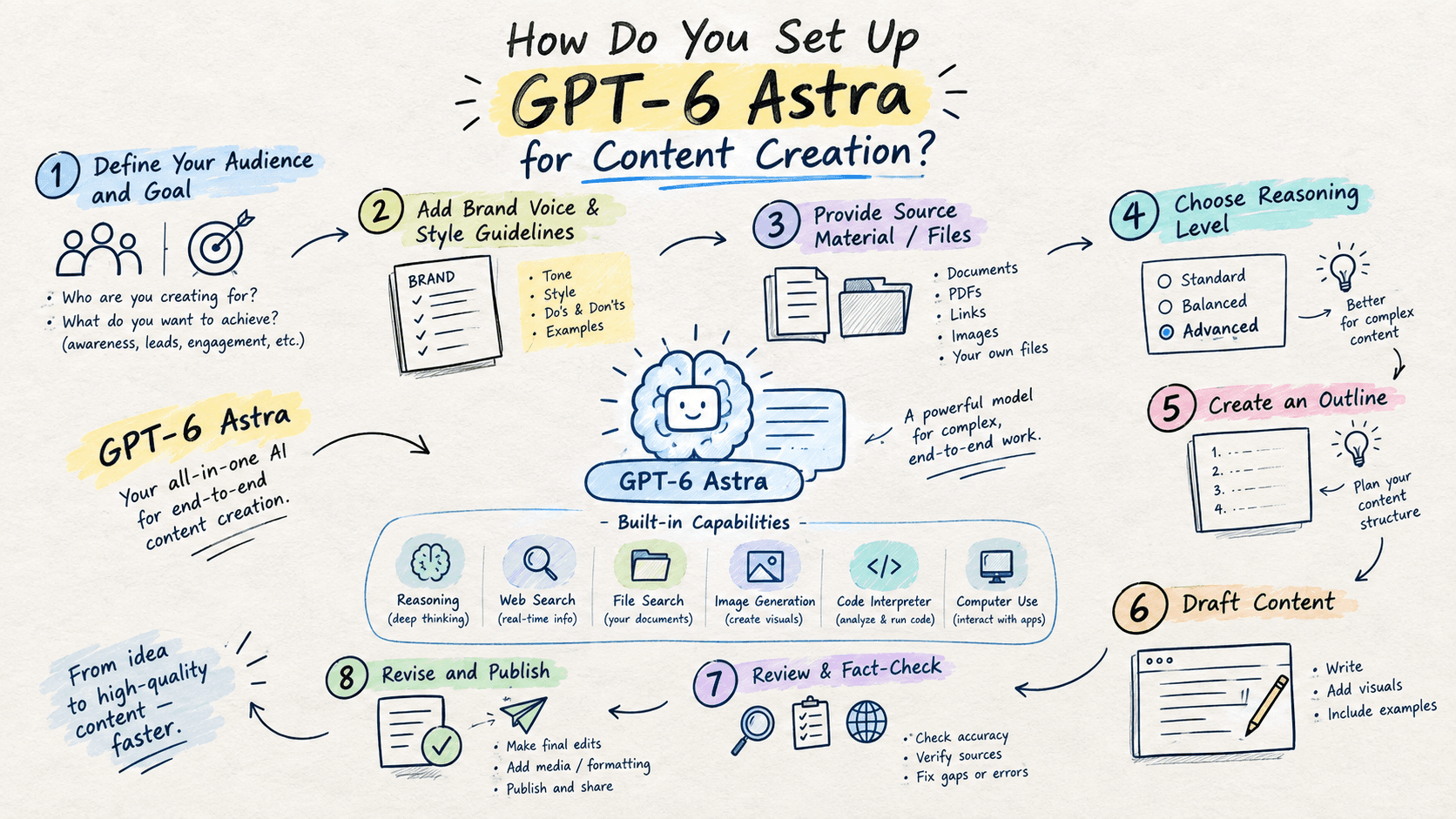
Skip this setup and you will spend your session correcting the same three things. Do it once per brand and reuse it.
1. Load the Brand Truth Before the Brief
Give the model the non negotiables in one block: product facts, claims you are allowed to make, claims that are legally off limits, banned words, tone rules, and the audience. Astra respects stated boundaries better than previous models, but only if the boundaries are stated. Vague instructions produce vague guardrails.
2. Give It a Real Example, Including a Bad One
One approved asset teaches voice faster than a page of adjectives. Add one rejected asset with a line explaining why it was rejected. The negative example is the part most people skip and it is the part that stops the model repeating a pattern you already killed.
3. Hand Over the Template, Not a Description of It
If the output is a deck, a content calendar, or a formatted doc, attach the actual file. Template adherence is one of the model strengths, and it cannot adhere to a template it has never seen.
4. Set the Output Contract
State the deliverable count, the format, the length band, and whether you want variants or a single best answer. Ambiguity here is where sessions go sideways. If you want thirty hooks in a numbered list with no commentary, say that.
5. Give It Permission to Ask
Add one line: if anything is unclear enough to change the output, ask before writing. The model is trained to fill routine gaps on its own and raise the consequential ones, and that instruction turns a guess into a question.
How Do You Write Ad Hooks With GPT-6 Astra?
A hook is the first line, the first frame, or the first three words. It has one job, which is to buy the next two seconds. Most teams prompt for hooks and get thirty variations of the same idea, because they asked for wording when the variation needs to happen at the angle level.
The fix is to define the angle set first, then generate inside each angle.
Hook Angle | What It Does | Example Shape |
|---|---|---|
Problem callout | Names the friction in the viewer's own words | The reason your X keeps happening is not what you think |
Contrarian | Attacks a belief the audience holds | Stop doing X. It is why Y is not working |
Specific person | Filters for the exact buyer | If you run X for a Y sized team, this is for you |
Proof first | Leads with the outcome, then the method | We cut X by half. Here is the change we made |
Curiosity gap | Withholds one necessary detail | Nobody tells you what happens after you do X |
Demonstration | Opens on the product doing the thing | Visual first, no spoken hook at all |
Question | Forces a self check | How long has your X been doing this? |
Insider | Positions the viewer as being let in | What we do internally that we never publish |
A Prompt Structure That Works
Use this shape rather than asking for hooks in one line. Fill the brackets and paste it whole.
Ad Hook Prompt Template
|
Two details in that template do the heavy lifting. Grouping by angle stops the model collapsing into one favourite idea, and banning repeated opening words forces structural variation instead of synonym swapping.
The Second Pass Is Where Quality Comes From
First generation output is raw material. Run a second pass on the shortlist with a different instruction: rewrite each of these five hooks so the first three words carry the meaning, and cut every word that could be removed without changing the claim. That single pass usually does more for performance than another thirty variants would.
Which Ad Hooks Get the Best CTR?
There is no universal best hook, and any article that hands you a list of magic openers is selling something. What holds across accounts is a set of properties that correlate with a higher click through rate, and those are worth building into the brief.
Property | Why It Lifts Click Through Rate |
|---|---|
Specificity | Concrete details signal the ad is about the viewer, not about everyone. Vague hooks get read as ads and skipped. |
Named audience | Saying who it is for filters the click. Fewer clicks, better ones, and cost per acquisition follows. |
Tension in the first three words | The scroll decision happens before the sentence finishes, so the meaning has to be front loaded. |
Native format | A hook that matches how people already post on the platform gets treated as content, not as advertising. |
One idea only | Two ideas in a hook means neither lands. Split them into two ads. |
Language borrowed from the audience | Comment sections and support tickets carry the exact phrasing your buyers use. Copy it. |
Deliverable promise | The hook has to be honest about what follows. Curiosity that gets punished produces clicks and no conversions. |
Worth saying plainly: click through rate is a diagnostic, not a goal. A hook can lift click through rate and lower revenue if it attracts the wrong person or overpromises. Judge the hook against the funnel stage it was built for, and check what happens after the click before you scale it.
Where AI Helps and Where It Does Not
The model is good at generating angle coverage, holding constraints, and rewriting for compression. It is not good at knowing what your audience is tired of hearing, and it has no access to which of your ads fatigued last month. That context has to come from you. Feed in your last winning hooks and your last losers, labelled, and the output improves immediately.
Skip this setup and you will spend your session correcting the same three things. Do it once per brand and reuse it.
1. Load the Brand Truth Before the Brief
Give the model the non negotiables in one block: product facts, claims you are allowed to make, claims that are legally off limits, banned words, tone rules, and the audience. Astra respects stated boundaries better than previous models, but only if the boundaries are stated. Vague instructions produce vague guardrails.
2. Give It a Real Example, Including a Bad One
One approved asset teaches voice faster than a page of adjectives. Add one rejected asset with a line explaining why it was rejected. The negative example is the part most people skip and it is the part that stops the model repeating a pattern you already killed.
3. Hand Over the Template, Not a Description of It
If the output is a deck, a content calendar, or a formatted doc, attach the actual file. Template adherence is one of the model strengths, and it cannot adhere to a template it has never seen.
4. Set the Output Contract
State the deliverable count, the format, the length band, and whether you want variants or a single best answer. Ambiguity here is where sessions go sideways. If you want thirty hooks in a numbered list with no commentary, say that.
5. Give It Permission to Ask
Add one line: if anything is unclear enough to change the output, ask before writing. The model is trained to fill routine gaps on its own and raise the consequential ones, and that instruction turns a guess into a question.
How Do You Write Ad Hooks With GPT-6 Astra?
A hook is the first line, the first frame, or the first three words. It has one job, which is to buy the next two seconds. Most teams prompt for hooks and get thirty variations of the same idea, because they asked for wording when the variation needs to happen at the angle level.
The fix is to define the angle set first, then generate inside each angle.
Hook Angle | What It Does | Example Shape |
|---|---|---|
Problem callout | Names the friction in the viewer's own words | The reason your X keeps happening is not what you think |
Contrarian | Attacks a belief the audience holds | Stop doing X. It is why Y is not working |
Specific person | Filters for the exact buyer | If you run X for a Y sized team, this is for you |
Proof first | Leads with the outcome, then the method | We cut X by half. Here is the change we made |
Curiosity gap | Withholds one necessary detail | Nobody tells you what happens after you do X |
Demonstration | Opens on the product doing the thing | Visual first, no spoken hook at all |
Question | Forces a self check | How long has your X been doing this? |
Insider | Positions the viewer as being let in | What we do internally that we never publish |
A Prompt Structure That Works
Use this shape rather than asking for hooks in one line. Fill the brackets and paste it whole.
Ad Hook Prompt Template
|
Two details in that template do the heavy lifting. Grouping by angle stops the model collapsing into one favourite idea, and banning repeated opening words forces structural variation instead of synonym swapping.
The Second Pass Is Where Quality Comes From
First generation output is raw material. Run a second pass on the shortlist with a different instruction: rewrite each of these five hooks so the first three words carry the meaning, and cut every word that could be removed without changing the claim. That single pass usually does more for performance than another thirty variants would.
Which Ad Hooks Get the Best CTR?
There is no universal best hook, and any article that hands you a list of magic openers is selling something. What holds across accounts is a set of properties that correlate with a higher click through rate, and those are worth building into the brief.
Property | Why It Lifts Click Through Rate |
|---|---|
Specificity | Concrete details signal the ad is about the viewer, not about everyone. Vague hooks get read as ads and skipped. |
Named audience | Saying who it is for filters the click. Fewer clicks, better ones, and cost per acquisition follows. |
Tension in the first three words | The scroll decision happens before the sentence finishes, so the meaning has to be front loaded. |
Native format | A hook that matches how people already post on the platform gets treated as content, not as advertising. |
One idea only | Two ideas in a hook means neither lands. Split them into two ads. |
Language borrowed from the audience | Comment sections and support tickets carry the exact phrasing your buyers use. Copy it. |
Deliverable promise | The hook has to be honest about what follows. Curiosity that gets punished produces clicks and no conversions. |
Worth saying plainly: click through rate is a diagnostic, not a goal. A hook can lift click through rate and lower revenue if it attracts the wrong person or overpromises. Judge the hook against the funnel stage it was built for, and check what happens after the click before you scale it.
Where AI Helps and Where It Does Not
The model is good at generating angle coverage, holding constraints, and rewriting for compression. It is not good at knowing what your audience is tired of hearing, and it has no access to which of your ads fatigued last month. That context has to come from you. Feed in your last winning hooks and your last losers, labelled, and the output improves immediately.

Generate thirty to fifty, then cut hard. Shortlist five that are structurally different, not five that sound nice. If two hooks would be answered by the same objection, they are the same hook.
Change one variable per test. Same visual, same offer, different hook. If you change the creative and the hook together, you learn nothing about either.
Give each variant enough impressions to be readable. A hook that has been seen four hundred times has told you nothing yet.
Read the drop off point, not just the click. Where people leave tells you whether the hook overpromised or the body failed to deliver.
Log the winners with their angle label. Over a quarter you build a map of which angles work for your category, which is the real asset.
Refresh before fatigue, not after. Cost per acquisition climbing on an unchanged campaign is usually the creative going stale, not the audience.
What Else Can GPT-6 Astra Do in a Content Workflow?
Task | How to Use the Model | Human Still Required For |
|---|---|---|
Ad hooks and primary text | Batch generation by angle, then compression pass | Choosing which angle fits the campaign goal |
Video and UGC scripts | Beat by beat script from a hook plus product facts | Casting, delivery, and whether it sounds like a person |
Blog and editorial drafts | Structure, first draft, and internal link suggestions | Point of view, original examples, and fact checking |
Repurposing | Turning one asset into platform native variants | Deciding what is worth repurposing at all |
Content calendars | Building the sheet in your existing template | Prioritisation against business goals |
Research and briefs | Browsing, summarising, and pulling reference assets | Verifying anything that becomes a public claim |
Landing pages | Draft copy, structure, and page level layout | Offer design and conversion decisions |
The pattern across all of these is the same. The model compresses production time. It does not compress judgement time, and treating its output as finished is how brands end up with content that is fluent and forgettable.
Search Is Changing, Which Raises the Value of Original Creative
There is a strategic reason to push output toward original media rather than more written copy. Answer engines increasingly resolve queries on the results page, so the click that used to reward an optimised article often never happens. Search Engine Land has covered how this pushes priorities toward brand signals and original media. Video, first party proof, and creator made assets are hard to summarise away, which is exactly why they hold value while text only content gets compressed.
The same logic applies to how you use the model. Using it to produce more of the content everyone else is producing is a losing trade. Using it to remove the production drag around genuinely original work is not. Ninjapromo makes a related argument about distribution needing to be designed into the asset rather than bolted on afterwards, and that holds whether the asset came from a writer or a model.
Common Mistakes Teams Make With GPT-6 Astra
Prompting for output before loading constraints. The model cannot stay inside claims it has not been shown.
Asking for punchier. It is not an instruction. Give it a structural rule instead, such as a word cap or a required opening word.
Accepting the first batch. First generation is a spread of possibilities, not a shortlist.
Using a frontier model for bulk repetitive passes. Expensive and unnecessary. Reserve it for judgement heavy work.
Letting it invent statistics. If a number appears in the output and you did not supply it, do not publish it.
Skipping the negative example. Without it the model keeps returning the pattern you already rejected.
Treating output as the campaign. The first batch is research. Distribution and testing are still the job.
If the gap on your team is strategy rather than production, Copyblogger maintains a useful roundup of content marketing training that covers the thinking layer. Better prompts do not fix an unclear content thesis.
Frequently Asked Questions
Is GPT-6 Astra better than previous models for writing ad copy?
For ad copy specifically the improvement is in constraint handling and consistency across a batch rather than in individual sentence quality. It holds your rules across fifty variants and matches a supplied voice more reliably. If you only need three headlines, a cheaper model is fine.
How many hooks should I generate before testing?
Generate thirty to fifty, shortlist five that are structurally different, and test those. Volume matters at the generation stage and hurts at the testing stage, because too many live variants means none of them collect enough impressions to be readable.
Can GPT-6 Astra tell me which hook will get the best CTR?
No, and any model that claims to is guessing. It can rank hooks against principles like specificity and front loaded meaning, which is useful for shortlisting. Actual performance comes from the test in your account with your audience.
Where can I access GPT-6 Astra?
It is available across ChatGPT Plus, Pro, Business, and Enterprise plans, and through the OpenAI API, Microsoft Azure, and AWS Bedrock. Pro, Business, and Enterprise plans also get an Astra Pro tier. Enterprise administrators need to enable it for the workspace because access is off by default at launch.
Is AI generated ad copy penalised on ad platforms?
Platforms judge the asset, not the tool that made it. What gets penalised is misleading claims, poor landing page experience, and policy violations, and those are authoring problems rather than model problems. The bigger practical risk is sameness, because generic output stops performing long before anyone flags it.
Should the model write the script or just the hook?
Both work, but the hook is where the leverage sits. Use it for hook batches and structural script beats, then have a human handle the lines that need to sound like a specific person. Fully model written scripts tend to read fluent and land flat on camera.
Does this replace working with content creators?
It replaces some of the production work, not the credibility. Synthetic video and AI avatars are strong for volume testing, localisation, and variant production where a human shoot would be uneconomical. Original concepts, authentic testimonials, and category trust still come from people.
Want Hooks That Are Tested, Not Guessed? We build AI assisted creative programmes for brands across the US, UK, UAE, and Europe, backed by a creator network of 500 plus. Model output is the starting line. Our teams write the hook angles, shoot the variants, run the tests, and hand back the ones that actually move click through rate. Motion Labs runs the whole pipeline so your team stops prompting and starts reviewing results. Book a creative audit | See our content creation work | Explore AI video production |
Generate thirty to fifty, then cut hard. Shortlist five that are structurally different, not five that sound nice. If two hooks would be answered by the same objection, they are the same hook.
Change one variable per test. Same visual, same offer, different hook. If you change the creative and the hook together, you learn nothing about either.
Give each variant enough impressions to be readable. A hook that has been seen four hundred times has told you nothing yet.
Read the drop off point, not just the click. Where people leave tells you whether the hook overpromised or the body failed to deliver.
Log the winners with their angle label. Over a quarter you build a map of which angles work for your category, which is the real asset.
Refresh before fatigue, not after. Cost per acquisition climbing on an unchanged campaign is usually the creative going stale, not the audience.
What Else Can GPT-6 Astra Do in a Content Workflow?
Task | How to Use the Model | Human Still Required For |
|---|---|---|
Ad hooks and primary text | Batch generation by angle, then compression pass | Choosing which angle fits the campaign goal |
Video and UGC scripts | Beat by beat script from a hook plus product facts | Casting, delivery, and whether it sounds like a person |
Blog and editorial drafts | Structure, first draft, and internal link suggestions | Point of view, original examples, and fact checking |
Repurposing | Turning one asset into platform native variants | Deciding what is worth repurposing at all |
Content calendars | Building the sheet in your existing template | Prioritisation against business goals |
Research and briefs | Browsing, summarising, and pulling reference assets | Verifying anything that becomes a public claim |
Landing pages | Draft copy, structure, and page level layout | Offer design and conversion decisions |
The pattern across all of these is the same. The model compresses production time. It does not compress judgement time, and treating its output as finished is how brands end up with content that is fluent and forgettable.
Search Is Changing, Which Raises the Value of Original Creative
There is a strategic reason to push output toward original media rather than more written copy. Answer engines increasingly resolve queries on the results page, so the click that used to reward an optimised article often never happens. Search Engine Land has covered how this pushes priorities toward brand signals and original media. Video, first party proof, and creator made assets are hard to summarise away, which is exactly why they hold value while text only content gets compressed.
The same logic applies to how you use the model. Using it to produce more of the content everyone else is producing is a losing trade. Using it to remove the production drag around genuinely original work is not. Ninjapromo makes a related argument about distribution needing to be designed into the asset rather than bolted on afterwards, and that holds whether the asset came from a writer or a model.
Common Mistakes Teams Make With GPT-6 Astra
Prompting for output before loading constraints. The model cannot stay inside claims it has not been shown.
Asking for punchier. It is not an instruction. Give it a structural rule instead, such as a word cap or a required opening word.
Accepting the first batch. First generation is a spread of possibilities, not a shortlist.
Using a frontier model for bulk repetitive passes. Expensive and unnecessary. Reserve it for judgement heavy work.
Letting it invent statistics. If a number appears in the output and you did not supply it, do not publish it.
Skipping the negative example. Without it the model keeps returning the pattern you already rejected.
Treating output as the campaign. The first batch is research. Distribution and testing are still the job.
If the gap on your team is strategy rather than production, Copyblogger maintains a useful roundup of content marketing training that covers the thinking layer. Better prompts do not fix an unclear content thesis.
Frequently Asked Questions
Is GPT-6 Astra better than previous models for writing ad copy?
For ad copy specifically the improvement is in constraint handling and consistency across a batch rather than in individual sentence quality. It holds your rules across fifty variants and matches a supplied voice more reliably. If you only need three headlines, a cheaper model is fine.
How many hooks should I generate before testing?
Generate thirty to fifty, shortlist five that are structurally different, and test those. Volume matters at the generation stage and hurts at the testing stage, because too many live variants means none of them collect enough impressions to be readable.
Can GPT-6 Astra tell me which hook will get the best CTR?
No, and any model that claims to is guessing. It can rank hooks against principles like specificity and front loaded meaning, which is useful for shortlisting. Actual performance comes from the test in your account with your audience.
Where can I access GPT-6 Astra?
It is available across ChatGPT Plus, Pro, Business, and Enterprise plans, and through the OpenAI API, Microsoft Azure, and AWS Bedrock. Pro, Business, and Enterprise plans also get an Astra Pro tier. Enterprise administrators need to enable it for the workspace because access is off by default at launch.
Is AI generated ad copy penalised on ad platforms?
Platforms judge the asset, not the tool that made it. What gets penalised is misleading claims, poor landing page experience, and policy violations, and those are authoring problems rather than model problems. The bigger practical risk is sameness, because generic output stops performing long before anyone flags it.
Should the model write the script or just the hook?
Both work, but the hook is where the leverage sits. Use it for hook batches and structural script beats, then have a human handle the lines that need to sound like a specific person. Fully model written scripts tend to read fluent and land flat on camera.
Does this replace working with content creators?
It replaces some of the production work, not the credibility. Synthetic video and AI avatars are strong for volume testing, localisation, and variant production where a human shoot would be uneconomical. Original concepts, authentic testimonials, and category trust still come from people.
Want Hooks That Are Tested, Not Guessed? We build AI assisted creative programmes for brands across the US, UK, UAE, and Europe, backed by a creator network of 500 plus. Model output is the starting line. Our teams write the hook angles, shoot the variants, run the tests, and hand back the ones that actually move click through rate. Motion Labs runs the whole pipeline so your team stops prompting and starts reviewing results. Book a creative audit | See our content creation work | Explore AI video production |
the call your competitor wish you would'nt take


Related Posts





Related Posts
Related Posts
Motion labs
info@motionlabs.agency


+971 55317 1706
C-1802, ONTARIO TOWER, PLOT NO. 49-0, BUSINESS BAY, DUBAI, 00000
click to meet me :)
click to meet me :)
© All Rights Reserved | 2026


Motion labs
info@motionlabs.agency
+971 55317 1706
C-1802, ONTARIO TOWER, PLOT NO. 49-0, BUSINESS BAY, DUBAI, 00000
Private policy
Terms & Conditions
© All Rights Reserved | 2026
click to meet me :)