/
/
Content Creation Services in San Francisco
Content Creation Services in San Francisco
5 min
read
Content Creation Services in San Francisco
Content Creation Services in San Francisco
Content
Marketing

Author

Scroll down
to read more!
Summerize with ChatGPT
Summerize with Gemini
Summerize with Claude
Content Creation Services in San Francisco
Content Creation Services in San Francisco
Comparing the best content creation services in San Francisco? Motion Labs produces AI video, UGC, and B2B creative for SF tech brands. Talk to our team.
Comparing the best content creation services in San Francisco? Motion Labs produces AI video, UGC, and B2B creative for SF tech brands. Talk to our team.
San Francisco has the most content-literate buyer in the world, and that makes marketing here unusually difficult. Your audience builds software, reads changelogs for fun, and can spot a stock template from the first frame.
So the bar is not production value. It is credibility. An SF audience will forgive rough edges and will not forgive vagueness. The moment a video says nothing specific about what the product does, attention is gone and no amount of motion graphics brings it back.
We are Motion Labs, a Gen AI-first creative and performance agency working with brands in San Francisco and across the US, UK, UAE, and Europe. This page covers what content creation services in San Francisco include, what they cost, and how to produce content that a technical audience actually takes seriously.
What Do Content Creation Services in San Francisco Include?
Content creation is a broad term, so here is what it means in practice when you work with us. Every item below is produced end to end, delivered in the formats your channels need, and built to be tested rather than admired.
Content type | What you get | Typical turnaround |
|---|---|---|
AI video ads | 3 to 5 scripted concepts, voiceover, edit, captions, and aspect ratio variants for every placement | 5 to 7 days |
UGC creator content | Creator matching from our 500+ network, briefs, raw footage, edited cutdowns, and usage rights | 7 to 10 days |
AI avatar videos | Scripted spokesperson videos, multi language versions, and personalised variants at scale | 3 to 5 days |
Social media content | Monthly calendar, static posts, motion graphics, captions, and scheduling | Weekly batches, rolling |
Graphic design | Paid ad creatives, carousels, landing page visuals, and brand collateral | 2 to 4 days |
Influencer content | Creator matching on X and LinkedIn, brief development, and publishing coordination | 10 to 14 days |
Turnaround times assume an approved brief and a single revision round. Larger batches run on the same cycle rather than a longer one, because we scale the team assigned to a batch instead of stretching the calendar.
San Francisco has the most content-literate buyer in the world, and that makes marketing here unusually difficult. Your audience builds software, reads changelogs for fun, and can spot a stock template from the first frame.
So the bar is not production value. It is credibility. An SF audience will forgive rough edges and will not forgive vagueness. The moment a video says nothing specific about what the product does, attention is gone and no amount of motion graphics brings it back.
We are Motion Labs, a Gen AI-first creative and performance agency working with brands in San Francisco and across the US, UK, UAE, and Europe. This page covers what content creation services in San Francisco include, what they cost, and how to produce content that a technical audience actually takes seriously.
What Do Content Creation Services in San Francisco Include?
Content creation is a broad term, so here is what it means in practice when you work with us. Every item below is produced end to end, delivered in the formats your channels need, and built to be tested rather than admired.
Content type | What you get | Typical turnaround |
|---|---|---|
AI video ads | 3 to 5 scripted concepts, voiceover, edit, captions, and aspect ratio variants for every placement | 5 to 7 days |
UGC creator content | Creator matching from our 500+ network, briefs, raw footage, edited cutdowns, and usage rights | 7 to 10 days |
AI avatar videos | Scripted spokesperson videos, multi language versions, and personalised variants at scale | 3 to 5 days |
Social media content | Monthly calendar, static posts, motion graphics, captions, and scheduling | Weekly batches, rolling |
Graphic design | Paid ad creatives, carousels, landing page visuals, and brand collateral | 2 to 4 days |
Influencer content | Creator matching on X and LinkedIn, brief development, and publishing coordination | 10 to 14 days |
Turnaround times assume an approved brief and a single revision round. Larger batches run on the same cycle rather than a longer one, because we scale the team assigned to a batch instead of stretching the calendar.
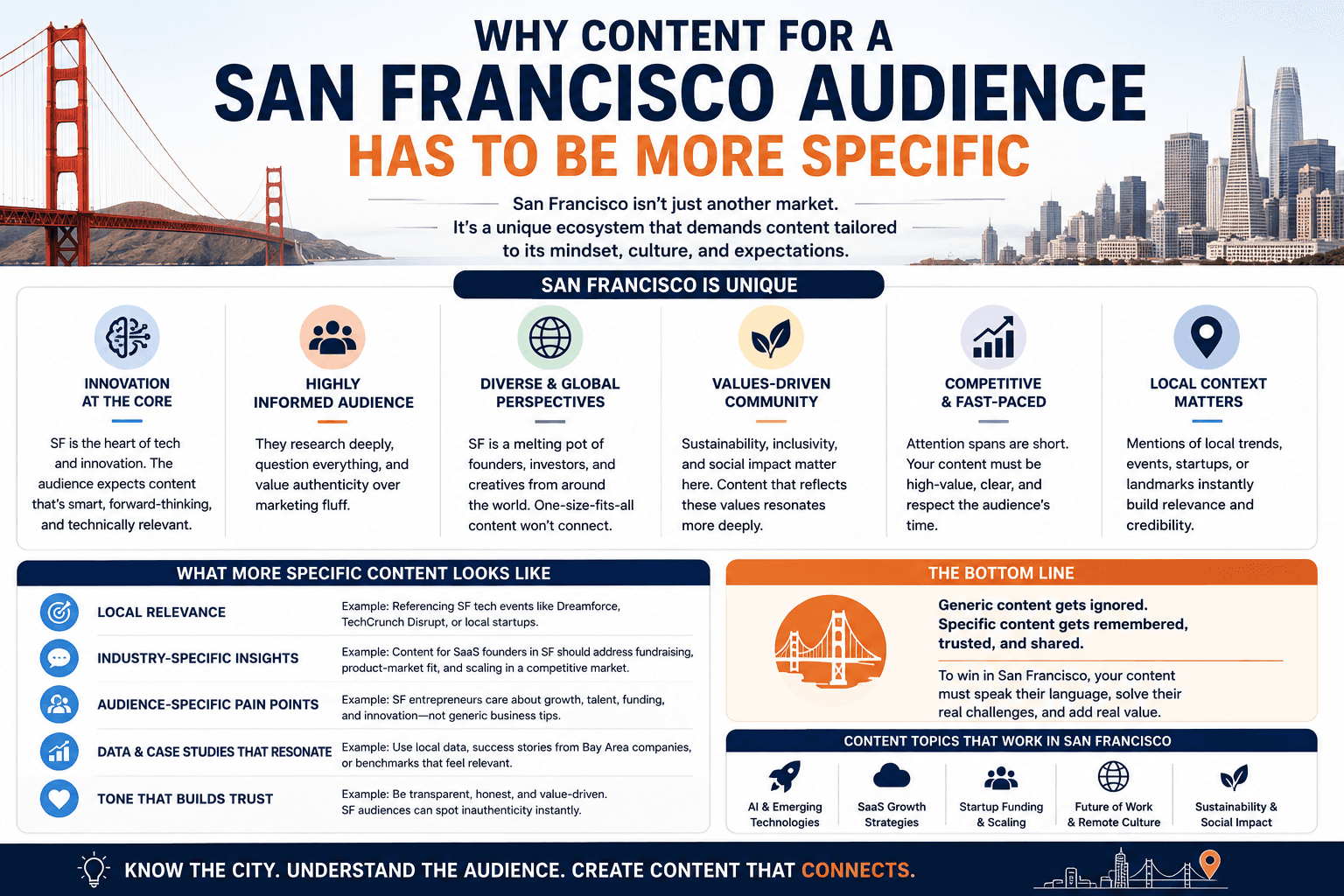
Most B2B video fails here for the same reason: it describes an outcome without describing the mechanism. A developer or technical buyer wants to know what the product does, where it sits in their stack, and what breaks without it. Content that skips that and jumps straight to transformation language reads as noise.
There is also an unusual amount of competition for the same attention. San Francisco companies are marketing to each other, often through the same channels, frequently with the same messaging vocabulary. Differentiation ends up coming from specificity rather than production budget.
The third factor is who your content has to work for. Bottom-up software adoption means the person watching your video may be an engineer, a product manager, or a VP, each needing something different. Content volume in SF is largely a function of persona count, and one asset cannot cover all three.
Technical audiences reward specific mechanism-level explanation over aspirational messaging
Bottom-up adoption means separate content for practitioners and for economic buyers
Category vocabulary gets crowded fast, so differentiation comes from concrete detail
Developer-facing brands need content that respects the audience's existing expertise
WORTH KNOWING If you are running paid social in San Francisco, plan to replace roughly a third of your live creative every month. Creative fatigue, not budget, is what caps performance for most brands, and the fix is production capacity rather than a bigger media plan. |
How Much Do Content Creation Services Cost in San Francisco?
Pricing depends on volume, format count, and whether media buying sits inside the engagement. The ranges below reflect typical market pricing for San Francisco brands rather than a fixed rate card, and they are a starting point for a scoping conversation.
Engagement type | What it usually covers | Typical market range |
|---|---|---|
One-off campaign | A single launch, product drop, or seasonal push | $2,500 to $8,000 per project |
Content retainer | Always-on social and paid creative, produced in monthly batches | $3,500 to $9,000 per month |
Full-funnel retainer | Content production plus media buying, testing, and reporting | $9,000 to $25,000 per month |
Three things move a quote more than anything else: how many assets you need per month, how many placements each concept has to be cut for, and how many review rounds your approval process requires. Get clear on those before you compare proposals, otherwise you will be comparing numbers that describe different amounts of work.
Should You Hire In-House, Use Freelancers, or Work With an Agency?
Each option solves a different problem, and the right answer depends on how much content you need and how quickly your messaging changes. Here is an honest comparison of the four routes San Francisco teams usually consider.
Option | Time to first asset | Realistic monthly volume | Best fit for |
|---|---|---|---|
In-house content hire | 4 to 8 weeks including hiring | 8 to 15 pieces | Brands with a single channel and stable messaging |
Freelance creators | 1 to 2 weeks per freelancer | 10 to 20 pieces | Teams that already have a producer to manage everyone |
Traditional production agency | 3 to 6 weeks | 2 to 6 pieces | Hero films, brand launches, and broadcast work |
Gen AI-first content partner | 3 to 7 days | 40 to 100+ pieces | Paid social, always-on testing, and multi market rollouts |
Most of our clients end up running a hybrid: brand strategy and channel ownership stay in-house, and production capacity comes from us. That keeps decision making close to the business while removing the part that eats a small team's week.
How to Choose the Best Content Creation Services in San Francisco
Most agency evaluations get decided by a showreel, which tells you what a team produced with a large budget and a long timeline. These questions tell you far more about what working together will actually feel like.
Ask how many assets they realistically deliver per month, not how many they can theoretically produce.
Ask how fast the second version arrives after you give notes. Revision speed matters more than first draft quality.
Ask who writes the scripts, and read three examples. Weak writing is the most common failure point in video content.
Ask whether usage rights for creator content are documented and transferred, and what happens when you want to put paid spend behind an asset.
Ask for creative-level reporting rather than campaign averages, so you can see which specific assets earned the result.
Confirm who owns the source files at the end of the engagement, and whether you can take them elsewhere.
Most B2B video fails here for the same reason: it describes an outcome without describing the mechanism. A developer or technical buyer wants to know what the product does, where it sits in their stack, and what breaks without it. Content that skips that and jumps straight to transformation language reads as noise.
There is also an unusual amount of competition for the same attention. San Francisco companies are marketing to each other, often through the same channels, frequently with the same messaging vocabulary. Differentiation ends up coming from specificity rather than production budget.
The third factor is who your content has to work for. Bottom-up software adoption means the person watching your video may be an engineer, a product manager, or a VP, each needing something different. Content volume in SF is largely a function of persona count, and one asset cannot cover all three.
Technical audiences reward specific mechanism-level explanation over aspirational messaging
Bottom-up adoption means separate content for practitioners and for economic buyers
Category vocabulary gets crowded fast, so differentiation comes from concrete detail
Developer-facing brands need content that respects the audience's existing expertise
WORTH KNOWING If you are running paid social in San Francisco, plan to replace roughly a third of your live creative every month. Creative fatigue, not budget, is what caps performance for most brands, and the fix is production capacity rather than a bigger media plan. |
How Much Do Content Creation Services Cost in San Francisco?
Pricing depends on volume, format count, and whether media buying sits inside the engagement. The ranges below reflect typical market pricing for San Francisco brands rather than a fixed rate card, and they are a starting point for a scoping conversation.
Engagement type | What it usually covers | Typical market range |
|---|---|---|
One-off campaign | A single launch, product drop, or seasonal push | $2,500 to $8,000 per project |
Content retainer | Always-on social and paid creative, produced in monthly batches | $3,500 to $9,000 per month |
Full-funnel retainer | Content production plus media buying, testing, and reporting | $9,000 to $25,000 per month |
Three things move a quote more than anything else: how many assets you need per month, how many placements each concept has to be cut for, and how many review rounds your approval process requires. Get clear on those before you compare proposals, otherwise you will be comparing numbers that describe different amounts of work.
Should You Hire In-House, Use Freelancers, or Work With an Agency?
Each option solves a different problem, and the right answer depends on how much content you need and how quickly your messaging changes. Here is an honest comparison of the four routes San Francisco teams usually consider.
Option | Time to first asset | Realistic monthly volume | Best fit for |
|---|---|---|---|
In-house content hire | 4 to 8 weeks including hiring | 8 to 15 pieces | Brands with a single channel and stable messaging |
Freelance creators | 1 to 2 weeks per freelancer | 10 to 20 pieces | Teams that already have a producer to manage everyone |
Traditional production agency | 3 to 6 weeks | 2 to 6 pieces | Hero films, brand launches, and broadcast work |
Gen AI-first content partner | 3 to 7 days | 40 to 100+ pieces | Paid social, always-on testing, and multi market rollouts |
Most of our clients end up running a hybrid: brand strategy and channel ownership stay in-house, and production capacity comes from us. That keeps decision making close to the business while removing the part that eats a small team's week.
How to Choose the Best Content Creation Services in San Francisco
Most agency evaluations get decided by a showreel, which tells you what a team produced with a large budget and a long timeline. These questions tell you far more about what working together will actually feel like.
Ask how many assets they realistically deliver per month, not how many they can theoretically produce.
Ask how fast the second version arrives after you give notes. Revision speed matters more than first draft quality.
Ask who writes the scripts, and read three examples. Weak writing is the most common failure point in video content.
Ask whether usage rights for creator content are documented and transferred, and what happens when you want to put paid spend behind an asset.
Ask for creative-level reporting rather than campaign averages, so you can see which specific assets earned the result.
Confirm who owns the source files at the end of the engagement, and whether you can take them elsewhere.

Most agency evaluations get decided by a showreel, which tells you what a team produced with a large budget and a long timeline. These questions tell you far more about what working together will actually feel like.
Ask how many assets they realistically deliver per month, not how many they can theoretically produce.
Ask how fast the second version arrives after you give notes. Revision speed matters more than first draft quality.
Ask who writes the scripts, and read three examples. Weak writing is the most common failure point in video content.
Ask whether usage rights for creator content are documented and transferred, and what happens when you want to put paid spend behind an asset.
Ask for creative-level reporting rather than campaign averages, so you can see which specific assets earned the result.
Confirm who owns the source files at the end of the engagement, and whether you can take them elsewhere.
Which San Francisco Industries Do We Create Content For?
We produce content for San Francisco companies across the categories where technical credibility decides whether marketing lands.
B2B SaaS: Product explainers, demo cutdowns, and multi-persona ad creative
AI and developer tools: Technical explainer video, docs-adjacent content, and practitioner-facing social
Fintech and infrastructure: Compliance-aware creative and clear mechanism-led explainers
Cybersecurity: Threat and capability content built for both technical and executive audiences
Marketplaces and consumer tech: Performance creative, UGC, and app install video
Healthtech and biotech: Regulated content, avatar-led education video, and evidence-forward creative
How We Work With San Francisco Teams
Our production team works from New Delhi, so our day covers your night. Feedback given on a Wednesday evening in San Francisco is usually reflected in a revised version before Thursday morning, which meaningfully shortens the calendar on any multi-round asset.
We work in weekly batches against a shared calendar, reviewed through a link rather than a meeting. For technical products, we run a short accuracy pass with someone on your side who knows the product deeply, because getting the mechanism right matters more than getting the edit perfect.
Frequently Asked Questions About Content Creation Services in San Francisco
How much do content creation services cost in San Francisco?
Content retainers in San Francisco typically run $3,500 to $9,000 per month, with one-off campaigns between $2,500 and $8,000, and full-funnel engagements starting around $9,000 per month. Local production studios often price higher because Bay Area crew and facility costs are baked in. Our pricing tracks output volume rather than shoot days.
How do you make content that a technical audience will not dismiss?
By writing it around mechanism rather than outcome. That means naming the actual problem, showing the product doing the thing, and using the vocabulary the audience already uses. We also run an accuracy review with someone technical on your team before anything is finalised, because a single wrong term costs more credibility than a weak edit does.
Can you produce different content for engineers and for executive buyers?
Yes, and for most SF B2B companies that is the correct approach. The practitioner needs specificity and proof it works. The economic buyer needs the business case and the risk picture. We usually build both from one concept so the messaging stays consistent while the framing changes.
What is the fastest you can deliver a video?
AI and avatar-led video generally ships in three to five days after script approval. Standard video ad packages take five to seven days. UGC runs seven to ten days because creators need to be briefed and film.
Do you use AI to write the scripts?
We use AI across parts of the production pipeline, which is how we compress timelines. Scripts are written and edited by people, because script quality is where technical content lives or dies. Anything that reads as generated does not go out.
Can you work with our existing brand system and design tokens?
Yes. We work inside whatever brand system you already have, including component libraries, motion guidelines, and tone documentation. If those do not exist yet, we can establish a working set of rules during the first month so output stays consistent as volume increases.
What does a good first ninety days look like?
Month one is calibration: brand rules, messaging accuracy, and an initial content library. Month two gives you enough creative variation to see which angles hold attention across personas. By month three you should know which formats to scale, and have a repeatable pipeline rather than a series of one-off requests.
Work With Motion Labs in San Francisco
If you are comparing content creation services in San Francisco, judge partners on how well they can explain a product they have just learned about. Production quality is buyable. Understanding is not, and it is the thing your audience is actually reacting to.
We produce AI video, UGC, avatar content, social assets, influencer campaigns, and performance creative for brands in San Francisco and across the US, UK, UAE, and Europe. Our creator network runs to over 500 people, and our production model is built for volume rather than for shoot days.
Tell us what your channels need this quarter and we will come back with a production plan and a realistic volume estimate. Start at motionlabs.agency.
Most agency evaluations get decided by a showreel, which tells you what a team produced with a large budget and a long timeline. These questions tell you far more about what working together will actually feel like.
Ask how many assets they realistically deliver per month, not how many they can theoretically produce.
Ask how fast the second version arrives after you give notes. Revision speed matters more than first draft quality.
Ask who writes the scripts, and read three examples. Weak writing is the most common failure point in video content.
Ask whether usage rights for creator content are documented and transferred, and what happens when you want to put paid spend behind an asset.
Ask for creative-level reporting rather than campaign averages, so you can see which specific assets earned the result.
Confirm who owns the source files at the end of the engagement, and whether you can take them elsewhere.
Which San Francisco Industries Do We Create Content For?
We produce content for San Francisco companies across the categories where technical credibility decides whether marketing lands.
B2B SaaS: Product explainers, demo cutdowns, and multi-persona ad creative
AI and developer tools: Technical explainer video, docs-adjacent content, and practitioner-facing social
Fintech and infrastructure: Compliance-aware creative and clear mechanism-led explainers
Cybersecurity: Threat and capability content built for both technical and executive audiences
Marketplaces and consumer tech: Performance creative, UGC, and app install video
Healthtech and biotech: Regulated content, avatar-led education video, and evidence-forward creative
How We Work With San Francisco Teams
Our production team works from New Delhi, so our day covers your night. Feedback given on a Wednesday evening in San Francisco is usually reflected in a revised version before Thursday morning, which meaningfully shortens the calendar on any multi-round asset.
We work in weekly batches against a shared calendar, reviewed through a link rather than a meeting. For technical products, we run a short accuracy pass with someone on your side who knows the product deeply, because getting the mechanism right matters more than getting the edit perfect.
Frequently Asked Questions About Content Creation Services in San Francisco
How much do content creation services cost in San Francisco?
Content retainers in San Francisco typically run $3,500 to $9,000 per month, with one-off campaigns between $2,500 and $8,000, and full-funnel engagements starting around $9,000 per month. Local production studios often price higher because Bay Area crew and facility costs are baked in. Our pricing tracks output volume rather than shoot days.
How do you make content that a technical audience will not dismiss?
By writing it around mechanism rather than outcome. That means naming the actual problem, showing the product doing the thing, and using the vocabulary the audience already uses. We also run an accuracy review with someone technical on your team before anything is finalised, because a single wrong term costs more credibility than a weak edit does.
Can you produce different content for engineers and for executive buyers?
Yes, and for most SF B2B companies that is the correct approach. The practitioner needs specificity and proof it works. The economic buyer needs the business case and the risk picture. We usually build both from one concept so the messaging stays consistent while the framing changes.
What is the fastest you can deliver a video?
AI and avatar-led video generally ships in three to five days after script approval. Standard video ad packages take five to seven days. UGC runs seven to ten days because creators need to be briefed and film.
Do you use AI to write the scripts?
We use AI across parts of the production pipeline, which is how we compress timelines. Scripts are written and edited by people, because script quality is where technical content lives or dies. Anything that reads as generated does not go out.
Can you work with our existing brand system and design tokens?
Yes. We work inside whatever brand system you already have, including component libraries, motion guidelines, and tone documentation. If those do not exist yet, we can establish a working set of rules during the first month so output stays consistent as volume increases.
What does a good first ninety days look like?
Month one is calibration: brand rules, messaging accuracy, and an initial content library. Month two gives you enough creative variation to see which angles hold attention across personas. By month three you should know which formats to scale, and have a repeatable pipeline rather than a series of one-off requests.
Work With Motion Labs in San Francisco
If you are comparing content creation services in San Francisco, judge partners on how well they can explain a product they have just learned about. Production quality is buyable. Understanding is not, and it is the thing your audience is actually reacting to.
We produce AI video, UGC, avatar content, social assets, influencer campaigns, and performance creative for brands in San Francisco and across the US, UK, UAE, and Europe. Our creator network runs to over 500 people, and our production model is built for volume rather than for shoot days.
Tell us what your channels need this quarter and we will come back with a production plan and a realistic volume estimate. Start at motionlabs.agency.


Related Posts





Related Posts
Related Posts
Motion labs
info@motionlabs.agency


+971 55317 1706
C-1802, ONTARIO TOWER, PLOT NO. 49-0, BUSINESS BAY, DUBAI, 00000
click to meet me :)
click to meet me :)
© All Rights Reserved | 2026


Motion labs
info@motionlabs.agency
+971 55317 1706
C-1802, ONTARIO TOWER, PLOT NO. 49-0, BUSINESS BAY, DUBAI, 00000
Private policy
Terms & Conditions
© All Rights Reserved | 2026
click to meet me :)