/
/
Ecommerce Website Development in Dubai: The Complete 2026 Guide
Ecommerce Website Development in Dubai: The Complete 2026 Guide
5 min
read
Ecommerce Website Development in Dubai: The Complete 2026 Guide
Ecommerce Website Development in Dubai: The Complete 2026 Guide
Startup
Marketing

Author

Scroll down
to read more!
Summerize with ChatGPT
Summerize with Gemini
Summerize with Claude
Ecommerce Website Development in Dubai: The Complete 2026 Guide
Ecommerce Website Development in Dubai: The Complete 2026 Guide
Planning an ecommerce website in Dubai? Compare 2026 costs, platforms, payment gateways and the step-by-step build process for UAE businesses.
Planning an ecommerce website in Dubai? Compare 2026 costs, platforms, payment gateways and the step-by-step build process for UAE businesses.
This article is for business owners, startups and marketing managers in the UAE who are planning to launch or upgrade an online store and want a clear, experience-based picture of cost, process and platform choices before they talk to a developer.
I have spent more than a decade building, migrating and fixing ecommerce websites for businesses across Dubai and the wider UAE, from single-founder Shopify stores to multivendor platforms handling thousands of SKUs. In that time I have seen the same three mistakes sink otherwise good businesses: choosing a platform based on hype instead of catalog size, treating Arabic as a translation checkbox instead of a design requirement, and skipping local payment gateways until launch week. This guide is built around what actually works, not just what a spec sheet says should work.
The market backs up the urgency. The UAE ecommerce sector is worth USD 12.30 billion in 2026 and is projected to grow at a CAGR of 11.29% to reach USD 21.01 billion by 2031, according to Mordor Intelligence. With 96% of the UAE population shopping online and smartphones driving 79% of all transactions, the opportunity is real. But I can tell you from experience that the businesses winning that opportunity are the ones whose sites were built for how Dubai actually shops, not for a generic template. Top 10 Influencer Marketing Agencies in the UAE
This article is for business owners, startups and marketing managers in the UAE who are planning to launch or upgrade an online store and want a clear, experience-based picture of cost, process and platform choices before they talk to a developer.
I have spent more than a decade building, migrating and fixing ecommerce websites for businesses across Dubai and the wider UAE, from single-founder Shopify stores to multivendor platforms handling thousands of SKUs. In that time I have seen the same three mistakes sink otherwise good businesses: choosing a platform based on hype instead of catalog size, treating Arabic as a translation checkbox instead of a design requirement, and skipping local payment gateways until launch week. This guide is built around what actually works, not just what a spec sheet says should work.
The market backs up the urgency. The UAE ecommerce sector is worth USD 12.30 billion in 2026 and is projected to grow at a CAGR of 11.29% to reach USD 21.01 billion by 2031, according to Mordor Intelligence. With 96% of the UAE population shopping online and smartphones driving 79% of all transactions, the opportunity is real. But I can tell you from experience that the businesses winning that opportunity are the ones whose sites were built for how Dubai actually shops, not for a generic template. Top 10 Influencer Marketing Agencies in the UAE

Three market signals explain the urgency, and I have watched all three play out with clients:
Market size: The UAE ecommerce sector generated USD 8.13 billion in revenue in 2025 and is trending toward 10-15% year-over-year growth in 2026.
Shopper reach: 11.04 million people in the UAE shop online, equal to 96% of the population. I rarely meet a Dubai business today whose customers aren't already comfortable buying online; the question is whether they'll buy from you or from Noon.
Concentration risk: Amazon.ae, Noon and Carrefour UAE jointly control 45-50% of GMV. Every independent brand I've worked with has had to fight for the remaining share, and the ones that win do it with a faster, better-targeted site, not a bigger ad budget.
Three market signals explain the urgency, and I have watched all three play out with clients:
Market size: The UAE ecommerce sector generated USD 8.13 billion in revenue in 2025 and is trending toward 10-15% year-over-year growth in 2026.
Shopper reach: 11.04 million people in the UAE shop online, equal to 96% of the population. I rarely meet a Dubai business today whose customers aren't already comfortable buying online; the question is whether they'll buy from you or from Noon.
Concentration risk: Amazon.ae, Noon and Carrefour UAE jointly control 45-50% of GMV. Every independent brand I've worked with has had to fight for the remaining share, and the ones that win do it with a faster, better-targeted site, not a bigger ad budget.
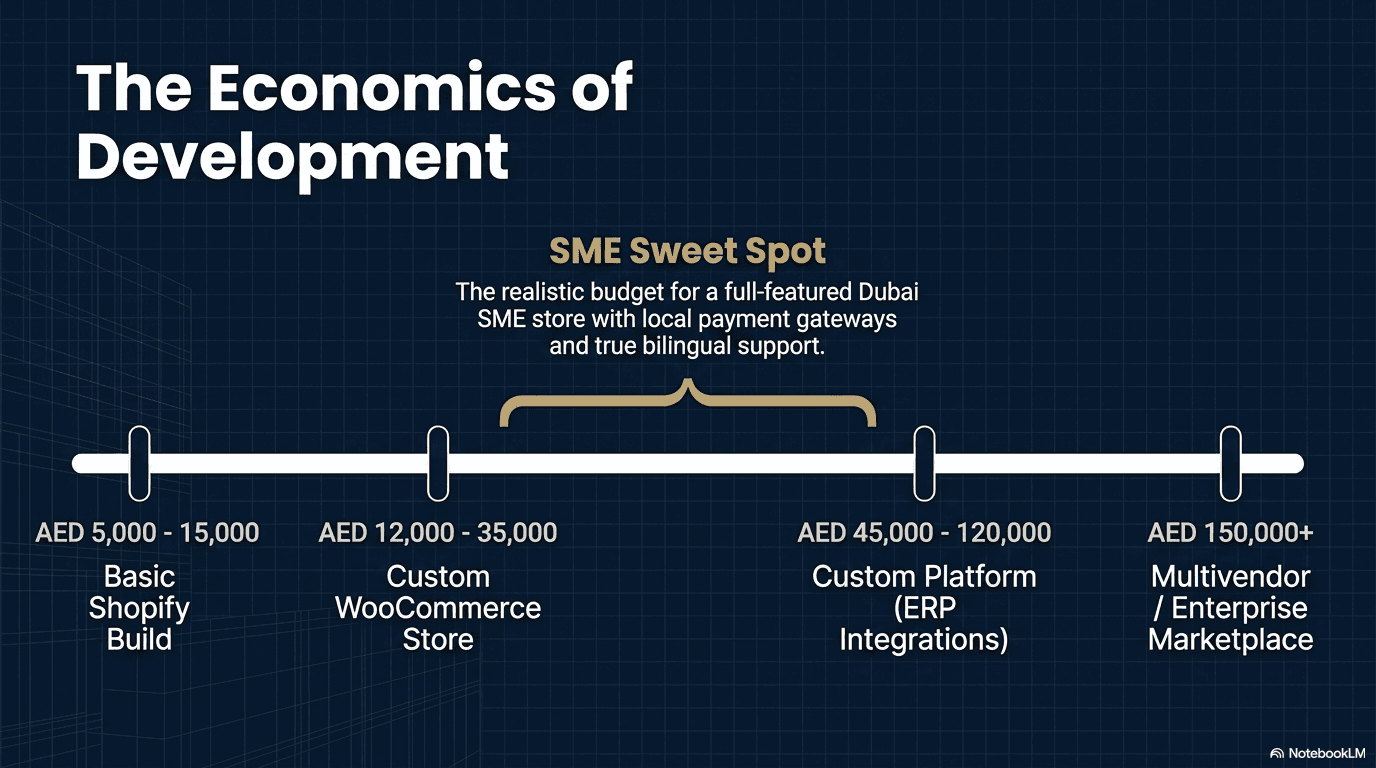
Pricing depends heavily on platform and complexity. Based on current UAE market data and what I typically see quoted to clients, here is the realistic 2026 range:
Platform / Build Type | Typical Cost (AED) | Best For |
|---|---|---|
Basic Shopify store | 5,000 - 15,000 | Small catalogs, fast launch |
WooCommerce store | 12,000 - 35,000 | WordPress-based brands wanting control |
Custom ecommerce platform | 45,000 - 120,000+ | Complex catalogs, unique workflows |
Multivendor marketplace / enterprise | 150,000+ | Large-scale or marketplace models |
Most SMEs in Dubai spend between AED 25,000 and AED 90,000 on a full build. Three factors move the number more than anything else in the quotes I review:
Bilingual Arabic/English support – every layout must work correctly in both RTL (Arabic) and LTR (English) orientation. I have seen "bilingual" projects blow their timeline by weeks because RTL was bolted on after the English design was already locked, instead of designed for from day one.
Regional payment integrations – gateways like Telr, Network International, PayTabs, Tabby and Tamara each require separate integration work, and each has its own quirks in testing and settlement.
Product catalog scale – a 50-product store needs far less photography, copywriting and Arabic translation than a 5,000-product catalog. Catalog prep is consistently the most underestimated line item in a project timeline.
Choosing the Right Platform for Your Dubai Online Store
Shopify
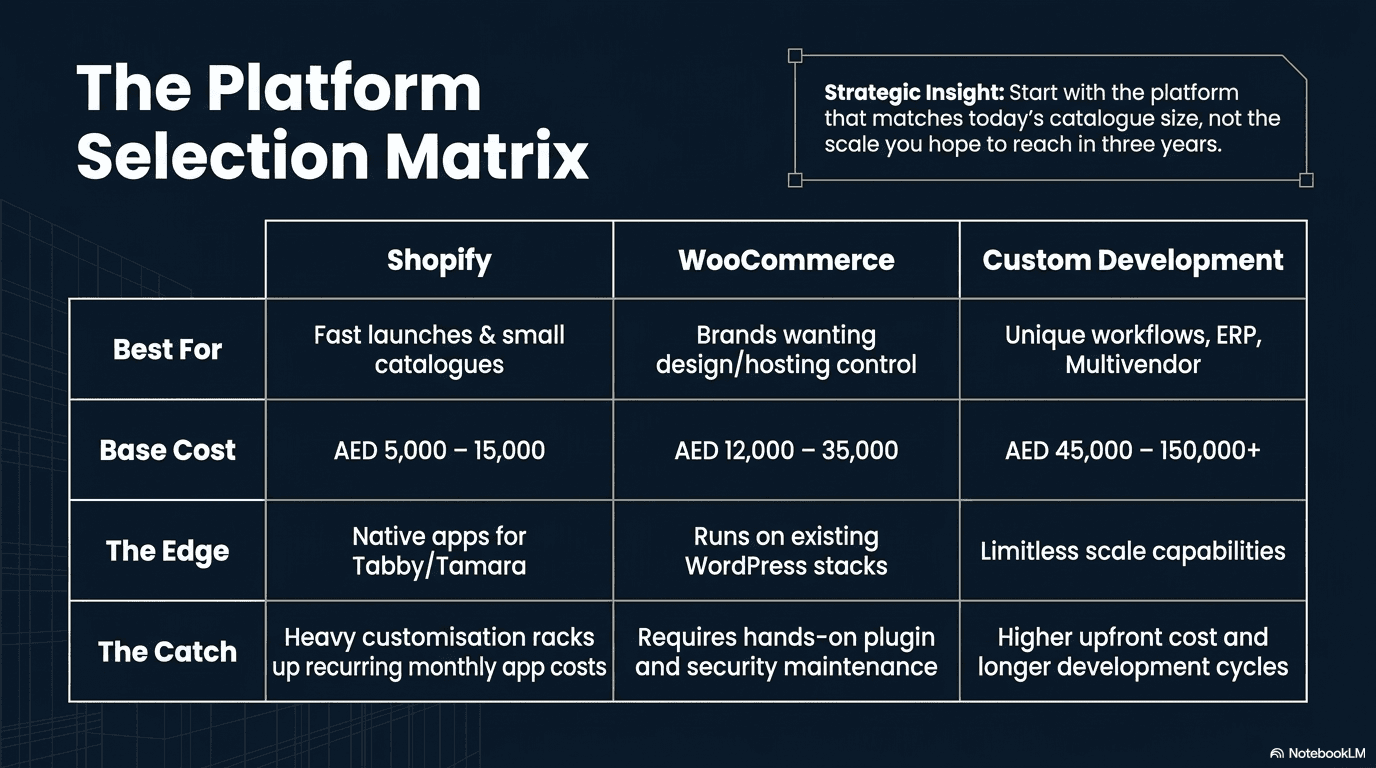
Shopify is my default recommendation for businesses that want to launch quickly with lower upfront cost. It has native apps for Tabby and Tamara, which UAE shoppers increasingly expect at checkout. The catch: heavy customization racks up app subscription costs fast, and I've seen stores end up paying more monthly in apps than they saved on the initial build.
WooCommerce
WooCommerce gives more control over design and hosting since it runs on WordPress. It's the right call for brands that already have WordPress content and don't want to run two separate systems. The tradeoff is maintenance: WooCommerce sites need more hands-on plugin and security upkeep than Shopify, and I always tell clients to budget for that ongoing work, not just the build.
Custom Development
A custom platform earns its cost once a business needs unique checkout logic, ERP integration, or a multivendor marketplace model. It takes longer and costs more up front, but I've watched businesses on off-the-shelf platforms hit a wall at scale that a custom build simply doesn't have.
From experience: Start with the platform that matches today's catalog size and budget, not the one built for the scale you hope to reach in three years. I have re-platformed more stores because a client over-built early than because they under-built.
Must-Have Features for a Dubai Ecommerce Website
After a decade of post-launch audits, these are the features I flag as non-negotiable for the UAE market:
Bilingual Arabic/English interface with proper RTL layout support, not just translated text
Local payment gateways: Telr, PayTabs, Network International, Tabby and Tamara for buy-now-pay-later
VAT-compliant checkout and invoicing at the UAE's 5% rate
Mobile-first design, given that 79% of UAE ecommerce transactions happen on smartphones
Cash on delivery (COD), still one of the highest-converting payment options I see across the region
Fast page load and CDN setup, since Dubai shoppers compare against Amazon.ae and Noon on speed as well as price
UAE-specific shipping and address formats, including PO Box and area-based addressing
Step-by-Step Ecommerce Website Development Process
This is the sequence I follow on nearly every build, refined after some early projects where skipping a step cost weeks later:
Discovery and planning: Define target customers, product catalog size, and required payment/shipping integrations.
Platform selection: Choose Shopify, WooCommerce or a custom build based on budget and complexity.
Design and UX: Build wireframes and visual design, including the Arabic RTL version from the start if bilingual.
Development: Build the storefront, product pages, cart and checkout, and connect payment gateways.
Content and catalog setup: Add product photography, descriptions and Arabic translations.
Testing and QA: Test checkout flows, payment gateways, mobile responsiveness and RTL layout end to end.
Launch: Go live, submit sitemap to search engines, and connect analytics.
Post-launch optimization: Monitor conversion rate, page speed and SEO performance, then iterate. The stores I've managed longest improve more in the six months after launch than in the build itself.
Choosing an Ecommerce Development Company in Dubai
Having sat on both sides of this conversation, here's what I tell business owners to check before signing:
Portfolio of UAE ecommerce projects, specifically ones with bilingual and local payment gateway integration, not just international work relabeled for the region
A fixed-scope quote broken down by design, development, integrations and post-launch support
Ongoing maintenance terms, since ecommerce sites need regular security and platform updates
Clear timeline, typically 4-8 weeks for a Shopify/WooCommerce build and 3-6 months for a custom platform
If a quote looks unusually low, ask what's excluded. In my experience it's almost always Arabic RTL work, payment gateway testing, or post-launch support.
Frequently Asked Questions
How much does ecommerce website development cost in Dubai?
Costs in 2026 range from AED 5,000 for a basic Shopify store to AED 150,000+ for a custom multivendor platform. Most SMEs in Dubai spend between AED 25,000 and AED 90,000 for a full-featured store with local payment gateways and bilingual support.
Which ecommerce platform is best for a Dubai business?
Shopify works best for fast, lower-cost launches. WooCommerce suits brands wanting more design control on WordPress. Custom development fits businesses that need unique workflows, ERP integration, or a marketplace model at scale.
What payment gateways should a UAE ecommerce site support?
A Dubai ecommerce site should support Telr, PayTabs and Network International for card payments, plus Tabby and Tamara for buy-now-pay-later, since these are the gateways UAE shoppers use most.
How long does it take to build an ecommerce website in Dubai?
A Shopify or WooCommerce store typically takes 4-8 weeks. A custom-built platform with ERP integration or marketplace functionality usually takes 3-6 months from discovery to launch.
Conclusion
Ecommerce website development in Dubai in 2026 means building for a market worth USD 12.3 billion, where 96% of the population already shops online and mobile drives most transactions. After a decade of builds, migrations and post-mortems, my view hasn't changed: bilingual RTL design, local payment gateways, VAT-compliant checkout and mobile-first performance are what separate a competitive Dubai storefront from a generic template. Match your platform to your current catalog size and budget, build in the local features UAE shoppers expect from day one, and you'll avoid the mistakes I still see new stores make every month.
Next step: Request quotes from two or three UAE-based development companies, compare their fixed-scope pricing against the ranges above, and confirm they have shipped bilingual, local-payment-integrated stores before.
Pricing depends heavily on platform and complexity. Based on current UAE market data and what I typically see quoted to clients, here is the realistic 2026 range:
Platform / Build Type | Typical Cost (AED) | Best For |
|---|---|---|
Basic Shopify store | 5,000 - 15,000 | Small catalogs, fast launch |
WooCommerce store | 12,000 - 35,000 | WordPress-based brands wanting control |
Custom ecommerce platform | 45,000 - 120,000+ | Complex catalogs, unique workflows |
Multivendor marketplace / enterprise | 150,000+ | Large-scale or marketplace models |
Most SMEs in Dubai spend between AED 25,000 and AED 90,000 on a full build. Three factors move the number more than anything else in the quotes I review:
Bilingual Arabic/English support – every layout must work correctly in both RTL (Arabic) and LTR (English) orientation. I have seen "bilingual" projects blow their timeline by weeks because RTL was bolted on after the English design was already locked, instead of designed for from day one.
Regional payment integrations – gateways like Telr, Network International, PayTabs, Tabby and Tamara each require separate integration work, and each has its own quirks in testing and settlement.
Product catalog scale – a 50-product store needs far less photography, copywriting and Arabic translation than a 5,000-product catalog. Catalog prep is consistently the most underestimated line item in a project timeline.
Choosing the Right Platform for Your Dubai Online Store
Shopify
Shopify is my default recommendation for businesses that want to launch quickly with lower upfront cost. It has native apps for Tabby and Tamara, which UAE shoppers increasingly expect at checkout. The catch: heavy customization racks up app subscription costs fast, and I've seen stores end up paying more monthly in apps than they saved on the initial build.
WooCommerce
WooCommerce gives more control over design and hosting since it runs on WordPress. It's the right call for brands that already have WordPress content and don't want to run two separate systems. The tradeoff is maintenance: WooCommerce sites need more hands-on plugin and security upkeep than Shopify, and I always tell clients to budget for that ongoing work, not just the build.
Custom Development
A custom platform earns its cost once a business needs unique checkout logic, ERP integration, or a multivendor marketplace model. It takes longer and costs more up front, but I've watched businesses on off-the-shelf platforms hit a wall at scale that a custom build simply doesn't have.
From experience: Start with the platform that matches today's catalog size and budget, not the one built for the scale you hope to reach in three years. I have re-platformed more stores because a client over-built early than because they under-built.
Must-Have Features for a Dubai Ecommerce Website
After a decade of post-launch audits, these are the features I flag as non-negotiable for the UAE market:
Bilingual Arabic/English interface with proper RTL layout support, not just translated text
Local payment gateways: Telr, PayTabs, Network International, Tabby and Tamara for buy-now-pay-later
VAT-compliant checkout and invoicing at the UAE's 5% rate
Mobile-first design, given that 79% of UAE ecommerce transactions happen on smartphones
Cash on delivery (COD), still one of the highest-converting payment options I see across the region
Fast page load and CDN setup, since Dubai shoppers compare against Amazon.ae and Noon on speed as well as price
UAE-specific shipping and address formats, including PO Box and area-based addressing
Step-by-Step Ecommerce Website Development Process
This is the sequence I follow on nearly every build, refined after some early projects where skipping a step cost weeks later:
Discovery and planning: Define target customers, product catalog size, and required payment/shipping integrations.
Platform selection: Choose Shopify, WooCommerce or a custom build based on budget and complexity.
Design and UX: Build wireframes and visual design, including the Arabic RTL version from the start if bilingual.
Development: Build the storefront, product pages, cart and checkout, and connect payment gateways.
Content and catalog setup: Add product photography, descriptions and Arabic translations.
Testing and QA: Test checkout flows, payment gateways, mobile responsiveness and RTL layout end to end.
Launch: Go live, submit sitemap to search engines, and connect analytics.
Post-launch optimization: Monitor conversion rate, page speed and SEO performance, then iterate. The stores I've managed longest improve more in the six months after launch than in the build itself.
Choosing an Ecommerce Development Company in Dubai
Having sat on both sides of this conversation, here's what I tell business owners to check before signing:
Portfolio of UAE ecommerce projects, specifically ones with bilingual and local payment gateway integration, not just international work relabeled for the region
A fixed-scope quote broken down by design, development, integrations and post-launch support
Ongoing maintenance terms, since ecommerce sites need regular security and platform updates
Clear timeline, typically 4-8 weeks for a Shopify/WooCommerce build and 3-6 months for a custom platform
If a quote looks unusually low, ask what's excluded. In my experience it's almost always Arabic RTL work, payment gateway testing, or post-launch support.
Frequently Asked Questions
How much does ecommerce website development cost in Dubai?
Costs in 2026 range from AED 5,000 for a basic Shopify store to AED 150,000+ for a custom multivendor platform. Most SMEs in Dubai spend between AED 25,000 and AED 90,000 for a full-featured store with local payment gateways and bilingual support.
Which ecommerce platform is best for a Dubai business?
Shopify works best for fast, lower-cost launches. WooCommerce suits brands wanting more design control on WordPress. Custom development fits businesses that need unique workflows, ERP integration, or a marketplace model at scale.
What payment gateways should a UAE ecommerce site support?
A Dubai ecommerce site should support Telr, PayTabs and Network International for card payments, plus Tabby and Tamara for buy-now-pay-later, since these are the gateways UAE shoppers use most.
How long does it take to build an ecommerce website in Dubai?
A Shopify or WooCommerce store typically takes 4-8 weeks. A custom-built platform with ERP integration or marketplace functionality usually takes 3-6 months from discovery to launch.
Conclusion
Ecommerce website development in Dubai in 2026 means building for a market worth USD 12.3 billion, where 96% of the population already shops online and mobile drives most transactions. After a decade of builds, migrations and post-mortems, my view hasn't changed: bilingual RTL design, local payment gateways, VAT-compliant checkout and mobile-first performance are what separate a competitive Dubai storefront from a generic template. Match your platform to your current catalog size and budget, build in the local features UAE shoppers expect from day one, and you'll avoid the mistakes I still see new stores make every month.
Next step: Request quotes from two or three UAE-based development companies, compare their fixed-scope pricing against the ranges above, and confirm they have shipped bilingual, local-payment-integrated stores before.


Related Posts





Related Posts
Related Posts
Motion labs
info@motionlabs.agency


+971 55317 1706
C-1802, ONTARIO TOWER, PLOT NO. 49-0, BUSINESS BAY, DUBAI, 00000
click to meet me :)
click to meet me :)
© All Rights Reserved | 2026


Motion labs
info@motionlabs.agency
+971 55317 1706
C-1802, ONTARIO TOWER, PLOT NO. 49-0, BUSINESS BAY, DUBAI, 00000
Private policy
Terms & Conditions
© All Rights Reserved | 2026
click to meet me :)