/
/
How to Choose a UGC and Video Agency in the US, New York to San Francisco
How to Choose a UGC and Video Agency in the US, New York to San Francisco
5 min
read
How to Choose a UGC and Video Agency in the US, New York to San Francisco
How to Choose a UGC and Video Agency in the US, New York to San Francisco
Content
Market

Author

Scroll down
to read more!
Summerize with ChatGPT
Summerize with Gemini
Summerize with Claude
How to Choose a UGC and Video Agency in the US, New York to San Francisco
How to Choose a UGC and Video Agency in the US, New York to San Francisco
Picking a video partner in the US used to be simple. You booked a production house, paid for a crew and a studio day, and waited a month for one polished spot. That model still exists and it still has a place. It just does not match how people watch anything now.
Picking a video partner in the US used to be simple. You booked a production house, paid for a crew and a studio day, and waited a month for one polished spot. That model still exists and it still has a place. It just does not match how people watch anything now.
Picking a video partner in the US used to be simple. You booked a production house, paid for a crew and a studio day, and waited a month for one polished spot. That model still exists and it still has a place. It just does not match how people watch anything now.
Most of the video that actually performs on Meta, TikTok and YouTube Shorts looks like a customer filmed it on a phone. That is UGC, user generated content, and the agencies that make it operate more like a content line than a film set. If you are a brand anywhere between New York and San Francisco, the real question is not whether to use UGC. It is how to find someone who can produce it at volume without the quality sliding after month two.
Here is what we look at when we build these programmes at Motion Labs, and what we would ask if we were sitting on your side of the table.
What does a UGC and video agency actually do?
A UGC agency owns four things: finding creators, briefing them, editing what comes back, and turning that footage into ad variants that a media buyer can test.
That last part is where most of the value sits, and it is the part brands underestimate. One raw creator video is not one ad. It is a hook, a demo, a proof section and a call to action that can be recut into a dozen different edits. A good agency treats the raw footage as raw material, not as the deliverable.
This is also the line between UGC and influencer marketing. With an influencer, you are buying access to their audience and the post lives on their profile. With UGC, you are buying a licensed video file that runs on your ad account, under your control, for as long as your contract allows.
Why are US brands moving their budgets toward UGC video?
Two reasons, and neither of them is that UGC is cheap.
The first is creative volume. Paid social platforms now do most of the targeting work, which means the creative is the variable you still control. Ad accounts burn through winning creative fast, and once an ad fatigues, the fix is a new angle, not a new audience. That requires a steady supply of assets rather than one shoot per quarter.
The second is trust. A polished brand film signals that a company spent money. A creator talking to camera about a problem they had signals that a person used the product. For most consideration-stage buyers the second one lands harder, which is why so many brands now shoot polished assets for their site and UGC for their ads.
Picking a video partner in the US used to be simple. You booked a production house, paid for a crew and a studio day, and waited a month for one polished spot. That model still exists and it still has a place. It just does not match how people watch anything now.
Most of the video that actually performs on Meta, TikTok and YouTube Shorts looks like a customer filmed it on a phone. That is UGC, user generated content, and the agencies that make it operate more like a content line than a film set. If you are a brand anywhere between New York and San Francisco, the real question is not whether to use UGC. It is how to find someone who can produce it at volume without the quality sliding after month two.
Here is what we look at when we build these programmes at Motion Labs, and what we would ask if we were sitting on your side of the table.
What does a UGC and video agency actually do?
A UGC agency owns four things: finding creators, briefing them, editing what comes back, and turning that footage into ad variants that a media buyer can test.
That last part is where most of the value sits, and it is the part brands underestimate. One raw creator video is not one ad. It is a hook, a demo, a proof section and a call to action that can be recut into a dozen different edits. A good agency treats the raw footage as raw material, not as the deliverable.
This is also the line between UGC and influencer marketing. With an influencer, you are buying access to their audience and the post lives on their profile. With UGC, you are buying a licensed video file that runs on your ad account, under your control, for as long as your contract allows.
Why are US brands moving their budgets toward UGC video?
Two reasons, and neither of them is that UGC is cheap.
The first is creative volume. Paid social platforms now do most of the targeting work, which means the creative is the variable you still control. Ad accounts burn through winning creative fast, and once an ad fatigues, the fix is a new angle, not a new audience. That requires a steady supply of assets rather than one shoot per quarter.
The second is trust. A polished brand film signals that a company spent money. A creator talking to camera about a problem they had signals that a person used the product. For most consideration-stage buyers the second one lands harder, which is why so many brands now shoot polished assets for their site and UGC for their ads.
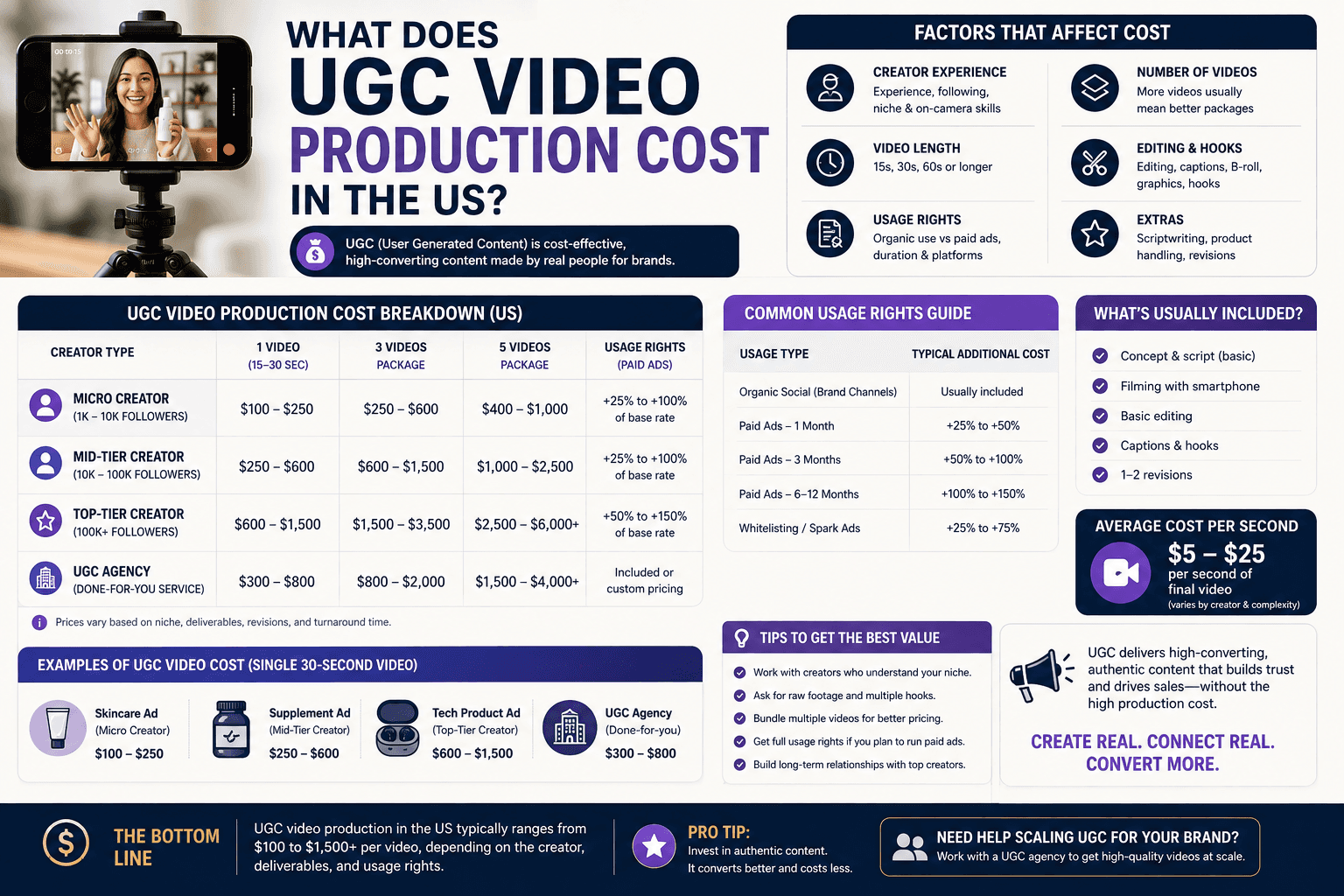
Pricing usually shows up in one of three shapes.
Per finished asset, where you pay for each ad-ready video delivered
Per creator batch, where you book a creator to produce a set number of videos
Monthly retainer, where you commit to an output volume and a revision allowance
Whichever shape a vendor quotes, convert it into one number before you compare anything: cost per finished, ad-ready asset, including editing and at least one revision round. Agencies quote very differently and it is easy to compare a raw creator fee against a fully edited deliverable and think you found a bargain.
Also ask what is excluded. Product seeding cost, paid usage rights, whitelisting, and creator reshoots are the four line items that quietly move a budget after signature.
What should you look for in a UGC agency in New York?
New York brands tend to be direct to consumer, fashion, beauty, food and fintech, and the buying cycle is short. Creative fatigue hits fast because these categories are crowded and everyone is bidding on the same audiences.
So the question to ask a New York focused partner is about throughput and turnaround. Can they hold a consistent monthly output? How quickly can they respond when a winning ad drops off and you need three new angles this week, not next month? Ask to see the same brand's creative across six months, not a highlight reel of one-off assets.
If in-person shoots matter to you, whether that is a founder-led piece or a studio day for a product launch, confirm whether the agency can actually crew locally or whether they source everything remotely. Both are fine. Being told one and getting the other is not.
What about San Francisco and Bay Area brands?
The West Coast brief is usually different. More B2B, more SaaS, longer sales cycles, and a product that needs explaining before anyone buys it.
UGC still works here, it just changes format. Instead of unboxings you get screen recordings, customer interviews, founder explainers and short product walkthroughs. The creator pool is different too, because you need people who can speak credibly about a workflow, not just hold a product to camera.
The measurement shifts as well. A Bay Area SaaS brand judging UGC on immediate ROAS will usually conclude it does not work. Judged on demo bookings, pipeline influenced and cost per qualified lead, the picture is often very different. Agree the metric before the first batch, not after it.
Pricing usually shows up in one of three shapes.
Per finished asset, where you pay for each ad-ready video delivered
Per creator batch, where you book a creator to produce a set number of videos
Monthly retainer, where you commit to an output volume and a revision allowance
Whichever shape a vendor quotes, convert it into one number before you compare anything: cost per finished, ad-ready asset, including editing and at least one revision round. Agencies quote very differently and it is easy to compare a raw creator fee against a fully edited deliverable and think you found a bargain.
Also ask what is excluded. Product seeding cost, paid usage rights, whitelisting, and creator reshoots are the four line items that quietly move a budget after signature.
What should you look for in a UGC agency in New York?
New York brands tend to be direct to consumer, fashion, beauty, food and fintech, and the buying cycle is short. Creative fatigue hits fast because these categories are crowded and everyone is bidding on the same audiences.
So the question to ask a New York focused partner is about throughput and turnaround. Can they hold a consistent monthly output? How quickly can they respond when a winning ad drops off and you need three new angles this week, not next month? Ask to see the same brand's creative across six months, not a highlight reel of one-off assets.
If in-person shoots matter to you, whether that is a founder-led piece or a studio day for a product launch, confirm whether the agency can actually crew locally or whether they source everything remotely. Both are fine. Being told one and getting the other is not.
What about San Francisco and Bay Area brands?
The West Coast brief is usually different. More B2B, more SaaS, longer sales cycles, and a product that needs explaining before anyone buys it.
UGC still works here, it just changes format. Instead of unboxings you get screen recordings, customer interviews, founder explainers and short product walkthroughs. The creator pool is different too, because you need people who can speak credibly about a workflow, not just hold a product to camera.
The measurement shifts as well. A Bay Area SaaS brand judging UGC on immediate ROAS will usually conclude it does not work. Judged on demo bookings, pipeline influenced and cost per qualified lead, the picture is often very different. Agree the metric before the first batch, not after it.

These are not competing options so much as different tools. Most brands running serious paid social end up using both.

What you are comparing | Traditional production house | UGC and video agency |
|---|---|---|
Output per month | One to two hero assets | Twenty to fifty short form assets |
Typical turnaround | Four to eight weeks | One to two weeks per batch |
Pricing basis | Project fee, crew and studio days | Per finished asset or monthly retainer |
Best used for | Brand films, TV, website hero video | Paid social testing, organic short form |
Revisions | Costly, often needs a reshoot | Built into the cycle as new variants |
Main risk | One expensive asset that underperforms | Volume without a creative point of view |
That last row is the one to take seriously. The failure mode of a UGC agency is not bad video. It is fifty videos that all say the same thing in a slightly different order. Ask any shortlisted agency to walk you through how they develop angles, not just how they source creators.
What questions should you ask before signing?
What is the cost per finished, ad-ready asset, all in?
What usage rights do we get, for how long, and does that include paid and whitelisting?
Can the creator reuse this footage for a competitor?
Who writes the briefs and the hooks, your team or ours?
How many revision rounds are included per asset?
What happens if a creator delivers footage we cannot use?
Which of your case studies is closest to our category, and what did the account look like six months in?
Who is actually on our account day to day?
The answers matter less than how quickly they come. A team that has run these programmes will answer all eight without checking with anyone.
How do you know if the UGC is working?
Do not judge a batch on how the videos look. Judge it on how the account behaves.
Hook rate, the share of viewers still watching after the first three seconds
Hold rate, how far into the video people get before dropping
Cost per acquisition against your control creative
How long a winning asset lasts before spend efficiency drops
Hit rate, meaning how many assets out of each batch beat control
That last metric is the honest one. No agency produces winners every time and anyone who claims otherwise is describing a sample size of one. A healthy programme has a hit rate that improves over time as the team learns what your audience responds to. Ask for it by name and see how comfortable the answer feels.
Should you hire locally or work with a distributed team?
Plenty of strong UGC work for US brands is produced by distributed teams, ours included. Motion Labs runs out of New Delhi with a creator network of more than 500 people, and we produce for brands across the US, UK, UAE and Europe.
What makes that work is not proximity, it is overlap and process. You want a partner with real working hours in your time zone, a named person who owns your account, briefs that get written properly instead of forwarded, and reporting that a media buyer can act on. If a local agency gives you that and a distributed one does not, hire local. Most of the time the deciding factor is how the team runs, not where they sit.
Working on your next batch of ad creative? Motion Labs builds UGC and AI video programmes for brands across the US, from DTC teams in New York to B2B SaaS in the Bay Area. Creator sourcing, scripting, editing and performance-ready variants, run as one pipeline. Tell us what your ad account needs this quarter and we will show you what the first batch would look like. Visit motionlabs.agency to start the conversation. |
Frequently asked questions
What is a UGC agency and how is it different from an influencer agency?
A UGC agency produces content that you own and run as ads on your own channels. An influencer agency buys distribution on someone else's audience. The deliverable is different: one is a media buy, the other is a licensed video file you can test, cut and re-edit as many times as you want.
How much should I budget for UGC video in the US?
Pricing usually lands in one of three shapes: per finished asset, per creator per batch, or a monthly retainer with a committed output number. Ask for the cost per finished, ad-ready asset including editing and revisions. That number is the only one you can compare across vendors.
Do I need to hire an agency located in New York or San Francisco?
Only if your workflow depends on in-person shoots or on-site brand days. Creator sourcing, briefing, editing and reporting all run remotely. What matters more is whether the team works in your time zone for at least part of the day and whether they have shipped in your category.
How many UGC videos do I need to run paid social properly?
Enough to keep testing after your winners fatigue. Most brands running consistent spend need a steady monthly refresh rather than one big drop. Agree an output number up front so creative supply does not become the bottleneck on your media plan.
Who owns the footage the creators shoot?
That depends entirely on the licensing terms in the contract. Check whether you get perpetual usage, paid ad usage, whitelisting rights, and whether the creator can reuse the footage for a competitor. Get this in writing before the first shoot.
Can UGC work for B2B and SaaS, not just ecommerce?
Yes, though the format shifts. B2B UGC tends to be screen recordings, customer interviews, founder explainers and product walkthroughs rather than unboxings. The measurement shifts too, from ROAS to pipeline and demo bookings.
How fast can a UGC agency turn around a batch of videos?
A realistic cycle for briefing, casting, shooting, editing and one revision round is a couple of weeks. Anything promised in a few days is either reusing stock footage or skipping the revision loop. Ask which one it is.
These are not competing options so much as different tools. Most brands running serious paid social end up using both.
What you are comparing | Traditional production house | UGC and video agency |
|---|---|---|
Output per month | One to two hero assets | Twenty to fifty short form assets |
Typical turnaround | Four to eight weeks | One to two weeks per batch |
Pricing basis | Project fee, crew and studio days | Per finished asset or monthly retainer |
Best used for | Brand films, TV, website hero video | Paid social testing, organic short form |
Revisions | Costly, often needs a reshoot | Built into the cycle as new variants |
Main risk | One expensive asset that underperforms | Volume without a creative point of view |
That last row is the one to take seriously. The failure mode of a UGC agency is not bad video. It is fifty videos that all say the same thing in a slightly different order. Ask any shortlisted agency to walk you through how they develop angles, not just how they source creators.
What questions should you ask before signing?
What is the cost per finished, ad-ready asset, all in?
What usage rights do we get, for how long, and does that include paid and whitelisting?
Can the creator reuse this footage for a competitor?
Who writes the briefs and the hooks, your team or ours?
How many revision rounds are included per asset?
What happens if a creator delivers footage we cannot use?
Which of your case studies is closest to our category, and what did the account look like six months in?
Who is actually on our account day to day?
The answers matter less than how quickly they come. A team that has run these programmes will answer all eight without checking with anyone.
How do you know if the UGC is working?
Do not judge a batch on how the videos look. Judge it on how the account behaves.
Hook rate, the share of viewers still watching after the first three seconds
Hold rate, how far into the video people get before dropping
Cost per acquisition against your control creative
How long a winning asset lasts before spend efficiency drops
Hit rate, meaning how many assets out of each batch beat control
That last metric is the honest one. No agency produces winners every time and anyone who claims otherwise is describing a sample size of one. A healthy programme has a hit rate that improves over time as the team learns what your audience responds to. Ask for it by name and see how comfortable the answer feels.
Should you hire locally or work with a distributed team?
Plenty of strong UGC work for US brands is produced by distributed teams, ours included. Motion Labs runs out of New Delhi with a creator network of more than 500 people, and we produce for brands across the US, UK, UAE and Europe.
What makes that work is not proximity, it is overlap and process. You want a partner with real working hours in your time zone, a named person who owns your account, briefs that get written properly instead of forwarded, and reporting that a media buyer can act on. If a local agency gives you that and a distributed one does not, hire local. Most of the time the deciding factor is how the team runs, not where they sit.
Working on your next batch of ad creative? Motion Labs builds UGC and AI video programmes for brands across the US, from DTC teams in New York to B2B SaaS in the Bay Area. Creator sourcing, scripting, editing and performance-ready variants, run as one pipeline. Tell us what your ad account needs this quarter and we will show you what the first batch would look like. Visit motionlabs.agency to start the conversation. |
Frequently asked questions
What is a UGC agency and how is it different from an influencer agency?
A UGC agency produces content that you own and run as ads on your own channels. An influencer agency buys distribution on someone else's audience. The deliverable is different: one is a media buy, the other is a licensed video file you can test, cut and re-edit as many times as you want.
How much should I budget for UGC video in the US?
Pricing usually lands in one of three shapes: per finished asset, per creator per batch, or a monthly retainer with a committed output number. Ask for the cost per finished, ad-ready asset including editing and revisions. That number is the only one you can compare across vendors.
Do I need to hire an agency located in New York or San Francisco?
Only if your workflow depends on in-person shoots or on-site brand days. Creator sourcing, briefing, editing and reporting all run remotely. What matters more is whether the team works in your time zone for at least part of the day and whether they have shipped in your category.
How many UGC videos do I need to run paid social properly?
Enough to keep testing after your winners fatigue. Most brands running consistent spend need a steady monthly refresh rather than one big drop. Agree an output number up front so creative supply does not become the bottleneck on your media plan.
Who owns the footage the creators shoot?
That depends entirely on the licensing terms in the contract. Check whether you get perpetual usage, paid ad usage, whitelisting rights, and whether the creator can reuse the footage for a competitor. Get this in writing before the first shoot.
Can UGC work for B2B and SaaS, not just ecommerce?
Yes, though the format shifts. B2B UGC tends to be screen recordings, customer interviews, founder explainers and product walkthroughs rather than unboxings. The measurement shifts too, from ROAS to pipeline and demo bookings.
How fast can a UGC agency turn around a batch of videos?
A realistic cycle for briefing, casting, shooting, editing and one revision round is a couple of weeks. Anything promised in a few days is either reusing stock footage or skipping the revision loop. Ask which one it is.
the call your competitor wish you would'nt take


Related Posts





Related Posts
Related Posts
Motion labs
info@motionlabs.agency


+971 55317 1706
C-1802, ONTARIO TOWER, PLOT NO. 49-0, BUSINESS BAY, DUBAI, 00000
click to meet me :)
click to meet me :)
© All Rights Reserved | 2026


Motion labs
info@motionlabs.agency
+971 55317 1706
C-1802, ONTARIO TOWER, PLOT NO. 49-0, BUSINESS BAY, DUBAI, 00000
Private policy
Terms & Conditions
© All Rights Reserved | 2026
click to meet me :)