/
/
How to Create an AI Digital Marketing Strategy?
How to Create an AI Digital Marketing Strategy?
5 min
read
How to Create an AI Digital Marketing Strategy?
How to Create an AI Digital Marketing Strategy?
Marketing
Ai

Author
Scroll down
to read more!
Summerize with ChatGPT
Summerize with Gemini
Summerize with Claude
How to Create an AI Digital Marketing Strategy?
How to Create an AI Digital Marketing Strategy?
Why is your competitor showing up on AI search, and you're not? AI just recommended your competitor. To your customer. And not you. Let’s see the core problem and the solution.
Why is your competitor showing up on AI search, and you're not? AI just recommended your competitor. To your customer. And not you. Let’s see the core problem and the solution.
What Is an AI Digital Marketing Strategy
An AI digital marketing strategy is a plan that uses artificial intelligence to improve how you reach, engage, and convert your audience. That covers a lot of ground, from how you create content to how you target ads to how you respond to customers.
But here's where most brands go wrong: they treat AI as a shortcut instead of a system.
They use ChatGPT to write captions faster. They use an AI image tool to fill their feed. They automate emails but don't personalise them. The result? Content that looks the same as everyone else's and doesn't convert.
The brands winning right now are using AI to do things they couldn't do before, understand their audience at scale, produce content without burning out their team, and tell their brand story across every channel, consistently.
How to Use AI Effectively?
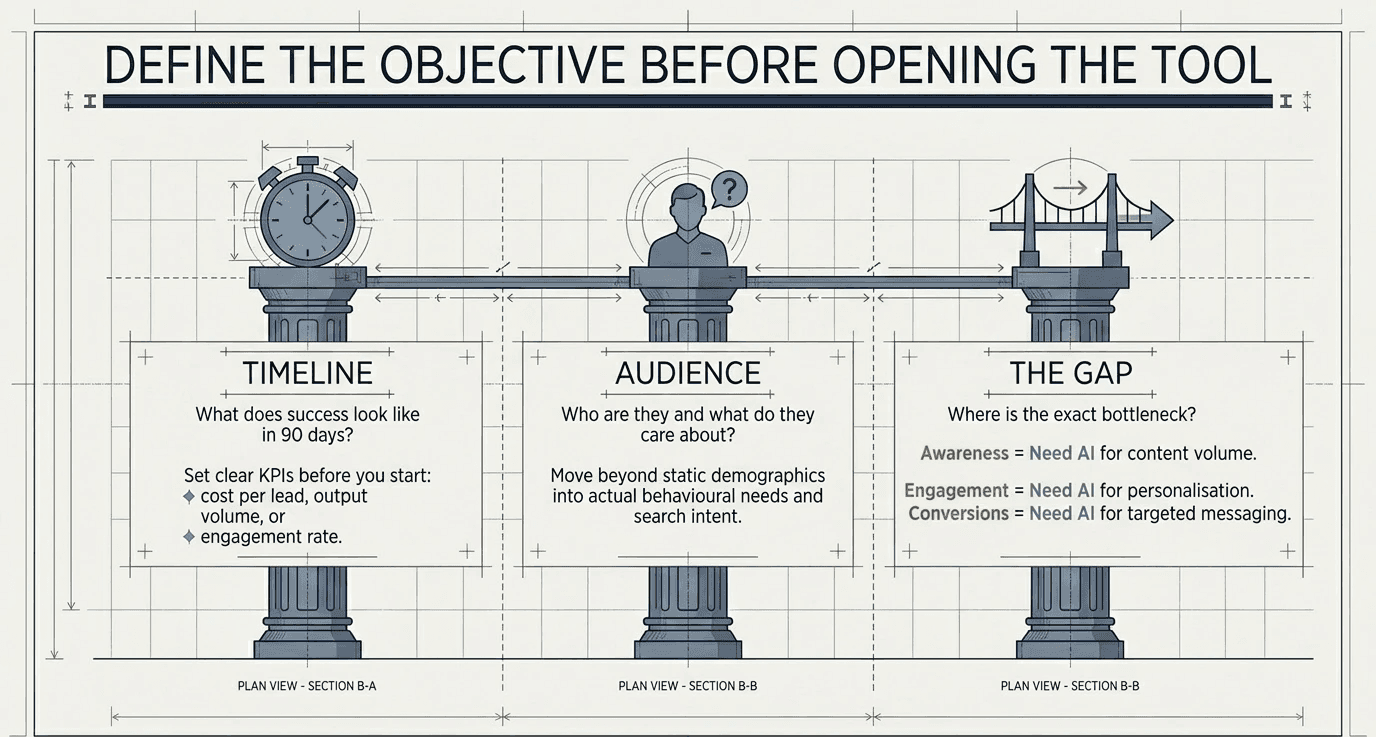
Before you open any tool, write down what you actually want to achieve. This sounds obvious, but most teams skip it and end up with a bunch of AI outputs and no clear direction.
Ask yourself these three questions:
• What does success look like in 90 days?
• Who is my audience and what do they actually care about?
• Where do I have the biggest gap right now, awareness, engagement, or conversions?
Your answers will tell you where AI can help the most. If you're struggling with awareness, you need AI for content volume and distribution. If it's engagement, you need AI for personalisation. If it's conversions, you need AI for targeting and messaging.
Set KPIs before you start. Not after. Things like cost per lead, content output per week, email open rates, or social engagement rate. These are your benchmarks. Everything you do with AI gets measured against them.
How to Use AI for Brand Storytelling
Brand storytelling is the art of making people care about your brand before they're ready to buy. And it's one of the most important things AI can help you do at scale, if you do it right.
The problem most brands have is this: AI-generated content often sounds like AI-generated content. It's polished, balanced, and completely forgettable. It checks all the boxes and connects with nobody.
Here's how to use AI for brand storytelling without losing your voice:
Train Your AI Tools on Your Voice
Feed your best content into your AI tools. Your tone, your vocabulary, your way of framing problems. Most AI writing tools let you add style instructions or use past content as a reference. Use that feature. Don't start from scratch every time.
Use AI to Find the Stories, Not Just Write Them
AI is excellent at analysing customer reviews, social comments, and support tickets to surface what your audience actually says and feels. Mine that data for real stories. Then use those real insights to build narratives that hit.
Automate Distribution, Not Creation
Use AI to distribute your best human-made content wider and faster. Auto-repurpose a long article into social snippets, email sequences, and short videos. Let AI handle the packaging while your team handles the core message.
💡 Pro Tip The best AI-assisted brand storytelling still has a human at the centre. Use AI to amplify your message, not replace the thinking behind it. One original insight, amplified across 10 formats by AI, will always outperform 10 generic AI posts. |
AI Content Strategy
Content is still the foundation of digital marketing. But creating it consistently, at the quality and volume search engines and social algorithms reward, is genuinely hard without AI.
Here's how to build an AI content system that produces quality work at scale:
Build a Content Calendar with AI Research
Use AI tools to research what your audience is searching for, what questions they have, and what your competitors are writing about. Build your calendar around real demand, not guesswork. This is where keyword research, trend data, and competitor gap analysis come together.
Use AI to Draft, Humans to Edit
The most efficient workflow is AI for drafts, humans for final edits. AI handles the structure, the research synthesis, and the first pass. Your team adds the nuance, the original examples, and the personality. You get speed without losing quality.
Repurpose Everything
One blog post can become a LinkedIn carousel, three social posts, an email, a short video script, and a FAQ page. AI makes repurposing fast. Set up templates for each format and run every major piece of content through them.
Manual Content Marketing vs. AI-Assisted Content Marketing
Metric | Manual Process | AI-Assisted Process |
Content output per week | 2–3 pieces | 8–15 pieces |
Research time per article | 3–5 hours | 30–60 minutes |
SEO optimization | Manual, inconsistent | Automated, consistent |
Personalisation at scale | Not feasible | Fully achievable |
Repurposing speed | Days | Hours |
Cost per content piece | High | Significantly lower |
Also read: Is AI damaging or saving your brand?
What Is an AI Digital Marketing Strategy
An AI digital marketing strategy is a plan that uses artificial intelligence to improve how you reach, engage, and convert your audience. That covers a lot of ground, from how you create content to how you target ads to how you respond to customers.
But here's where most brands go wrong: they treat AI as a shortcut instead of a system.
They use ChatGPT to write captions faster. They use an AI image tool to fill their feed. They automate emails but don't personalise them. The result? Content that looks the same as everyone else's and doesn't convert.
The brands winning right now are using AI to do things they couldn't do before, understand their audience at scale, produce content without burning out their team, and tell their brand story across every channel, consistently.
How to Use AI Effectively?
Before you open any tool, write down what you actually want to achieve. This sounds obvious, but most teams skip it and end up with a bunch of AI outputs and no clear direction.
Ask yourself these three questions:
• What does success look like in 90 days?
• Who is my audience and what do they actually care about?
• Where do I have the biggest gap right now, awareness, engagement, or conversions?
Your answers will tell you where AI can help the most. If you're struggling with awareness, you need AI for content volume and distribution. If it's engagement, you need AI for personalisation. If it's conversions, you need AI for targeting and messaging.
Set KPIs before you start. Not after. Things like cost per lead, content output per week, email open rates, or social engagement rate. These are your benchmarks. Everything you do with AI gets measured against them.
How to Use AI for Brand Storytelling
Brand storytelling is the art of making people care about your brand before they're ready to buy. And it's one of the most important things AI can help you do at scale, if you do it right.
The problem most brands have is this: AI-generated content often sounds like AI-generated content. It's polished, balanced, and completely forgettable. It checks all the boxes and connects with nobody.
Here's how to use AI for brand storytelling without losing your voice:
Train Your AI Tools on Your Voice
Feed your best content into your AI tools. Your tone, your vocabulary, your way of framing problems. Most AI writing tools let you add style instructions or use past content as a reference. Use that feature. Don't start from scratch every time.
Use AI to Find the Stories, Not Just Write Them
AI is excellent at analysing customer reviews, social comments, and support tickets to surface what your audience actually says and feels. Mine that data for real stories. Then use those real insights to build narratives that hit.
Automate Distribution, Not Creation
Use AI to distribute your best human-made content wider and faster. Auto-repurpose a long article into social snippets, email sequences, and short videos. Let AI handle the packaging while your team handles the core message.
💡 Pro Tip The best AI-assisted brand storytelling still has a human at the centre. Use AI to amplify your message, not replace the thinking behind it. One original insight, amplified across 10 formats by AI, will always outperform 10 generic AI posts. |
AI Content Strategy
Content is still the foundation of digital marketing. But creating it consistently, at the quality and volume search engines and social algorithms reward, is genuinely hard without AI.
Here's how to build an AI content system that produces quality work at scale:
Build a Content Calendar with AI Research
Use AI tools to research what your audience is searching for, what questions they have, and what your competitors are writing about. Build your calendar around real demand, not guesswork. This is where keyword research, trend data, and competitor gap analysis come together.
Use AI to Draft, Humans to Edit
The most efficient workflow is AI for drafts, humans for final edits. AI handles the structure, the research synthesis, and the first pass. Your team adds the nuance, the original examples, and the personality. You get speed without losing quality.
Repurpose Everything
One blog post can become a LinkedIn carousel, three social posts, an email, a short video script, and a FAQ page. AI makes repurposing fast. Set up templates for each format and run every major piece of content through them.
Manual Content Marketing vs. AI-Assisted Content Marketing
Metric | Manual Process | AI-Assisted Process |
Content output per week | 2–3 pieces | 8–15 pieces |
Research time per article | 3–5 hours | 30–60 minutes |
SEO optimization | Manual, inconsistent | Automated, consistent |
Personalisation at scale | Not feasible | Fully achievable |
Repurposing speed | Days | Hours |
Cost per content piece | High | Significantly lower |
Also read: Is AI damaging or saving your brand?
How to Use AI for Audience Targeting and Personalisation
Personalisation is the biggest competitive advantage AI gives you. And it's not just about putting someone's first name in an email. Real personalisation means showing the right message to the right person at exactly the right moment.
Here's how that works in practice:
Behavioral Segmentation
AI tools can analyse how different users interact with your content, what they click, what they ignore, what they buy, and what they bounce from. This lets you build audience segments based on actual behaviour, not demographics. A first-time visitor gets a different message than someone who has visited your pricing page three times.
Predictive Lead Scoring
AI can score your leads based on how likely they are to convert. It looks at engagement signals, firmographic data, timing, and behavioural patterns. Your sales and marketing team focuses their energy on the leads most likely to close instead of treating everyone the same.
Dynamic Content
Dynamic content means different people see different versions of the same page or email based on who they are. AI makes this possible at scale. Your landing page can change its headline, its hero image, and its CTA based on where the visitor came from, what industry they're in, or where they are in the buying journey.
AI Video and UGC: The Fastest Growing Channel in Digital Marketing
Video is no longer optional. It's the default format for capturing attention online, and AI has completely changed what's possible for brands that don't have massive production budgets.
AI-generated video, AI avatars, and AI-assisted UGC (user-generated content) are letting brands produce professional video content at a fraction of the cost and time of traditional production.
Here's what's working right now:
• AI avatar videos for product explainers, testimonials, and brand storytelling, no camera, no studio
• AI-generated UGC-style ads that look and feel authentic, designed for short-form platforms
• Auto-captioning, repurposing long videos into Reels and Shorts, and generating multiple ad variations from a single shoot
• Influencer content augmented with AI editing and localisation for different markets
How to Measure AI Marketing Performance
You can't improve what you don't measure. And with AI in the mix, the volume of data you have access to goes up dramatically. The challenge is knowing which numbers to actually care about.
Focus on these core metrics:
Core AI Marketing KPIs
Metric | What It Measures | Why It Matters |
Content engagement rate | How people interact with your content | Shows if your message is landing |
Lead conversion rate | Leads converted from AI-targeted campaigns | Measures targeting and message quality |
Cost per acquisition (CPA) | Cost to acquire one customer via AI channels | Core profitability signal |
Email open and click-through rate | Engagement with personalised email sequences | Measures personalisation effectiveness |
Return on ad spend (ROAS) | Revenue generated per dollar of ad spend | Campaign efficiency benchmark |
Organic search traffic | Visitors from unpaid search | Content and SEO strategy health |
Social reach and engagement | How far does your content travel | Brand awareness and storytelling impact |
Review these metrics weekly. Monthly reviews are too slow for AI-driven campaigns where things can shift quickly. Set up automated dashboards so your team isn't spending time pulling reports; they should be spending time acting on them.
Also read: What's social media SEO?
AI Tools for Digital Marketing: What to Use and When
You don't need every tool. You need the right tools for what you're actually trying to do. Here's a practical breakdown:
Goal | Tool Category | Examples |
Content writing and drafts | AI writing tools | ChatGPT, Claude, Jasper |
SEO research and optimization | AI SEO tools | Semrush, Ahrefs, Surfer SEO |
AI video production | AI video and avatar tools | HeyGen, Synthesia, Runway |
Social media scheduling | AI social tools | Buffer, Hootsuite, Lately |
Email personalization | AI email platforms | Klaviyo, ActiveCampaign, HubSpot |
Ad creative testing | AI ad platforms | Meta Advantage+, Google Performance Max |
Analytics and reporting | AI analytics tools | GA4, Tableau, Looker Studio |
Full-service AI execution | Agency partner | Motion Labs (motionlabs.agency) |
How to Use AI for Audience Targeting and Personalisation
Personalisation is the biggest competitive advantage AI gives you. And it's not just about putting someone's first name in an email. Real personalisation means showing the right message to the right person at exactly the right moment.
Here's how that works in practice:
Behavioral Segmentation
AI tools can analyse how different users interact with your content, what they click, what they ignore, what they buy, and what they bounce from. This lets you build audience segments based on actual behaviour, not demographics. A first-time visitor gets a different message than someone who has visited your pricing page three times.
Predictive Lead Scoring
AI can score your leads based on how likely they are to convert. It looks at engagement signals, firmographic data, timing, and behavioural patterns. Your sales and marketing team focuses their energy on the leads most likely to close instead of treating everyone the same.
Dynamic Content
Dynamic content means different people see different versions of the same page or email based on who they are. AI makes this possible at scale. Your landing page can change its headline, its hero image, and its CTA based on where the visitor came from, what industry they're in, or where they are in the buying journey.
AI Video and UGC: The Fastest Growing Channel in Digital Marketing
Video is no longer optional. It's the default format for capturing attention online, and AI has completely changed what's possible for brands that don't have massive production budgets.
AI-generated video, AI avatars, and AI-assisted UGC (user-generated content) are letting brands produce professional video content at a fraction of the cost and time of traditional production.
Here's what's working right now:
• AI avatar videos for product explainers, testimonials, and brand storytelling, no camera, no studio
• AI-generated UGC-style ads that look and feel authentic, designed for short-form platforms
• Auto-captioning, repurposing long videos into Reels and Shorts, and generating multiple ad variations from a single shoot
• Influencer content augmented with AI editing and localisation for different markets
How to Measure AI Marketing Performance
You can't improve what you don't measure. And with AI in the mix, the volume of data you have access to goes up dramatically. The challenge is knowing which numbers to actually care about.
Focus on these core metrics:
Core AI Marketing KPIs
Metric | What It Measures | Why It Matters |
Content engagement rate | How people interact with your content | Shows if your message is landing |
Lead conversion rate | Leads converted from AI-targeted campaigns | Measures targeting and message quality |
Cost per acquisition (CPA) | Cost to acquire one customer via AI channels | Core profitability signal |
Email open and click-through rate | Engagement with personalised email sequences | Measures personalisation effectiveness |
Return on ad spend (ROAS) | Revenue generated per dollar of ad spend | Campaign efficiency benchmark |
Organic search traffic | Visitors from unpaid search | Content and SEO strategy health |
Social reach and engagement | How far does your content travel | Brand awareness and storytelling impact |
Review these metrics weekly. Monthly reviews are too slow for AI-driven campaigns where things can shift quickly. Set up automated dashboards so your team isn't spending time pulling reports; they should be spending time acting on them.
Also read: What's social media SEO?
AI Tools for Digital Marketing: What to Use and When
You don't need every tool. You need the right tools for what you're actually trying to do. Here's a practical breakdown:
Goal | Tool Category | Examples |
Content writing and drafts | AI writing tools | ChatGPT, Claude, Jasper |
SEO research and optimization | AI SEO tools | Semrush, Ahrefs, Surfer SEO |
AI video production | AI video and avatar tools | HeyGen, Synthesia, Runway |
Social media scheduling | AI social tools | Buffer, Hootsuite, Lately |
Email personalization | AI email platforms | Klaviyo, ActiveCampaign, HubSpot |
Ad creative testing | AI ad platforms | Meta Advantage+, Google Performance Max |
Analytics and reporting | AI analytics tools | GA4, Tableau, Looker Studio |
Full-service AI execution | Agency partner | Motion Labs (motionlabs.agency) |
Conclusion
The brands that will win the next few years aren't the ones with the most AI tools. They're the ones with the clearest strategy for using AI to do something meaningful, reach more people, tell a better story, convert more leads, and do it all without burning out their team.
Building an AI digital marketing strategy doesn't have to be complicated. Start with your goals. Pick the right tools for those goals. Use AI to amplify your content and brand storytelling, not replace the thinking behind it. Measure what matters and move fast when something isn't working.
And if you want to skip the learning curve and get straight to results, that's exactly what Motion Labs is built for.
Ready to Build Your AI Marketing Strategy? We can provide the best AI marketing strategy for your brand, from AI video and UGC production to full social media management and influencer campaigns. Motion Labs is a done-for-you AI marketing agency based in New Delhi, built for brands that want results, not just content. → Visit motionlabs.agency to get started |
Frequently Asked Questions About AI Digital Marketing Strategy
What is an AI digital marketing strategy?
An AI digital marketing strategy is a structured plan for using artificial intelligence tools and data to improve how you reach, engage, and convert your target audience. It covers content creation, audience targeting, personalisation, advertising, and measurement, all enhanced by AI to work faster and smarter.
How do I start using AI in my digital marketing?
Start with one clear goal and one area of your marketing. Most brands start with content, using AI to speed up writing, research, or repurposing. Once you have a system there, expand into AI-powered email personalisation, ad optimisation, or social media scheduling.
Does AI replace human marketers?
No. AI handles repetitive, data-heavy tasks so your team can focus on strategy, creativity, and relationship-building. The brands that win with AI are the ones where humans and AI are working together, not where AI is running on autopilot.
What is brand storytelling in AI marketing?
Brand storytelling in AI marketing means using AI tools to tell your brand's story consistently and at scale across channels, without losing the human voice that makes it resonate. AI can help you find customer insights, build narrative frameworks, and distribute your story in multiple formats.
How much does it cost to build an AI marketing strategy?
Costs vary widely depending on whether you build in-house or work with an agency. Tool subscriptions can range from a few hundred to a few thousand dollars per month. A full-service AI marketing agency like Motion Labs gives you a team, tools, and production, typically more cost-effective than hiring internally.
What AI tools are best for small businesses?
For content, ChatGPT or Claude. For SEO, Semrush or Ubersuggest. For social, Buffer or Later. For email, Klaviyo or Mailchimp with AI features. For video, HeyGen or Canva AI. Start free or low-cost, prove the ROI, then invest in more advanced tools.
How do I measure the success of an AI marketing strategy?
Focus on the metrics tied to your goals: content engagement, lead conversion rate, cost per acquisition, email open rates, ROAS, and organic search traffic. Set your benchmarks before you launch, review weekly, and adjust fast. AI campaigns can shift quickly; you need to be watching regularly.
Conclusion
The brands that will win the next few years aren't the ones with the most AI tools. They're the ones with the clearest strategy for using AI to do something meaningful, reach more people, tell a better story, convert more leads, and do it all without burning out their team.
Building an AI digital marketing strategy doesn't have to be complicated. Start with your goals. Pick the right tools for those goals. Use AI to amplify your content and brand storytelling, not replace the thinking behind it. Measure what matters and move fast when something isn't working.
And if you want to skip the learning curve and get straight to results, that's exactly what Motion Labs is built for.
Ready to Build Your AI Marketing Strategy? We can provide the best AI marketing strategy for your brand, from AI video and UGC production to full social media management and influencer campaigns. Motion Labs is a done-for-you AI marketing agency based in New Delhi, built for brands that want results, not just content. → Visit motionlabs.agency to get started |
Frequently Asked Questions About AI Digital Marketing Strategy
What is an AI digital marketing strategy?
An AI digital marketing strategy is a structured plan for using artificial intelligence tools and data to improve how you reach, engage, and convert your target audience. It covers content creation, audience targeting, personalisation, advertising, and measurement, all enhanced by AI to work faster and smarter.
How do I start using AI in my digital marketing?
Start with one clear goal and one area of your marketing. Most brands start with content, using AI to speed up writing, research, or repurposing. Once you have a system there, expand into AI-powered email personalisation, ad optimisation, or social media scheduling.
Does AI replace human marketers?
No. AI handles repetitive, data-heavy tasks so your team can focus on strategy, creativity, and relationship-building. The brands that win with AI are the ones where humans and AI are working together, not where AI is running on autopilot.
What is brand storytelling in AI marketing?
Brand storytelling in AI marketing means using AI tools to tell your brand's story consistently and at scale across channels, without losing the human voice that makes it resonate. AI can help you find customer insights, build narrative frameworks, and distribute your story in multiple formats.
How much does it cost to build an AI marketing strategy?
Costs vary widely depending on whether you build in-house or work with an agency. Tool subscriptions can range from a few hundred to a few thousand dollars per month. A full-service AI marketing agency like Motion Labs gives you a team, tools, and production, typically more cost-effective than hiring internally.
What AI tools are best for small businesses?
For content, ChatGPT or Claude. For SEO, Semrush or Ubersuggest. For social, Buffer or Later. For email, Klaviyo or Mailchimp with AI features. For video, HeyGen or Canva AI. Start free or low-cost, prove the ROI, then invest in more advanced tools.
How do I measure the success of an AI marketing strategy?
Focus on the metrics tied to your goals: content engagement, lead conversion rate, cost per acquisition, email open rates, ROAS, and organic search traffic. Set your benchmarks before you launch, review weekly, and adjust fast. AI campaigns can shift quickly; you need to be watching regularly.
the call your competitor wish you would'nt take


Related Posts





Related Posts
Related Posts
Motion labs
info@motionlabs.agency


+971 55317 1706
C-1802, ONTARIO TOWER, PLOT NO. 49-0, BUSINESS BAY, DUBAI, 00000
click to meet me :)
click to meet me :)
© All Rights Reserved | 2026


Motion labs
info@motionlabs.agency
+971 55317 1706
C-1802, ONTARIO TOWER, PLOT NO. 49-0, BUSINESS BAY, DUBAI, 00000
Private policy
Terms & Conditions
© All Rights Reserved | 2026
click to meet me :)