/
/
How to Get More Customers on TikTok: Ads, Views, and Growth
How to Get More Customers on TikTok: Ads, Views, and Growth
5 min
read
How to Get More Customers on TikTok: Ads, Views, and Growth
How to Get More Customers on TikTok: Ads, Views, and Growth
Content
Marketing

Author

Scroll down
to read more!
Summerize with ChatGPT
Summerize with Gemini
Summerize with Claude
How to Get More Customers on TikTok: Ads, Views, and Growth
How to Get More Customers on TikTok: Ads, Views, and Growth
A practical guide to getting customers on TikTok: how to make TikTok ads, how to get views, what creative to produce, and how to grow a business with paid and organic together. how to make ads on TikTok, how to get views on TikTok, grow fast with TikTok ads, grow your business on TikTok.
A practical guide to getting customers on TikTok: how to make TikTok ads, how to get views, what creative to produce, and how to grow a business with paid and organic together. how to make ads on TikTok, how to get views on TikTok, grow fast with TikTok ads, grow your business on TikTok.
You get customers on TikTok by producing enough native video to find a hook that holds attention, then putting paid budget behind the versions that already earn watch time. TikTok is not a place where you post a catalogue and wait. It is a discovery feed that shows your video to people who have never heard of you, judges it in the first second, and either keeps serving it or quietly stops. Everything else, ad account setup, targeting, landing pages, sits downstream of whether the creative earns the view.
We run this model daily for brands in ecommerce, SaaS, hospitality, and consumer apps. This guide covers how to get views, how to build and launch TikTok ads, how to scale spend without burning budget, and how to keep an organic presence feeding the paid account.

Key Takeaways
|
How Does TikTok Actually Find Customers for a Business?
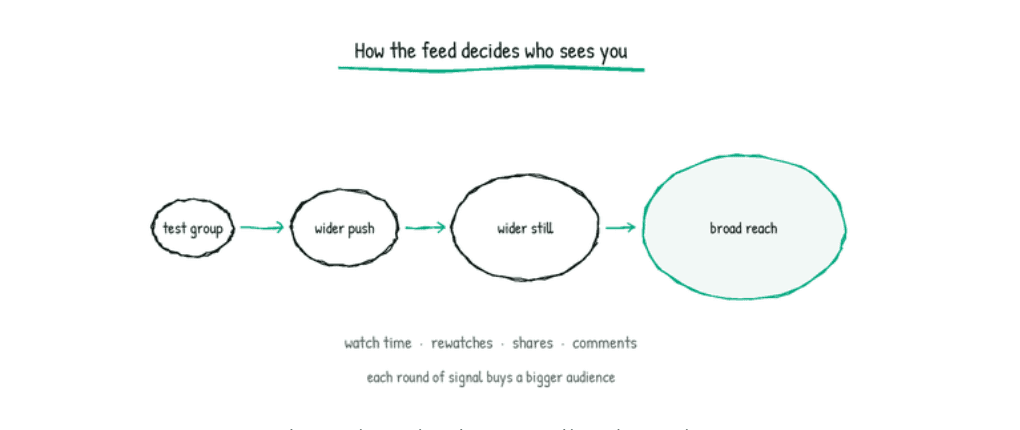
TikTok distributes by interest, not by follower graph. A new account with no followers can reach a large audience if the video performs, and an account with a big following can post to near silence if it does not. The system pushes a video to a small test group, reads watch time, rewatches, shares, and comments, then decides whether to widen the audience. Each round of positive signal buys a larger audience.
For a business, that has a practical consequence. You are not buying reach with budget alone, you are earning it with creative and then buying more of what already works. Brands that treat TikTok as a placement to run their existing video assets on get poor results, because those assets were built for a viewer who was already paying attention.
Why TikTok Traffic Behaves Differently From Search Traffic
Search traffic arrives with intent. Somebody typed a query, so the job of the page is to answer it. TikTok traffic arrives with no intent at all, so the job of the video is to create it. That is a different craft, and it is also becoming more valuable as search results get compressed by AI summaries. Motionlabs Agency has covered how this shifts priorities toward brand signals and original media, the kind of content an answer engine cannot summarise away. Video demand generation is one of the few channels that gets stronger as the classic blue link gets weaker.
The two channels also feed each other. TikTok builds recall and branded search. Search content catches that demand when it turns into a query. Running one without the other is why a lot of programmes stall.
You get customers on TikTok by producing enough native video to find a hook that holds attention, then putting paid budget behind the versions that already earn watch time. TikTok is not a place where you post a catalogue and wait. It is a discovery feed that shows your video to people who have never heard of you, judges it in the first second, and either keeps serving it or quietly stops. Everything else, ad account setup, targeting, landing pages, sits downstream of whether the creative earns the view.
We run this model daily for brands in ecommerce, SaaS, hospitality, and consumer apps. This guide covers how to get views, how to build and launch TikTok ads, how to scale spend without burning budget, and how to keep an organic presence feeding the paid account.
Key Takeaways
|
How Does TikTok Actually Find Customers for a Business?
TikTok distributes by interest, not by follower graph. A new account with no followers can reach a large audience if the video performs, and an account with a big following can post to near silence if it does not. The system pushes a video to a small test group, reads watch time, rewatches, shares, and comments, then decides whether to widen the audience. Each round of positive signal buys a larger audience.
For a business, that has a practical consequence. You are not buying reach with budget alone, you are earning it with creative and then buying more of what already works. Brands that treat TikTok as a placement to run their existing video assets on get poor results, because those assets were built for a viewer who was already paying attention.
Why TikTok Traffic Behaves Differently From Search Traffic
Search traffic arrives with intent. Somebody typed a query, so the job of the page is to answer it. TikTok traffic arrives with no intent at all, so the job of the video is to create it. That is a different craft, and it is also becoming more valuable as search results get compressed by AI summaries. Motionlabs Agency has covered how this shifts priorities toward brand signals and original media, the kind of content an answer engine cannot summarise away. Video demand generation is one of the few channels that gets stronger as the classic blue link gets weaker.
The two channels also feed each other. TikTok builds recall and branded search. Search content catches that demand when it turns into a query. Running one without the other is why a lot of programmes stall.

Views are a creative problem before they are a distribution problem. The same product, the same offer, and the same account can produce a video that reaches a few hundred people and one that reaches a few hundred thousand. The difference is almost always the opening.

Open on the payoff, not the setup. Show the result, the problem, or the strangest frame in the video first. Introductions are where retention dies.
Give the viewer a reason to stay in the first second. A question, a claim, a visual that does not resolve immediately. Anything that makes stopping feel like a choice rather than an accident.
Shoot vertical and native. Repurposed landscape ads with letterboxing read as an ad instantly, and the audience scrolls past ads.
Use on screen text as a second hook. Many viewers watch muted at first. The caption on frame one has to carry the promise on its own.
Keep the edit moving. Cut on the beat of the sentence, not on the beat of the footage. Dead air is the most common retention killer we fix.
Post consistently enough to read a pattern. A single video is noise. A batch of ten tells you which hook style your audience responds to.
Reply to comments with video. Comment replies are the cheapest content format on the platform and they inherit the interest of the original post.
What Makes TikTok Push a Video Further?
Signal | What It Tells the System | How to Influence It |
|---|---|---|
Hook retention | Whether the opening earned the view | Rewrite the first line, cut the intro, start mid action |
Watch through rate | Whether the video delivered on its promise | Shorten the video to the length the story actually needs |
Rewatches | The video rewarded a second look | Layer detail, fast text, or a twist ending |
Shares and saves | The content has social or practical value | Make it useful, funny, or worth sending to one specific person |
Comments | The video provoked a response | Leave a question open, take a position, invite disagreement |
Follows from video | The viewer wants more of this | Build a repeatable format instead of one off posts |
How Do You Make Ads on TikTok?
The mechanics of launching are simple. The hard part is having enough creative ready before you launch. Here is the sequence we use when setting up a new account.
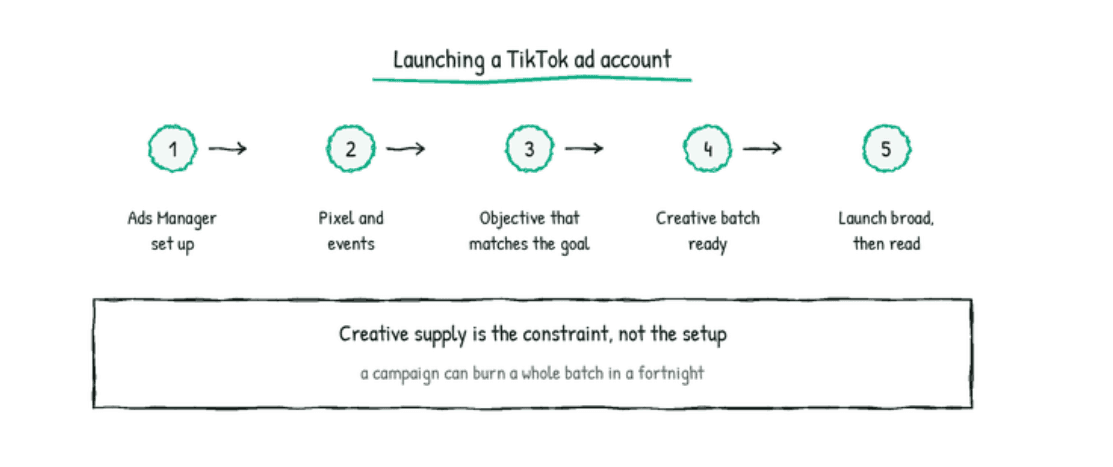
Set up TikTok Ads Manager and the business account. Create the ad account, add billing, and connect the organic profile so you can run Spark Ads from real posts.
Install the pixel or server side events. Track the actions you care about, not just page views. Without purchase or lead events the optimisation has nothing to learn from.
Choose an objective that matches the actual goal. Traffic objectives buy clicks. Conversion objectives buy buyers. Picking the easier objective to make the dashboard look good is a common self inflicted wound.
Keep targeting broad at the start. TikTok's delivery system finds the audience from creative signals. Stacking narrow interest layers on a new account starves it of learning data.
Launch with multiple creative concepts, not multiple audiences. Test hooks, formats, and creator archetypes. That is where the variance lives.
Use Spark Ads for anything that performed organically. Running the real post keeps the social proof, the comments, and the native look.
Let campaigns exit the learning phase before judging them. Turning ad sets off after a day tells you nothing except that you are impatient.
Refresh creative on a schedule. Fatigue arrives faster on TikTok than on most channels. Plan the next batch before the current one drops off.
Views are a creative problem before they are a distribution problem. The same product, the same offer, and the same account can produce a video that reaches a few hundred people and one that reaches a few hundred thousand. The difference is almost always the opening.
Open on the payoff, not the setup. Show the result, the problem, or the strangest frame in the video first. Introductions are where retention dies.
Give the viewer a reason to stay in the first second. A question, a claim, a visual that does not resolve immediately. Anything that makes stopping feel like a choice rather than an accident.
Shoot vertical and native. Repurposed landscape ads with letterboxing read as an ad instantly, and the audience scrolls past ads.
Use on screen text as a second hook. Many viewers watch muted at first. The caption on frame one has to carry the promise on its own.
Keep the edit moving. Cut on the beat of the sentence, not on the beat of the footage. Dead air is the most common retention killer we fix.
Post consistently enough to read a pattern. A single video is noise. A batch of ten tells you which hook style your audience responds to.
Reply to comments with video. Comment replies are the cheapest content format on the platform and they inherit the interest of the original post.
What Makes TikTok Push a Video Further?
Signal | What It Tells the System | How to Influence It |
|---|---|---|
Hook retention | Whether the opening earned the view | Rewrite the first line, cut the intro, start mid action |
Watch through rate | Whether the video delivered on its promise | Shorten the video to the length the story actually needs |
Rewatches | The video rewarded a second look | Layer detail, fast text, or a twist ending |
Shares and saves | The content has social or practical value | Make it useful, funny, or worth sending to one specific person |
Comments | The video provoked a response | Leave a question open, take a position, invite disagreement |
Follows from video | The viewer wants more of this | Build a repeatable format instead of one off posts |
How Do You Make Ads on TikTok?
The mechanics of launching are simple. The hard part is having enough creative ready before you launch. Here is the sequence we use when setting up a new account.
Set up TikTok Ads Manager and the business account. Create the ad account, add billing, and connect the organic profile so you can run Spark Ads from real posts.
Install the pixel or server side events. Track the actions you care about, not just page views. Without purchase or lead events the optimisation has nothing to learn from.
Choose an objective that matches the actual goal. Traffic objectives buy clicks. Conversion objectives buy buyers. Picking the easier objective to make the dashboard look good is a common self inflicted wound.
Keep targeting broad at the start. TikTok's delivery system finds the audience from creative signals. Stacking narrow interest layers on a new account starves it of learning data.
Launch with multiple creative concepts, not multiple audiences. Test hooks, formats, and creator archetypes. That is where the variance lives.
Use Spark Ads for anything that performed organically. Running the real post keeps the social proof, the comments, and the native look.
Let campaigns exit the learning phase before judging them. Turning ad sets off after a day tells you nothing except that you are impatient.
Refresh creative on a schedule. Fatigue arrives faster on TikTok than on most channels. Plan the next batch before the current one drops off.

Which TikTok Ad Formats Should You Use?
Format | What It Is | Best Used For |
|---|---|---|
In feed video ad | A standard video in the For You feed | Cold reach, prospecting, and hook testing at volume |
Spark Ad | Paid amplification of a real organic post | Keeping social proof and native credibility on a winner |
Creator or UGC ad | Creator produced video licensed for paid use | Overcoming objections and building trust mid funnel |
Product and shopping ads | Catalogue driven placements | Ecommerce conversion and retargeting warm audiences |
Carousel and image ads | Static or multi image placements | Offer led retargeting and simple promotional messages |
Branded effect or hashtag | Participation led brand formats | Large budget brand campaigns, rarely the first move |
How Much Creative Does a TikTok Campaign Need?
More than most brands plan for. A paid campaign can exhaust a creative batch in a fortnight because fatigue sets in quickly on a feed that serves the same user dozens of videos a day. One or two in house editors cannot feed that pace, which is why most scaled TikTok programmes run on a creator roster or an agency pipeline. Ninjapromo makes a related point about distribution needing to be designed into the asset rather than bolted on afterwards, and that holds here. The video has to be built for the feed it will live in.
A workable production floor is a fresh batch of concepts every fortnight, with each concept shot in several variations. You are not looking for one perfect video. You are looking for enough shots on goal to find the one the audience picks.
How Do You Grow Fast With TikTok Ads Without Wasting Budget?
Speed comes from removing the guesswork, not from raising the daily spend. The accounts that scale cleanly tend to follow the same pattern.

Let creative do the targeting. Broad audiences with strong creative beat narrow audiences with weak creative almost every time.
Scale the winner, do not rebuild it. Raise budget on what already converts rather than duplicating it into new ad sets and resetting the learning.
Raise spend in steps. Large jumps push campaigns back into learning and undo the stability you just paid for.
Retarget with a different message. Someone who watched most of your video does not need the same hook again. They need the objection answered.
Match the landing page to the video. If the creative sells a specific promise, the page has to open on that promise. Most wasted TikTok budget dies between the click and the fold.
Set a creative refresh trigger. When cost per result drifts and frequency climbs, the fix is new creative, not new bidding.
Keep a control asset running. Without a benchmark you cannot tell whether the new batch is genuinely better or whether the week was just good.
How Do You Turn TikTok Views Into Paying Customers?
A large view count with no revenue attached usually means the content was built to entertain and nothing was built to catch the interest it created. The fix is a path, not a louder call to action.

Funnel Stage | What the Video Is For | What Good Looks Like |
|---|---|---|
Awareness | Stopping the scroll and introducing the problem | Opening seconds hold attention above your account baseline |
Consideration | Showing the product doing the thing | People rewatch, save, and visit the profile or the link |
Conversion | Answering the last objection and making the offer | Cost per acquisition improves against the control asset |
Retention | Giving existing buyers a reason to keep watching | Repeat engagement and rising branded search volume |
Branded search volume is the underrated indicator. When TikTok content is working, more people type your brand name into a search bar. That lift shows up weeks later and rarely gets attributed to the video that caused it.
How Do You Grow Your Business on TikTok Organically?
Organic is the cheapest testing ground you will ever have. It is also where the brand gets built, because the audience decides who you are from the videos you post repeatedly, not from the one you paid to boost.

Pick a content thesis. Decide what your brand is consistently interesting about. Not what it sells, what it knows. Posting a bit of everything builds no recognition at all.
Build formats, not posts. A repeatable format gives the audience a reason to follow and gives your team a production template.
Put a face on the account. Audiences trust a person more than a logo. A founder, an employee, or a recurring creator gives the brand a body.
Mine the comments. They are free research on objections, confusion, and the exact language your buyers use. That language belongs in the next ad.
Repurpose across surfaces. One shoot should produce a dozen assets for TikTok, Reels, and Shorts. Most brands extract two and move on.
Promote what already performed. Organic is the lottery ticket. Paid is how you cash it in.
Should You Build the Skill In House or Outsource It?
Both work, and most brands that get this right run a hybrid. In house owns the brand system and the product truth. Creators or an agency own the volume, because throughput is where internal teams break first. If you want to build the strategy layer internally, Copyblogger maintains a useful roundup of content marketing training, and the strategy layer is usually the gap rather than the production layer.
Common TikTok Mistakes That Cost Customers

Over producing. Assets that look like commercials get scrolled past. Rough and specific beats slick and generic on this platform.
Reposting landscape ads. Wrong aspect ratio, wrong pacing, wrong grammar. The audience clocks it in half a second.
Judging a concept on one post. A single video is noise. Read performance across a batch before killing an idea.
Chasing trends with no link to the product. A trending sound gets you views from people who will never buy. That is a hobby, not a channel.
Running everything through brand approval. Necessary for claims, fatal for pacing. Pre approve the guardrails so individual videos do not need sign off.
Underfunding creative and overfunding media. It shows up as a rising cost per acquisition on a campaign where nothing except the creative has gone stale.
Ignoring the landing page. The best hook in the world cannot survive a page that loads slowly and says something else.
Frequently Asked Questions
How long does it take to get customers from TikTok?
Paid campaigns can show a cost per acquisition difference within a fortnight because you are testing against a control. Organic audience building is slower and usually needs a consistent quarter of output before the pattern is readable.
Do you need followers before running TikTok ads?
No. Ads are served to an interest based audience, not to your follower list. A populated profile does help conversion though, because people who like an ad often check the account before they buy.
How many videos should a brand post per week on TikTok?
Set a production floor you can protect rather than a number you can hit once. Consistency is what trains the system and what gives you enough data to identify a pattern, so a steady weekly cadence beats an occasional burst.
Are TikTok ads worth it for small businesses?
They can be, provided you can produce creative continuously. If the business can only generate one video a month, the budget is better spent elsewhere, because the channel rewards iteration more than spend.
What is the difference between a Spark Ad and a normal in feed ad?
A Spark Ad runs an existing organic post as an ad, keeping its likes, comments, and social proof. A normal in feed ad runs an uploaded asset with no history attached. For anything that already performed organically, Spark is usually the better buy.
Can AI generated video work for TikTok ads?
It works well for volume testing, localisation, and variant production where a human shoot would be uneconomical. Original concepts, authentic testimonials, and category credibility still come from people, so treat it as a multiplier rather than a replacement.
Who should own TikTok internally?
Whoever owns paid performance, not whoever owns brand. TikTok lives or dies on iteration speed, and performance teams are structurally set up to test, read data, and change the brief quickly.
Which TikTok Ad Formats Should You Use?
Format | What It Is | Best Used For |
|---|---|---|
In feed video ad | A standard video in the For You feed | Cold reach, prospecting, and hook testing at volume |
Spark Ad | Paid amplification of a real organic post | Keeping social proof and native credibility on a winner |
Creator or UGC ad | Creator produced video licensed for paid use | Overcoming objections and building trust mid funnel |
Product and shopping ads | Catalogue driven placements | Ecommerce conversion and retargeting warm audiences |
Carousel and image ads | Static or multi image placements | Offer led retargeting and simple promotional messages |
Branded effect or hashtag | Participation led brand formats | Large budget brand campaigns, rarely the first move |
How Much Creative Does a TikTok Campaign Need?
More than most brands plan for. A paid campaign can exhaust a creative batch in a fortnight because fatigue sets in quickly on a feed that serves the same user dozens of videos a day. One or two in house editors cannot feed that pace, which is why most scaled TikTok programmes run on a creator roster or an agency pipeline. Ninjapromo makes a related point about distribution needing to be designed into the asset rather than bolted on afterwards, and that holds here. The video has to be built for the feed it will live in.
A workable production floor is a fresh batch of concepts every fortnight, with each concept shot in several variations. You are not looking for one perfect video. You are looking for enough shots on goal to find the one the audience picks.
How Do You Grow Fast With TikTok Ads Without Wasting Budget?
Speed comes from removing the guesswork, not from raising the daily spend. The accounts that scale cleanly tend to follow the same pattern.
Let creative do the targeting. Broad audiences with strong creative beat narrow audiences with weak creative almost every time.
Scale the winner, do not rebuild it. Raise budget on what already converts rather than duplicating it into new ad sets and resetting the learning.
Raise spend in steps. Large jumps push campaigns back into learning and undo the stability you just paid for.
Retarget with a different message. Someone who watched most of your video does not need the same hook again. They need the objection answered.
Match the landing page to the video. If the creative sells a specific promise, the page has to open on that promise. Most wasted TikTok budget dies between the click and the fold.
Set a creative refresh trigger. When cost per result drifts and frequency climbs, the fix is new creative, not new bidding.
Keep a control asset running. Without a benchmark you cannot tell whether the new batch is genuinely better or whether the week was just good.
How Do You Turn TikTok Views Into Paying Customers?
A large view count with no revenue attached usually means the content was built to entertain and nothing was built to catch the interest it created. The fix is a path, not a louder call to action.
Funnel Stage | What the Video Is For | What Good Looks Like |
|---|---|---|
Awareness | Stopping the scroll and introducing the problem | Opening seconds hold attention above your account baseline |
Consideration | Showing the product doing the thing | People rewatch, save, and visit the profile or the link |
Conversion | Answering the last objection and making the offer | Cost per acquisition improves against the control asset |
Retention | Giving existing buyers a reason to keep watching | Repeat engagement and rising branded search volume |
Branded search volume is the underrated indicator. When TikTok content is working, more people type your brand name into a search bar. That lift shows up weeks later and rarely gets attributed to the video that caused it.
How Do You Grow Your Business on TikTok Organically?
Organic is the cheapest testing ground you will ever have. It is also where the brand gets built, because the audience decides who you are from the videos you post repeatedly, not from the one you paid to boost.
Pick a content thesis. Decide what your brand is consistently interesting about. Not what it sells, what it knows. Posting a bit of everything builds no recognition at all.
Build formats, not posts. A repeatable format gives the audience a reason to follow and gives your team a production template.
Put a face on the account. Audiences trust a person more than a logo. A founder, an employee, or a recurring creator gives the brand a body.
Mine the comments. They are free research on objections, confusion, and the exact language your buyers use. That language belongs in the next ad.
Repurpose across surfaces. One shoot should produce a dozen assets for TikTok, Reels, and Shorts. Most brands extract two and move on.
Promote what already performed. Organic is the lottery ticket. Paid is how you cash it in.
Should You Build the Skill In House or Outsource It?
Both work, and most brands that get this right run a hybrid. In house owns the brand system and the product truth. Creators or an agency own the volume, because throughput is where internal teams break first. If you want to build the strategy layer internally, Copyblogger maintains a useful roundup of content marketing training, and the strategy layer is usually the gap rather than the production layer.
Common TikTok Mistakes That Cost Customers
Over producing. Assets that look like commercials get scrolled past. Rough and specific beats slick and generic on this platform.
Reposting landscape ads. Wrong aspect ratio, wrong pacing, wrong grammar. The audience clocks it in half a second.
Judging a concept on one post. A single video is noise. Read performance across a batch before killing an idea.
Chasing trends with no link to the product. A trending sound gets you views from people who will never buy. That is a hobby, not a channel.
Running everything through brand approval. Necessary for claims, fatal for pacing. Pre approve the guardrails so individual videos do not need sign off.
Underfunding creative and overfunding media. It shows up as a rising cost per acquisition on a campaign where nothing except the creative has gone stale.
Ignoring the landing page. The best hook in the world cannot survive a page that loads slowly and says something else.
Frequently Asked Questions
How long does it take to get customers from TikTok?
Paid campaigns can show a cost per acquisition difference within a fortnight because you are testing against a control. Organic audience building is slower and usually needs a consistent quarter of output before the pattern is readable.
Do you need followers before running TikTok ads?
No. Ads are served to an interest based audience, not to your follower list. A populated profile does help conversion though, because people who like an ad often check the account before they buy.
How many videos should a brand post per week on TikTok?
Set a production floor you can protect rather than a number you can hit once. Consistency is what trains the system and what gives you enough data to identify a pattern, so a steady weekly cadence beats an occasional burst.
Are TikTok ads worth it for small businesses?
They can be, provided you can produce creative continuously. If the business can only generate one video a month, the budget is better spent elsewhere, because the channel rewards iteration more than spend.
What is the difference between a Spark Ad and a normal in feed ad?
A Spark Ad runs an existing organic post as an ad, keeping its likes, comments, and social proof. A normal in feed ad runs an uploaded asset with no history attached. For anything that already performed organically, Spark is usually the better buy.
Can AI generated video work for TikTok ads?
It works well for volume testing, localisation, and variant production where a human shoot would be uneconomical. Original concepts, authentic testimonials, and category credibility still come from people, so treat it as a multiplier rather than a replacement.
Who should own TikTok internally?
Whoever owns paid performance, not whoever owns brand. TikTok lives or dies on iteration speed, and performance teams are structurally set up to test, read data, and change the brief quickly.
the call your competitor wish you would'nt take


Related Posts





Related Posts
Related Posts
Motion labs
info@motionlabs.agency


+971 55317 1706
C-1802, ONTARIO TOWER, PLOT NO. 49-0, BUSINESS BAY, DUBAI, 00000
click to meet me :)
click to meet me :)
© All Rights Reserved | 2026


Motion labs
info@motionlabs.agency
+971 55317 1706
C-1802, ONTARIO TOWER, PLOT NO. 49-0, BUSINESS BAY, DUBAI, 00000
Private policy
Terms & Conditions
© All Rights Reserved | 2026
click to meet me :)