/
/
How to use Muse Spark 1.2: the Contributor tier, Artificial Analysis scores, and creating content with it
How to use Muse Spark 1.2: the Contributor tier, Artificial Analysis scores, and creating content with it
5 min
read
How to use Muse Spark 1.2: the Contributor tier, Artificial Analysis scores, and creating content with it
How to use Muse Spark 1.2: the Contributor tier, Artificial Analysis scores, and creating content with it
Ai
Content

Author

Scroll down
to read more!
Summerize with ChatGPT
Summerize with Gemini
Summerize with Claude
How to use Muse Spark 1.2: the Contributor tier, Artificial Analysis scores, and creating content with it
How to use Muse Spark 1.2: the Contributor tier, Artificial Analysis scores, and creating content with it
Muse Spark 1.2 explained. Setup, the cheaper Contributor tier at $0.10/M input, verified Artificial Analysis benchmarks, and how to create content with Meta's coding model
Muse Spark 1.2 explained. Setup, the cheaper Contributor tier at $0.10/M input, verified Artificial Analysis benchmarks, and how to create content with Meta's coding model
Meta released Muse Spark 1.2 on 5 August 2026 alongside Muse Code, its own coding agent. Artificial Analysis scored it 54 on the Intelligence Index, three points above Muse Spark 1.1 and eleven points above the 1.0 release from April. The more interesting number for anyone running a team on it is the Contributor tier, which lists at $0.10 per million input tokens against $1.25 on standard pricing.
This guide is for marketers, founders and developers who want to actually run the model rather than read about it. It covers what changed, what the benchmarks say, which pricing tier to pick, how to get access, and what content work the model is genuinely good at.
Key takeaways
Muse Spark 1.2 scores 54 on the Artificial Analysis Intelligence Index, tied with Grok 4.5 (high) and just behind GPT-5.5 (xhigh, 55).
Standard pricing is $1.25 per million input tokens and $4.25 per million output, with cache hits at $0.15 per million.
The Contributor tier lists on OpenRouter at $0.10 input and $0.20 output per million tokens for the same model.
The gains over 1.1 are concentrated in agentic work: GDPval-AA v2 rose 260 Elo points to 1631, ranking fifth of every model Artificial Analysis has benchmarked.
Context window stays at 1M tokens, unchanged from 1.1.
Hallucination rate dropped from 38% to 28%, mostly because the model now declines to answer more often.
Meta released Muse Spark 1.2 on 5 August 2026 alongside Muse Code, its own coding agent. Artificial Analysis scored it 54 on the Intelligence Index, three points above Muse Spark 1.1 and eleven points above the 1.0 release from April. The more interesting number for anyone running a team on it is the Contributor tier, which lists at $0.10 per million input tokens against $1.25 on standard pricing.
This guide is for marketers, founders and developers who want to actually run the model rather than read about it. It covers what changed, what the benchmarks say, which pricing tier to pick, how to get access, and what content work the model is genuinely good at.
Key takeaways
Muse Spark 1.2 scores 54 on the Artificial Analysis Intelligence Index, tied with Grok 4.5 (high) and just behind GPT-5.5 (xhigh, 55).
Standard pricing is $1.25 per million input tokens and $4.25 per million output, with cache hits at $0.15 per million.
The Contributor tier lists on OpenRouter at $0.10 input and $0.20 output per million tokens for the same model.
The gains over 1.1 are concentrated in agentic work: GDPval-AA v2 rose 260 Elo points to 1631, ranking fifth of every model Artificial Analysis has benchmarked.
Context window stays at 1M tokens, unchanged from 1.1.
Hallucination rate dropped from 38% to 28%, mostly because the model now declines to answer more often.

Muse Spark 1.2 is a multimodal reasoning model from Meta, tuned for coding and agentic tasks. It is the third release in the Muse Spark line in four months, following 1.0 in April and 1.1 in July. Meta describes it as optimised for the work coding agents get handed most often, meaning multi-file changes, debugging across a large repository, and long tool-calling chains that need to survive without a human stepping in.
If you are new to the family, our breakdown of the Muse Spark AI model covers the architecture and the original release, and the complete guide to features and benefits walks through what the tool does outside of pure coding.
Two things matter before you commit to it. First, this is a coding and agent model, not an image or video generator. Second, it ships with a 1M token context window, which is the single biggest practical difference between it and most models in its price bracket.
What changed from 1.1
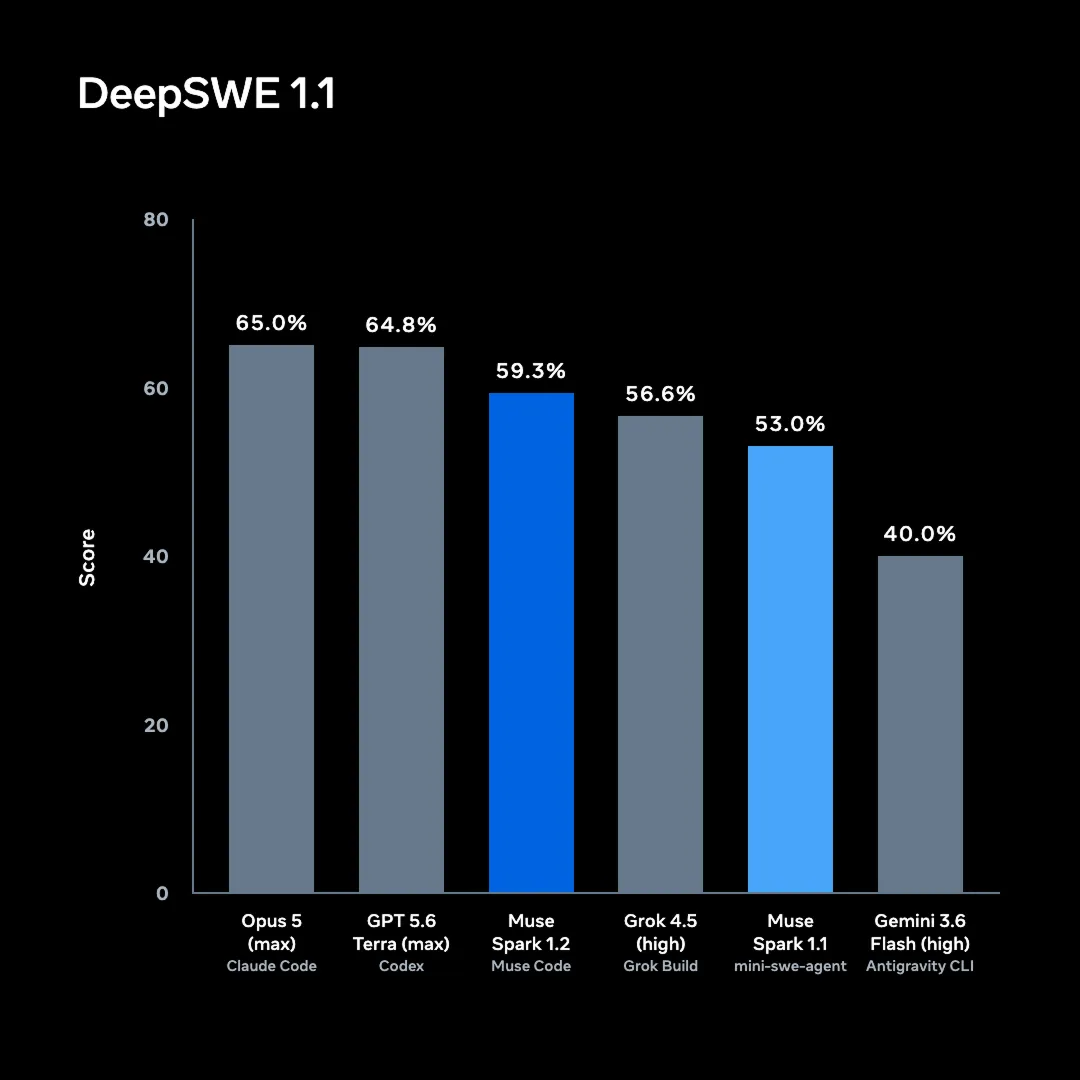
Meta co-trained the model and the Muse Code agent together, so the model behaves differently inside an agent loop than 1.1 did. The measurable changes, per Artificial Analysis testing on 5 August 2026:
Benchmark | Muse Spark 1.1 | Muse Spark 1.2 | Change |
|---|---|---|---|
Intelligence Index | 51 | 54 | +3 |
GDPval-AA v2 (Elo) | 1371 | 1631 | +260 |
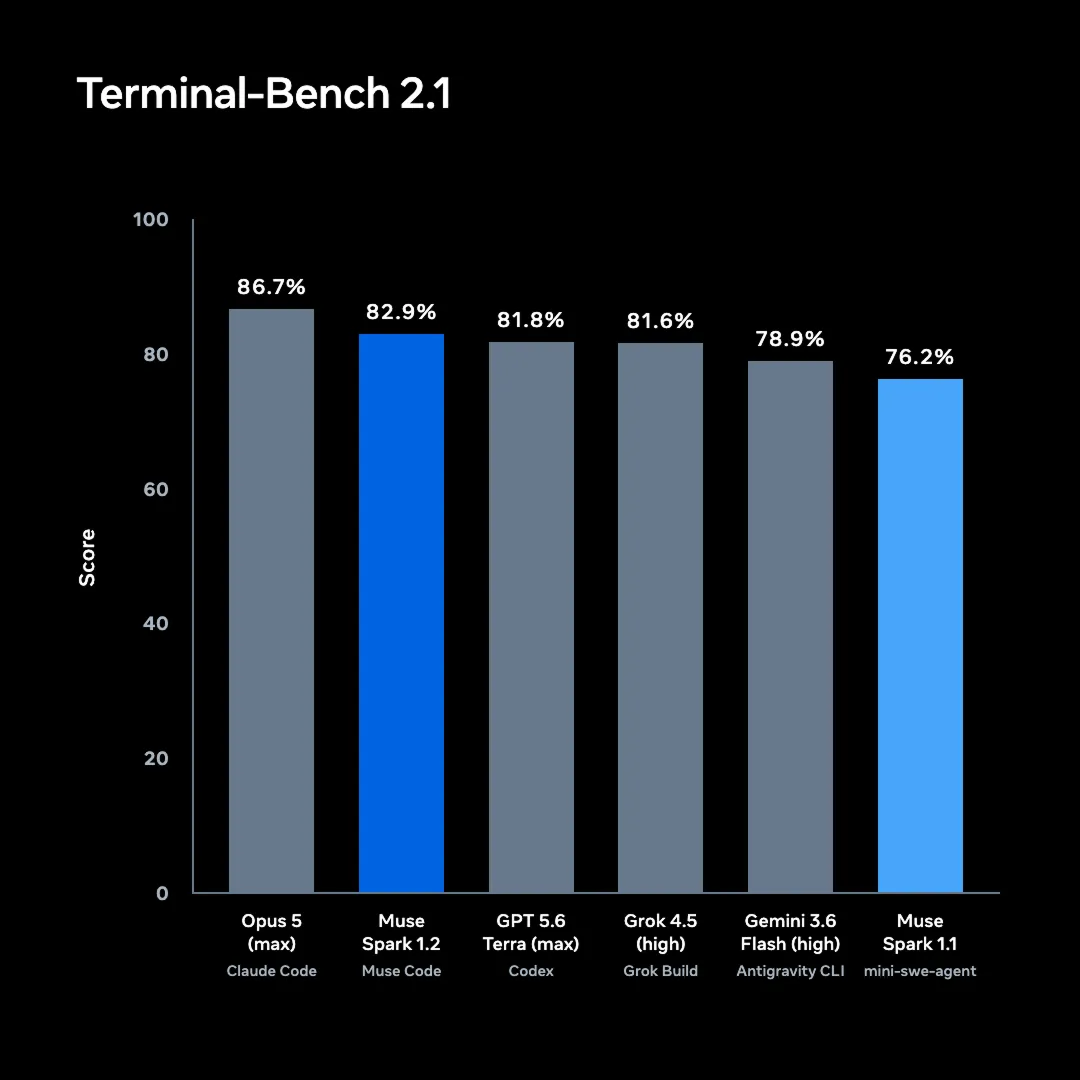
Terminal-Bench v2.1 | 78% | 80% | +2 |
τ³-Banking (tool use) | 25% | 27% | +2 |
SciCode | 58% | 56% | -2 |
Humanity's Last Exam | 45% | 44% | -1 |
CritPt (physics reasoning) | 15% | 18% | +3 |
The pattern is clear. Agentic work improved, scientific reasoning stayed flat or slipped slightly. If you are running short one-shot prompts, 1.2 will feel nearly identical to 1.1. If you are running a five-hour agent job across a repository, that 260 point Elo jump on GDPval-AA v2 is where you will feel it.
Note the cost side of the same coin. Artificial Analysis measured cost per Intelligence Index task rising from $0.29 on 1.1 to $0.40 on 1.2, with input tokens up around 53% and output tokens up around 36%. Per-token pricing did not change. The model simply thinks more.
Muse Spark 1.2 is a multimodal reasoning model from Meta, tuned for coding and agentic tasks. It is the third release in the Muse Spark line in four months, following 1.0 in April and 1.1 in July. Meta describes it as optimised for the work coding agents get handed most often, meaning multi-file changes, debugging across a large repository, and long tool-calling chains that need to survive without a human stepping in.
If you are new to the family, our breakdown of the Muse Spark AI model covers the architecture and the original release, and the complete guide to features and benefits walks through what the tool does outside of pure coding.
Two things matter before you commit to it. First, this is a coding and agent model, not an image or video generator. Second, it ships with a 1M token context window, which is the single biggest practical difference between it and most models in its price bracket.
What changed from 1.1
Meta co-trained the model and the Muse Code agent together, so the model behaves differently inside an agent loop than 1.1 did. The measurable changes, per Artificial Analysis testing on 5 August 2026:
Benchmark | Muse Spark 1.1 | Muse Spark 1.2 | Change |
|---|---|---|---|
Intelligence Index | 51 | 54 | +3 |
GDPval-AA v2 (Elo) | 1371 | 1631 | +260 |
Terminal-Bench v2.1 | 78% | 80% | +2 |
τ³-Banking (tool use) | 25% | 27% | +2 |
SciCode | 58% | 56% | -2 |
Humanity's Last Exam | 45% | 44% | -1 |
CritPt (physics reasoning) | 15% | 18% | +3 |
The pattern is clear. Agentic work improved, scientific reasoning stayed flat or slipped slightly. If you are running short one-shot prompts, 1.2 will feel nearly identical to 1.1. If you are running a five-hour agent job across a repository, that 260 point Elo jump on GDPval-AA v2 is where you will feel it.
Note the cost side of the same coin. Artificial Analysis measured cost per Intelligence Index task rising from $0.29 on 1.1 to $0.40 on 1.2, with input tokens up around 53% and output tokens up around 36%. Per-token pricing did not change. The model simply thinks more.
Artificial Analysis received pre-release access from Meta for benchmarking, and published on launch day. Their headline placement puts Muse Spark 1.2 (xhigh) at 54 on the Intelligence Index, which ties Meta with SpaceXAI for third place among US labs.
Against the current field:
Model | Intelligence Index | Cost per Index task |
|---|---|---|
Claude Opus 5 (max) | 61 | not listed in cluster |
Claude Fable 5 (max w/ fallback) | 60 | not listed in cluster |
GPT-5.6 Sol (max) | 59 | $0.39 at medium effort |
Kimi K3 (max) | 57 | $0.86 |
GPT-5.5 (xhigh) | 55 | $1.18 |
Muse Spark 1.2 (xhigh) | 54 | $0.40 |
Grok 4.5 (high) | 54 | $0.37 |
On GDPval-AA v2, which Artificial Analysis calls its leading general agentic metric, Muse Spark 1.2 ranks fifth at 1631 Elo, ahead of Claude Opus 4.8 (max, 1588) and behind Claude Opus 5 (max, 1852), GPT-5.6 Sol (max, 1730) and Kimi K3 (max, 1685).
One result deserves reading carefully. The AA-Omniscience score rose from 18 to 22, and the hallucination rate fell from 38% to 28%. That looks like a straight reliability win, but the attempt rate also dropped from 82% to 67% and raw accuracy slipped from 41% to 38%. The model is hallucinating less because it is answering less. For factual research work, that trade is worth knowing about before you build a workflow on it.
Source: Artificial Analysis, Muse Spark 1.2 benchmarks and analysis, 5 August 2026.
The Contributor tier explained
This is the part most coverage skips. Meta ships Muse Spark 1.2 in two pricing tiers.
Tier | Input (per 1M tokens) | Output (per 1M tokens) | Cache hits |
|---|---|---|---|
Standard | $1.25 | $4.25 | $0.15 |
Contributor | $0.10 | $0.20 | not published |
Contributor is the same model with the same capabilities at roughly a twelfth of the input cost and a twentieth of the output cost. Blackbox, which lists both tiers, describes it as pricing designed for builders. OpenRouter added the Contributor tier listing in August 2026.
The practical read: if you are prototyping, running internal tooling, or building something that has not shipped revenue yet, Contributor is the tier. Verify the current terms on Meta's developer docs before you build a cost model on it, because tier conditions on cheap developer pricing tend to move.
How to get access
Four routes, in order of how quickly you can be running:
Meta's first-party API. Available at launch through Meta's Model API. Sign up at dev.meta.ai, generate a key, and point your existing client at it.
Muse Code. Meta's own coding agent, built to run Muse Spark 1.2. It installs with a single command and authenticates in the browser at dev.meta.ai. It shipped in beta in August 2026, so expect rough edges on long-running jobs.
OpenRouter. Both Standard and Contributor tiers are listed. Useful if you are already routing across several models and want to A/B without changing your integration.
OpenCode and Blackbox. Third-party harnesses carrying the model, with OpenCode running promotional free access in August 2026. Availability varies by region, and EU users reported access errors during that window.
How to create content in Muse Spark 1.2
Set expectations first. Muse Spark 1.2 does not generate images or video. It is multimodal on the input side, which means it reads visuals and turns them into working code. Meta's own framing on X was turning visuals into working code and translating perception into physical action. That is a different content workflow than a generative model, and it is more useful than it sounds for a marketing team.
Four things it does well:
Screenshot to working page. Feed it a design screenshot or a Figma export and ask for the component. This is the strongest single use case for the multimodal input, and it is where the 1.2 gains in multi-file coding show up. For the 3D and visual pipeline side of this, see our explainer on GPT Blender MCP and AI 3D modelling.
Ad variant generation at scale. Point it at a creative brief and a landing page, and have it write the variant matrix as structured output rather than prose. The 1M context window means you can drop an entire campaign history, past creative, and performance export into a single call. Our step by step guide to using Muse Spark 1.1 for Facebook Ads still applies directly, since the prompting patterns did not change between versions.
Long-context campaign analysis. Drop twelve months of exports into context and ask for the pattern, not the summary. Ask for specific numbers back and check them, given the accuracy drop noted above.
Agentic build jobs. Landing pages, tracking implementation, scraper scripts, automation glue. This is where the GDPval-AA v2 jump actually pays off, and it is the reason to prefer 1.2 over 1.1 despite the higher token consumption.
A prompting note that matters for this model specifically. Because 1.2 abstains more, vague questions get vaguer answers than 1.1 gave. Be explicit about what you want it to do when it is uncertain, and give it the source material rather than expecting recall.
Where it sits against other models
Muse Spark 1.2 is not the frontier. Claude Opus 5 sits seven points above it on the Intelligence Index and 221 Elo above it on agentic knowledge work. What Muse Spark 1.2 is, at $0.40 per Index task on standard pricing and far less on Contributor, is close to the best value on the intelligence-versus-cost frontier.
For a fuller side by side, our comparison of GPT-5.6 Blender MCP, Flux 3, Muse Spark 1.1 and Seedance 3 covers how these tools split across a real creative pipeline rather than a benchmark table.
Meta has also signalled plans to release Muse Spark 1.2 weights openly, reported by CNBC in August 2026. If that lands, the cost calculation changes again for anyone able to self-host.
Frequently Asked Questions
Is Muse Spark 1.2 free?
Not officially from Meta. Standard API pricing is $1.25 per million input tokens and $4.25 per million output. The Contributor tier drops that to $0.10 and $0.20. Third-party harnesses including OpenCode ran free promotional access in August 2026, with regional restrictions.
What is the difference between Muse Spark 1.2 Standard and Contributor?
Same model, same capabilities, different price. Contributor lists at $0.10 per million input tokens against $1.25 on Standard. Blackbox describes the saving as up to 95% versus Standard pricing.
How big is the context window?
1M tokens, unchanged from Muse Spark 1.1.
Is Muse Spark 1.2 better than Claude Opus 5?
No, on published benchmarks. Claude Opus 5 (max) scores 61 on the Artificial Analysis Intelligence Index against 54 for Muse Spark 1.2 (xhigh), and 1852 Elo against 1631 on GDPval-AA v2. Muse Spark 1.2 competes on cost per task, not on raw capability.
Can Muse Spark 1.2 generate images or video?
No. It reads visual input and produces code and text. For image and video generation you need a separate model in the pipeline.
Should I upgrade from Muse Spark 1.1?
If you run agent loops or multi-file coding tasks, yes, the gains are real. If you run short single-turn prompts, 1.1 costs less per task ($0.29 against $0.40) for nearly the same output quality.
Getting started
Pick the tier before you pick the harness. Contributor for anything pre-revenue, Standard for production. Then start with one workflow, most likely screenshot to component or ad variant generation, and measure the token cost against what you were paying before. The 1M context window rewards feeding it everything at once, which is the opposite of how most teams prompt.
If you want this built into your stack rather than tested in a sandbox, Motion Labs runs AI production and performance pipelines end to end.
Artificial Analysis received pre-release access from Meta for benchmarking, and published on launch day. Their headline placement puts Muse Spark 1.2 (xhigh) at 54 on the Intelligence Index, which ties Meta with SpaceXAI for third place among US labs.
Against the current field:
Model | Intelligence Index | Cost per Index task |
|---|---|---|
Claude Opus 5 (max) | 61 | not listed in cluster |
Claude Fable 5 (max w/ fallback) | 60 | not listed in cluster |
GPT-5.6 Sol (max) | 59 | $0.39 at medium effort |
Kimi K3 (max) | 57 | $0.86 |
GPT-5.5 (xhigh) | 55 | $1.18 |
Muse Spark 1.2 (xhigh) | 54 | $0.40 |
Grok 4.5 (high) | 54 | $0.37 |
On GDPval-AA v2, which Artificial Analysis calls its leading general agentic metric, Muse Spark 1.2 ranks fifth at 1631 Elo, ahead of Claude Opus 4.8 (max, 1588) and behind Claude Opus 5 (max, 1852), GPT-5.6 Sol (max, 1730) and Kimi K3 (max, 1685).
One result deserves reading carefully. The AA-Omniscience score rose from 18 to 22, and the hallucination rate fell from 38% to 28%. That looks like a straight reliability win, but the attempt rate also dropped from 82% to 67% and raw accuracy slipped from 41% to 38%. The model is hallucinating less because it is answering less. For factual research work, that trade is worth knowing about before you build a workflow on it.
Source: Artificial Analysis, Muse Spark 1.2 benchmarks and analysis, 5 August 2026.
The Contributor tier explained
This is the part most coverage skips. Meta ships Muse Spark 1.2 in two pricing tiers.
Tier | Input (per 1M tokens) | Output (per 1M tokens) | Cache hits |
|---|---|---|---|
Standard | $1.25 | $4.25 | $0.15 |
Contributor | $0.10 | $0.20 | not published |
Contributor is the same model with the same capabilities at roughly a twelfth of the input cost and a twentieth of the output cost. Blackbox, which lists both tiers, describes it as pricing designed for builders. OpenRouter added the Contributor tier listing in August 2026.
The practical read: if you are prototyping, running internal tooling, or building something that has not shipped revenue yet, Contributor is the tier. Verify the current terms on Meta's developer docs before you build a cost model on it, because tier conditions on cheap developer pricing tend to move.
How to get access
Four routes, in order of how quickly you can be running:
Meta's first-party API. Available at launch through Meta's Model API. Sign up at dev.meta.ai, generate a key, and point your existing client at it.
Muse Code. Meta's own coding agent, built to run Muse Spark 1.2. It installs with a single command and authenticates in the browser at dev.meta.ai. It shipped in beta in August 2026, so expect rough edges on long-running jobs.
OpenRouter. Both Standard and Contributor tiers are listed. Useful if you are already routing across several models and want to A/B without changing your integration.
OpenCode and Blackbox. Third-party harnesses carrying the model, with OpenCode running promotional free access in August 2026. Availability varies by region, and EU users reported access errors during that window.
How to create content in Muse Spark 1.2
Set expectations first. Muse Spark 1.2 does not generate images or video. It is multimodal on the input side, which means it reads visuals and turns them into working code. Meta's own framing on X was turning visuals into working code and translating perception into physical action. That is a different content workflow than a generative model, and it is more useful than it sounds for a marketing team.
Four things it does well:
Screenshot to working page. Feed it a design screenshot or a Figma export and ask for the component. This is the strongest single use case for the multimodal input, and it is where the 1.2 gains in multi-file coding show up. For the 3D and visual pipeline side of this, see our explainer on GPT Blender MCP and AI 3D modelling.
Ad variant generation at scale. Point it at a creative brief and a landing page, and have it write the variant matrix as structured output rather than prose. The 1M context window means you can drop an entire campaign history, past creative, and performance export into a single call. Our step by step guide to using Muse Spark 1.1 for Facebook Ads still applies directly, since the prompting patterns did not change between versions.
Long-context campaign analysis. Drop twelve months of exports into context and ask for the pattern, not the summary. Ask for specific numbers back and check them, given the accuracy drop noted above.
Agentic build jobs. Landing pages, tracking implementation, scraper scripts, automation glue. This is where the GDPval-AA v2 jump actually pays off, and it is the reason to prefer 1.2 over 1.1 despite the higher token consumption.
A prompting note that matters for this model specifically. Because 1.2 abstains more, vague questions get vaguer answers than 1.1 gave. Be explicit about what you want it to do when it is uncertain, and give it the source material rather than expecting recall.
Where it sits against other models
Muse Spark 1.2 is not the frontier. Claude Opus 5 sits seven points above it on the Intelligence Index and 221 Elo above it on agentic knowledge work. What Muse Spark 1.2 is, at $0.40 per Index task on standard pricing and far less on Contributor, is close to the best value on the intelligence-versus-cost frontier.
For a fuller side by side, our comparison of GPT-5.6 Blender MCP, Flux 3, Muse Spark 1.1 and Seedance 3 covers how these tools split across a real creative pipeline rather than a benchmark table.
Meta has also signalled plans to release Muse Spark 1.2 weights openly, reported by CNBC in August 2026. If that lands, the cost calculation changes again for anyone able to self-host.
Frequently Asked Questions
Is Muse Spark 1.2 free?
Not officially from Meta. Standard API pricing is $1.25 per million input tokens and $4.25 per million output. The Contributor tier drops that to $0.10 and $0.20. Third-party harnesses including OpenCode ran free promotional access in August 2026, with regional restrictions.
What is the difference between Muse Spark 1.2 Standard and Contributor?
Same model, same capabilities, different price. Contributor lists at $0.10 per million input tokens against $1.25 on Standard. Blackbox describes the saving as up to 95% versus Standard pricing.
How big is the context window?
1M tokens, unchanged from Muse Spark 1.1.
Is Muse Spark 1.2 better than Claude Opus 5?
No, on published benchmarks. Claude Opus 5 (max) scores 61 on the Artificial Analysis Intelligence Index against 54 for Muse Spark 1.2 (xhigh), and 1852 Elo against 1631 on GDPval-AA v2. Muse Spark 1.2 competes on cost per task, not on raw capability.
Can Muse Spark 1.2 generate images or video?
No. It reads visual input and produces code and text. For image and video generation you need a separate model in the pipeline.
Should I upgrade from Muse Spark 1.1?
If you run agent loops or multi-file coding tasks, yes, the gains are real. If you run short single-turn prompts, 1.1 costs less per task ($0.29 against $0.40) for nearly the same output quality.
Getting started
Pick the tier before you pick the harness. Contributor for anything pre-revenue, Standard for production. Then start with one workflow, most likely screenshot to component or ad variant generation, and measure the token cost against what you were paying before. The 1M context window rewards feeding it everything at once, which is the opposite of how most teams prompt.
If you want this built into your stack rather than tested in a sandbox, Motion Labs runs AI production and performance pipelines end to end.
the call your competitor wish you would'nt take


Related Posts





Related Posts
Related Posts
Motion labs
info@motionlabs.agency


+971 55317 1706
C-1802, ONTARIO TOWER, PLOT NO. 49-0, BUSINESS BAY, DUBAI, 00000
click to meet me :)
click to meet me :)
© All Rights Reserved | 2026


Motion labs
info@motionlabs.agency
+971 55317 1706
C-1802, ONTARIO TOWER, PLOT NO. 49-0, BUSINESS BAY, DUBAI, 00000
Private policy
Terms & Conditions
© All Rights Reserved | 2026
click to meet me :)