/
/
Micro-Influencer vs. Macro-Influencer: What Works Best
Micro-Influencer vs. Macro-Influencer: What Works Best
5 min
read
Micro-Influencer vs. Macro-Influencer: What Works Best
Micro-Influencer vs. Macro-Influencer: What Works Best

Author
Scroll down
to read more!
Summerize with ChatGPT
Summerize with Gemini
Summerize with Claude
Micro-Influencer vs. Macro-Influencer: What Works Best
Micro-Influencer vs. Macro-Influencer: What Works Best
You've got $5,000 to spend on influencer marketing this month. Do you hand it all to one person with 500K followers? Or do you spread it across 20 creators with 20K followers each? What should you ideally do?
You've got $5,000 to spend on influencer marketing this month. Do you hand it all to one person with 500K followers? Or do you spread it across 20 creators with 20K followers each? What should you ideally do?
What's the Difference Between Micro and Macro Influencers?
Micro-influencers typically have between 10,000 and 100,000 followers. They're niche creators: the fitness coach in your city, the skincare educator with a hyper-loyal audience, the founder who built a following sharing their startup journey.
Macro-influencers sit in the 100K to 1M+ range. These are recognizable faces: YouTubers, TikTok celebrities, and lifestyle personalities who have built mass audiences across platforms.
Both have a place in marketing. But they serve very different purposes, and for startups operating on tight budgets, understanding that distinction can be the difference between burning cash and actually growing.
Micro vs. Macro Influencer: Side-by-Side Data Comparison
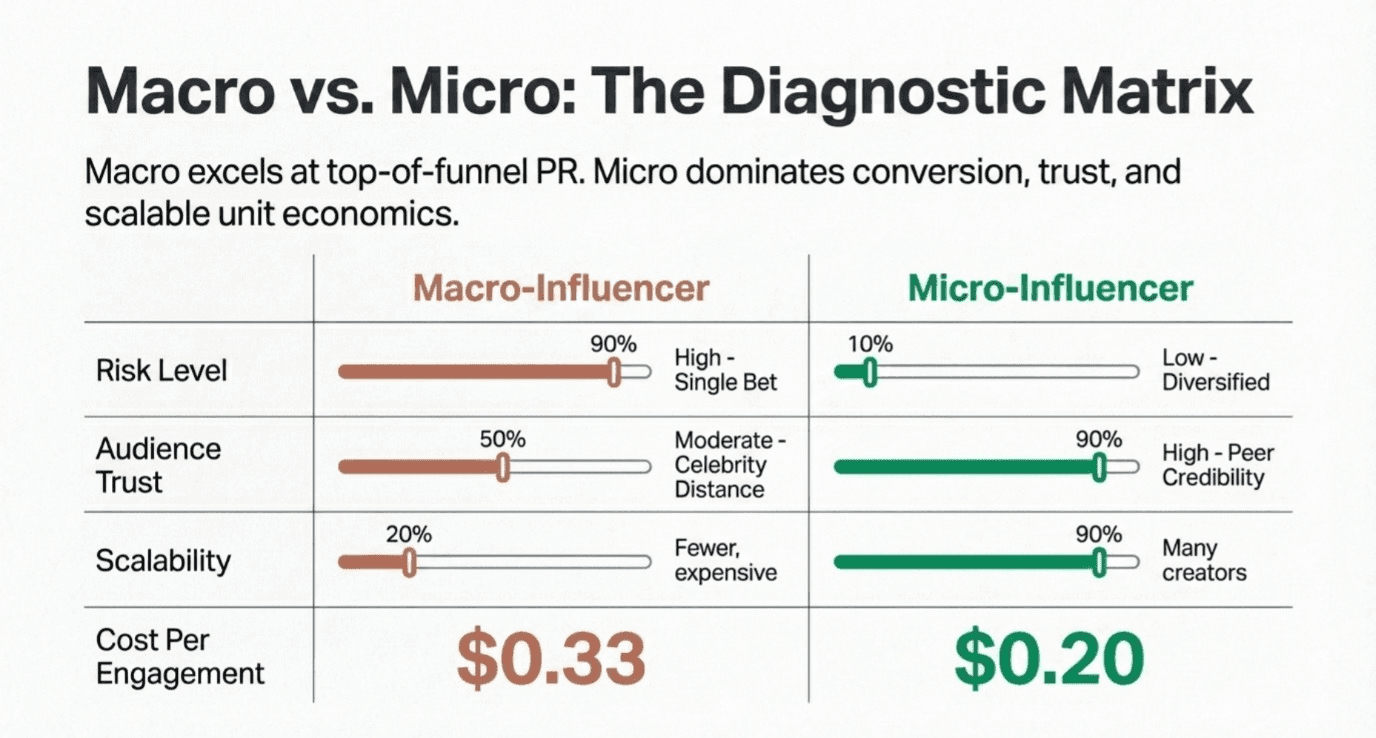
Here's how the two stack up across the metrics that matter most for startup growth:
| Micro-Influencer (10K–100K) | Macro-Influencer (100K–1M+) |
Followers | 10K–100K | 100K–1M+ |
Avg. Engagement Rate | 3%–7% (Reels up to 6.9%) | 1%–3% |
Cost Per Post (Instagram) | $100–$2,000 | $5,000–$50,000 |
Cost Per Engagement | ~$0.20 | ~$0.33 |
Avg. ROI | 5x–13x | 3x–5x |
LTV:CAC Ratio | ~11.74 | ~2.98 |
Best For | Conversions, niche targeting | Brand awareness, product launches |
Audience Trust | High (peer-like credibility) | Moderate (celebrity distance) |
Content Authenticity | Very high | Varies |
Scalability | High (many creators) | Low (fewer, expensive) |
Risk Level | Low (spread across creators) | High (single-bet spend) |
The ROI Problem With Macro Influencers And Why Startups Keep Getting Burned
Macro influencers look great on paper. Huge reach. Verified accounts. Press-worthy partnerships. But the actual numbers are hard to justify when you're running lean.
The cost gap is enormous. A macro-influencer charges $5,000 to $50,000 per Instagram post. A micro-influencer? $100 to $2,000. For the same budget, you can run campaigns with 10–50 micro-creators instead of going all-in on one macro post.
Engagement drops off sharply at scale. Macro influencers average 1–3% engagement. Micro-influencers regularly hit 3–7%, with Instagram Reels pushing that to nearly 7%. When you're paying 30x more per post and getting half the engagement, the math falls apart fast.
ROI reflects this. Analysis of DTC brand campaigns shows macro influencers deliver roughly 3–5x ROI. Micro-influencers consistently return 5–13x, with top campaigns hitting even higher.
Also read: What is best for a B2B startup X vs. LinkedIn?
📊 Real Case Study: Blueland ran a micro-influencer campaign using 211 Instagram creators. The result: a 4.7x jump in monthly Amazon sales and a 13:1 ROI. Total impressions hit ~247K with a 4.6% engagement rate. For the cost of a single macro influencer, they got 211 pieces of authentic content and 211 mini brand ambassadors. That's hard to beat. |
The LTV:CAC ratio tells the full story. Customers acquired through micro-influencers show an LTV:CAC ratio of 11.74 compared to just 2.98 for macro-influencer-acquired customers. They spend more, stay longer, and refer more. That's not a marginal difference; it's a completely different growth profile.
When Macro Influencers Actually Make Sense
This isn't a takedown of macro influencers. There are real scenarios where they're the right call. You just need to be honest about what they're good for and what they're not.
Macro-influencers work best when you need
• Fast, wide brand awareness for a mass-market product
• A product launch that needs cultural momentum quickly
• PR-driven exposure (press mentions, trending, social proof at scale)
• Top-of-funnel reach where conversion isn't the immediate goal
What's the Difference Between Micro and Macro Influencers?
Micro-influencers typically have between 10,000 and 100,000 followers. They're niche creators: the fitness coach in your city, the skincare educator with a hyper-loyal audience, the founder who built a following sharing their startup journey.
Macro-influencers sit in the 100K to 1M+ range. These are recognizable faces: YouTubers, TikTok celebrities, and lifestyle personalities who have built mass audiences across platforms.
Both have a place in marketing. But they serve very different purposes, and for startups operating on tight budgets, understanding that distinction can be the difference between burning cash and actually growing.
Micro vs. Macro Influencer: Side-by-Side Data Comparison
Here's how the two stack up across the metrics that matter most for startup growth:
| Micro-Influencer (10K–100K) | Macro-Influencer (100K–1M+) |
Followers | 10K–100K | 100K–1M+ |
Avg. Engagement Rate | 3%–7% (Reels up to 6.9%) | 1%–3% |
Cost Per Post (Instagram) | $100–$2,000 | $5,000–$50,000 |
Cost Per Engagement | ~$0.20 | ~$0.33 |
Avg. ROI | 5x–13x | 3x–5x |
LTV:CAC Ratio | ~11.74 | ~2.98 |
Best For | Conversions, niche targeting | Brand awareness, product launches |
Audience Trust | High (peer-like credibility) | Moderate (celebrity distance) |
Content Authenticity | Very high | Varies |
Scalability | High (many creators) | Low (fewer, expensive) |
Risk Level | Low (spread across creators) | High (single-bet spend) |
The ROI Problem With Macro Influencers And Why Startups Keep Getting Burned
Macro influencers look great on paper. Huge reach. Verified accounts. Press-worthy partnerships. But the actual numbers are hard to justify when you're running lean.
The cost gap is enormous. A macro-influencer charges $5,000 to $50,000 per Instagram post. A micro-influencer? $100 to $2,000. For the same budget, you can run campaigns with 10–50 micro-creators instead of going all-in on one macro post.
Engagement drops off sharply at scale. Macro influencers average 1–3% engagement. Micro-influencers regularly hit 3–7%, with Instagram Reels pushing that to nearly 7%. When you're paying 30x more per post and getting half the engagement, the math falls apart fast.
ROI reflects this. Analysis of DTC brand campaigns shows macro influencers deliver roughly 3–5x ROI. Micro-influencers consistently return 5–13x, with top campaigns hitting even higher.
Also read: What is best for a B2B startup X vs. LinkedIn?
📊 Real Case Study: Blueland ran a micro-influencer campaign using 211 Instagram creators. The result: a 4.7x jump in monthly Amazon sales and a 13:1 ROI. Total impressions hit ~247K with a 4.6% engagement rate. For the cost of a single macro influencer, they got 211 pieces of authentic content and 211 mini brand ambassadors. That's hard to beat. |
The LTV:CAC ratio tells the full story. Customers acquired through micro-influencers show an LTV:CAC ratio of 11.74 compared to just 2.98 for macro-influencer-acquired customers. They spend more, stay longer, and refer more. That's not a marginal difference; it's a completely different growth profile.
When Macro Influencers Actually Make Sense
This isn't a takedown of macro influencers. There are real scenarios where they're the right call. You just need to be honest about what they're good for and what they're not.
Macro-influencers work best when you need
• Fast, wide brand awareness for a mass-market product
• A product launch that needs cultural momentum quickly
• PR-driven exposure (press mentions, trending, social proof at scale)
• Top-of-funnel reach where conversion isn't the immediate goal
Why Micro-Influencers Outperform for Startup-Specific Growth
For a startup, every dollar needs to work harder. That's exactly where micro-influencers shine.
1. Their audiences actually trust them
Micro-influencers feel like a knowledgeable friend, not a sponsored spokesperson. Their recommendations carry real weight. Research from HubSpot shows micro-influencer recommendations convert 25% better than macro-influencer posts. The trust is baked in because the audience is smaller, more engaged, and more aligned with what the creator actually talks about.
2. You can test and scale without massive risk
When you work with 20 micro-influencers instead of 1 macro, you get 20 different creative angles, 20 audience segments, and 20 data points. You can see what resonates and scale what works. With a macro influencer, you're betting everything on one post. If it flops, there's no learning, just loss.
3. The content is a bonus asset
Every micro-influencer post is a piece of authentic content you can repurpose in ads, on your site, in email campaigns. One campaign can generate 30–50 pieces of real UGC. That content library has lasting value well beyond the initial campaign window.
4. 73% of brands have already switched
It's worth noting that 73% of brands now favor micro and mid-tier creators over macro and celebrity partnerships. The influencer marketing industry hit $32.55 billion in 2026, and a full 40% of that budget is allocated specifically to micro-influencers. The market has already voted.
Also read: Why is your content not converting?
Which Influencer Tier Is Right for Your Startup?
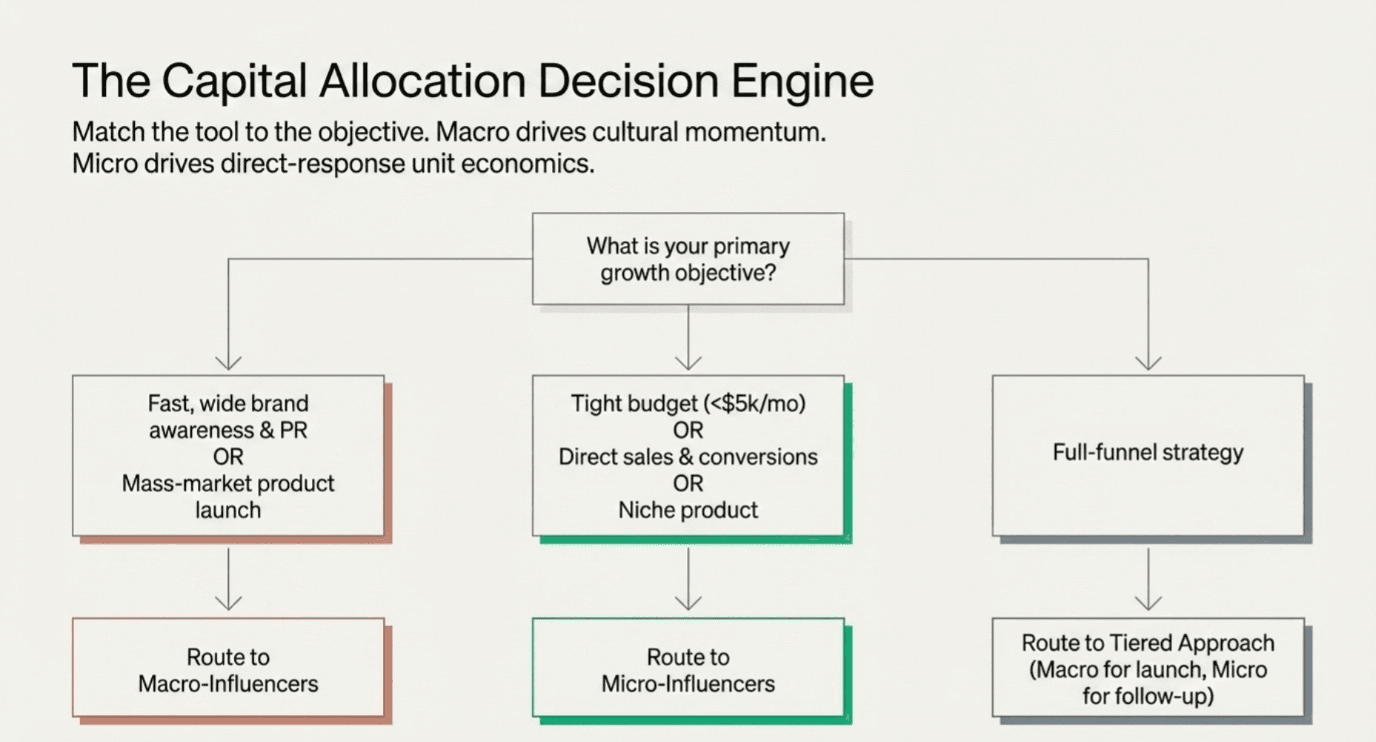
Use this to make a fast, informed decision based on your specific situation:
Your Goal / Situation | Best Choice |
Tight budget (under $5K/mo) | Micro-influencers |
Need fast brand awareness at scale | Macro-influencers |
Niche product (health, wellness, tech) | Micro-influencers |
Mass-market consumer product | Macro-influencers |
Want direct sales & conversions | Micro-influencers |
Launching a product to new audiences | Macro for launch, Micro for follow-up |
Running performance-tracked campaigns | Micro-influencers |
Building long-term brand credibility | Micro-influencers |
Need social proof + UGC content | Micro-influencers |
Full-funnel campaign strategy | Both (tiered approach) |
How to Run a Micro-Influencer Campaign as a Startup in 2026
If you've decided micro is the move (and for most early-stage startups, it is), here's how to actually do it well.
Step 1: Define the goal first
Sales? Email signups? App downloads? Brand awareness? Your goal determines your creator brief, the content you ask for, and how you track success. Don't brief a creator without knowing what a win looks like for you.
Step 2: Find niche-aligned creators
Follower count is the last thing you should look at. Check their engagement rate, the quality of comments, and how consistently their audience interacts. A creator with 18K followers and 7% engagement is worth five creators with 80K followers and 1% engagement.
Step 3: Use tracked links and promo codes
You can't optimize what you don't measure. Every creator gets a unique discount code or UTM-tracked link. This lets you see exactly which creators are driving conversions, so you know who to work with again and who to cut.
Step 4: Repurpose the content
The video a creator makes for Instagram can run as a paid ad, a product page testimonial, and an email campaign asset. Build this into your brief upfront and get usage rights for the content from day one.
Step 5: Scale what works
Identify your top 3–5 performers after the first campaign. Offer them ongoing partnerships or ambassador deals. Micro-influencers who genuinely like a product become long-term brand assets, and their authenticity only grows the more they talk about you.
Need Help Finding the Right Influencers? Motion Labs Can Do It for You.
Finding, briefing, managing, and tracking 20–50 micro-influencers at once takes real infrastructure. Most startups don't have that in-house, and they shouldn't have to build it from scratch.
Motion Labs (motionlabs.agency) is a New Delhi-based AI content and UGC agency that runs end-to-end influencer campaigns for startups and growing brands. They handle creator sourcing, content production, campaign management, and performance reporting — so you get the results without the operational headache.
If you're serious about making influencer marketing a real growth channel in 2026, Motion Labs is built for exactly that.
Also learn about: The art of brand storytelling.
🚀 Motion Labs Influencer Network End-to-end micro-influencer campaign management. Creator sourcing, UGC production, performance tracking, and ROI reporting; all done for you. Visit motionlabs.agency to learn more. |
Why Micro-Influencers Outperform for Startup-Specific Growth
For a startup, every dollar needs to work harder. That's exactly where micro-influencers shine.
1. Their audiences actually trust them
Micro-influencers feel like a knowledgeable friend, not a sponsored spokesperson. Their recommendations carry real weight. Research from HubSpot shows micro-influencer recommendations convert 25% better than macro-influencer posts. The trust is baked in because the audience is smaller, more engaged, and more aligned with what the creator actually talks about.
2. You can test and scale without massive risk
When you work with 20 micro-influencers instead of 1 macro, you get 20 different creative angles, 20 audience segments, and 20 data points. You can see what resonates and scale what works. With a macro influencer, you're betting everything on one post. If it flops, there's no learning, just loss.
3. The content is a bonus asset
Every micro-influencer post is a piece of authentic content you can repurpose in ads, on your site, in email campaigns. One campaign can generate 30–50 pieces of real UGC. That content library has lasting value well beyond the initial campaign window.
4. 73% of brands have already switched
It's worth noting that 73% of brands now favor micro and mid-tier creators over macro and celebrity partnerships. The influencer marketing industry hit $32.55 billion in 2026, and a full 40% of that budget is allocated specifically to micro-influencers. The market has already voted.
Also read: Why is your content not converting?
Which Influencer Tier Is Right for Your Startup?
Use this to make a fast, informed decision based on your specific situation:
Your Goal / Situation | Best Choice |
Tight budget (under $5K/mo) | Micro-influencers |
Need fast brand awareness at scale | Macro-influencers |
Niche product (health, wellness, tech) | Micro-influencers |
Mass-market consumer product | Macro-influencers |
Want direct sales & conversions | Micro-influencers |
Launching a product to new audiences | Macro for launch, Micro for follow-up |
Running performance-tracked campaigns | Micro-influencers |
Building long-term brand credibility | Micro-influencers |
Need social proof + UGC content | Micro-influencers |
Full-funnel campaign strategy | Both (tiered approach) |
How to Run a Micro-Influencer Campaign as a Startup in 2026
If you've decided micro is the move (and for most early-stage startups, it is), here's how to actually do it well.
Step 1: Define the goal first
Sales? Email signups? App downloads? Brand awareness? Your goal determines your creator brief, the content you ask for, and how you track success. Don't brief a creator without knowing what a win looks like for you.
Step 2: Find niche-aligned creators
Follower count is the last thing you should look at. Check their engagement rate, the quality of comments, and how consistently their audience interacts. A creator with 18K followers and 7% engagement is worth five creators with 80K followers and 1% engagement.
Step 3: Use tracked links and promo codes
You can't optimize what you don't measure. Every creator gets a unique discount code or UTM-tracked link. This lets you see exactly which creators are driving conversions, so you know who to work with again and who to cut.
Step 4: Repurpose the content
The video a creator makes for Instagram can run as a paid ad, a product page testimonial, and an email campaign asset. Build this into your brief upfront and get usage rights for the content from day one.
Step 5: Scale what works
Identify your top 3–5 performers after the first campaign. Offer them ongoing partnerships or ambassador deals. Micro-influencers who genuinely like a product become long-term brand assets, and their authenticity only grows the more they talk about you.
Need Help Finding the Right Influencers? Motion Labs Can Do It for You.
Finding, briefing, managing, and tracking 20–50 micro-influencers at once takes real infrastructure. Most startups don't have that in-house, and they shouldn't have to build it from scratch.
Motion Labs (motionlabs.agency) is a New Delhi-based AI content and UGC agency that runs end-to-end influencer campaigns for startups and growing brands. They handle creator sourcing, content production, campaign management, and performance reporting — so you get the results without the operational headache.
If you're serious about making influencer marketing a real growth channel in 2026, Motion Labs is built for exactly that.
Also learn about: The art of brand storytelling.
🚀 Motion Labs Influencer Network End-to-end micro-influencer campaign management. Creator sourcing, UGC production, performance tracking, and ROI reporting; all done for you. Visit motionlabs.agency to learn more. |
Conclusion
The influencer playbook has changed. The era of writing one big check to one big creator and hoping for the best is over, at least for startups that are serious about growth.
Micro-influencers give you more content, more data, more trust, and more conversions per dollar. That's not a trend. That's where the industry has definitively landed in 2026, with 73% of brands already preferring micro and mid-tier creators.
Start small. Be strategic. Track everything. And work with partners who know how to execute it well. Your budget is too valuable to bet on reach alone.
Frequently Asked Questions
1. Is micro-influencer marketing better than macro for ROI?
For most startups, yes. Micro-influencers consistently deliver 5–13x ROI compared to 3–5x for macro-influencers, at a fraction of the cost. They also produce customers with higher lifetime value and better retention.
2. How much does a micro-influencer cost per post in 2026?
Typically between $100 and $2,000 per Instagram post, depending on follower count, niche, and content type. TikTok rates vary but are often lower for the same follower range.
3. How many micro-influencers should a startup work with?
Start with 10–20 creators in your first campaign. This gives you enough data points to identify top performers without overwhelming your operations. Scale from there based on results.
4. Do macro influencers ever make sense for startups?
Yes, specifically for product launches or when you need fast, broad brand awareness. But they work best as a top-of-funnel tool, not a direct-response channel. Follow up any macro campaign with micro-influencer activity to convert the awareness into sales.
5. What engagement rate should I look for in a micro-influencer?
Look for 3% or higher on feed posts, and 5%+ on Reels or TikTok. Anything above 7% is excellent. Check the comments too; real engagement looks like actual conversations, not just emojis and generic compliments.
6. What platforms are best for micro-influencer campaigns in 2026?
Instagram and TikTok are the strongest platforms for conversion-focused micro campaigns. Instagram Reels are especially effective; micro-influencers with 10K–100K followers see Reels engagement rates around 6.9%. YouTube Shorts is growing as a third option for product demos.
7. How do I measure the ROI of a micro-influencer campaign?
Use UTM-tracked links and unique discount codes for each creator. Track clicks, conversions, average order value, and new vs. returning customers. Compare revenue generated against total campaign spend to get your true ROI.
Conclusion
The influencer playbook has changed. The era of writing one big check to one big creator and hoping for the best is over, at least for startups that are serious about growth.
Micro-influencers give you more content, more data, more trust, and more conversions per dollar. That's not a trend. That's where the industry has definitively landed in 2026, with 73% of brands already preferring micro and mid-tier creators.
Start small. Be strategic. Track everything. And work with partners who know how to execute it well. Your budget is too valuable to bet on reach alone.
Frequently Asked Questions
1. Is micro-influencer marketing better than macro for ROI?
For most startups, yes. Micro-influencers consistently deliver 5–13x ROI compared to 3–5x for macro-influencers, at a fraction of the cost. They also produce customers with higher lifetime value and better retention.
2. How much does a micro-influencer cost per post in 2026?
Typically between $100 and $2,000 per Instagram post, depending on follower count, niche, and content type. TikTok rates vary but are often lower for the same follower range.
3. How many micro-influencers should a startup work with?
Start with 10–20 creators in your first campaign. This gives you enough data points to identify top performers without overwhelming your operations. Scale from there based on results.
4. Do macro influencers ever make sense for startups?
Yes, specifically for product launches or when you need fast, broad brand awareness. But they work best as a top-of-funnel tool, not a direct-response channel. Follow up any macro campaign with micro-influencer activity to convert the awareness into sales.
5. What engagement rate should I look for in a micro-influencer?
Look for 3% or higher on feed posts, and 5%+ on Reels or TikTok. Anything above 7% is excellent. Check the comments too; real engagement looks like actual conversations, not just emojis and generic compliments.
6. What platforms are best for micro-influencer campaigns in 2026?
Instagram and TikTok are the strongest platforms for conversion-focused micro campaigns. Instagram Reels are especially effective; micro-influencers with 10K–100K followers see Reels engagement rates around 6.9%. YouTube Shorts is growing as a third option for product demos.
7. How do I measure the ROI of a micro-influencer campaign?
Use UTM-tracked links and unique discount codes for each creator. Track clicks, conversions, average order value, and new vs. returning customers. Compare revenue generated against total campaign spend to get your true ROI.
the call your competitor wish you would'nt take


Related Posts





Related Posts
Related Posts
Motion labs
info@motionlabs.agency


+971 55317 1706
C-1802, ONTARIO TOWER, PLOT NO. 49-0, BUSINESS BAY, DUBAI, 00000
click to meet me :)
click to meet me :)
© All Rights Reserved | 2026


Motion labs
info@motionlabs.agency
+971 55317 1706
C-1802, ONTARIO TOWER, PLOT NO. 49-0, BUSINESS BAY, DUBAI, 00000
Private policy
Terms & Conditions
© All Rights Reserved | 2026
click to meet me :)