/
/
How We Predict Viral Videos Before We Make Them
How We Predict Viral Videos Before We Make Them
5 min
read
How We Predict Viral Videos Before We Make Them
How We Predict Viral Videos Before We Make Them
Content
Marketing

Author

Scroll down
to read more!
Summerize with ChatGPT
Summerize with Gemini
Summerize with Claude
How We Predict Viral Videos Before We Make Them
How We Predict Viral Videos Before We Make Them
We've watched hundreds of short-form videos break out across client accounts. Almost none of them were original ideas. All of them were proven formats wearing a new subject.
We've watched hundreds of short-form videos break out across client accounts. Almost none of them were original ideas. All of them were proven formats wearing a new subject.
They run the process backwards.
Pick a topic the team likes. Produce a video everyone thinks is good. Watch it stall at 400 views. Blame the algorithm. We've audited enough accounts to say it plainly: the editing was almost never the problem. The input was.
A viral video is rarely a new idea. It's a format that already worked, pointed at a fresh subject. The format is the asset. The subject is disposable. Once a team internalizes that, everything downstream gets easier and cheaper.
So the job flips: find the format that's hitting this week, feed it your subject, ship before the window closes.
They run the process backwards.
Pick a topic the team likes. Produce a video everyone thinks is good. Watch it stall at 400 views. Blame the algorithm. We've audited enough accounts to say it plainly: the editing was almost never the problem. The input was.
A viral video is rarely a new idea. It's a format that already worked, pointed at a fresh subject. The format is the asset. The subject is disposable. Once a team internalizes that, everything downstream gets easier and cheaper.
So the job flips: find the format that's hitting this week, feed it your subject, ship before the window closes.
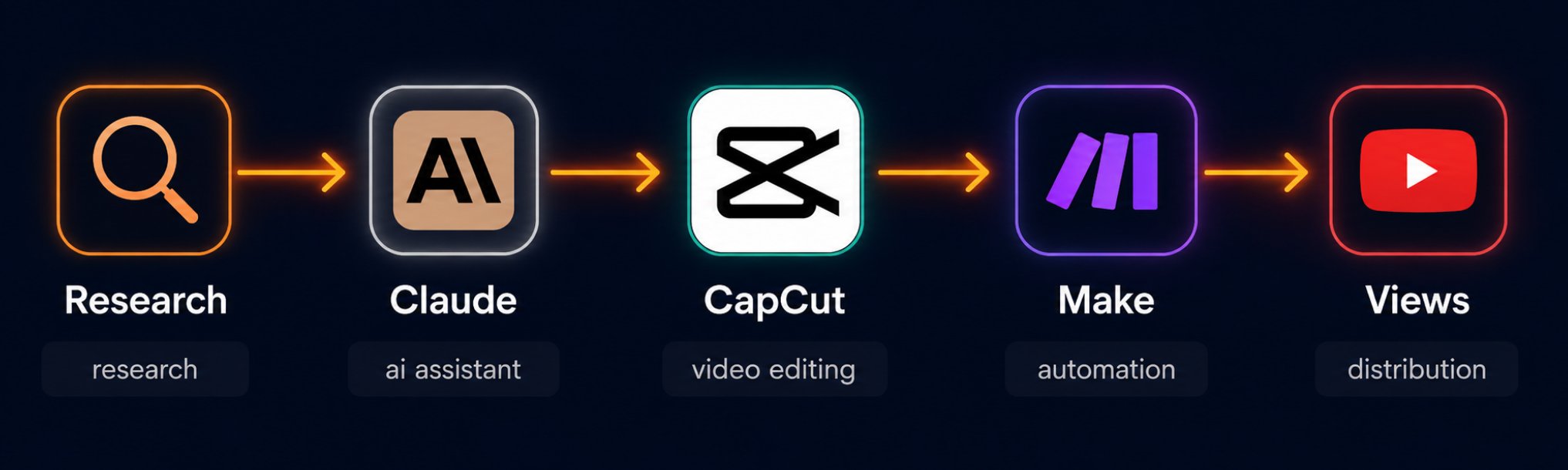
Ours is five steps, four tools:
Research finds the format. Claude writes the script. CapCut builds the video. Make publishes everywhere and tracks what hit. Results feed back into the research.
Research runs first, every single time. It's 80% of the outcome. Skip it and the other steps produce polished videos nobody watches.
Ours is five steps, four tools:
Research finds the format. Claude writes the script. CapCut builds the video. Make publishes everywhere and tracks what hit. Results feed back into the research.
Research runs first, every single time. It's 80% of the outcome. Skip it and the other steps produce polished videos nobody watches.

We never ask "what should this account post." We ask "what's already outperforming, and why." Here's the method we hand our strategists.
Build a swipe feed
Track 40 channels in one lane. AI stories, history facts, product edits, pet clips, whatever the account ships. Open a sheet and log every video that breaks out, daily.
Score the outliers
An outlier is a video pulling far more views than the channel's own average:
Outlier score = video views ÷ channel median views
A channel averaging 20,000 views drops a video at 900,000. That's a score of 45. That video found something. Above 10 is a signal. Above 30 is a format worth copying this week.
Ignore raw view counts. A 2M-view video on a 5M-average channel teaches you nothing. A 900K video on a 20K channel is a map.
Separate topic from format
The topic is what a video is about. The format is the shape it's built in. Topics die in a week. Viral video formats repeat for months.
Example: "POV: you're the last human on Earth" hits. The topic is loneliness. The format is "POV: you're the last X in Y." That reskins into 200 videos for 200 different accounts. Last knight, last barista, last dial-up user. One outlier, a season of content.
Read the first two seconds
The video hook does most of the work. For every outlier, log the exact first frame and the first line of on-screen text. That's what stopped the scroll. The rest of the video just has to not disappoint.
Feed the pattern to Claude
Paste 20 outlier titles and hooks into Claude and have it extract the shape:
You are a short-form video strategist.
<p>Below are 20 videos that outperformed their channel by 10x or more.<br>For each I've listed: title, first line of on-screen text, outlier score.</p>
<p>[paste your 20 rows]</p>
<p>Do three things:</p>
<ol>
<li>Group them into 5 repeatable FORMATS (the shape, not the topic).</li>
<li>For each format, write the hook rule in one sentence.</li>
<li>Rank the 5 formats by how easily they reskin to a new subject.</li>
</ol>
You are a short-form video strategist.
<p>Below are 20 videos that outperformed their channel by 10x or more.<br>For each I've listed: title, first line of on-screen text, outlier score.</p>
<p>[paste your 20 rows]</p>
<p>Do three things:</p>
<ol>
<li>Group them into 5 repeatable FORMATS (the shape, not the topic).</li>
<li>For each format, write the hook rule in one sentence.</li>
<li>Rank the 5 formats by how easily they reskin to a new subject.</li>
</ol>
Then generate:
Take format #1. My subject is [brand or niche].<p></p>
<p>Generate 30 video concepts in that exact format.<br>For each: the on-screen hook line (max 8 words) and the one<br>image or moment that carries the first 2 seconds.</p>
Take format #1. My subject is [brand or niche].<p></p>
<p>Generate 30 video concepts in that exact format.<br>For each: the on-screen hook line (max 8 words) and the one<br>image or moment that carries the first 2 seconds.</p>
Thirty concepts sharing a proven skeleton. Zero guessing.
Which Short Form Video Formats Keep Going Viral?
The same shapes resurface every month across every niche we work in. Log them once, reuse forever:
POV: you're the [role] when [event] puts the viewer inside the scene in one line
What if [familiar thing] but [twist] opens a curiosity gap with no context needed
The invisible-force gag where objects move on their own until a chaotic reveal
Oddly satisfying process with a start-to-finish build and no talking
1 vs escalation like 1 vs 100 or level 1 vs level 100
The creature reveal where a normal scene flips in the last two seconds
Day in the life of [unexpected subject] like a rock, a medieval peasant, a deep-sea fish
The shape is the reusable part. Your brand or subject is the variable.
How Do You Write a Viral Video Script With AI?
We have Claude write for the cut, not for a blog post:
Write a 25-second vertical short in the format:<br>"POV: you're the last lighthouse keeper on Earth."<p></p>
<p>Write for shots, not paragraphs. Output:</p>
<ul>
<li>on-screen hook text for the first 2 seconds (max 8 words)</li>
<li>5 shots, one line each, described for AI image generation</li>
<li>one line of narration per shot, spoken pace</li>
<li>a final 2-second beat that forces a rewatch or comment</li>
</ul>
Write a 25-second vertical short in the format:<br>"POV: you're the last lighthouse keeper on Earth."<p></p>
<p>Write for shots, not paragraphs. Output:</p>
<ul>
<li>on-screen hook text for the first 2 seconds (max 8 words)</li>
<li>5 shots, one line each, described for AI image generation</li>
<li>one line of narration per shot, spoken pace</li>
<li>a final 2-second beat that forces a rewatch or comment</li>
</ul>
The output is a shot list a producer can build directly.
How Do You Produce Faceless Videos With CapCut?
CapCut's AI tools turn that shot list into the finished vertical. Generate the frames, animate them, drop in AI voice and word-by-word captions, export 9:16. Hook text sits over shot one, large and high contrast, for the first two seconds.
One production tip that compounds: lock recurring characters and settings as assets. A one-off clip becomes a repeatable series. Cast once, change the plot, ship forever. It's the same principle we apply with AI avatars and UGC-style creators for client accounts.
How Do You Automate Publishing and Performance Tracking?
The research loop only compounds if your own results feed back in. A Make scenario closes it:
Trigger on a new finished video in a Drive folder
Read the concept, format tag, and hook line from the intake row
Post to TikTok, YouTube Shorts, and Instagram Reels
Wait 48 hours, pull view counts via each platform's API
Write the new outlier score into the same research sheet
Flag any video that beats the account's median by 10x
Ping the team with which format won this week
Now your own hits become inputs. The system learns which formats work for your specific account, not just the market. Setup takes about four hours once, then runs indefinitely.
What Is This Pipeline Worth?
For creators running faceless channels, the public benchmarks are consistent: accounts landing 3 to 6M monthly views typically clear $2,000 to $6,000 a month from short-form funds and AdSense, and channels with a proven format and 100K followers change hands for $3,000 to $10,000.
For brands, the math is different but bigger. A single organic short that breaks out delivers reach that would cost five figures in paid media, and the research sheet itself becomes a permanent strategic asset. Every month the data sharpens and the hit rate climbs.
Tool cost either way: roughly $50 a month. Claude Pro, CapCut Pro, Make, and a workspace account. The expensive part isn't the stack. It's the discipline to run the research before touching the editor.
Frequently Asked Questions
Can you really predict if a video will go viral?
Not with certainty, but you can stack the odds hard. A video built on a format with a 30+ outlier score, a proven hook shape, and a fresh subject enters the feed with a track record instead of a guess. That's the difference between a 2% hit rate and a 20% one.
What is a good outlier score for a viral format?
Anything above 10 is a signal worth logging. Above 30 means the format is actively breaking out and worth copying within the week, because most formats saturate and die within about two weeks.
How long does a viral video format last?
Roughly two weeks from breakout to saturation. Topics die even faster, often within a week. That's why we track formats, not topics, and why speed of execution matters more than production polish.
Do faceless channels still make money?
Yes. Short-form funds and AdSense pay on views, and channels landing 3 to 6M monthly views typically clear $2,000 to $6,000 a month. For brands, the same pipeline pays out in organic reach that replaces paid spend.
What tools do you need to run this pipeline?
Four: a research sheet, Claude for pattern extraction and scripts, CapCut for production, and Make for publishing and tracking. Around $50 a month total.
Why do most short-form accounts fail?
They start with a topic the team likes instead of a format that's already winning. The input is broken before editing starts. Reverse the order: format first, subject second, video last.
We never ask "what should this account post." We ask "what's already outperforming, and why." Here's the method we hand our strategists.
Build a swipe feed
Track 40 channels in one lane. AI stories, history facts, product edits, pet clips, whatever the account ships. Open a sheet and log every video that breaks out, daily.
Score the outliers
An outlier is a video pulling far more views than the channel's own average:
Outlier score = video views ÷ channel median views
A channel averaging 20,000 views drops a video at 900,000. That's a score of 45. That video found something. Above 10 is a signal. Above 30 is a format worth copying this week.
Ignore raw view counts. A 2M-view video on a 5M-average channel teaches you nothing. A 900K video on a 20K channel is a map.
Separate topic from format
The topic is what a video is about. The format is the shape it's built in. Topics die in a week. Viral video formats repeat for months.
Example: "POV: you're the last human on Earth" hits. The topic is loneliness. The format is "POV: you're the last X in Y." That reskins into 200 videos for 200 different accounts. Last knight, last barista, last dial-up user. One outlier, a season of content.
Read the first two seconds
The video hook does most of the work. For every outlier, log the exact first frame and the first line of on-screen text. That's what stopped the scroll. The rest of the video just has to not disappoint.
Feed the pattern to Claude
Paste 20 outlier titles and hooks into Claude and have it extract the shape:
You are a short-form video strategist.
<p>Below are 20 videos that outperformed their channel by 10x or more.<br>For each I've listed: title, first line of on-screen text, outlier score.</p>
<p>[paste your 20 rows]</p>
<p>Do three things:</p>
<ol>
<li>Group them into 5 repeatable FORMATS (the shape, not the topic).</li>
<li>For each format, write the hook rule in one sentence.</li>
<li>Rank the 5 formats by how easily they reskin to a new subject.</li>
</ol>
Then generate:
Take format #1. My subject is [brand or niche].<p></p>
<p>Generate 30 video concepts in that exact format.<br>For each: the on-screen hook line (max 8 words) and the one<br>image or moment that carries the first 2 seconds.</p>
Thirty concepts sharing a proven skeleton. Zero guessing.
Which Short Form Video Formats Keep Going Viral?
The same shapes resurface every month across every niche we work in. Log them once, reuse forever:
POV: you're the [role] when [event] puts the viewer inside the scene in one line
What if [familiar thing] but [twist] opens a curiosity gap with no context needed
The invisible-force gag where objects move on their own until a chaotic reveal
Oddly satisfying process with a start-to-finish build and no talking
1 vs escalation like 1 vs 100 or level 1 vs level 100
The creature reveal where a normal scene flips in the last two seconds
Day in the life of [unexpected subject] like a rock, a medieval peasant, a deep-sea fish
The shape is the reusable part. Your brand or subject is the variable.
How Do You Write a Viral Video Script With AI?
We have Claude write for the cut, not for a blog post:
Write a 25-second vertical short in the format:<br>"POV: you're the last lighthouse keeper on Earth."<p></p>
<p>Write for shots, not paragraphs. Output:</p>
<ul>
<li>on-screen hook text for the first 2 seconds (max 8 words)</li>
<li>5 shots, one line each, described for AI image generation</li>
<li>one line of narration per shot, spoken pace</li>
<li>a final 2-second beat that forces a rewatch or comment</li>
</ul>
The output is a shot list a producer can build directly.
How Do You Produce Faceless Videos With CapCut?
CapCut's AI tools turn that shot list into the finished vertical. Generate the frames, animate them, drop in AI voice and word-by-word captions, export 9:16. Hook text sits over shot one, large and high contrast, for the first two seconds.
One production tip that compounds: lock recurring characters and settings as assets. A one-off clip becomes a repeatable series. Cast once, change the plot, ship forever. It's the same principle we apply with AI avatars and UGC-style creators for client accounts.
How Do You Automate Publishing and Performance Tracking?
The research loop only compounds if your own results feed back in. A Make scenario closes it:
Trigger on a new finished video in a Drive folder
Read the concept, format tag, and hook line from the intake row
Post to TikTok, YouTube Shorts, and Instagram Reels
Wait 48 hours, pull view counts via each platform's API
Write the new outlier score into the same research sheet
Flag any video that beats the account's median by 10x
Ping the team with which format won this week
Now your own hits become inputs. The system learns which formats work for your specific account, not just the market. Setup takes about four hours once, then runs indefinitely.
What Is This Pipeline Worth?
For creators running faceless channels, the public benchmarks are consistent: accounts landing 3 to 6M monthly views typically clear $2,000 to $6,000 a month from short-form funds and AdSense, and channels with a proven format and 100K followers change hands for $3,000 to $10,000.
For brands, the math is different but bigger. A single organic short that breaks out delivers reach that would cost five figures in paid media, and the research sheet itself becomes a permanent strategic asset. Every month the data sharpens and the hit rate climbs.
Tool cost either way: roughly $50 a month. Claude Pro, CapCut Pro, Make, and a workspace account. The expensive part isn't the stack. It's the discipline to run the research before touching the editor.
Frequently Asked Questions
Can you really predict if a video will go viral?
Not with certainty, but you can stack the odds hard. A video built on a format with a 30+ outlier score, a proven hook shape, and a fresh subject enters the feed with a track record instead of a guess. That's the difference between a 2% hit rate and a 20% one.
What is a good outlier score for a viral format?
Anything above 10 is a signal worth logging. Above 30 means the format is actively breaking out and worth copying within the week, because most formats saturate and die within about two weeks.
How long does a viral video format last?
Roughly two weeks from breakout to saturation. Topics die even faster, often within a week. That's why we track formats, not topics, and why speed of execution matters more than production polish.
Do faceless channels still make money?
Yes. Short-form funds and AdSense pay on views, and channels landing 3 to 6M monthly views typically clear $2,000 to $6,000 a month. For brands, the same pipeline pays out in organic reach that replaces paid spend.
What tools do you need to run this pipeline?
Four: a research sheet, Claude for pattern extraction and scripts, CapCut for production, and Make for publishing and tracking. Around $50 a month total.
Why do most short-form accounts fail?
They start with a topic the team likes instead of a format that's already winning. The input is broken before editing starts. Reverse the order: format first, subject second, video last.
the call your competitor wish you would'nt take


Related Posts





Related Posts
Related Posts
Motion labs
info@motionlabs.agency


+971 55317 1706
C-1802, ONTARIO TOWER, PLOT NO. 49-0, BUSINESS BAY, DUBAI, 00000
click to meet me :)
click to meet me :)
© All Rights Reserved | 2026


Motion labs
info@motionlabs.agency
+971 55317 1706
C-1802, ONTARIO TOWER, PLOT NO. 49-0, BUSINESS BAY, DUBAI, 00000
Private policy
Terms & Conditions
© All Rights Reserved | 2026
click to meet me :)