/
/
Programmatic SEO in 2026: the system behind Zapier's 16 million monthly visitors
Programmatic SEO in 2026: the system behind Zapier's 16 million monthly visitors
5 min
read
Programmatic SEO in 2026: the system behind Zapier's 16 million monthly visitors
Programmatic SEO in 2026: the system behind Zapier's 16 million monthly visitors
SEO
Ads

Author

Scroll down
to read more!
Summerize with ChatGPT
Summerize with Gemini
Summerize with Claude
Programmatic SEO in 2026: the system behind Zapier's 16 million monthly visitors
Programmatic SEO in 2026: the system behind Zapier's 16 million monthly visitors
Most SEO strategies in 2026 still look the same. Pick a keyword, write a 2,000 word blog post, wait six months, hope it ranks. Meanwhile Zapier is publishing 800,000 landing pages, ranking for 1.3 million keywords, and pulling 16.2 million organic visitors a month. They are not outworking anyone. They built a system that generates every page automatically from a template and a database.
Most SEO strategies in 2026 still look the same. Pick a keyword, write a 2,000 word blog post, wait six months, hope it ranks. Meanwhile Zapier is publishing 800,000 landing pages, ranking for 1.3 million keywords, and pulling 16.2 million organic visitors a month. They are not outworking anyone. They built a system that generates every page automatically from a template and a database.
We have used the same approach as part of our SEO services to drive $35M+ in client revenue across 100+ B2B SaaS companies. One client hit 692,000 organic clicks and $1M+ in revenue in four months. Another went from zero to 24,700 daily organic clicks in a category Google will not even let them advertise in. Below is the exact system.
The core idea
Search demand always follows patterns. People search "best CRM for startups," "notion vs coda," "slack + asana integration," "cold email template," "coworking spaces in austin." Every one of those queries follows a repeatable structure.
Once you spot the pattern, you can build one template that captures the demand behind every variation of that structure. Hundreds of pages. Thousands of keywords. All from a single blueprint.
With regular SEO, you write one page at a time. With programmatic SEO, you write the structure once and produce the pages at scale. Each page targets a specific query someone is actively searching for right now. Tiny volume per keyword, massive cumulative traffic when you stack them.
We have used the same approach as part of our SEO services to drive $35M+ in client revenue across 100+ B2B SaaS companies. One client hit 692,000 organic clicks and $1M+ in revenue in four months. Another went from zero to 24,700 daily organic clicks in a category Google will not even let them advertise in. Below is the exact system.
The core idea
Search demand always follows patterns. People search "best CRM for startups," "notion vs coda," "slack + asana integration," "cold email template," "coworking spaces in austin." Every one of those queries follows a repeatable structure.
Once you spot the pattern, you can build one template that captures the demand behind every variation of that structure. Hundreds of pages. Thousands of keywords. All from a single blueprint.
With regular SEO, you write one page at a time. With programmatic SEO, you write the structure once and produce the pages at scale. Each page targets a specific query someone is actively searching for right now. Tiny volume per keyword, massive cumulative traffic when you stack them.

Every viable programmatic play falls into one of these 12 structures. Pick the one that matches your product, build the template, plug in the data, and ship.
1. Curation — pattern: best [category], top [tools]. Examples: best CRM for startups, top AI tools for marketers. Curated rankings of tools or services carry high commercial intent and decision-stage traffic. Make a clear #1 recommendation and do not hedge.
2. Comparisons — pattern: [x] vs [y], [x] alternatives. Examples: webflow vs wordpress, notion vs coda. Side-by-side breakdowns target users at the point of decision. Include a "who this is for" line, since AI engines pull that line directly.
3. Use-case pages — pattern: [product] for [audience]. Examples: CRM for real estate, payroll software for agencies. Persona-specific pages convert better because relevance is higher. Reuse the structure and swap only the persona.
4. Integrations — pattern: [tool] + [tool]. Examples: hubspot + salesforce, slack + asana. These pages capture users already inside a competing tool, and are the easiest way to intercept that traffic.
5. Templates — pattern: [type] template, free [type] generator. Examples: invoice template, cold email generator. Usable assets earn engagement and backlinks. Skip the signup wall and make it work in the browser.
6. Converters — pattern: [x] to [y]. Examples: pdf to word, USD to EUR. Repeat usage plus high search volume. Add related conversions on every page to multiply traffic.
7. Examples — pattern: [type] examples. Examples: SaaS landing page examples, portfolio website examples. Highly shareable and strong for research-phase traffic. Filters and categories boost time on page.
8. Directories — pattern: [category] tools, [category] software. Examples: AI copywriting tools, CRM platforms. Broad research traffic at scale and a natural backlink magnet, as long as you keep updating it.
9. Glossary — pattern: what is [term]. Examples: what is LLM SEO, what does CRM mean. Simple definitions build topical authority and give AI engines the entity definitions they need. Link glossary pages into your higher-intent pages.
10. Localization — pattern: translated versions of existing queries. Examples: qué es SEO, was ist CRM. Opens new markets with lower competition, but localize intent, not just words.
11. Locations — pattern: [service] in [location]. Examples: coworking spaces in austin, dentists in nyc. Massive local intent and geographic scalability, but use real local data. AI engines penalize pages with only the city name swapped.
12. Profiles — pattern: [entity] + [attribute]. Examples: stripe ceo, airbnb founding story. Informational demand at scale, long-tail coverage. Unique insights beat repackaged Wikipedia data every time.
Every viable programmatic play falls into one of these 12 structures. Pick the one that matches your product, build the template, plug in the data, and ship.
1. Curation — pattern: best [category], top [tools]. Examples: best CRM for startups, top AI tools for marketers. Curated rankings of tools or services carry high commercial intent and decision-stage traffic. Make a clear #1 recommendation and do not hedge.
2. Comparisons — pattern: [x] vs [y], [x] alternatives. Examples: webflow vs wordpress, notion vs coda. Side-by-side breakdowns target users at the point of decision. Include a "who this is for" line, since AI engines pull that line directly.
3. Use-case pages — pattern: [product] for [audience]. Examples: CRM for real estate, payroll software for agencies. Persona-specific pages convert better because relevance is higher. Reuse the structure and swap only the persona.
4. Integrations — pattern: [tool] + [tool]. Examples: hubspot + salesforce, slack + asana. These pages capture users already inside a competing tool, and are the easiest way to intercept that traffic.
5. Templates — pattern: [type] template, free [type] generator. Examples: invoice template, cold email generator. Usable assets earn engagement and backlinks. Skip the signup wall and make it work in the browser.
6. Converters — pattern: [x] to [y]. Examples: pdf to word, USD to EUR. Repeat usage plus high search volume. Add related conversions on every page to multiply traffic.
7. Examples — pattern: [type] examples. Examples: SaaS landing page examples, portfolio website examples. Highly shareable and strong for research-phase traffic. Filters and categories boost time on page.
8. Directories — pattern: [category] tools, [category] software. Examples: AI copywriting tools, CRM platforms. Broad research traffic at scale and a natural backlink magnet, as long as you keep updating it.
9. Glossary — pattern: what is [term]. Examples: what is LLM SEO, what does CRM mean. Simple definitions build topical authority and give AI engines the entity definitions they need. Link glossary pages into your higher-intent pages.
10. Localization — pattern: translated versions of existing queries. Examples: qué es SEO, was ist CRM. Opens new markets with lower competition, but localize intent, not just words.
11. Locations — pattern: [service] in [location]. Examples: coworking spaces in austin, dentists in nyc. Massive local intent and geographic scalability, but use real local data. AI engines penalize pages with only the city name swapped.
12. Profiles — pattern: [entity] + [attribute]. Examples: stripe ceo, airbnb founding story. Informational demand at scale, long-tail coverage. Unique insights beat repackaged Wikipedia data every time.

Any single pattern captures a slice of demand. Combining two or more patterns compounds it into something no single-pattern site can beat.
Locations + personas: "marketing agencies for startups in austin"
Curation + locations: "best coworking spaces in san diego"
Integrations + personas: "slack for sales teams"
Comparisons + use-case: "notion vs coda for remote teams"
Glossary + translations: multi-language educational content
Each combined page targets a much narrower query with almost zero competition. One of our AI-native clients is now ranking positions one through three for "AI app builder," "no code app builder," and "AI app maker" by layering curation, personas, and comparisons across their category. They went from zero clicks a day to over 900, outranking Replit and Lovable in the process.
Layering is what turns 100 pages into 10,000 keywords.
Why this works even harder in AI search
Most original programmatic SEO plays were built for Google. That is still where it starts, but in 2026 the same system puts you directly in front of AI search too.
When a buyer asks ChatGPT "what's the best CRM for remote teams," the engine grabs the most authoritative comparison page already indexed on Google. The same happens with Perplexity, Claude, and Google AI Overviews. 76% of AI Overview citations come from URLs already ranking in Google's top 10 organic results, so programmatic pages that rank in Google get cited by AI engines by default.
One warning: template-generated pages with no unique data underneath them are getting penalized in 2026. QuickSEO's March 2026 analysis found template pages with only the variable swapped are less likely to be cited by AI engines than static content. Every programmatic page needs at least one genuinely unique data point. Real pricing, user counts, screenshots, testimonials. AI engines can tell the difference, and so can Google. The companies winning in 2026 run programmatic at scale with real data underneath every page.
What this looks like in practice
Musicfy is one of the cleanest examples we have run. They came to us right after viral TikTok moments started sending thousands of users searching for AI voice tools every day. Queries like "Drake AI voice" and "Spongebob AI voice" were exploding, but Musicfy was not showing up. Their competitors were collecting all the traffic. This is exactly the kind of gap that opens when your social media marketing and search strategy are not talking to each other.
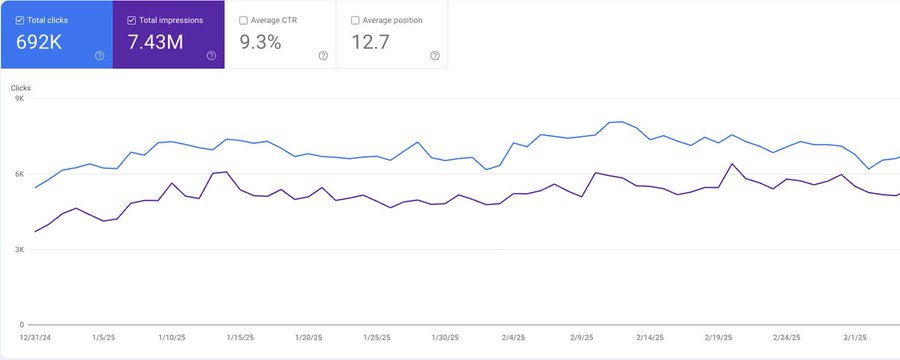
We built a programmatic system covering every celebrity voice and every use case, layered with topical authority content and LLM structuring so ChatGPT, Perplexity, Claude, and Gemini could extract Musicfy as the answer for AI voice generation. Four months later: 692,000 organic clicks, 7.43M impressions, 9.3% CTR, and 3,000 to 6,000 new signups a day from Google alone. Well over seven figures in revenue, and ChatGPT now regularly cites Musicfy when buyers ask about AI voice tools.
Another client, a subscription SaaS in the B2B space, went from under 10 non-branded clicks a day to over 250 non-branded clicks a day in 12 months. $1.83M in new revenue, with top visibility across ChatGPT, Claude, Perplexity, and Gemini. Built entirely on programmatic pages targeting decision-stage buyer queries in their category, the kind of query that a performance ads budget would otherwise be paying to reach.
Most B2B founders treat every page as a one-off. That is why SEO feels slow and traffic never compounds. Programmatic changes the math: one template and dataset, hundreds of pages ranked in Google, and AI engines citing you across every category query buyers are asking, all from a structure you built once and now maintain.
We have used this system to drive $35M+ in client revenue across 100+ B2B SaaS companies, and we back it with community building and PR work that keeps the brand signals strong across every category query buyers are asking. Our clients show up across ChatGPT, Claude, Perplexity, Gemini, and Google AI Overviews because the pages we build are structured to win both search and citation.
If you want us to run this system for your B2B SaaS, book a discovery call with our team.
Frequently Asked Questions
What is programmatic SEO?
Programmatic SEO is a method of building large numbers of search-optimized pages from a single template and a structured dataset, instead of writing each page individually. One template can generate hundreds or thousands of pages, each targeting a specific, narrow search query.
How is programmatic SEO different from regular SEO?
Regular SEO writes one page at a time for one keyword at a time. Programmatic SEO builds the page structure once and populates it with data to produce many pages at scale, so a single build can capture thousands of keyword variations instead of one.
Does programmatic SEO still work with Google's algorithm updates in 2026?
Yes, as long as each page carries genuinely unique data. Google and AI engines now penalize pages where only a variable like a city or product name is swapped with no real content underneath. Pages with real pricing, user counts, screenshots, or testimonials continue to rank and get cited.
Can programmatic SEO help with AI search visibility, not just Google rankings?
Yes. Most AI Overview and chatbot citations come from URLs that already rank in Google's top 10 organic results, so programmatic pages built to rank well in Google tend to get pulled into ChatGPT, Perplexity, Gemini, and Claude answers as well.
What's the fastest way to start with programmatic SEO?
Pick one pattern that matches your product, such as comparisons, use-case pages, or integrations, build a single page template around it, and connect it to a dataset you already have. Once that template performs, layer a second pattern on top to multiply the keyword coverage.
How long does it take to see results from a programmatic SEO campaign?
Timelines vary by category and competition, but clients in the examples above saw meaningful organic traffic growth within four to twelve months of launching their programmatic pages.
Any single pattern captures a slice of demand. Combining two or more patterns compounds it into something no single-pattern site can beat.
Locations + personas: "marketing agencies for startups in austin"
Curation + locations: "best coworking spaces in san diego"
Integrations + personas: "slack for sales teams"
Comparisons + use-case: "notion vs coda for remote teams"
Glossary + translations: multi-language educational content
Each combined page targets a much narrower query with almost zero competition. One of our AI-native clients is now ranking positions one through three for "AI app builder," "no code app builder," and "AI app maker" by layering curation, personas, and comparisons across their category. They went from zero clicks a day to over 900, outranking Replit and Lovable in the process.
Layering is what turns 100 pages into 10,000 keywords.
Why this works even harder in AI search
Most original programmatic SEO plays were built for Google. That is still where it starts, but in 2026 the same system puts you directly in front of AI search too.
When a buyer asks ChatGPT "what's the best CRM for remote teams," the engine grabs the most authoritative comparison page already indexed on Google. The same happens with Perplexity, Claude, and Google AI Overviews. 76% of AI Overview citations come from URLs already ranking in Google's top 10 organic results, so programmatic pages that rank in Google get cited by AI engines by default.
One warning: template-generated pages with no unique data underneath them are getting penalized in 2026. QuickSEO's March 2026 analysis found template pages with only the variable swapped are less likely to be cited by AI engines than static content. Every programmatic page needs at least one genuinely unique data point. Real pricing, user counts, screenshots, testimonials. AI engines can tell the difference, and so can Google. The companies winning in 2026 run programmatic at scale with real data underneath every page.
What this looks like in practice
Musicfy is one of the cleanest examples we have run. They came to us right after viral TikTok moments started sending thousands of users searching for AI voice tools every day. Queries like "Drake AI voice" and "Spongebob AI voice" were exploding, but Musicfy was not showing up. Their competitors were collecting all the traffic. This is exactly the kind of gap that opens when your social media marketing and search strategy are not talking to each other.
We built a programmatic system covering every celebrity voice and every use case, layered with topical authority content and LLM structuring so ChatGPT, Perplexity, Claude, and Gemini could extract Musicfy as the answer for AI voice generation. Four months later: 692,000 organic clicks, 7.43M impressions, 9.3% CTR, and 3,000 to 6,000 new signups a day from Google alone. Well over seven figures in revenue, and ChatGPT now regularly cites Musicfy when buyers ask about AI voice tools.
Another client, a subscription SaaS in the B2B space, went from under 10 non-branded clicks a day to over 250 non-branded clicks a day in 12 months. $1.83M in new revenue, with top visibility across ChatGPT, Claude, Perplexity, and Gemini. Built entirely on programmatic pages targeting decision-stage buyer queries in their category, the kind of query that a performance ads budget would otherwise be paying to reach.
Most B2B founders treat every page as a one-off. That is why SEO feels slow and traffic never compounds. Programmatic changes the math: one template and dataset, hundreds of pages ranked in Google, and AI engines citing you across every category query buyers are asking, all from a structure you built once and now maintain.
We have used this system to drive $35M+ in client revenue across 100+ B2B SaaS companies, and we back it with community building and PR work that keeps the brand signals strong across every category query buyers are asking. Our clients show up across ChatGPT, Claude, Perplexity, Gemini, and Google AI Overviews because the pages we build are structured to win both search and citation.
If you want us to run this system for your B2B SaaS, book a discovery call with our team.
Frequently Asked Questions
What is programmatic SEO?
Programmatic SEO is a method of building large numbers of search-optimized pages from a single template and a structured dataset, instead of writing each page individually. One template can generate hundreds or thousands of pages, each targeting a specific, narrow search query.
How is programmatic SEO different from regular SEO?
Regular SEO writes one page at a time for one keyword at a time. Programmatic SEO builds the page structure once and populates it with data to produce many pages at scale, so a single build can capture thousands of keyword variations instead of one.
Does programmatic SEO still work with Google's algorithm updates in 2026?
Yes, as long as each page carries genuinely unique data. Google and AI engines now penalize pages where only a variable like a city or product name is swapped with no real content underneath. Pages with real pricing, user counts, screenshots, or testimonials continue to rank and get cited.
Can programmatic SEO help with AI search visibility, not just Google rankings?
Yes. Most AI Overview and chatbot citations come from URLs that already rank in Google's top 10 organic results, so programmatic pages built to rank well in Google tend to get pulled into ChatGPT, Perplexity, Gemini, and Claude answers as well.
What's the fastest way to start with programmatic SEO?
Pick one pattern that matches your product, such as comparisons, use-case pages, or integrations, build a single page template around it, and connect it to a dataset you already have. Once that template performs, layer a second pattern on top to multiply the keyword coverage.
How long does it take to see results from a programmatic SEO campaign?
Timelines vary by category and competition, but clients in the examples above saw meaningful organic traffic growth within four to twelve months of launching their programmatic pages.
the call your competitor wish you would'nt take


Related Posts




Related Posts
Related Posts
Motion labs
info@motionlabs.agency


+971 55317 1706
C-1802, ONTARIO TOWER, PLOT NO. 49-0, BUSINESS BAY, DUBAI, 00000
click to meet me :)
click to meet me :)
© All Rights Reserved | 2026


Motion labs
info@motionlabs.agency
+971 55317 1706
C-1802, ONTARIO TOWER, PLOT NO. 49-0, BUSINESS BAY, DUBAI, 00000
Private policy
Terms & Conditions
© All Rights Reserved | 2026
click to meet me :)