/
/
SEO vs Google Ads: Which Gives Better ROI in 2026?
SEO vs Google Ads: Which Gives Better ROI in 2026?
5 min
read
SEO vs Google Ads: Which Gives Better ROI in 2026?
SEO vs Google Ads: Which Gives Better ROI in 2026?
Ads
SEO

Author
Scroll down
to read more!
Summerize with ChatGPT
Summerize with Gemini
Summerize with Claude
SEO vs Google Ads: Which Gives Better ROI in 2026?
SEO vs Google Ads: Which Gives Better ROI in 2026?
SEO vs Googles Ads, what is perfect for your business type and brand? Find the accurate and perfect answer in this blog and utilise your money wisely.
SEO vs Googles Ads, what is perfect for your business type and brand? Find the accurate and perfect answer in this blog and utilise your money wisely.
What is the difference between SEO and Google Ads?
SEO stands for search engine optimization. It's the work you do to show up in Google's normal search results without paying for the click. You write helpful pages, fix your website, get other sites to link to you, and slowly climb up the list. When someone clicks your page, you pay nothing.
Google Ads is the paid lane. You bid on keywords, your ad shows up at the very top marked "Sponsored," and you pay every time someone clicks. Turn the budget on, the traffic comes. Turn it off, the traffic stops that same day.
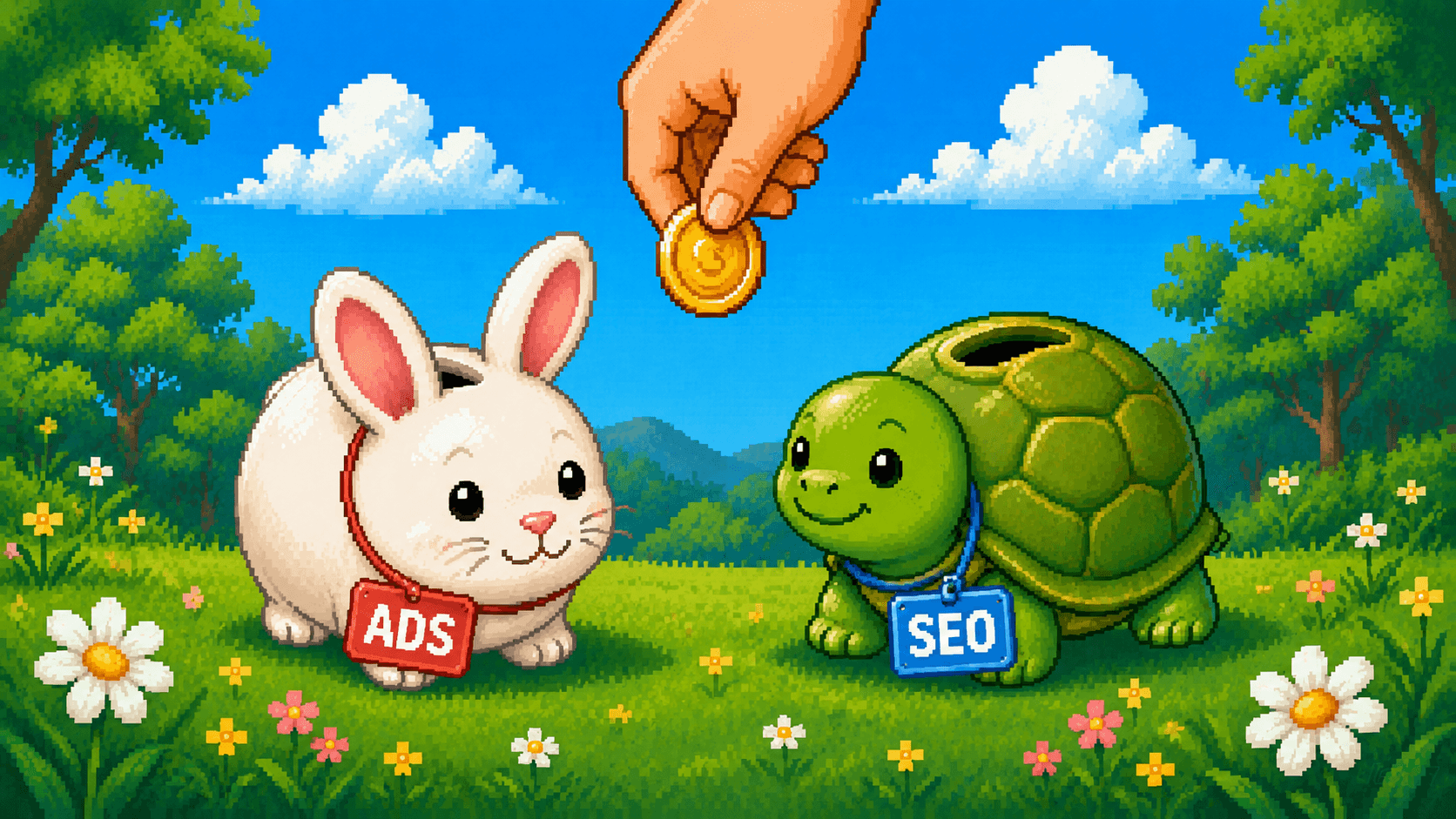
Here's an easy way to picture it. SEO is like buying a house. The down payment hurts and it takes a while to move in. But once it's yours, it keeps its value whether you spend more or not. Google Ads is like renting. You get the keys today, but stop paying and you're out the next day.
How much ROI does SEO actually deliver?
This is where SEO looks like the clear winner on paper. Studies that track results over the long run show SEO returning up to $12.20 for every $1 spent, compared with roughly $2 for Google Ads. People also buy more often from organic results, with organic search showing about a 14.6% conversion rate, while paid search sits closer to 4%.
Why do organic leads buy more? Simple. People trust results they know weren't paid for. If your page earns the top spot on its own, the visitor figures you must be good. And the savings add up over time. As a rule, organic channels give you a higher long-term return than paid ones because they keep growing and bring in better-quality leads.
Also Read: What are the most effective digital marketing agencies?
How much ROI does Google Ads deliver?
Google Ads wins on speed, and speed is worth a lot. SEO brings far more traffic per dollar over the long run, but Google Ads gets you results within 24 hours. Launch a product on Monday and you can have buyers clicking your ad by Monday afternoon.
What you pay per lead changes a lot depending on your industry. The average cost per lead on Google Ads recently sat around $70, with cheaper fields like auto repair near $28 and legal services running much higher. That gap matters. A dentist and a personal injury lawyer will have very different experiences on the same platform.
Google Ads also gives you something SEO can't: control. You pick the exact search terms, the location, the time of day, even the type of person. You can test one message in the morning and swap it out by lunch. If you need leads now, that control is worth paying for.
What is the difference between SEO and Google Ads?
SEO stands for search engine optimization. It's the work you do to show up in Google's normal search results without paying for the click. You write helpful pages, fix your website, get other sites to link to you, and slowly climb up the list. When someone clicks your page, you pay nothing.
Google Ads is the paid lane. You bid on keywords, your ad shows up at the very top marked "Sponsored," and you pay every time someone clicks. Turn the budget on, the traffic comes. Turn it off, the traffic stops that same day.
Here's an easy way to picture it. SEO is like buying a house. The down payment hurts and it takes a while to move in. But once it's yours, it keeps its value whether you spend more or not. Google Ads is like renting. You get the keys today, but stop paying and you're out the next day.
How much ROI does SEO actually deliver?
This is where SEO looks like the clear winner on paper. Studies that track results over the long run show SEO returning up to $12.20 for every $1 spent, compared with roughly $2 for Google Ads. People also buy more often from organic results, with organic search showing about a 14.6% conversion rate, while paid search sits closer to 4%.
Why do organic leads buy more? Simple. People trust results they know weren't paid for. If your page earns the top spot on its own, the visitor figures you must be good. And the savings add up over time. As a rule, organic channels give you a higher long-term return than paid ones because they keep growing and bring in better-quality leads.
Also Read: What are the most effective digital marketing agencies?
How much ROI does Google Ads deliver?
Google Ads wins on speed, and speed is worth a lot. SEO brings far more traffic per dollar over the long run, but Google Ads gets you results within 24 hours. Launch a product on Monday and you can have buyers clicking your ad by Monday afternoon.
What you pay per lead changes a lot depending on your industry. The average cost per lead on Google Ads recently sat around $70, with cheaper fields like auto repair near $28 and legal services running much higher. That gap matters. A dentist and a personal injury lawyer will have very different experiences on the same platform.
Google Ads also gives you something SEO can't: control. You pick the exact search terms, the location, the time of day, even the type of person. You can test one message in the morning and swap it out by lunch. If you need leads now, that control is worth paying for.
Which one is better for a new business?
If you're just starting out, here's the hard truth. You probably can't afford to wait around for SEO on its own.
A brand new website has no rankings and no traffic. For early-stage companies without any organic authority, paid search is often the only way to get leads while SEO is still being built. That's the real job paid ads do. You need money coming in so you can survive long enough for the slow channel to grow up.
So the smart order for most new businesses is to start with Google Ads for quick leads, then build SEO once things are steady. For most businesses, the right order is Google Ads first, then SEO as the money starts coming in steadily. There's a nice bonus too. Your ad data shows you exactly which keywords turn into customers. You can take those proven winners straight into your SEO plan instead of guessing.
How is AI changing this in 2026?
This is the part most old comparisons skip, and it's the biggest change in years.
Google now answers a lot of searches right on the results page with AI Overviews. So people get their answer without clicking any website at all. About 60% of Google searches in 2026 end without a click, and AI Overviews now show up in more than half of all searches. For SEO, that means ranking number one isn't the prize it used to be, at least for "how to" type questions.
But don't panic and dump all your money into ads just yet. Read the rest. The people who do still click are now much more likely to buy, which turns SEO into a quality game instead of a numbers game. The clicks that survive are the serious ones. And the hit lands hardest on simple info searches, not on the buying searches that actually make you money. For searches where someone wants to compare options or make a purchase, the top organic spot still pulls in plenty of clicks.
One more thing. Ads are getting squeezed too. Paid search clicks have dropped even more sharply than organic, with one study showing a 68% fall. So this isn't a clean win for either side. Both are changing fast, and chasing plain traffic is the wrong goal in 2026. What counts now is sales.
Also Read: How to combine AI research with human editing
What is better, SEO or Google Ads?
Stop treating this like a fight. The businesses winning in 2026 use both. They just dial each one up or down based on where they are.
Need leads this week? Got a tight budget or a launch coming up? Lead with Google Ads. Got a flexible timeline and want traffic that keeps growing on its own? Lean into SEO. Most steady businesses land in the middle, often putting around 60% of the budget into SEO for the long game and 40% into ads for quick wins.
The biggest mistake is choosing based on which one sounds nicer instead of which one fits your situation. A solid business with patience should build SEO. A startup burning through cash should run ads. Match the channel to the moment, not to a catchy headline you read somewhere.
Which one is better for a new business?
If you're just starting out, here's the hard truth. You probably can't afford to wait around for SEO on its own.
A brand new website has no rankings and no traffic. For early-stage companies without any organic authority, paid search is often the only way to get leads while SEO is still being built. That's the real job paid ads do. You need money coming in so you can survive long enough for the slow channel to grow up.
So the smart order for most new businesses is to start with Google Ads for quick leads, then build SEO once things are steady. For most businesses, the right order is Google Ads first, then SEO as the money starts coming in steadily. There's a nice bonus too. Your ad data shows you exactly which keywords turn into customers. You can take those proven winners straight into your SEO plan instead of guessing.
How is AI changing this in 2026?
This is the part most old comparisons skip, and it's the biggest change in years.
Google now answers a lot of searches right on the results page with AI Overviews. So people get their answer without clicking any website at all. About 60% of Google searches in 2026 end without a click, and AI Overviews now show up in more than half of all searches. For SEO, that means ranking number one isn't the prize it used to be, at least for "how to" type questions.
But don't panic and dump all your money into ads just yet. Read the rest. The people who do still click are now much more likely to buy, which turns SEO into a quality game instead of a numbers game. The clicks that survive are the serious ones. And the hit lands hardest on simple info searches, not on the buying searches that actually make you money. For searches where someone wants to compare options or make a purchase, the top organic spot still pulls in plenty of clicks.
One more thing. Ads are getting squeezed too. Paid search clicks have dropped even more sharply than organic, with one study showing a 68% fall. So this isn't a clean win for either side. Both are changing fast, and chasing plain traffic is the wrong goal in 2026. What counts now is sales.
Also Read: How to combine AI research with human editing
What is better, SEO or Google Ads?
Stop treating this like a fight. The businesses winning in 2026 use both. They just dial each one up or down based on where they are.
Need leads this week? Got a tight budget or a launch coming up? Lead with Google Ads. Got a flexible timeline and want traffic that keeps growing on its own? Lean into SEO. Most steady businesses land in the middle, often putting around 60% of the budget into SEO for the long game and 40% into ads for quick wins.
The biggest mistake is choosing based on which one sounds nicer instead of which one fits your situation. A solid business with patience should build SEO. A startup burning through cash should run ads. Match the channel to the moment, not to a catchy headline you read somewhere.
Conclusion
SEO gives you the better return over the long run. It's not even close. More money back per dollar, better conversion, and traffic you keep owning after you stop spending. But that payback takes 6 to 12 months, not a week. And with AI Overviews around, SEO now rewards trust and real buying searches more than simple info rankings.
Google Ads gives you the better speed and control. You buy your way to the top today, you can measure every dollar, and you can scale up or shut it off in an afternoon. The downside is plain: stop paying and the traffic vanishes.
For 2026, the right answer is rarely one or the other. Use Google Ads to bring in leads while your SEO is too young to deliver. Let your ad data sharpen your content. Then build SEO into the engine that lowers your cost per customer year after year. Speed now, ownership later. That's how you get the most out of both.
Frequently Asked Questions
1. Is SEO cheaper than Google Ads? Over time, yes. SEO costs more upfront in content and website work, but there's no charge per click, so your cost per lead keeps dropping as your rankings hold. Google Ads charges you for every single click, so the cost never goes away. In the first few months, though, Google Ads is cheaper per lead simply because SEO hasn't kicked in yet.
2. How long does SEO take to show results? Usually 6 to 12 months before you see real traffic and leads, sometimes longer in tough industries. That's the main reason new businesses can't lean on SEO alone at the start.
3. Will AI Overviews kill SEO in 2026? No, but they're changing it. A lot of info searches now end without a click, so chasing plain traffic is risky. But buying searches still send clicks, and the people who do click are more likely to buy. SEO is moving from a traffic game to a trust-and-sales game.
4. Can I run SEO and Google Ads at the same time? Yes, and most successful businesses do. Google Ads brings quick leads and shows you which keywords actually convert. SEO builds a long-term asset. Running both lets your paid data make your organic plan smarter.
5. Which has better conversion rates, SEO or Google Ads? Organic search usually converts better, around 14.6% versus roughly 4% for paid, because people trust results they know weren't paid for. That said, paid traffic is easier to control and predict, which has its own value when you need leads on a deadline.
Conclusion
SEO gives you the better return over the long run. It's not even close. More money back per dollar, better conversion, and traffic you keep owning after you stop spending. But that payback takes 6 to 12 months, not a week. And with AI Overviews around, SEO now rewards trust and real buying searches more than simple info rankings.
Google Ads gives you the better speed and control. You buy your way to the top today, you can measure every dollar, and you can scale up or shut it off in an afternoon. The downside is plain: stop paying and the traffic vanishes.
For 2026, the right answer is rarely one or the other. Use Google Ads to bring in leads while your SEO is too young to deliver. Let your ad data sharpen your content. Then build SEO into the engine that lowers your cost per customer year after year. Speed now, ownership later. That's how you get the most out of both.
Frequently Asked Questions
1. Is SEO cheaper than Google Ads? Over time, yes. SEO costs more upfront in content and website work, but there's no charge per click, so your cost per lead keeps dropping as your rankings hold. Google Ads charges you for every single click, so the cost never goes away. In the first few months, though, Google Ads is cheaper per lead simply because SEO hasn't kicked in yet.
2. How long does SEO take to show results? Usually 6 to 12 months before you see real traffic and leads, sometimes longer in tough industries. That's the main reason new businesses can't lean on SEO alone at the start.
3. Will AI Overviews kill SEO in 2026? No, but they're changing it. A lot of info searches now end without a click, so chasing plain traffic is risky. But buying searches still send clicks, and the people who do click are more likely to buy. SEO is moving from a traffic game to a trust-and-sales game.
4. Can I run SEO and Google Ads at the same time? Yes, and most successful businesses do. Google Ads brings quick leads and shows you which keywords actually convert. SEO builds a long-term asset. Running both lets your paid data make your organic plan smarter.
5. Which has better conversion rates, SEO or Google Ads? Organic search usually converts better, around 14.6% versus roughly 4% for paid, because people trust results they know weren't paid for. That said, paid traffic is easier to control and predict, which has its own value when you need leads on a deadline.
the call your competitor wish you would'nt take


Related Posts




Related Posts
Related Posts
Motion labs
info@motionlabs.agency


+971 55317 1706
C-1802, ONTARIO TOWER, PLOT NO. 49-0, BUSINESS BAY, DUBAI, 00000
click to meet me :)
click to meet me :)
© All Rights Reserved | 2026


Motion labs
info@motionlabs.agency
+971 55317 1706
C-1802, ONTARIO TOWER, PLOT NO. 49-0, BUSINESS BAY, DUBAI, 00000
Private policy
Terms & Conditions
© All Rights Reserved | 2026
click to meet me :)