/
/
The Best Way to Measure Influencer Marketing ROI
The Best Way to Measure Influencer Marketing ROI
5 min
read
The Best Way to Measure Influencer Marketing ROI
The Best Way to Measure Influencer Marketing ROI
Marketing
Content

Author

Scroll down
to read more!
Summerize with ChatGPT
Summerize with Gemini
Summerize with Claude
The Best Way to Measure Influencer Marketing ROI
The Best Way to Measure Influencer Marketing ROI
A practical guide to explain the best way to measure influencer marketing, UTM tracking, promo codes, and attribution models that actually prove influencer value to your team.
A practical guide to explain the best way to measure influencer marketing, UTM tracking, promo codes, and attribution models that actually prove influencer value to your team.
You ran an influencer campaign. The post went live, the comments were decent, and a few DMs came in. But when your CMO asks what the return was, you're scrambling through screenshots trying to piece together a number.
That's the core problem with influencer marketing. It works, often really well, but the proof is hard to show. And without clear numbers, it's tough to justify the budget, scale what's working, or cut what isn't.
This guide is going to fix that. No complicated jargon, no overly technical frameworks. Just a clear, practical system to track influencer marketing ROI using UTMs, promo codes, and attribution models, so you always have something solid to show.
Why Most Brands Struggle to Track Influencer ROI
The short answer: influencer marketing was never built with tracking in mind. It grew out of organic content, where creators just posted and brands hoped for the best.
The longer answer involves a few real problems that come up again and again.
First, social platforms don't hand over clean data. Instagram Stories disappear. TikTok doesn't always pass referral info. Link clicks on Twitter get filtered through link shorteners. By the time the user lands on your site, the connection to the original post is often broken.
Second, most brands set up campaigns without a tracking plan. They agree on a deliverable with the creator, get the content approved, and go live, without setting up a UTM link, a dedicated promo code, or a landing page variant. Then they wonder why Google Analytics shows a spike in direct traffic instead of influencer-attributed sessions.
Third, influencer results don't always show up in the same channel. Someone sees a TikTok, searches your brand name three days later, and converts through an organic Google result. That journey is real, but none of the standard reports will connect it back to the creator.
The fix isn't a magic platform. It's a consistent process, applied before the campaign goes live, not after.
Also Read: Micro influencer vs macro influencer which is best for your business
How to Set Up UTM Links for Influencer Campaigns
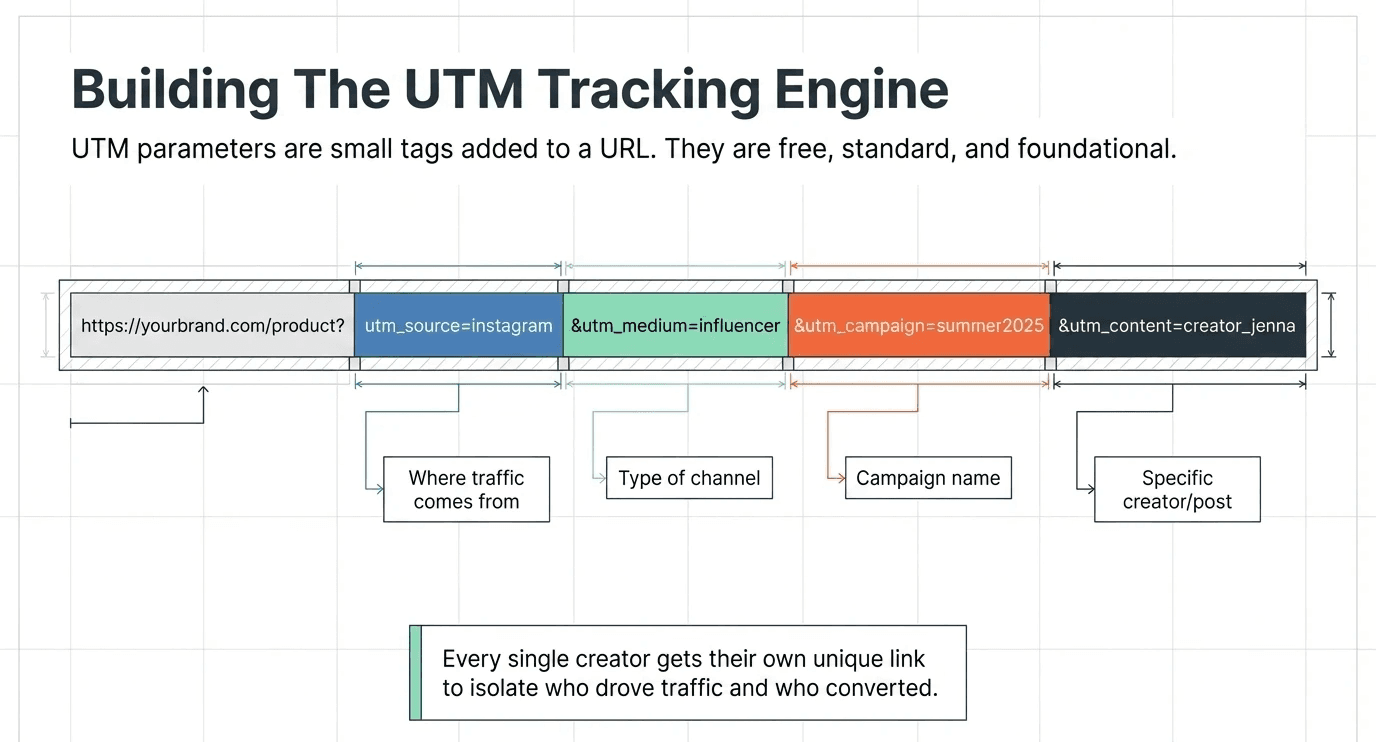
UTM parameters are small tags you add to the end of a URL. When someone clicks that link, Google Analytics (or whatever tool you use) can see exactly where they came from. They're free, they're standard, and they're the foundation of any solid influencer tracking setup.
Here's how to build one for an influencer campaign.
The Five UTM Parameters You Need to Know
• utm_source — where the traffic comes from (e.g., instagram, tiktok, youtube)
• utm_medium — the type of channel (e.g., influencer, paid_social, organic)
• utm_campaign — the name of your campaign (e.g., summer_drop_2025)
• utm_content — which specific creator or post (e.g., creator_jenna_reel)
• utm_term — optional, useful for paid setups or product-specific links
A real-world example might look like this:
https://yourbrand.com/product?utm_source=instagram&utm_medium=influencer&utm_campaign=summer2025&utm_content=creator_jenna
Each creator in your campaign gets their own unique link. That way, if five influencers run the same campaign, you can see exactly who drove traffic, who converted, and who didn't deliver.
You ran an influencer campaign. The post went live, the comments were decent, and a few DMs came in. But when your CMO asks what the return was, you're scrambling through screenshots trying to piece together a number.
That's the core problem with influencer marketing. It works, often really well, but the proof is hard to show. And without clear numbers, it's tough to justify the budget, scale what's working, or cut what isn't.
This guide is going to fix that. No complicated jargon, no overly technical frameworks. Just a clear, practical system to track influencer marketing ROI using UTMs, promo codes, and attribution models, so you always have something solid to show.
Why Most Brands Struggle to Track Influencer ROI
The short answer: influencer marketing was never built with tracking in mind. It grew out of organic content, where creators just posted and brands hoped for the best.
The longer answer involves a few real problems that come up again and again.
First, social platforms don't hand over clean data. Instagram Stories disappear. TikTok doesn't always pass referral info. Link clicks on Twitter get filtered through link shorteners. By the time the user lands on your site, the connection to the original post is often broken.
Second, most brands set up campaigns without a tracking plan. They agree on a deliverable with the creator, get the content approved, and go live, without setting up a UTM link, a dedicated promo code, or a landing page variant. Then they wonder why Google Analytics shows a spike in direct traffic instead of influencer-attributed sessions.
Third, influencer results don't always show up in the same channel. Someone sees a TikTok, searches your brand name three days later, and converts through an organic Google result. That journey is real, but none of the standard reports will connect it back to the creator.
The fix isn't a magic platform. It's a consistent process, applied before the campaign goes live, not after.
Also Read: Micro influencer vs macro influencer which is best for your business
How to Set Up UTM Links for Influencer Campaigns
UTM parameters are small tags you add to the end of a URL. When someone clicks that link, Google Analytics (or whatever tool you use) can see exactly where they came from. They're free, they're standard, and they're the foundation of any solid influencer tracking setup.
Here's how to build one for an influencer campaign.
The Five UTM Parameters You Need to Know
• utm_source — where the traffic comes from (e.g., instagram, tiktok, youtube)
• utm_medium — the type of channel (e.g., influencer, paid_social, organic)
• utm_campaign — the name of your campaign (e.g., summer_drop_2025)
• utm_content — which specific creator or post (e.g., creator_jenna_reel)
• utm_term — optional, useful for paid setups or product-specific links
A real-world example might look like this:
https://yourbrand.com/product?utm_source=instagram&utm_medium=influencer&utm_campaign=summer2025&utm_content=creator_jenna
Each creator in your campaign gets their own unique link. That way, if five influencers run the same campaign, you can see exactly who drove traffic, who converted, and who didn't deliver.
Common UTM Mistakes to Avoid
• Using inconsistent naming conventions across campaigns (utm_source=Instagram vs instagram vs IG all read as different sources)
• Not using lowercase consistently, UTMs are case-sensitive
• Forgetting to create UTMs before the campaign launches, not after
• Using the same UTM link across multiple creators so you lose creator-level data
Pro tip: Use a simple UTM spreadsheet or Google's Campaign URL Builder to keep naming consistent across your team. Motion Labs includes UTM tracking setup as part of their campaign management service, so every link is built and tracked correctly from day one. |
Using Promo Codes to Track Influencer Conversions
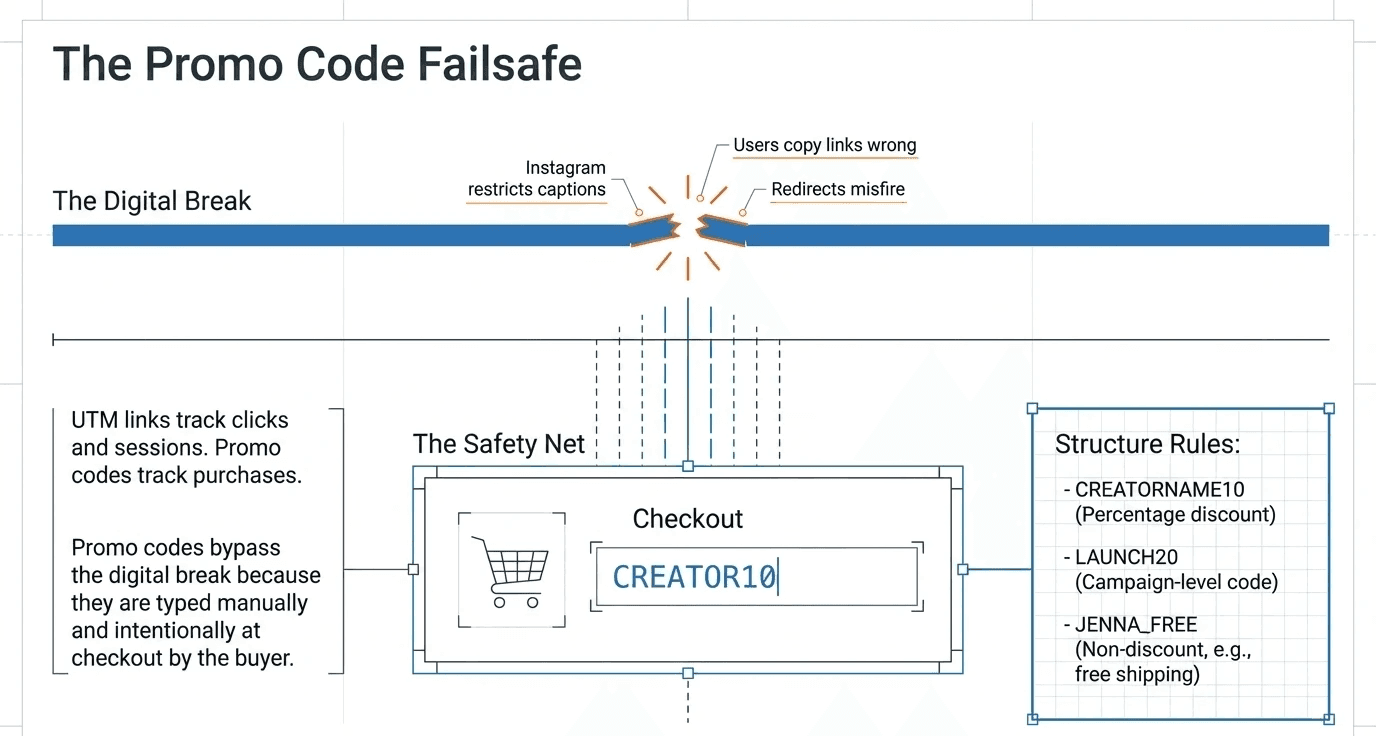
UTM links track clicks and sessions. Promo codes track purchases. They do different jobs, and you often need both.
A promo code like JENNA15 or SUMMER10 tied to a specific creator does a few things at once. It gives the audience a reason to act (a discount or bonus), it gives you a direct conversion signal in your Shopify or ecommerce backend, and it works even when the UTM link breaks.
Because here's the thing: links break. Instagram restricts clickable links in captions. Someone copied the link wrong. A redirect misfires. Promo codes don't have those problems. They're typed in at checkout, manually and intentionally, by an actual buyer.
How to Structure Promo Codes for Attribution
Keep codes short, memorable, and creator-specific. Here's a simple format that works well:
• CREATORNAME10 — percentage discount tied to the creator
• LAUNCH20 — campaign-level code shared across a few related creators
• JENNA_FREE — a non-discount code (free shipping, bonus item) tied to a specific creator
Once the campaign ends, you pull the code usage report from your ecommerce platform. Every order that used JENNA15 is attributable to that creator's campaign, with revenue attached.
Use this alongside your UTM data and you get a much fuller picture. UTM says 800 people visited from Jenna's post. Promo code says 45 of them actually bought. That's a 5.6% conversion rate, a number you can take to leadership.
Heads up: Make sure your team creates unique promo codes before briefing creators. Never reuse codes across campaigns or influencers unless it's intentional, because it will muddy your attribution data. |
Also read: How often you should post on Social Media
Attribution Models Explained: Which One Should You Use?
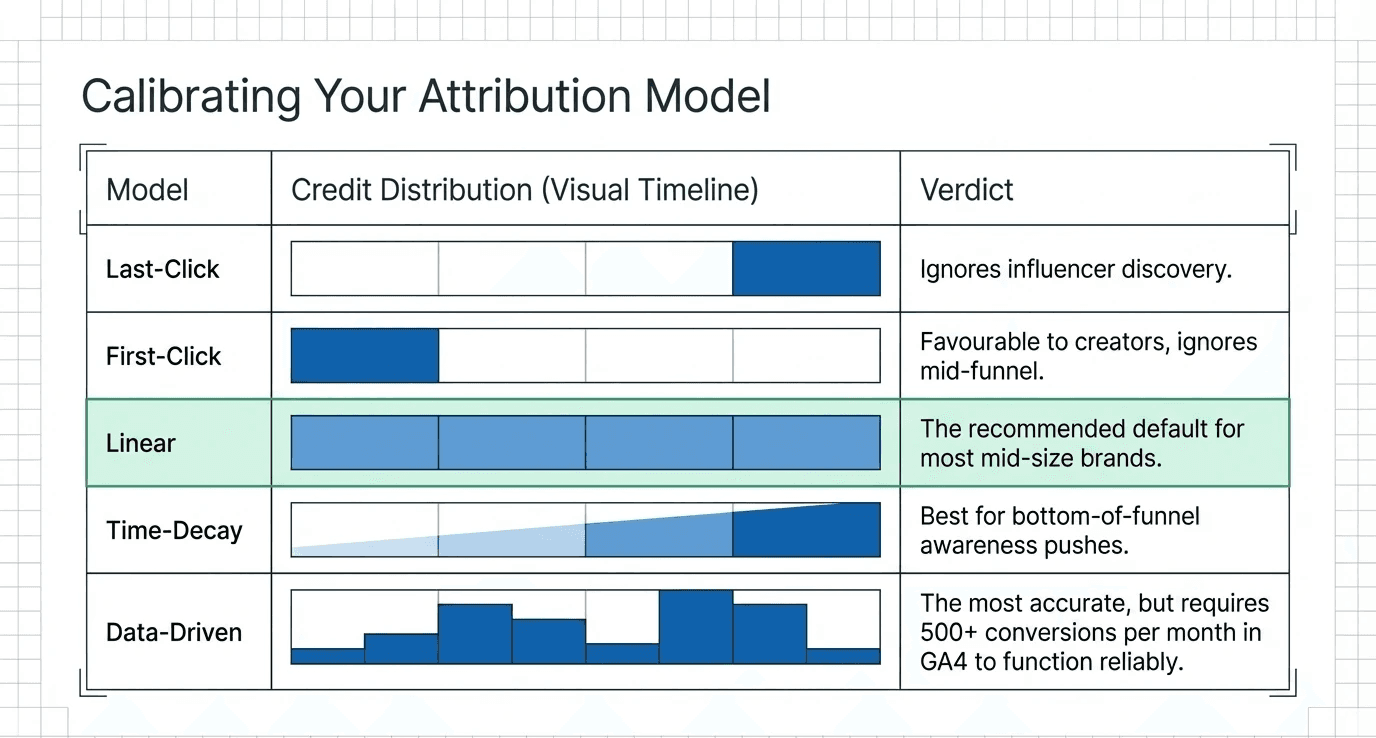
Attribution models are just rules that decide which touchpoint gets credit for a sale. This matters for influencer marketing because the creator is rarely the last click before someone buys.
Last-Click Attribution
The most common model. Whatever the customer clicked right before buying gets 100% of the credit. Simple to set up and understand, but it undersells influencers almost every time. If someone sees an influencer post, searches your brand, and converts via a Google ad, the influencer gets zero credit.
First-Click Attribution
The first touchpoint gets all the credit. Better for influencer campaigns since creators often introduce people to a brand for the first time. But it ignores everything that happened between discovery and purchase.
Linear Attribution
Every touchpoint in the journey gets equal credit. More balanced, and honestly a good default for most mid-size brands that don't have complex data infrastructure. If someone interacted with an influencer post, a retargeting ad, and an email before buying, all three share the credit equally.
Time-Decay Attribution
Touchpoints closer to the purchase get more credit, earlier touchpoints get less. This works well if your influencer campaigns are more of a last-push awareness play rather than a top-of-funnel discovery mechanism.
Data-Driven Attribution (Best, If You Have the Volume)
Google Analytics 4 and some CRM platforms offer data-driven attribution that uses machine learning to assign credit based on actual conversion patterns in your data. It's the most accurate, but you need enough volume (usually 500+ conversions per month) for the model to work reliably.
For most brands running influencer campaigns, linear or first-click attribution will give you a fairer picture of influencer value than last-click. Set your model in GA4 before the campaign starts, not after you want to pull the numbers.
How to Build an Influencer ROI Dashboard
Once your UTMs, promo codes, and attribution model are set up, you need somewhere to pull it all together. A good influencer ROI dashboard doesn't need to be complicated. It just needs to answer a few core questions clearly.
Metrics Your Dashboard Should Track
At the campaign level, you want to see:
• Total reach and impressions per creator
• Link clicks (from UTM data in GA4)
• Sessions attributed to each influencer
• Conversion rate per creator
• Revenue or leads per creator (from promo codes or goal completions)
• Cost per click and cost per acquisition
• Earned Media Value (optional, but useful for awareness campaigns)
At the brand level across multiple campaigns, you want to see which creators consistently deliver, which content formats perform, and whether influencer as a channel is worth its share of the marketing budget.
Tools Worth Using
• Google Analytics 4 for UTM-based traffic and conversion tracking
• Shopify Reports or WooCommerce for promo code conversion data
• Notion or Google Sheets for campaign tracking templates
• Triple Whale or Northbeam for DTC brands that need cross-channel attribution
• Motion Labs UTM Tracking Service if you want someone to handle setup, naming, and reporting without building it yourself
How to Calculate Influencer Marketing ROI
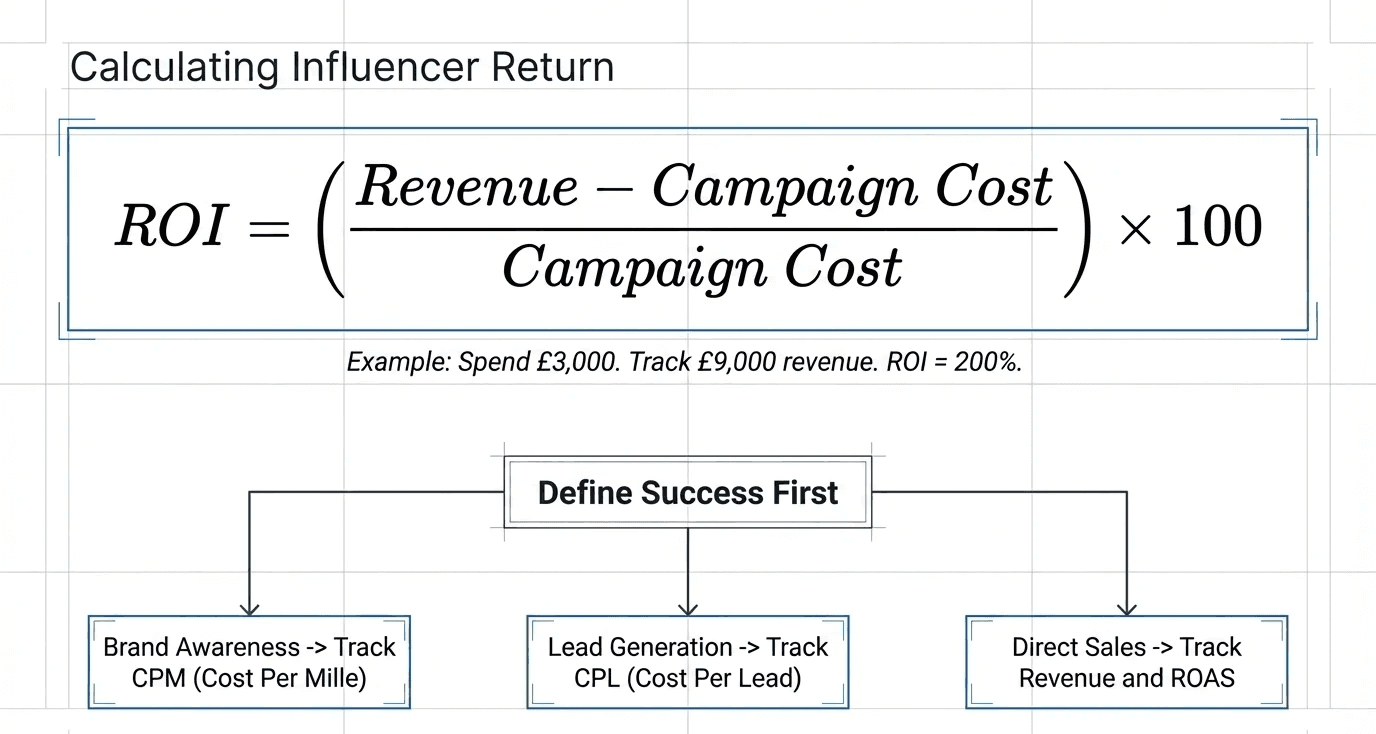
You don't need a data science team to calculate ROI. The basic formula is the same one you use for any marketing channel:
ROI = ((Revenue from Campaign − Campaign Cost) / Campaign Cost) × 100
So if you spent $3,000 on a creator and tracked $9,000 in attributed revenue, your ROI is 200%. That's a number leadership understands.
But here's the nuance: not every influencer campaign is meant to drive direct revenue. Some are for brand awareness. Some are for email list growth. Some are for launching into a new audience segment.
Before you run the campaign, define what success looks like. If it's awareness, your ROI metric might be cost per thousand impressions (CPM). If it's lead gen, it's cost per lead. If it's direct sales, it's revenue and ROAS.
The tracking setup changes a little depending on your goal, but the principle stays the same: define the metric first, set up tracking before launch, and pull the numbers once the campaign ends.
What Good Influencer Attribution Looks Like in Practice
A DTC skincare brand runs a campaign with three micro-influencers. Each creator gets a custom UTM link for their bio and Stories, a unique promo code for their audience, and a brief that includes both assets.
The brand sets up GA4 with linear attribution and creates a simple tracking sheet with each creator's name, their UTM parameters, their promo code, and their campaign fee.
After two weeks:
• Creator A drove 1,200 sessions, 38 promo code uses, $2,280 in revenue, $1,200 spend. ROAS 1.9x.
• Creator B drove 3,400 sessions, 12 promo code uses, $720 in revenue, $2,000 spend. ROAS 0.36x.
• Creator C drove 900 sessions, 61 promo code uses, $3,660 in revenue, $800 spend. ROAS 4.6x.
Without tracking, all three creators look similar on a surface-level engagement report. With tracking, it's clear Creator C is the standout and Creator B, despite the high traffic, wasn't converting. That's exactly the kind of data that changes how you invest next time.
Common UTM Mistakes to Avoid
• Using inconsistent naming conventions across campaigns (utm_source=Instagram vs instagram vs IG all read as different sources)
• Not using lowercase consistently, UTMs are case-sensitive
• Forgetting to create UTMs before the campaign launches, not after
• Using the same UTM link across multiple creators so you lose creator-level data
Pro tip: Use a simple UTM spreadsheet or Google's Campaign URL Builder to keep naming consistent across your team. Motion Labs includes UTM tracking setup as part of their campaign management service, so every link is built and tracked correctly from day one. |
Using Promo Codes to Track Influencer Conversions
UTM links track clicks and sessions. Promo codes track purchases. They do different jobs, and you often need both.
A promo code like JENNA15 or SUMMER10 tied to a specific creator does a few things at once. It gives the audience a reason to act (a discount or bonus), it gives you a direct conversion signal in your Shopify or ecommerce backend, and it works even when the UTM link breaks.
Because here's the thing: links break. Instagram restricts clickable links in captions. Someone copied the link wrong. A redirect misfires. Promo codes don't have those problems. They're typed in at checkout, manually and intentionally, by an actual buyer.
How to Structure Promo Codes for Attribution
Keep codes short, memorable, and creator-specific. Here's a simple format that works well:
• CREATORNAME10 — percentage discount tied to the creator
• LAUNCH20 — campaign-level code shared across a few related creators
• JENNA_FREE — a non-discount code (free shipping, bonus item) tied to a specific creator
Once the campaign ends, you pull the code usage report from your ecommerce platform. Every order that used JENNA15 is attributable to that creator's campaign, with revenue attached.
Use this alongside your UTM data and you get a much fuller picture. UTM says 800 people visited from Jenna's post. Promo code says 45 of them actually bought. That's a 5.6% conversion rate, a number you can take to leadership.
Heads up: Make sure your team creates unique promo codes before briefing creators. Never reuse codes across campaigns or influencers unless it's intentional, because it will muddy your attribution data. |
Also read: How often you should post on Social Media
Attribution Models Explained: Which One Should You Use?
Attribution models are just rules that decide which touchpoint gets credit for a sale. This matters for influencer marketing because the creator is rarely the last click before someone buys.
Last-Click Attribution
The most common model. Whatever the customer clicked right before buying gets 100% of the credit. Simple to set up and understand, but it undersells influencers almost every time. If someone sees an influencer post, searches your brand, and converts via a Google ad, the influencer gets zero credit.
First-Click Attribution
The first touchpoint gets all the credit. Better for influencer campaigns since creators often introduce people to a brand for the first time. But it ignores everything that happened between discovery and purchase.
Linear Attribution
Every touchpoint in the journey gets equal credit. More balanced, and honestly a good default for most mid-size brands that don't have complex data infrastructure. If someone interacted with an influencer post, a retargeting ad, and an email before buying, all three share the credit equally.
Time-Decay Attribution
Touchpoints closer to the purchase get more credit, earlier touchpoints get less. This works well if your influencer campaigns are more of a last-push awareness play rather than a top-of-funnel discovery mechanism.
Data-Driven Attribution (Best, If You Have the Volume)
Google Analytics 4 and some CRM platforms offer data-driven attribution that uses machine learning to assign credit based on actual conversion patterns in your data. It's the most accurate, but you need enough volume (usually 500+ conversions per month) for the model to work reliably.
For most brands running influencer campaigns, linear or first-click attribution will give you a fairer picture of influencer value than last-click. Set your model in GA4 before the campaign starts, not after you want to pull the numbers.
How to Build an Influencer ROI Dashboard
Once your UTMs, promo codes, and attribution model are set up, you need somewhere to pull it all together. A good influencer ROI dashboard doesn't need to be complicated. It just needs to answer a few core questions clearly.
Metrics Your Dashboard Should Track
At the campaign level, you want to see:
• Total reach and impressions per creator
• Link clicks (from UTM data in GA4)
• Sessions attributed to each influencer
• Conversion rate per creator
• Revenue or leads per creator (from promo codes or goal completions)
• Cost per click and cost per acquisition
• Earned Media Value (optional, but useful for awareness campaigns)
At the brand level across multiple campaigns, you want to see which creators consistently deliver, which content formats perform, and whether influencer as a channel is worth its share of the marketing budget.
Tools Worth Using
• Google Analytics 4 for UTM-based traffic and conversion tracking
• Shopify Reports or WooCommerce for promo code conversion data
• Notion or Google Sheets for campaign tracking templates
• Triple Whale or Northbeam for DTC brands that need cross-channel attribution
• Motion Labs UTM Tracking Service if you want someone to handle setup, naming, and reporting without building it yourself
How to Calculate Influencer Marketing ROI
You don't need a data science team to calculate ROI. The basic formula is the same one you use for any marketing channel:
ROI = ((Revenue from Campaign − Campaign Cost) / Campaign Cost) × 100
So if you spent $3,000 on a creator and tracked $9,000 in attributed revenue, your ROI is 200%. That's a number leadership understands.
But here's the nuance: not every influencer campaign is meant to drive direct revenue. Some are for brand awareness. Some are for email list growth. Some are for launching into a new audience segment.
Before you run the campaign, define what success looks like. If it's awareness, your ROI metric might be cost per thousand impressions (CPM). If it's lead gen, it's cost per lead. If it's direct sales, it's revenue and ROAS.
The tracking setup changes a little depending on your goal, but the principle stays the same: define the metric first, set up tracking before launch, and pull the numbers once the campaign ends.
What Good Influencer Attribution Looks Like in Practice
A DTC skincare brand runs a campaign with three micro-influencers. Each creator gets a custom UTM link for their bio and Stories, a unique promo code for their audience, and a brief that includes both assets.
The brand sets up GA4 with linear attribution and creates a simple tracking sheet with each creator's name, their UTM parameters, their promo code, and their campaign fee.
After two weeks:
• Creator A drove 1,200 sessions, 38 promo code uses, $2,280 in revenue, $1,200 spend. ROAS 1.9x.
• Creator B drove 3,400 sessions, 12 promo code uses, $720 in revenue, $2,000 spend. ROAS 0.36x.
• Creator C drove 900 sessions, 61 promo code uses, $3,660 in revenue, $800 spend. ROAS 4.6x.
Without tracking, all three creators look similar on a surface-level engagement report. With tracking, it's clear Creator C is the standout and Creator B, despite the high traffic, wasn't converting. That's exactly the kind of data that changes how you invest next time.
Conclusion
You don't need a $50,000 analytics tool to measure influencer ROI. You need a clear process, the right setup before launch, and a report that connects creator spend to business results.
UTM links tell you where the traffic came from. Promo codes tell you who actually bought. Attribution models help you give credit fairly. And a simple ROI calculation turns it all into a number that makes sense to everyone in the room.
The brands winning with influencer marketing right now aren't the ones with the biggest budgets. They're the ones who know what's working, can prove it, and scale accordingly.
Start with one campaign, one creator, and one clean tracking setup. See what the numbers tell you. Then build from there.
Need help setting up influencer tracking from scratch? Motion Labs builds full UTM attribution systems for creator campaigns, including link setup, naming conventions, GA4 integration, and reporting dashboards. Check out motionlabs.agency to book a discovery call. |
FAQ: How to Track Influencer Marketing ROI
What is influencer marketing ROI and why does it matter?
Influencer marketing ROI is the return you get compared to what you spent on a creator campaign. It matters because it turns vague metrics like engagement into actual business outcomes, which is what leadership cares about when deciding budget.
How do UTM parameters help track influencer campaigns?
UTMs are tags added to URLs that tell analytics tools where a visitor came from. When every influencer gets their own UTM link, you can see exactly how many sessions, conversions, and sales each creator drove.
Do promo codes replace UTM links for influencer tracking?
No, they work best together. UTMs track clicks and sessions. Promo codes track purchases. Sometimes links break or don't pass data correctly, so having a backup in the form of a promo code gives you a more complete picture.
What attribution model is best for influencer marketing?
For most brands, linear or first-click attribution gives influencers fairer credit than last-click, since creators often introduce customers to a brand at the start of the journey rather than at the point of purchase.
What tools do I need to track influencer campaign performance?
At minimum: Google Analytics 4 for UTM-based traffic, your ecommerce platform for promo code conversions, and a tracking spreadsheet. For a more automated setup, agencies like Motion Labs can handle UTM infrastructure and reporting end-to-end.
How early should I set up tracking before an influencer campaign?
At least a week before launch. You need time to create UTM links, set up promo codes, confirm GA4 goals are firing, and brief creators on how to use the links correctly. Setting up tracking after a campaign has started means you'll lose data from the first posts.
Conclusion
You don't need a $50,000 analytics tool to measure influencer ROI. You need a clear process, the right setup before launch, and a report that connects creator spend to business results.
UTM links tell you where the traffic came from. Promo codes tell you who actually bought. Attribution models help you give credit fairly. And a simple ROI calculation turns it all into a number that makes sense to everyone in the room.
The brands winning with influencer marketing right now aren't the ones with the biggest budgets. They're the ones who know what's working, can prove it, and scale accordingly.
Start with one campaign, one creator, and one clean tracking setup. See what the numbers tell you. Then build from there.
Need help setting up influencer tracking from scratch? Motion Labs builds full UTM attribution systems for creator campaigns, including link setup, naming conventions, GA4 integration, and reporting dashboards. Check out motionlabs.agency to book a discovery call. |
FAQ: How to Track Influencer Marketing ROI
What is influencer marketing ROI and why does it matter?
Influencer marketing ROI is the return you get compared to what you spent on a creator campaign. It matters because it turns vague metrics like engagement into actual business outcomes, which is what leadership cares about when deciding budget.
How do UTM parameters help track influencer campaigns?
UTMs are tags added to URLs that tell analytics tools where a visitor came from. When every influencer gets their own UTM link, you can see exactly how many sessions, conversions, and sales each creator drove.
Do promo codes replace UTM links for influencer tracking?
No, they work best together. UTMs track clicks and sessions. Promo codes track purchases. Sometimes links break or don't pass data correctly, so having a backup in the form of a promo code gives you a more complete picture.
What attribution model is best for influencer marketing?
For most brands, linear or first-click attribution gives influencers fairer credit than last-click, since creators often introduce customers to a brand at the start of the journey rather than at the point of purchase.
What tools do I need to track influencer campaign performance?
At minimum: Google Analytics 4 for UTM-based traffic, your ecommerce platform for promo code conversions, and a tracking spreadsheet. For a more automated setup, agencies like Motion Labs can handle UTM infrastructure and reporting end-to-end.
How early should I set up tracking before an influencer campaign?
At least a week before launch. You need time to create UTM links, set up promo codes, confirm GA4 goals are firing, and brief creators on how to use the links correctly. Setting up tracking after a campaign has started means you'll lose data from the first posts.
the call your competitor wish you would'nt take


Related Posts





Related Posts
Related Posts
Motion labs
info@motionlabs.agency


+971 55317 1706
C-1802, ONTARIO TOWER, PLOT NO. 49-0, BUSINESS BAY, DUBAI, 00000
click to meet me :)
click to meet me :)
© All Rights Reserved | 2026


Motion labs
info@motionlabs.agency
+971 55317 1706
C-1802, ONTARIO TOWER, PLOT NO. 49-0, BUSINESS BAY, DUBAI, 00000
Private policy
Terms & Conditions
© All Rights Reserved | 2026
click to meet me :)