/
/
Social Media SEO: Why It Matters and How to Implement It
Social Media SEO: Why It Matters and How to Implement It
5 min
read
Social Media SEO: Why It Matters and How to Implement It
Social Media SEO: Why It Matters and How to Implement It
SEO
Marketing

Author

Scroll down
to read more!
Summerize with ChatGPT
Summerize with Gemini
Summerize with Claude
Social Media SEO: Why It Matters and How to Implement It
Social Media SEO: Why It Matters and How to Implement It
For brands, social media SEO is either a massive opportunity or a growing blind spot. Most businesses are still treating social media as a broadcast channel. Post something, hope it goes viral, move on. Very few are thinking about social media the way they think about SEO. That needs to change. This article breaks down what social media SEO actually is, what you can do on each major platform to get your content found.
For brands, social media SEO is either a massive opportunity or a growing blind spot. Most businesses are still treating social media as a broadcast channel. Post something, hope it goes viral, move on. Very few are thinking about social media the way they think about SEO. That needs to change. This article breaks down what social media SEO actually is, what you can do on each major platform to get your content found.
What Is Social Media SEO and How Is It Different From Regular SEO?
Social media SEO is pretty much what it sounds like: optimizing your content on social platforms so people can find it through search.
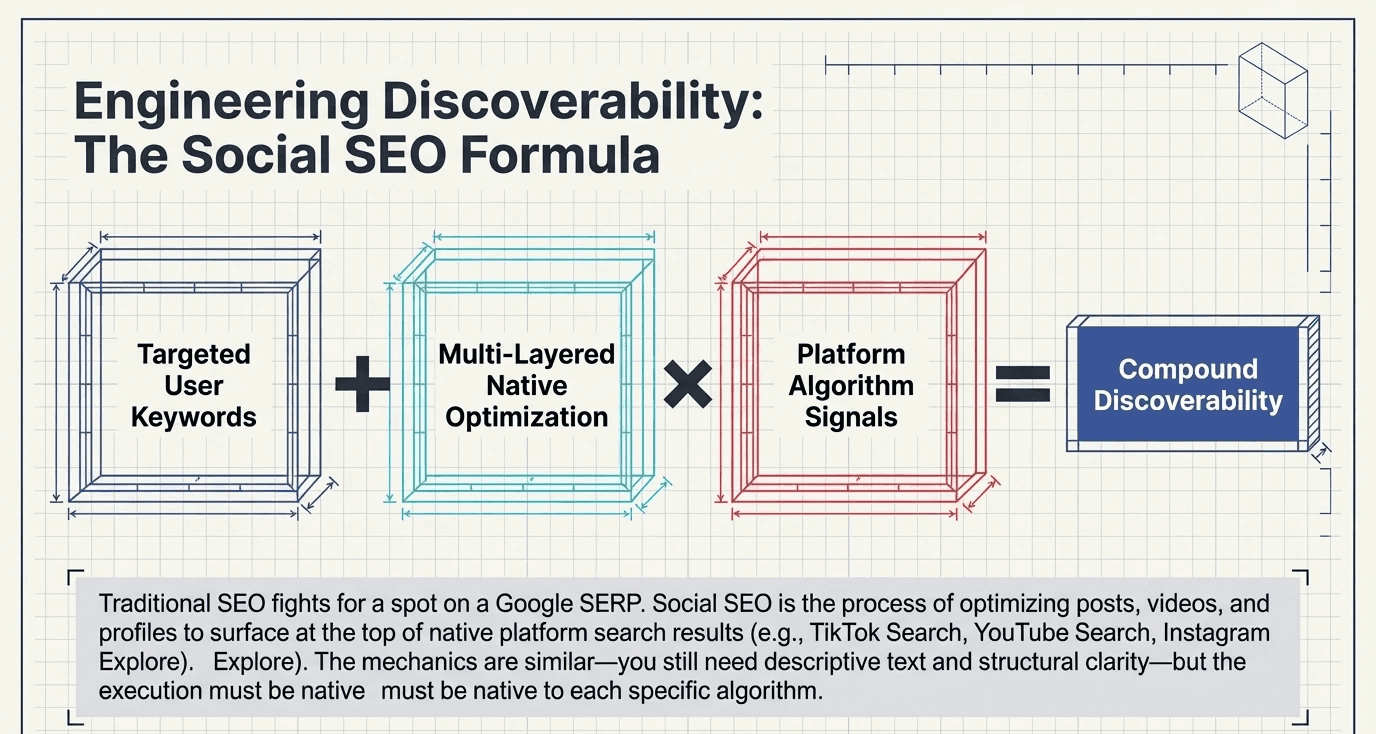
Traditional SEO is about getting your website to rank on Google. Social media SEO is about getting your posts, videos, and profiles to show up when someone searches inside TikTok, YouTube, Instagram, or any other platform.
The mechanics are similar. You use keywords. You write descriptive text. You structure your content so the platform's algorithm understands what it's about. But each platform has its own version of a search engine, and each one ranks content differently.
Quick Definition
Social media SEO = optimizing your social content so it surfaces in
platform search results. Think: TikTok search, YouTube search,
Instagram Explore; not just Google.
There's one more thing worth noting: social content increasingly shows up in Google too. YouTube videos appear in Google results constantly. TikToks surface in video carousels. Even Instagram posts and LinkedIn articles get indexed. So when you optimize for social search, you're often helping your Google visibility at the same time.
Also Read: Micro influencer vs macro influencer which is best for your business
Why Social Media SEO Matters
The numbers are hard to argue with at this point. Google's own internal research found that nearly 40% of younger users now go to TikTok or Instagram first when they're looking for something; a restaurant, a product, a solution to a problem. That was true a year ago. In 2026, it's even more pronounced.
Here's what's happening:
• Social platforms have built out real search functionality. TikTok, YouTube, and Instagram all have proper search bars now — with autocomplete, ranked results, and algorithm-driven discovery feeds.
• People trust social search results more. You're not getting a list of links. You're getting a real person showing you something. That's more persuasive for a lot of queries.
• AI tools are pulling from social content. When ChatGPT or Perplexity answers a question, it increasingly references video content and social posts, not just blog articles.
• Google itself is indexing more social content. So the line between social media and search is getting blurry fast.
The brands that understood Google SEO early built massive organic traffic advantages. The same thing is happening right now with social SEO, and most brands haven't caught on yet.
Social Media SEO by Platform: What Actually Works
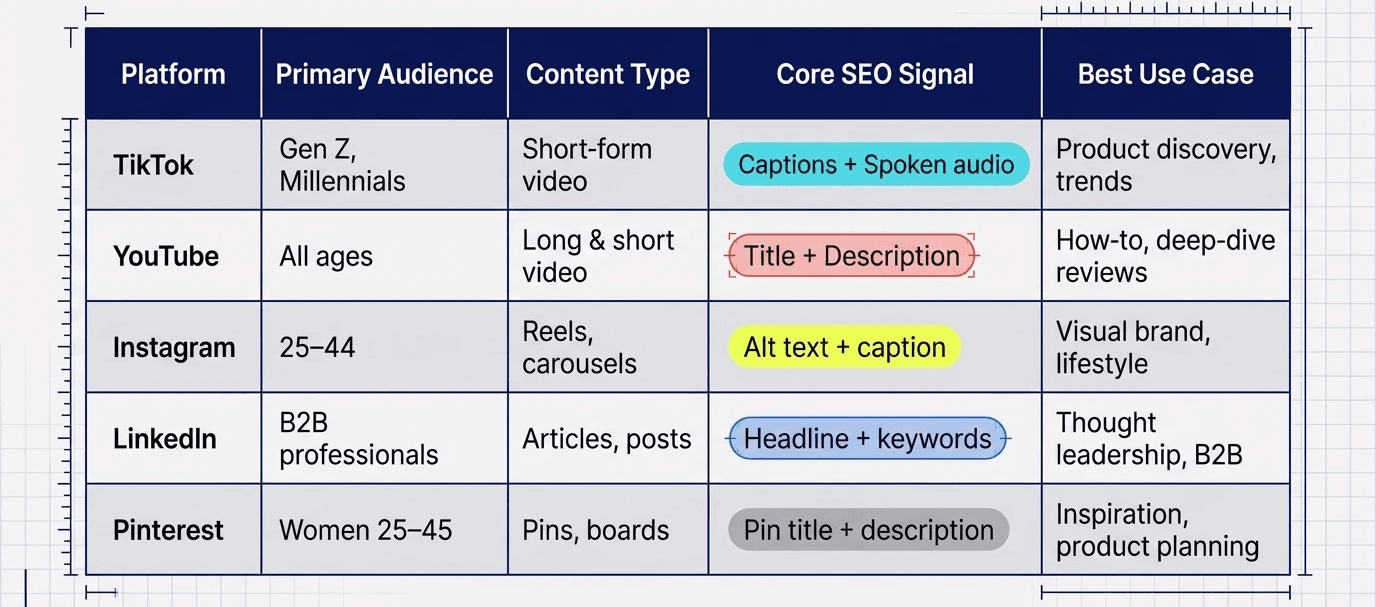
There's no one-size-fits-all approach here. Each platform has a different search engine under the hood. Here's what you need to know for each major one.
Platform Overview
Platform | Primary Audience | Content Type | Key SEO Signal | Best Use Case |
TikTok | Gen Z, Millennials | Short-form video | Captions + spoken words | Product discovery, trends |
YouTube | All ages | Long & short video | Title + description | How-to, deep-dive reviews |
25–44 | Reels, carousels | Alt text + caption | Visual brand, lifestyle | |
B2B professionals | Articles, posts | Headline + keywords | Thought leadership, B2B | |
Women 25–45 | Pins, boards | Pin title + description | Inspiration, product planning |
TikTok SEO: The Platform That Changed the Game
TikTok is where social SEO matters most right now. It's the fastest-growing search engine in the world for people under 30, and it's catching up fast with older audiences too.
The key thing to understand about TikTok search is that the algorithm reads everything — your captions, your on-screen text, and yes, your audio. If you say the keyword in the video, TikTok picks it up. That means optimization happens in three places at once.
What to do on TikTok:
• Put your main keyword in the first line of your caption — not buried at the end.
• Say the keyword out loud in the first three seconds of the video. TikTok transcribes audio and uses it as a ranking signal.
• Add on-screen text that includes your keyword. Think of it like a title tag for your video.
• Use three to five relevant hashtags; a mix of broad and specific. Don't go hashtag-crazy.
• Your account name matters too. If you can naturally include a keyword in your display name, it helps discoverability.
• Video completion rate is huge. TikTok rewards content people actually finish watching. So a strong hook is not optional; it's SEO.
What Is Social Media SEO and How Is It Different From Regular SEO?
Social media SEO is pretty much what it sounds like: optimizing your content on social platforms so people can find it through search.
Traditional SEO is about getting your website to rank on Google. Social media SEO is about getting your posts, videos, and profiles to show up when someone searches inside TikTok, YouTube, Instagram, or any other platform.
The mechanics are similar. You use keywords. You write descriptive text. You structure your content so the platform's algorithm understands what it's about. But each platform has its own version of a search engine, and each one ranks content differently.
Quick Definition
Social media SEO = optimizing your social content so it surfaces in
platform search results. Think: TikTok search, YouTube search,
Instagram Explore; not just Google.
There's one more thing worth noting: social content increasingly shows up in Google too. YouTube videos appear in Google results constantly. TikToks surface in video carousels. Even Instagram posts and LinkedIn articles get indexed. So when you optimize for social search, you're often helping your Google visibility at the same time.
Also Read: Micro influencer vs macro influencer which is best for your business
Why Social Media SEO Matters
The numbers are hard to argue with at this point. Google's own internal research found that nearly 40% of younger users now go to TikTok or Instagram first when they're looking for something; a restaurant, a product, a solution to a problem. That was true a year ago. In 2026, it's even more pronounced.
Here's what's happening:
• Social platforms have built out real search functionality. TikTok, YouTube, and Instagram all have proper search bars now — with autocomplete, ranked results, and algorithm-driven discovery feeds.
• People trust social search results more. You're not getting a list of links. You're getting a real person showing you something. That's more persuasive for a lot of queries.
• AI tools are pulling from social content. When ChatGPT or Perplexity answers a question, it increasingly references video content and social posts, not just blog articles.
• Google itself is indexing more social content. So the line between social media and search is getting blurry fast.
The brands that understood Google SEO early built massive organic traffic advantages. The same thing is happening right now with social SEO, and most brands haven't caught on yet.
Social Media SEO by Platform: What Actually Works
There's no one-size-fits-all approach here. Each platform has a different search engine under the hood. Here's what you need to know for each major one.
Platform Overview
Platform | Primary Audience | Content Type | Key SEO Signal | Best Use Case |
TikTok | Gen Z, Millennials | Short-form video | Captions + spoken words | Product discovery, trends |
YouTube | All ages | Long & short video | Title + description | How-to, deep-dive reviews |
25–44 | Reels, carousels | Alt text + caption | Visual brand, lifestyle | |
B2B professionals | Articles, posts | Headline + keywords | Thought leadership, B2B | |
Women 25–45 | Pins, boards | Pin title + description | Inspiration, product planning |
TikTok SEO: The Platform That Changed the Game
TikTok is where social SEO matters most right now. It's the fastest-growing search engine in the world for people under 30, and it's catching up fast with older audiences too.
The key thing to understand about TikTok search is that the algorithm reads everything — your captions, your on-screen text, and yes, your audio. If you say the keyword in the video, TikTok picks it up. That means optimization happens in three places at once.
What to do on TikTok:
• Put your main keyword in the first line of your caption — not buried at the end.
• Say the keyword out loud in the first three seconds of the video. TikTok transcribes audio and uses it as a ranking signal.
• Add on-screen text that includes your keyword. Think of it like a title tag for your video.
• Use three to five relevant hashtags; a mix of broad and specific. Don't go hashtag-crazy.
• Your account name matters too. If you can naturally include a keyword in your display name, it helps discoverability.
• Video completion rate is huge. TikTok rewards content people actually finish watching. So a strong hook is not optional; it's SEO.
YouTube SEO: The Most Underrated Visibility Channel
YouTube is the second-largest search engine in the world; and unlike TikTok, it feeds directly into Google search results too.
A well-optimized YouTube video can appear in YouTube search, in Google's regular results, in Google AI Overviews, and get referenced by AI tools like Perplexity or ChatGPT. No other content format has that kind of reach from a single piece of content.
What to do on YouTube:
• Your video title is your headline. Lead with the keyword, keep it under 60 characters, and make it sound like something a real person would search.
• Write a full description; at least 200 words; and use your main keyword in the first two sentences. Add related terms naturally throughout.
• Use timestamps (chapters). They help users navigate, and they help Google understand what the video is about.
• Choose tags carefully; they're less important than they used to be, but still relevant for topic categorization.
• Captions and transcripts matter. YouTube indexes them. Auto-captions work, but uploading your own is better.
• Click-through rate affects rankings. Your thumbnail and title work together to earn the click; treat them like a PPC ad.
What is Instagram SEO?
Instagram is increasingly a search destination, especially for products, aesthetics, and lifestyle content. The platform has improved its search function significantly, and posts now show up in Google results more often than they used to.
What to do on Instagram:
• Write captions like you'd write a short article intro. Get the keyword in early, be descriptive, and add context.
• Always fill in alt text on your images. It's meant for accessibility, but Instagram and Google both use it for indexing.
• Use location tags when relevant,local search on Instagram is very real.
• Your profile bio is indexed. Make sure it clearly explains who you are and what you do, with natural keyword placement.
• Reels get more search visibility than static posts right now. If you have to choose, prioritize video.
• Hashtags are secondary now, Instagram has said it publicly. Don't skip them entirely, but don't rely on them the way you did in 2020.
What is LinkedIn SEO?
LinkedIn gets overlooked in social SEO conversations, but it's a powerful search engine for B2B audiences. Professionals use it to find experts, agencies, tools, and services, and LinkedIn profiles and articles rank in Google.
What to do on LinkedIn:
• Treat your profile headline like a keyword-optimized title tag. Be specific about what you do and who you serve.
• Use the About section to naturally include the terms your ideal clients search for.
• Post articles directly on LinkedIn, they get indexed by Google and surface in LinkedIn search.
• Keywords in your post text matter. LinkedIn's search algorithm picks up on natural language.
Also read: How often you should post on Social Media
Common Social Media SEO Mistakes Brands Are Making
Most brands are making the same handful of mistakes. Here's what to stop doing:
• Treating captions as an afterthought. "Check out our new product!" tells the algorithm nothing. Be descriptive.
• Using the wrong keywords. What you call your product or service isn't always what your audience searches for. Do the research.
• Ignoring profile optimization. Your bio, your handle, your display name, all of it gets indexed. Make it count.
• Reposting the same content identically across every platform. Each platform has different signals. What works on TikTok doesn't translate exactly to YouTube.
• Chasing trends instead of building search traffic. Trends spike and die. Search content compounds over time.
• Not linking out. Where platforms allow it, link to your website. It drives traffic and builds cross-platform authority.
The Real Shift
Trend content = a spike today, gone tomorrow.
Search-optimized content = traffic that compounds over 6, 12, 24 months.
Both have a place — but most brands focus only on trends.
How to Build a Social Media SEO System?
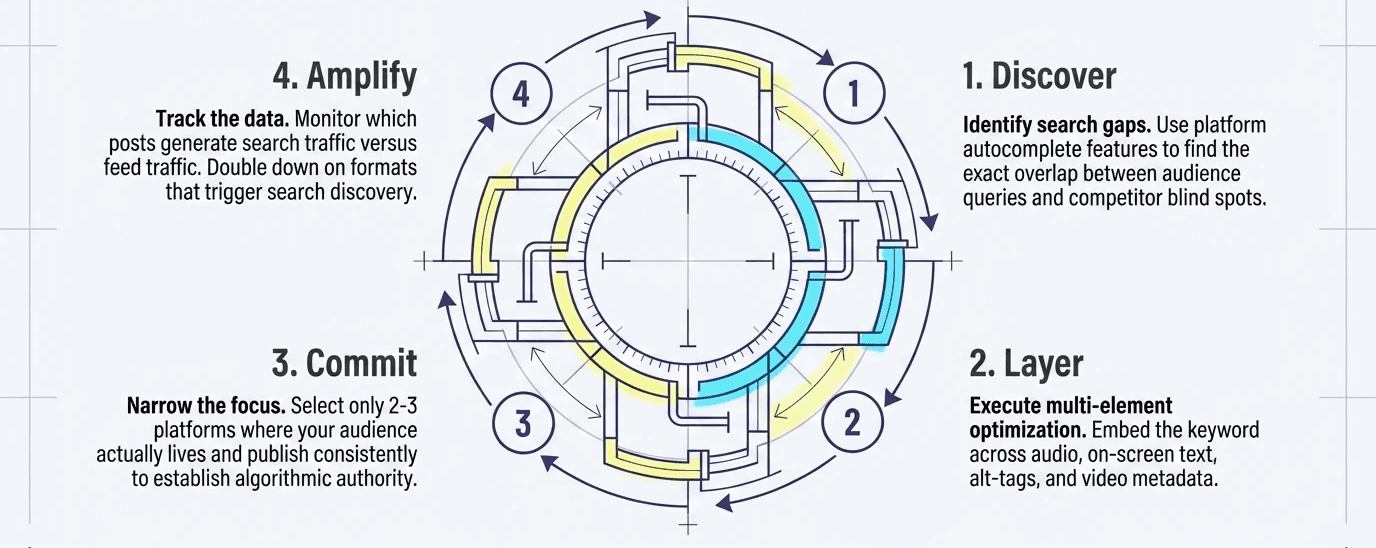
Social media SEO isn't a one-time fix. It's an ongoing system. Here's how to build one without it becoming a second job.
Step 1: Start With Keyword Research
Before you post anything, figure out what your audience is actually searching for on each platform. TikTok's search bar has autocomplete, type your topic and see what comes up. YouTube's suggestion tool is even more powerful. Tools like TubeBuddy help you find what people search on YouTube.
Look for the gap between what your audience searches and what your competitors have covered. That gap is your opportunity.
Step 2: Optimize Every Element, Not Just One
Don't just drop a keyword into your caption and call it done. On TikTok, you need it in the caption, the audio, and the on-screen text. On YouTube, it goes in the title, description, and your spoken script. On Instagram, it belongs in the caption and the alt text. Think in layers.
Step 3: Publish Consistently on 2 to 3 Platforms
You don't need to be everywhere. Pick the two or three platforms where your audience actually spends time, and own them. Consistent publishing signals to the algorithm that you're an active, relevant account. Sporadic posting kills your search visibility.
Step 4: Track What Works and Double Down
Most platforms now show you which posts got traffic from search vs. from your followers' feeds. Check those numbers. When a topic is driving search traffic, make more content around it. That's how you build compound visibility over time.
You Don't Have to Figure Out Social SEO Alone
This stuff works, but it does take time, consistency, and a clear strategy for each platform. Most business owners and marketing teams don't have bandwidth to do all of it well.
That's where a team like Motion Labs comes in. They handle the full social media pipeline, content strategy, video production, UGC campaigns, and platform-specific optimization, so you show up where your audience is searching without it taking over your calendar.
Want Your Brand to Show Up Everywhere?
Motion Labs handles your social media, video production, and content strategy end-to-end. From TikTok SEO-optimized videos to Instagram Reels and YouTube content — we build content that gets found.
Visit motionlabs.agency to get started.
YouTube SEO: The Most Underrated Visibility Channel
YouTube is the second-largest search engine in the world; and unlike TikTok, it feeds directly into Google search results too.
A well-optimized YouTube video can appear in YouTube search, in Google's regular results, in Google AI Overviews, and get referenced by AI tools like Perplexity or ChatGPT. No other content format has that kind of reach from a single piece of content.
What to do on YouTube:
• Your video title is your headline. Lead with the keyword, keep it under 60 characters, and make it sound like something a real person would search.
• Write a full description; at least 200 words; and use your main keyword in the first two sentences. Add related terms naturally throughout.
• Use timestamps (chapters). They help users navigate, and they help Google understand what the video is about.
• Choose tags carefully; they're less important than they used to be, but still relevant for topic categorization.
• Captions and transcripts matter. YouTube indexes them. Auto-captions work, but uploading your own is better.
• Click-through rate affects rankings. Your thumbnail and title work together to earn the click; treat them like a PPC ad.
What is Instagram SEO?
Instagram is increasingly a search destination, especially for products, aesthetics, and lifestyle content. The platform has improved its search function significantly, and posts now show up in Google results more often than they used to.
What to do on Instagram:
• Write captions like you'd write a short article intro. Get the keyword in early, be descriptive, and add context.
• Always fill in alt text on your images. It's meant for accessibility, but Instagram and Google both use it for indexing.
• Use location tags when relevant,local search on Instagram is very real.
• Your profile bio is indexed. Make sure it clearly explains who you are and what you do, with natural keyword placement.
• Reels get more search visibility than static posts right now. If you have to choose, prioritize video.
• Hashtags are secondary now, Instagram has said it publicly. Don't skip them entirely, but don't rely on them the way you did in 2020.
What is LinkedIn SEO?
LinkedIn gets overlooked in social SEO conversations, but it's a powerful search engine for B2B audiences. Professionals use it to find experts, agencies, tools, and services, and LinkedIn profiles and articles rank in Google.
What to do on LinkedIn:
• Treat your profile headline like a keyword-optimized title tag. Be specific about what you do and who you serve.
• Use the About section to naturally include the terms your ideal clients search for.
• Post articles directly on LinkedIn, they get indexed by Google and surface in LinkedIn search.
• Keywords in your post text matter. LinkedIn's search algorithm picks up on natural language.
Also read: How often you should post on Social Media
Common Social Media SEO Mistakes Brands Are Making
Most brands are making the same handful of mistakes. Here's what to stop doing:
• Treating captions as an afterthought. "Check out our new product!" tells the algorithm nothing. Be descriptive.
• Using the wrong keywords. What you call your product or service isn't always what your audience searches for. Do the research.
• Ignoring profile optimization. Your bio, your handle, your display name, all of it gets indexed. Make it count.
• Reposting the same content identically across every platform. Each platform has different signals. What works on TikTok doesn't translate exactly to YouTube.
• Chasing trends instead of building search traffic. Trends spike and die. Search content compounds over time.
• Not linking out. Where platforms allow it, link to your website. It drives traffic and builds cross-platform authority.
The Real Shift
Trend content = a spike today, gone tomorrow.
Search-optimized content = traffic that compounds over 6, 12, 24 months.
Both have a place — but most brands focus only on trends.
How to Build a Social Media SEO System?
Social media SEO isn't a one-time fix. It's an ongoing system. Here's how to build one without it becoming a second job.
Step 1: Start With Keyword Research
Before you post anything, figure out what your audience is actually searching for on each platform. TikTok's search bar has autocomplete, type your topic and see what comes up. YouTube's suggestion tool is even more powerful. Tools like TubeBuddy help you find what people search on YouTube.
Look for the gap between what your audience searches and what your competitors have covered. That gap is your opportunity.
Step 2: Optimize Every Element, Not Just One
Don't just drop a keyword into your caption and call it done. On TikTok, you need it in the caption, the audio, and the on-screen text. On YouTube, it goes in the title, description, and your spoken script. On Instagram, it belongs in the caption and the alt text. Think in layers.
Step 3: Publish Consistently on 2 to 3 Platforms
You don't need to be everywhere. Pick the two or three platforms where your audience actually spends time, and own them. Consistent publishing signals to the algorithm that you're an active, relevant account. Sporadic posting kills your search visibility.
Step 4: Track What Works and Double Down
Most platforms now show you which posts got traffic from search vs. from your followers' feeds. Check those numbers. When a topic is driving search traffic, make more content around it. That's how you build compound visibility over time.
You Don't Have to Figure Out Social SEO Alone
This stuff works, but it does take time, consistency, and a clear strategy for each platform. Most business owners and marketing teams don't have bandwidth to do all of it well.
That's where a team like Motion Labs comes in. They handle the full social media pipeline, content strategy, video production, UGC campaigns, and platform-specific optimization, so you show up where your audience is searching without it taking over your calendar.
Want Your Brand to Show Up Everywhere?
Motion Labs handles your social media, video production, and content strategy end-to-end. From TikTok SEO-optimized videos to Instagram Reels and YouTube content — we build content that gets found.
Visit motionlabs.agency to get started.
Conclusion
The separation between social media and search is closing fast. In 2026, TikTok is a search engine, YouTube is a search engine, Instagram is a search engine. And they're all feeding into the broader ecosystem that includes Google and AI tools.
The brands that are going to win organic visibility over the next few years aren't just the ones with the best websites. They're the ones who figured out that every caption, every video title, every piece of on-screen text is a chance to be found.
Social media SEO isn't complicated. But it does require intention. Start with keyword research, optimize your content properly for each platform, and publish consistently. The compounding effect will surprise you.
And if you want a team that handles all of it, from strategy to content to optimization, Motion Labs works with brands exactly like yours.
Frequently Asked Questions About Social Media SEO
1. Does social media help with Google SEO?
Yes, in multiple ways. Social profiles and posts from platforms like YouTube, LinkedIn, and even Instagram often appear in Google search results. Strong engagement on social content also builds brand authority, which Google uses as a trust signal. And YouTube videos specifically can rank in Google and appear in AI Overviews.
2. Which social platform is best for SEO in 2026?
It depends on your audience. For reaching Gen Z and Millennials with visual content, TikTok has the most untapped SEO opportunity right now. For long-term, evergreen visibility, YouTube is the strongest; especially because it feeds into Google. For B2B brands, LinkedIn is the place to invest. Most brands should focus on one or two platforms rather than spreading thin across all of them.
3. Do hashtags still matter for social media SEO?
Less than they used to, especially on Instagram, which has explicitly said that hashtags are no longer a primary discovery tool. On TikTok, hashtags still play a role in content categorization, but they've become secondary to captions and audio. On YouTube, they're largely irrelevant. Use them strategically, but don't rely on them as your main SEO lever.
4. How long does it take for social SEO to show results?
It varies by platform. TikTok can surface content in search results within hours if it gets strong early engagement. YouTube tends to build more slowly — an optimized video might pick up significant search traffic weeks or months after publishing. Across all platforms, search visibility from social tends to compound over time, so the results get better the longer you keep at it.
5. What's the difference between social SEO and social media marketing?
Social media marketing includes everything; paid ads, influencer campaigns, brand awareness, community management. Social SEO is specifically about making your organic content discoverable through search. They're connected, but social SEO is a subset of the broader social media marketing strategy. You can run great paid campaigns and still have zero search presence if your organic content isn't optimized.
6. Can small businesses compete with big brands in social SEO?
Yes; and in some ways, it's easier for smaller brands. Big brands often move slowly and stick to broadcast-style content. Small businesses can create niche, specific, keyword-targeted content that exactly matches what people are searching for. On TikTok especially, a well-optimized video from a small account can outrank content from brands with millions of followers if the engagement signals are strong.
7. Do I need to create different content for each platform?
You can use the same core topic across platforms, but you should adapt the format and optimization for each one. A YouTube video and a TikTok about the same subject should have different titles, captions, and structures based on how each platform's search algorithm works. Posting the exact same content copy-pasted across platforms tends to underperform.
Conclusion
The separation between social media and search is closing fast. In 2026, TikTok is a search engine, YouTube is a search engine, Instagram is a search engine. And they're all feeding into the broader ecosystem that includes Google and AI tools.
The brands that are going to win organic visibility over the next few years aren't just the ones with the best websites. They're the ones who figured out that every caption, every video title, every piece of on-screen text is a chance to be found.
Social media SEO isn't complicated. But it does require intention. Start with keyword research, optimize your content properly for each platform, and publish consistently. The compounding effect will surprise you.
And if you want a team that handles all of it, from strategy to content to optimization, Motion Labs works with brands exactly like yours.
Frequently Asked Questions About Social Media SEO
1. Does social media help with Google SEO?
Yes, in multiple ways. Social profiles and posts from platforms like YouTube, LinkedIn, and even Instagram often appear in Google search results. Strong engagement on social content also builds brand authority, which Google uses as a trust signal. And YouTube videos specifically can rank in Google and appear in AI Overviews.
2. Which social platform is best for SEO in 2026?
It depends on your audience. For reaching Gen Z and Millennials with visual content, TikTok has the most untapped SEO opportunity right now. For long-term, evergreen visibility, YouTube is the strongest; especially because it feeds into Google. For B2B brands, LinkedIn is the place to invest. Most brands should focus on one or two platforms rather than spreading thin across all of them.
3. Do hashtags still matter for social media SEO?
Less than they used to, especially on Instagram, which has explicitly said that hashtags are no longer a primary discovery tool. On TikTok, hashtags still play a role in content categorization, but they've become secondary to captions and audio. On YouTube, they're largely irrelevant. Use them strategically, but don't rely on them as your main SEO lever.
4. How long does it take for social SEO to show results?
It varies by platform. TikTok can surface content in search results within hours if it gets strong early engagement. YouTube tends to build more slowly — an optimized video might pick up significant search traffic weeks or months after publishing. Across all platforms, search visibility from social tends to compound over time, so the results get better the longer you keep at it.
5. What's the difference between social SEO and social media marketing?
Social media marketing includes everything; paid ads, influencer campaigns, brand awareness, community management. Social SEO is specifically about making your organic content discoverable through search. They're connected, but social SEO is a subset of the broader social media marketing strategy. You can run great paid campaigns and still have zero search presence if your organic content isn't optimized.
6. Can small businesses compete with big brands in social SEO?
Yes; and in some ways, it's easier for smaller brands. Big brands often move slowly and stick to broadcast-style content. Small businesses can create niche, specific, keyword-targeted content that exactly matches what people are searching for. On TikTok especially, a well-optimized video from a small account can outrank content from brands with millions of followers if the engagement signals are strong.
7. Do I need to create different content for each platform?
You can use the same core topic across platforms, but you should adapt the format and optimization for each one. A YouTube video and a TikTok about the same subject should have different titles, captions, and structures based on how each platform's search algorithm works. Posting the exact same content copy-pasted across platforms tends to underperform.
the call your competitor wish you would'nt take


Related Posts





Related Posts
Related Posts
Motion labs
info@motionlabs.agency


+971 55317 1706
C-1802, ONTARIO TOWER, PLOT NO. 49-0, BUSINESS BAY, DUBAI, 00000
click to meet me :)
click to meet me :)
© All Rights Reserved | 2026


Motion labs
info@motionlabs.agency
+971 55317 1706
C-1802, ONTARIO TOWER, PLOT NO. 49-0, BUSINESS BAY, DUBAI, 00000
Private policy
Terms & Conditions
© All Rights Reserved | 2026
click to meet me :)