/
/
What is UGC Content? The Complete Guide for 2026
What is UGC Content? The Complete Guide for 2026
5 min
read
What is UGC Content? The Complete Guide for 2026
What is UGC Content? The Complete Guide for 2026
Content
Marketing

Author
Scroll down
to read more!
Summerize with ChatGPT
Summerize with Gemini
Summerize with Claude
What is UGC Content? The Complete Guide for 2026
What is UGC Content? The Complete Guide for 2026
A customer films a 30-second TikTok of your product on their kitchen counter. No agency. No script. No studio lighting. It gets 1.4 million views. It drives more revenue than your last three paid campaigns combined. That is user-generated content (UGC) in action. In 2026, it is no longer rare.
A customer films a 30-second TikTok of your product on their kitchen counter. No agency. No script. No studio lighting. It gets 1.4 million views. It drives more revenue than your last three paid campaigns combined. That is user-generated content (UGC) in action. In 2026, it is no longer rare.
This guide explains what is UGC content and why it wins. It shows how to build a system around it. It also covers legal limits in the USA, UK, Germany, and France. If you run DTC, SaaS, or e-commerce, this is your 2026 UGC marketing playbook.
Key Takeaways
UGC content is content made by real customers, not the brand.
UGC ads deliver 4x higher CTR and 50% lower CPC than branded creative.
UGC content creators charge $100–$500 per video.
You need written permission to use customer content in paid ads.
The best UGC content strategy builds a content flywheel, not a one-off.
UGC content marketing ROI statistics 2026 include 29% more conversions.
What is UGC Content? A Clear Definition
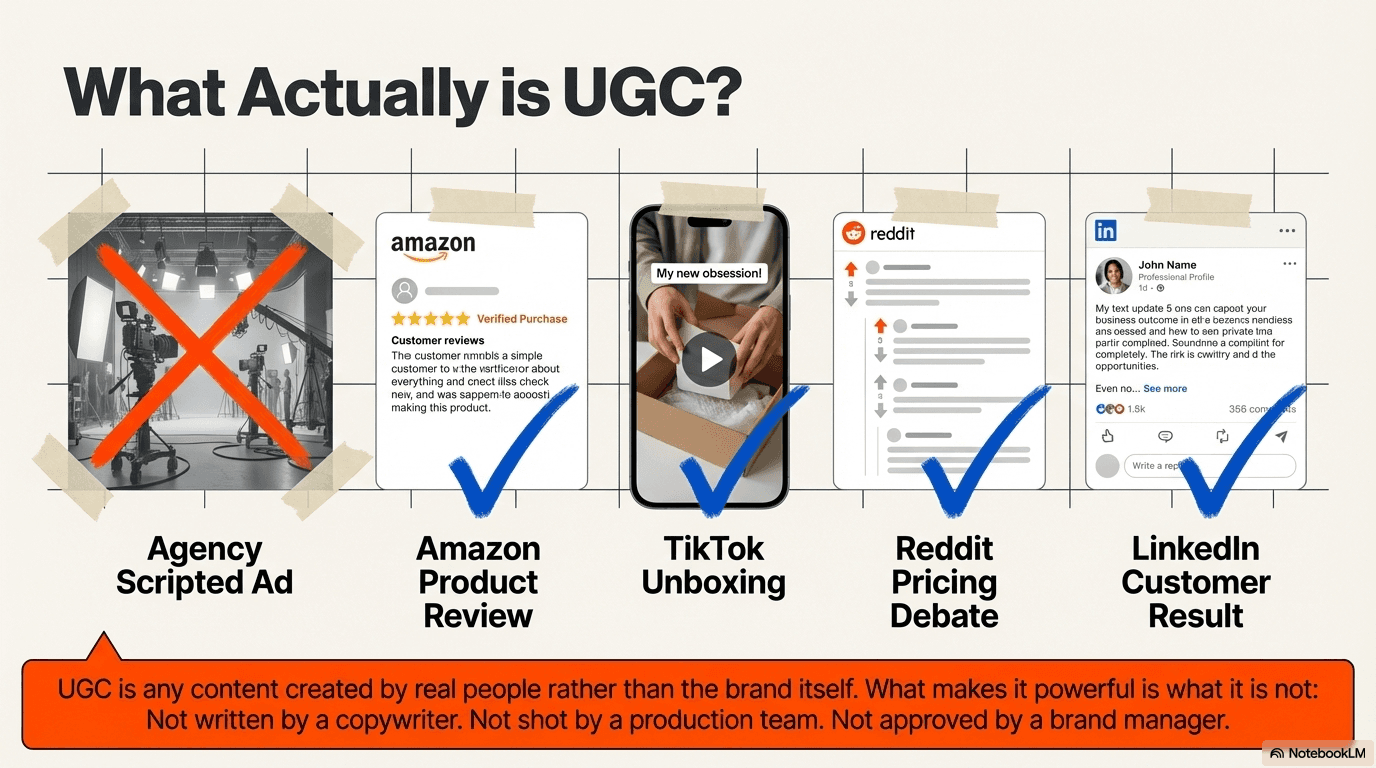
UGC means user-generated content. It is content made by real people, not the brand. This includes photos, videos, reviews, and social posts. It also includes unboxing clips and community threads. If a customer made it, it is UGC.
The user-generated content definition goes beyond social media. An Amazon review is UGC. A YouTube tutorial is UGC. A Reddit thread about your pricing is UGC. A LinkedIn post sharing results is UGC. If a real user makes it without a script, it is UGC.
UGC is powerful because of what it is not. It is not written by a copywriter. It is not shot by a production team. It is not approved by a brand manager. That raw style is why it converts.
In 2026, people spot branded content fast. They scroll past it without thinking. UGC stops the scroll because it looks like a friend’s post. It does not look like an ad.
The UGC Spectrum
Type | Example | Trust Level | Production Cost |
Organic reviews | Amazon, G2, Trustpilot | Highest | Free |
Social media posts | TikTok, Instagram, X | High | Free |
Customer testimonials | Video or written endorsements | High | Free to low |
Unboxing videos | YouTube, TikTok first impressions | High | Free |
Creator-produced UGC | Paid creators mimicking organic style | Medium-high | $100–$500 |
Employee-generated content | Team behind-the-scenes content | Medium | Low |
Types of User-Generated Content
Knowing the types of user-generated content helps your funnel.
It helps you capture trust signals at every stage.
Short-form video
Short video will be the top format in 2026.
TikTok, Reels, and Shorts reward authentic, unscripted clips.
This format gets 2.5x more engagement than long-form content.
Brands using creator content in paid social see 59% higher engagement.
This is at the same CPM.
Reviews and ratings
90% of consumers read reviews before buying.
Pages with reviews convert 4.5% higher than pages without.
Reviews are the bottom-of-funnel closer.
They matter a lot in Germany and France.
Buyers there often research deeply before purchasing.
Testimonials
A testimonial tells a story, not just a rating.
It shows the problem, the solution, and the result.
Video adds tone, facial cues, and body language.
Text cannot match that.
In the USA and UK, LinkedIn testimonials convert very well.
Tutorials and how-to content
Tutorials show how real customers use your product.
They teach others and prove the product works.
GoPro built a library from user-submitted adventure clips.
This user-generated content adds value at zero cost.
Community posts and social mentions
Tags, mentions, and threads build steady awareness.
They also create keyword variety for SEO.
Google’s 2026 EEAT system rewards this.
Why UGC Works: The Data Behind Authenticity
UGC marketing beats branded content on key metrics.
Here is what 2026 data shows:
Metric | UGC Performance | Branded Content | Difference |
Click-through rate | 4x higher | Baseline | +300% |
Cost per click | 50% lower | Baseline | -50% |
Conversion rate | 3–6% | 1–3% | +100–200% |
Cost per acquisition | 20–50% lower | Baseline | -20–50% |
Web conversions (with UGC gallery) | +29% lift | Baseline | +29% |
Ad memorability | 31% more memorable | Baseline | +31% |
People trust other people more than brands.
A relatable customer carries more weight than brand messaging.
Social proof and similarity bias amplify this effect.
They are strongest when UGC is the format.
The average person sees 6,000 to 10,000 ads daily.
UGC stops the scroll because it does not feel like an ad.
It feels like a friend sharing a find.
40% of shoppers abandon purchases without UGC or reviews.
These are the UGC content marketing ROI statistics 2026.
They should guide your CRO decisions this year.
UGC vs Influencer Marketing: What is the Difference?
The UGC vs influencer marketing question comes up often.
They are not the same thing.
Mixing them up can cost you money.
Factor | UGC | Influencer Marketing |
Creator | Customers, everyday users | Professional creators with large followings |
Motivation | Genuine experience | Paid partnership |
Cost | Free (organic) or $100–$500 | $1,000–$100,000+ per post |
Authenticity | High — feels real | Medium — feels sponsored |
Content ownership | Must negotiate rights | Defined in contract |
Best for | Ad creative, social proof, trust | Awareness, reach, launches |
My view after 20 years in growth marketing is simple. Influencer marketing rents someone else’s audience. UGC content builds assets you can reuse long-term. For most early and mid-growth brands, UGC wins on ROI. You can buy 20 UGC videos for one mid-tier influencer post.
The best approach in 2026 is a hybrid plan. Use UGC ads for lower-funnel performance. Use influencer content for top-funnel awareness. Together, they create a compounding content flywheel.
UGC Content Creator: Pricing, Platforms, and Process
A professional UGC content creator is not an influencer. They do not need a big following. They make content that looks like real customer UGC. They make it on demand for brands. Brands use it for ads, social posts, and on-site pages.
UGC creator pricing in 2026
Content Type | Price Range | What's Included |
Short-form video (15–60s) | $100–$500 | One video, basic editing, one revision |
Static photo set (3–5 images) | $250–$1,000 | Product photos in lifestyle settings |
Video package (3–5 videos) | $500–$2,000 | Multiple hooks, angles, revisions |
Full campaign package | $1,000–$5,000+ | Videos, photos, usage rights, revisions |
Where to find UGC creators
• Billo: Marketplace connecting brands with vetted creators. Best for ecommerce.
• Collabstr: Search and filter creators by niche, price, and platform.
• Insense: UGC platform with built-in rights management and ad integration.
• TikTok Creator Marketplace: Direct access to TikTok creators with performance data.
The UGC ad formula that converts
The highest-performing UGC ad structure in 2026, tested across hundreds of DTC and SaaS brands:
Hook (0–3 s): "I tried [product] for 30 days and here's what happened..."
Problem (3–8s): Describe the pain point the viewer instantly recognizes
Solution (8–20s): Show the product solving the problem naturally, no polish needed
Result (20–30s): Share the outcome with specific, believable details
CTA (last 3s): Soft call to action, never salesy, always conversational
This structure works because it mirrors how people naturally share recommendations with friends. No teleprompters. No studio backdrops. No brand guidelines are choking the authenticity.
How to Get UGC Content for Your Brand
The most common question from founders: how to get UGC content for your brand when you don't yet have a massive customer base. Here is the framework that works at every stage of growth.
Passive collection (always-on)
Monitor brand hashtags and mentions across TikTok, Instagram, X, YouTube, and Reddit.
Send a post-purchase review email 7–14 days after delivery, timed after they've actually used the product.
Create a branded hashtag. Make it simple, memorable, and searchable. It becomes your content discovery engine.
Active collection (campaign-driven)
Run UGC contests. Apple's Shot on iPhone turned millions of customers into content creators with a single prompt.
Add UGC prompts to packaging. A card in the box converts a percentage of every single order into content.
Build a customer community. Slack groups, Discord servers, and brand forums generate constant UGC naturally.
Understanding how to encourage customers to create UGC comes down to one principle: celebrate the people who create. Feature submitted content prominently on your site and social channels. People create more when they see others being recognized. The celebration drives more creation. The creation drives more celebration. This flywheel is the moat.
This guide explains what is UGC content and why it wins. It shows how to build a system around it. It also covers legal limits in the USA, UK, Germany, and France. If you run DTC, SaaS, or e-commerce, this is your 2026 UGC marketing playbook.
Key Takeaways
UGC content is content made by real customers, not the brand.
UGC ads deliver 4x higher CTR and 50% lower CPC than branded creative.
UGC content creators charge $100–$500 per video.
You need written permission to use customer content in paid ads.
The best UGC content strategy builds a content flywheel, not a one-off.
UGC content marketing ROI statistics 2026 include 29% more conversions.
What is UGC Content? A Clear Definition
UGC means user-generated content. It is content made by real people, not the brand. This includes photos, videos, reviews, and social posts. It also includes unboxing clips and community threads. If a customer made it, it is UGC.
The user-generated content definition goes beyond social media. An Amazon review is UGC. A YouTube tutorial is UGC. A Reddit thread about your pricing is UGC. A LinkedIn post sharing results is UGC. If a real user makes it without a script, it is UGC.
UGC is powerful because of what it is not. It is not written by a copywriter. It is not shot by a production team. It is not approved by a brand manager. That raw style is why it converts.
In 2026, people spot branded content fast. They scroll past it without thinking. UGC stops the scroll because it looks like a friend’s post. It does not look like an ad.
The UGC Spectrum
Type | Example | Trust Level | Production Cost |
Organic reviews | Amazon, G2, Trustpilot | Highest | Free |
Social media posts | TikTok, Instagram, X | High | Free |
Customer testimonials | Video or written endorsements | High | Free to low |
Unboxing videos | YouTube, TikTok first impressions | High | Free |
Creator-produced UGC | Paid creators mimicking organic style | Medium-high | $100–$500 |
Employee-generated content | Team behind-the-scenes content | Medium | Low |
Types of User-Generated Content
Knowing the types of user-generated content helps your funnel.
It helps you capture trust signals at every stage.
Short-form video
Short video will be the top format in 2026.
TikTok, Reels, and Shorts reward authentic, unscripted clips.
This format gets 2.5x more engagement than long-form content.
Brands using creator content in paid social see 59% higher engagement.
This is at the same CPM.
Reviews and ratings
90% of consumers read reviews before buying.
Pages with reviews convert 4.5% higher than pages without.
Reviews are the bottom-of-funnel closer.
They matter a lot in Germany and France.
Buyers there often research deeply before purchasing.
Testimonials
A testimonial tells a story, not just a rating.
It shows the problem, the solution, and the result.
Video adds tone, facial cues, and body language.
Text cannot match that.
In the USA and UK, LinkedIn testimonials convert very well.
Tutorials and how-to content
Tutorials show how real customers use your product.
They teach others and prove the product works.
GoPro built a library from user-submitted adventure clips.
This user-generated content adds value at zero cost.
Community posts and social mentions
Tags, mentions, and threads build steady awareness.
They also create keyword variety for SEO.
Google’s 2026 EEAT system rewards this.
Why UGC Works: The Data Behind Authenticity
UGC marketing beats branded content on key metrics.
Here is what 2026 data shows:
Metric | UGC Performance | Branded Content | Difference |
Click-through rate | 4x higher | Baseline | +300% |
Cost per click | 50% lower | Baseline | -50% |
Conversion rate | 3–6% | 1–3% | +100–200% |
Cost per acquisition | 20–50% lower | Baseline | -20–50% |
Web conversions (with UGC gallery) | +29% lift | Baseline | +29% |
Ad memorability | 31% more memorable | Baseline | +31% |
People trust other people more than brands.
A relatable customer carries more weight than brand messaging.
Social proof and similarity bias amplify this effect.
They are strongest when UGC is the format.
The average person sees 6,000 to 10,000 ads daily.
UGC stops the scroll because it does not feel like an ad.
It feels like a friend sharing a find.
40% of shoppers abandon purchases without UGC or reviews.
These are the UGC content marketing ROI statistics 2026.
They should guide your CRO decisions this year.
UGC vs Influencer Marketing: What is the Difference?
The UGC vs influencer marketing question comes up often.
They are not the same thing.
Mixing them up can cost you money.
Factor | UGC | Influencer Marketing |
Creator | Customers, everyday users | Professional creators with large followings |
Motivation | Genuine experience | Paid partnership |
Cost | Free (organic) or $100–$500 | $1,000–$100,000+ per post |
Authenticity | High — feels real | Medium — feels sponsored |
Content ownership | Must negotiate rights | Defined in contract |
Best for | Ad creative, social proof, trust | Awareness, reach, launches |
My view after 20 years in growth marketing is simple. Influencer marketing rents someone else’s audience. UGC content builds assets you can reuse long-term. For most early and mid-growth brands, UGC wins on ROI. You can buy 20 UGC videos for one mid-tier influencer post.
The best approach in 2026 is a hybrid plan. Use UGC ads for lower-funnel performance. Use influencer content for top-funnel awareness. Together, they create a compounding content flywheel.
UGC Content Creator: Pricing, Platforms, and Process
A professional UGC content creator is not an influencer. They do not need a big following. They make content that looks like real customer UGC. They make it on demand for brands. Brands use it for ads, social posts, and on-site pages.
UGC creator pricing in 2026
Content Type | Price Range | What's Included |
Short-form video (15–60s) | $100–$500 | One video, basic editing, one revision |
Static photo set (3–5 images) | $250–$1,000 | Product photos in lifestyle settings |
Video package (3–5 videos) | $500–$2,000 | Multiple hooks, angles, revisions |
Full campaign package | $1,000–$5,000+ | Videos, photos, usage rights, revisions |
Where to find UGC creators
• Billo: Marketplace connecting brands with vetted creators. Best for ecommerce.
• Collabstr: Search and filter creators by niche, price, and platform.
• Insense: UGC platform with built-in rights management and ad integration.
• TikTok Creator Marketplace: Direct access to TikTok creators with performance data.
The UGC ad formula that converts
The highest-performing UGC ad structure in 2026, tested across hundreds of DTC and SaaS brands:
Hook (0–3 s): "I tried [product] for 30 days and here's what happened..."
Problem (3–8s): Describe the pain point the viewer instantly recognizes
Solution (8–20s): Show the product solving the problem naturally, no polish needed
Result (20–30s): Share the outcome with specific, believable details
CTA (last 3s): Soft call to action, never salesy, always conversational
This structure works because it mirrors how people naturally share recommendations with friends. No teleprompters. No studio backdrops. No brand guidelines are choking the authenticity.
How to Get UGC Content for Your Brand
The most common question from founders: how to get UGC content for your brand when you don't yet have a massive customer base. Here is the framework that works at every stage of growth.
Passive collection (always-on)
Monitor brand hashtags and mentions across TikTok, Instagram, X, YouTube, and Reddit.
Send a post-purchase review email 7–14 days after delivery, timed after they've actually used the product.
Create a branded hashtag. Make it simple, memorable, and searchable. It becomes your content discovery engine.
Active collection (campaign-driven)
Run UGC contests. Apple's Shot on iPhone turned millions of customers into content creators with a single prompt.
Add UGC prompts to packaging. A card in the box converts a percentage of every single order into content.
Build a customer community. Slack groups, Discord servers, and brand forums generate constant UGC naturally.
Understanding how to encourage customers to create UGC comes down to one principle: celebrate the people who create. Feature submitted content prominently on your site and social channels. People create more when they see others being recognized. The celebration drives more creation. The creation drives more celebration. This flywheel is the moat.
UGC Content Strategy: The Complete Playbook
A great UGC content strategy for small businesses and scaling brands alike doesn't require a large team. It requires a clear system. Here is the week-by-week playbook.
Week 1: Set up collection
Create your branded hashtag and activate social listening across all platforms
Add a post-purchase review email flow (trigger: 7–14 days after delivery)
Add a UGC prompt to your packaging or onboarding sequence
Audit your existing UGC — search your brand on TikTok, Instagram, and Reddit right now
Weeks 2–4: Build your UGC library
Collect and organize the UGC you already have; most brands are sitting on a goldmine they haven't actioned
Reach out to 5–10 customers who've already posted about you and request usage rights
Hire 2–3 creators from the best UGC platforms for brands 2026 (Billo, Collabstr) for $100–$300 each for initial test videos
Month 2: Test in paid media
Run A/B tests: UGC creative vs your existing branded creative on identical audiences
Test 3–5 different UGC videos at $50–$100/day each
Measure CTR, CPC, and CPA against your branded benchmarks
Scale winners. Kill losers. Repeat.
Month 3: Systematize
Build repeatable monthly creator briefs and a weekly content review cadence
Create a UGC content calendar that refreshes ad creative every 2–4 weeks
Track performance by creator, format, and hook to identify winning patterns
The content flywheel: More customers → More UGC → Better ad creative → Lower CPA → More customers. The compounding starts slowly and then accelerates. Brands that build this system in 2026 will own it for years.
What is UGC Content on TikTok? The Platform-Specific Playbook
Understanding what UGC content is on TikTok matters. TikTok is now a search tool for ages 16–34. Social platforms drive most brand research for young adults. Social scrolling often beats text search for discovery.
On TikTok, UGC shows up in three forms. First are organic customer posts that tag or mention your brand. Second is creator-made content that looks organic and is licensed by the brand. Third is duets and stitches that boost reach through community interaction.
TikTok's Trend Discovery tool helps teams find trending keywords, sounds, and formats. UGC should match those trends when it fits. The algorithm rewards authenticity. UGC often beats polished brand content in reach, sometimes by huge margins.
If you target France and Germany, use local hooks in the native language. These beat translated US content most of the time. Invest in local creators who know the culture, not just words.
5 Brands That Built Their Growth Engine on UGC
GoPro
GoPro turned customers into its full content team. Users submit sports clips, travel videos, and underwater shots. GoPro uses these as marketing content. Its YouTube channel is mostly user content. It has billions of views and a near-zero production cost.
Apple: Shot on iPhone
This is one of the most successful UGC campaigns ever. iPhone users have created billions of photos. Apple featured them on billboards, TV, and social ads worldwide. The message is simple. Regular people can take great photos with this camera. The audience makes the content. The brand curates it.
Glossier
Glossier grew using customer selfies and community reviews. Its Instagram mixes product shots with real customers. Customers create the content. The content helps sell the product. No agency is needed.
Airbnb
Airbnb uses guest photos and stories instead of stock images. Listings feel real because travelers took the visuals. This UGC strategy helped build trust in the platform. Guests often stay in a stranger's home. That is a high-trust consumer tech purchase.
Fenty Beauty
Fenty uses customer tutorials and reviews to support its inclusivity. Real customers show products across many skin tones. This feels more authentic than brand-made campaigns.
UGC Legal Rights and Permissions
UGC legal rights and permissions are often ignored until they become a risk. This matters even more in the UK, Germany, and France. GDPR adds extra compliance work.
Copyright: Who owns UGC?
Customers own the content they create. Posting a photo on Instagram does not give you copyright. You need clear permission for commercial use. This includes paid ads, your website, and promotions.
How to get rights
Contact the creator via DM, email, or a rights request form.
Say exactly how you'll use the content. List social, paid ads, website, email, and print.
Specify the duration. Examples include 6 months, 1 year, or perpetual.
Specify the territories. Examples include US only, EU, or worldwide.
Get written confirmation and save it. Tools like TINT and Insense can automate this.
Credit the creator when you can. It is not always required. It builds goodwill and drives more content.
Best UGC Platforms for Brands 2026
Tool | Best For | Starting Price | Key Feature |
Bazaarvoice | Reviews and ratings at scale | Custom pricing | Syndication across retailer sites |
Yotpo | E-commerce UGC | Free tier available | Reviews, photos, loyalty integration |
TINT | Visual UGC aggregation | Custom pricing | Pulls from 15+ social platforms |
Billo | Creator marketplace | Pay per video | Vetted creators, fast turnaround |
Collabstr | Finding UGC creators | Pay per creator | Search by niche, price, platform |
Insense | UGC ads + rights management | $400/mo | Built-in ad integration |
Later | UGC discovery + scheduling | $25/mo | Streamlined repost workflow |
For early-stage brands, start with Yotpo's free tier for reviews. Collect social UGC by tracking your brand hashtag. You do not need a platform at first. Add a tool once you cannot manage UGC by hand. For scaling brands, consider TINT or Bazaarvoice. Use them for aggregation and rights at scale. Use them for dynamic product page displays too.
UGC Content Strategy: The Complete Playbook
A great UGC content strategy for small businesses and scaling brands alike doesn't require a large team. It requires a clear system. Here is the week-by-week playbook.
Week 1: Set up collection
Create your branded hashtag and activate social listening across all platforms
Add a post-purchase review email flow (trigger: 7–14 days after delivery)
Add a UGC prompt to your packaging or onboarding sequence
Audit your existing UGC — search your brand on TikTok, Instagram, and Reddit right now
Weeks 2–4: Build your UGC library
Collect and organize the UGC you already have; most brands are sitting on a goldmine they haven't actioned
Reach out to 5–10 customers who've already posted about you and request usage rights
Hire 2–3 creators from the best UGC platforms for brands 2026 (Billo, Collabstr) for $100–$300 each for initial test videos
Month 2: Test in paid media
Run A/B tests: UGC creative vs your existing branded creative on identical audiences
Test 3–5 different UGC videos at $50–$100/day each
Measure CTR, CPC, and CPA against your branded benchmarks
Scale winners. Kill losers. Repeat.
Month 3: Systematize
Build repeatable monthly creator briefs and a weekly content review cadence
Create a UGC content calendar that refreshes ad creative every 2–4 weeks
Track performance by creator, format, and hook to identify winning patterns
The content flywheel: More customers → More UGC → Better ad creative → Lower CPA → More customers. The compounding starts slowly and then accelerates. Brands that build this system in 2026 will own it for years.
What is UGC Content on TikTok? The Platform-Specific Playbook
Understanding what UGC content is on TikTok matters. TikTok is now a search tool for ages 16–34. Social platforms drive most brand research for young adults. Social scrolling often beats text search for discovery.
On TikTok, UGC shows up in three forms. First are organic customer posts that tag or mention your brand. Second is creator-made content that looks organic and is licensed by the brand. Third is duets and stitches that boost reach through community interaction.
TikTok's Trend Discovery tool helps teams find trending keywords, sounds, and formats. UGC should match those trends when it fits. The algorithm rewards authenticity. UGC often beats polished brand content in reach, sometimes by huge margins.
If you target France and Germany, use local hooks in the native language. These beat translated US content most of the time. Invest in local creators who know the culture, not just words.
5 Brands That Built Their Growth Engine on UGC
GoPro
GoPro turned customers into its full content team. Users submit sports clips, travel videos, and underwater shots. GoPro uses these as marketing content. Its YouTube channel is mostly user content. It has billions of views and a near-zero production cost.
Apple: Shot on iPhone
This is one of the most successful UGC campaigns ever. iPhone users have created billions of photos. Apple featured them on billboards, TV, and social ads worldwide. The message is simple. Regular people can take great photos with this camera. The audience makes the content. The brand curates it.
Glossier
Glossier grew using customer selfies and community reviews. Its Instagram mixes product shots with real customers. Customers create the content. The content helps sell the product. No agency is needed.
Airbnb
Airbnb uses guest photos and stories instead of stock images. Listings feel real because travelers took the visuals. This UGC strategy helped build trust in the platform. Guests often stay in a stranger's home. That is a high-trust consumer tech purchase.
Fenty Beauty
Fenty uses customer tutorials and reviews to support its inclusivity. Real customers show products across many skin tones. This feels more authentic than brand-made campaigns.
UGC Legal Rights and Permissions
UGC legal rights and permissions are often ignored until they become a risk. This matters even more in the UK, Germany, and France. GDPR adds extra compliance work.
Copyright: Who owns UGC?
Customers own the content they create. Posting a photo on Instagram does not give you copyright. You need clear permission for commercial use. This includes paid ads, your website, and promotions.
How to get rights
Contact the creator via DM, email, or a rights request form.
Say exactly how you'll use the content. List social, paid ads, website, email, and print.
Specify the duration. Examples include 6 months, 1 year, or perpetual.
Specify the territories. Examples include US only, EU, or worldwide.
Get written confirmation and save it. Tools like TINT and Insense can automate this.
Credit the creator when you can. It is not always required. It builds goodwill and drives more content.
Best UGC Platforms for Brands 2026
Tool | Best For | Starting Price | Key Feature |
Bazaarvoice | Reviews and ratings at scale | Custom pricing | Syndication across retailer sites |
Yotpo | E-commerce UGC | Free tier available | Reviews, photos, loyalty integration |
TINT | Visual UGC aggregation | Custom pricing | Pulls from 15+ social platforms |
Billo | Creator marketplace | Pay per video | Vetted creators, fast turnaround |
Collabstr | Finding UGC creators | Pay per creator | Search by niche, price, platform |
Insense | UGC ads + rights management | $400/mo | Built-in ad integration |
Later | UGC discovery + scheduling | $25/mo | Streamlined repost workflow |
For early-stage brands, start with Yotpo's free tier for reviews. Collect social UGC by tracking your brand hashtag. You do not need a platform at first. Add a tool once you cannot manage UGC by hand. For scaling brands, consider TINT or Bazaarvoice. Use them for aggregation and rights at scale. Use them for dynamic product page displays too.
Conclusion
What is UGC content? It is a cost-effective and high-converting format for brands in 2026. It includes photos, videos, reviews, and testimonials from real users. It often beats agency and in-house creative by a wide margin.
UGC marketing works because it is word of mouth. UGC is word of mouth at scale. Social platforms and paid ads amplify it. Brands that use it well grow faster. They spend less on creativity. They build stronger trust with their audience.
Three actions to take today
Audit your existing UGC. Search your brand name on TikTok, Instagram, X, and YouTube. You likely have UGC you have not seen. Save it, organize it, and request rights.
Run one UGC ad test. Hire one creator for $150 or use a customer video. Run it versus your best branded ad with $500. Compare CTR, CPC, and CPA.
Build the system. Add UGC collection to your post-purchase flow. Check mentions each week. Treat UGC like a machine, not a one-time campaign.
Check out the PDF for summary & details: Click here
Frequently Asked Questions
Q1. What does UGC stand for?
UGC means user-generated content. It includes photos, videos, reviews, and social posts. Real customers create it, not the brand. What makes it UGC is the source. It comes from the audience, not the marketing team.
Q2. What is the difference between UGC and influencer marketing?
UGC vs. influencer marketing is about source and intent. UGC comes from everyday customers sharing real experiences. Influencer marketing uses paid creators with established audiences. Influencer content is made under a contract. UGC is often cheaper and feels raw. Influencer content is more polished and audience-driven. Many brands use both in 2026.
Q3. How much does a UGC content creator charge?
A UGC content creator often charges $100–$500 per short video. Videos are usually 15–60 seconds. Photo sets often cost $250–$1,000. Larger packages with full usage rights can cost $1,000 to $5,000+. Negotiate usage rights separately from creation fees.
Q4. Do I need permission to use customer UGC?
Yes, you need explicit permission for commercial use. UGC legal rights and permissions should be written and specific. Include platform, duration, and territory. For EU markets, GDPR needs documented opt-in consent. General terms of service are not enough for ads.
Q5. What are the best types of user-generated content for ads?
Short-form video performs best for paid social in 2026. The best types of user-generated content include unboxings and first impressions. They also include problem-solution testimonials. Tutorials and how-to videos work well, too. "Honest review" clips often convert strongly. These work best when they feel organic, not scripted.
Q6. What is UGC content on TikTok specifically?
What UGC content on TikTok includes three main forms. It includes customer posts that tag or mention your brand. It includes creator-made posts that look organic and are licensed by the brand. It also includes duets and stitches that expand reach. TikTok rewards authentic content. That is why UGC often beats polished brand content.
Conclusion
What is UGC content? It is a cost-effective and high-converting format for brands in 2026. It includes photos, videos, reviews, and testimonials from real users. It often beats agency and in-house creative by a wide margin.
UGC marketing works because it is word of mouth. UGC is word of mouth at scale. Social platforms and paid ads amplify it. Brands that use it well grow faster. They spend less on creativity. They build stronger trust with their audience.
Three actions to take today
Audit your existing UGC. Search your brand name on TikTok, Instagram, X, and YouTube. You likely have UGC you have not seen. Save it, organize it, and request rights.
Run one UGC ad test. Hire one creator for $150 or use a customer video. Run it versus your best branded ad with $500. Compare CTR, CPC, and CPA.
Build the system. Add UGC collection to your post-purchase flow. Check mentions each week. Treat UGC like a machine, not a one-time campaign.
Check out the PDF for summary & details: Click here
Frequently Asked Questions
Q1. What does UGC stand for?
UGC means user-generated content. It includes photos, videos, reviews, and social posts. Real customers create it, not the brand. What makes it UGC is the source. It comes from the audience, not the marketing team.
Q2. What is the difference between UGC and influencer marketing?
UGC vs. influencer marketing is about source and intent. UGC comes from everyday customers sharing real experiences. Influencer marketing uses paid creators with established audiences. Influencer content is made under a contract. UGC is often cheaper and feels raw. Influencer content is more polished and audience-driven. Many brands use both in 2026.
Q3. How much does a UGC content creator charge?
A UGC content creator often charges $100–$500 per short video. Videos are usually 15–60 seconds. Photo sets often cost $250–$1,000. Larger packages with full usage rights can cost $1,000 to $5,000+. Negotiate usage rights separately from creation fees.
Q4. Do I need permission to use customer UGC?
Yes, you need explicit permission for commercial use. UGC legal rights and permissions should be written and specific. Include platform, duration, and territory. For EU markets, GDPR needs documented opt-in consent. General terms of service are not enough for ads.
Q5. What are the best types of user-generated content for ads?
Short-form video performs best for paid social in 2026. The best types of user-generated content include unboxings and first impressions. They also include problem-solution testimonials. Tutorials and how-to videos work well, too. "Honest review" clips often convert strongly. These work best when they feel organic, not scripted.
Q6. What is UGC content on TikTok specifically?
What UGC content on TikTok includes three main forms. It includes customer posts that tag or mention your brand. It includes creator-made posts that look organic and are licensed by the brand. It also includes duets and stitches that expand reach. TikTok rewards authentic content. That is why UGC often beats polished brand content.
the call your competitor wish you would'nt take


Related Posts






Related Posts
Related Posts
Motion labs
info@motionlabs.agency


+971 55317 1706
C-1802, ONTARIO TOWER, PLOT NO. 49-0, BUSINESS BAY, DUBAI, 00000
click to meet me :)
click to meet me :)
© All Rights Reserved | 2026


Motion labs
info@motionlabs.agency
+971 55317 1706
C-1802, ONTARIO TOWER, PLOT NO. 49-0, BUSINESS BAY, DUBAI, 00000
Private policy
Terms & Conditions
© All Rights Reserved | 2026
click to meet me :)