/
/
Best Performance Marketing Agencies: How to Pick One That Actually Fills Your Pipeline
Best Performance Marketing Agencies: How to Pick One That Actually Fills Your Pipeline
5 min
read
Best Performance Marketing Agencies: How to Pick One That Actually Fills Your Pipeline
Best Performance Marketing Agencies: How to Pick One That Actually Fills Your Pipeline
Marketing
Meta & Google ads

Author

Scroll down
to read more!
Summerize with ChatGPT
Summerize with Gemini
Summerize with Claude
Best Performance Marketing Agencies: How to Pick One That Actually Fills Your Pipeline
Best Performance Marketing Agencies: How to Pick One That Actually Fills Your Pipeline
A practical guide for B2B, SaaS, ecommerce and lead generation businesses. Most companies do not have a traffic problem. They have a conversion problem wearing a traffic costume. You spend on ads, the impressions look healthy, the click numbers look fine, and then the sales team says the leads are junk. That gap is exactly where performance marketing lives. We work with founders and marketing heads every week who have already burned through two or three agencies. The pattern is almost always the same. The agency reported on reach. Nobody reported on revenue. This guide breaks down what the best performance marketing agencies actually do differently, how B2B, SaaS and ecommerce needs are split apart, and how to use performance marketing on your own website so the traffic you already pay for stops leaking.
A practical guide for B2B, SaaS, ecommerce and lead generation businesses. Most companies do not have a traffic problem. They have a conversion problem wearing a traffic costume. You spend on ads, the impressions look healthy, the click numbers look fine, and then the sales team says the leads are junk. That gap is exactly where performance marketing lives. We work with founders and marketing heads every week who have already burned through two or three agencies. The pattern is almost always the same. The agency reported on reach. Nobody reported on revenue. This guide breaks down what the best performance marketing agencies actually do differently, how B2B, SaaS and ecommerce needs are split apart, and how to use performance marketing on your own website so the traffic you already pay for stops leaking.
Quick summary Performance marketing pays for outcomes, not exposure. The strongest agencies work backwards from cost per qualified lead or return on ad spend, treat creative as the main lever, and build landing experiences that match the ad promise. Everything else is reporting theatre. |
Performance marketing is any paid activity where you pay for a measurable action instead of paying for visibility. A click, a form fill, a demo booked, a trial started, a purchase completed. The spend is tied to something that shows up in your CRM or your checkout.
The mechanics are simple enough. You pick a channel, you set a target action, you attach a value to that action, and you optimize until the cost of the action sits below what the action is worth to you. The hard part is not the setup. The hard part is knowing which action to buy, and building creative and landing pages good enough that the action is affordable.
Paid search captures people already looking for a solution
Paid social creates demand from people who were not searching yet
Retargeting recovers the visitors who left without converting
Affiliate and partner channels pay only on a closed action
Creator and UGC campaigns feed fresh ad angles into all of the above
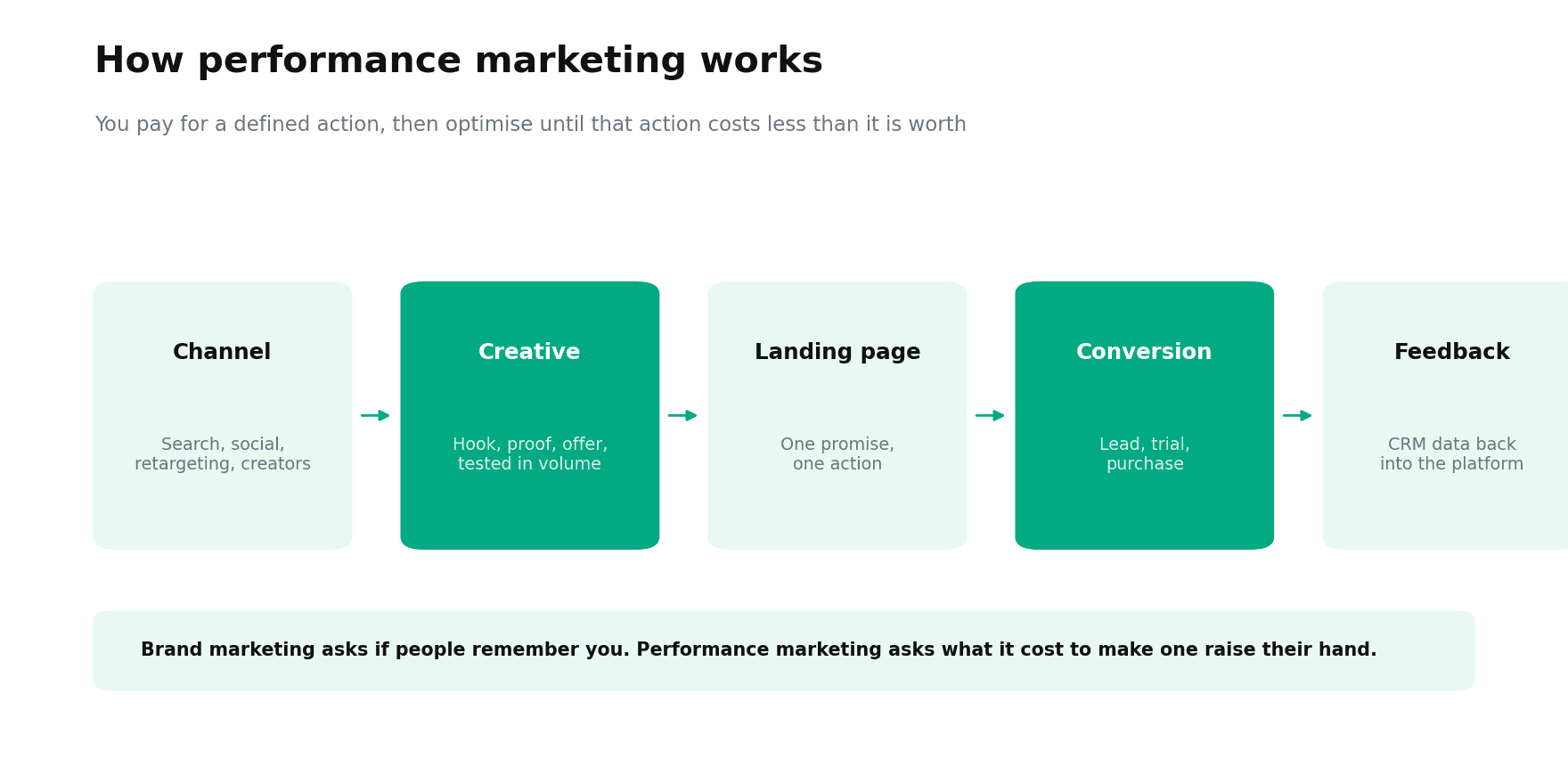
How performance marketing works, from channel to creative to conversion and back into the platform
Brand marketing asks whether people remember you. Performance marketing asks what it cost to make one of them raise their hand. Both matter. Only one of them can be defended line by line in a budget meeting.
Approach | What you buy | How success is judged | Feedback speed |
|---|---|---|---|
Brand marketing | Attention and recall | Awareness lift, share of voice | Months |
Traditional digital | Impressions and traffic | Sessions, reach, engagement | Weeks |
Performance marketing | A defined action | CPL, CAC, ROAS, pipeline | Days |
What Makes the Best Performance Marketing Agencies Different?
There is no shortage of teams that can run ads. The gap between an average agency and one of the best performance marketing agencies shows up in four places, and none of them are in the media buying itself.
They start with your economics, not your ad account
Before touching a campaign, a good team wants to know your average deal size, your close rate by lead source, your payback period and your churn. Without those numbers, nobody can tell you whether a lead at a certain cost is a win or a slow leak. If an agency quotes you a strategy before asking about your sales cycle, that is a signal.
They treat creative as the biggest lever
Targeting options have flattened out across every major platform. Algorithms find your buyer if you feed them a signal worth chasing. The variable you still fully control is the creative. This is why we build performance work around volume of tested angles rather than volume of ad sets. Hook, first three seconds, proof, offer. Change those and the numbers move. Change bid strategy and you get a rounding error.
They own the page after the click
An agency that hands off at the click is only doing half the job. The best ones write the landing page, argue about the form fields, cut the hero copy down, and test the offer. Ad and page have to make the same promise or the money evaporates between the two.
They report on outcomes your CFO recognises
Cost per qualified lead, pipeline created, blended acquisition cost, contribution margin. Not impressions. Not engagement rate. If a monthly report cannot be traced to money, it is a status update, not a performance report.
What to ask on a first call Ask any agency to walk you through one account where the numbers went the wrong way and what they changed. Anyone can present a winner. How a team diagnoses a losing month tells you far more about whether they will fix yours. |
Quick summary Performance marketing pays for outcomes, not exposure. The strongest agencies work backwards from cost per qualified lead or return on ad spend, treat creative as the main lever, and build landing experiences that match the ad promise. Everything else is reporting theatre. |
Performance marketing is any paid activity where you pay for a measurable action instead of paying for visibility. A click, a form fill, a demo booked, a trial started, a purchase completed. The spend is tied to something that shows up in your CRM or your checkout.
The mechanics are simple enough. You pick a channel, you set a target action, you attach a value to that action, and you optimize until the cost of the action sits below what the action is worth to you. The hard part is not the setup. The hard part is knowing which action to buy, and building creative and landing pages good enough that the action is affordable.
Paid search captures people already looking for a solution
Paid social creates demand from people who were not searching yet
Retargeting recovers the visitors who left without converting
Affiliate and partner channels pay only on a closed action
Creator and UGC campaigns feed fresh ad angles into all of the above
How performance marketing works, from channel to creative to conversion and back into the platform
Brand marketing asks whether people remember you. Performance marketing asks what it cost to make one of them raise their hand. Both matter. Only one of them can be defended line by line in a budget meeting.
Approach | What you buy | How success is judged | Feedback speed |
|---|---|---|---|
Brand marketing | Attention and recall | Awareness lift, share of voice | Months |
Traditional digital | Impressions and traffic | Sessions, reach, engagement | Weeks |
Performance marketing | A defined action | CPL, CAC, ROAS, pipeline | Days |
What Makes the Best Performance Marketing Agencies Different?
There is no shortage of teams that can run ads. The gap between an average agency and one of the best performance marketing agencies shows up in four places, and none of them are in the media buying itself.
They start with your economics, not your ad account
Before touching a campaign, a good team wants to know your average deal size, your close rate by lead source, your payback period and your churn. Without those numbers, nobody can tell you whether a lead at a certain cost is a win or a slow leak. If an agency quotes you a strategy before asking about your sales cycle, that is a signal.
They treat creative as the biggest lever
Targeting options have flattened out across every major platform. Algorithms find your buyer if you feed them a signal worth chasing. The variable you still fully control is the creative. This is why we build performance work around volume of tested angles rather than volume of ad sets. Hook, first three seconds, proof, offer. Change those and the numbers move. Change bid strategy and you get a rounding error.
They own the page after the click
An agency that hands off at the click is only doing half the job. The best ones write the landing page, argue about the form fields, cut the hero copy down, and test the offer. Ad and page have to make the same promise or the money evaporates between the two.
They report on outcomes your CFO recognises
Cost per qualified lead, pipeline created, blended acquisition cost, contribution margin. Not impressions. Not engagement rate. If a monthly report cannot be traced to money, it is a status update, not a performance report.
What to ask on a first call Ask any agency to walk you through one account where the numbers went the wrong way and what they changed. Anyone can present a winner. How a team diagnoses a losing month tells you far more about whether they will fix yours. |

B2B performance marketing runs on a longer clock. A buying committee of four to eight people, a cycle measured in months, and a lead that looks great in the ad platform and dies quietly in the CRM. Optimizing to form fills in this environment will reliably buy you the wrong leads.
The fix is feeding real outcomes back into the platforms. Qualified lead, opportunity created, closed deal. Once the algorithm learns what a good lead looks like on your side, cost per form fill usually rises and cost per opportunity falls. That trade is almost always worth taking.
Optimise to CRM stages, not to raw form submissions
Split budget between demand capture on search and demand creation on social
Use LinkedIn for precision on job title and company size, then retarget elsewhere at lower cost
Gate less, and use content offers to warm rather than to harvest
Give sales the ad context so the first call does not start from zero
The other thing that separates B2B performance work is patience with attribution. Last click will hand all the credit to your brand search and tell you to cut the channel that created the demand in the first place. Look at self reported attribution on the form, and look at how pipeline moves when a channel is paused.
What Does a SaaS Performance Marketing Agency Actually Do?
A SaaS performance marketing agency is judged on a different equation. You are not buying a sale, you are buying a subscription that has to survive long enough to pay back its acquisition cost. Cheap signups that churn in month two are worse than no signups because they also cost you support time.
So the work centres on activation, not just acquisition. We look at which acquisition sources produce trials that actually reach the product moment that predicts retention, then push budget toward those sources even when their upfront cost per signup looks higher.
Metric | Why it matters for SaaS | What good pressure looks like |
|---|---|---|
Cost per trial | Top of the funnel efficiency | Stable while volume scales |
Trial to paid rate | Tells you if the ad promised the right thing | Improves as messaging tightens |
CAC payback | How long until a customer pays for itself | Shortening quarter on quarter |
Net revenue retention | Whether you attracted the right fit | Above one hundred percent |
Comparison and alternative keywords deserve their own budget line in SaaS. Someone typing your competitor plus alternative is further down the funnel than anyone you will reach on social. Those clicks cost more and convert far better.
What Does an Ecommerce Performance Marketing Agency Focus On?
An ecommerce performance marketing agency lives closer to the money. The purchase happens in the same session or the same week, so feedback loops are fast and the temptation is to over optimise on daily numbers. The teams that win here think in contribution margin and in creative supply.
Two things move ecommerce results more than anything else. The first is the volume and freshness of creative going into the account, because ad fatigue on social media is brutal and a winning video has a shelf life measured in weeks. The second is what happens after the first purchase. Repeat rate, email and SMS flows, bundles and subscriptions decide whether you can afford to bid aggressively at the top.
Feed health and product titles fix more shopping campaign problems than bid tweaks
UGC style video usually outperforms polished studio work on social feeds
Blended ROAS across the whole business beats platform reported ROAS for decisions
Post purchase flows raise lifetime value and unlock higher acquisition budgets
Seasonal peaks need creative built weeks ahead, not the week before
B2B performance marketing runs on a longer clock. A buying committee of four to eight people, a cycle measured in months, and a lead that looks great in the ad platform and dies quietly in the CRM. Optimizing to form fills in this environment will reliably buy you the wrong leads.
The fix is feeding real outcomes back into the platforms. Qualified lead, opportunity created, closed deal. Once the algorithm learns what a good lead looks like on your side, cost per form fill usually rises and cost per opportunity falls. That trade is almost always worth taking.
Optimise to CRM stages, not to raw form submissions
Split budget between demand capture on search and demand creation on social
Use LinkedIn for precision on job title and company size, then retarget elsewhere at lower cost
Gate less, and use content offers to warm rather than to harvest
Give sales the ad context so the first call does not start from zero
The other thing that separates B2B performance work is patience with attribution. Last click will hand all the credit to your brand search and tell you to cut the channel that created the demand in the first place. Look at self reported attribution on the form, and look at how pipeline moves when a channel is paused.
What Does a SaaS Performance Marketing Agency Actually Do?
A SaaS performance marketing agency is judged on a different equation. You are not buying a sale, you are buying a subscription that has to survive long enough to pay back its acquisition cost. Cheap signups that churn in month two are worse than no signups because they also cost you support time.
So the work centres on activation, not just acquisition. We look at which acquisition sources produce trials that actually reach the product moment that predicts retention, then push budget toward those sources even when their upfront cost per signup looks higher.
Metric | Why it matters for SaaS | What good pressure looks like |
|---|---|---|
Cost per trial | Top of the funnel efficiency | Stable while volume scales |
Trial to paid rate | Tells you if the ad promised the right thing | Improves as messaging tightens |
CAC payback | How long until a customer pays for itself | Shortening quarter on quarter |
Net revenue retention | Whether you attracted the right fit | Above one hundred percent |
Comparison and alternative keywords deserve their own budget line in SaaS. Someone typing your competitor plus alternative is further down the funnel than anyone you will reach on social. Those clicks cost more and convert far better.
What Does an Ecommerce Performance Marketing Agency Focus On?
An ecommerce performance marketing agency lives closer to the money. The purchase happens in the same session or the same week, so feedback loops are fast and the temptation is to over optimise on daily numbers. The teams that win here think in contribution margin and in creative supply.
Two things move ecommerce results more than anything else. The first is the volume and freshness of creative going into the account, because ad fatigue on social media is brutal and a winning video has a shelf life measured in weeks. The second is what happens after the first purchase. Repeat rate, email and SMS flows, bundles and subscriptions decide whether you can afford to bid aggressively at the top.
Feed health and product titles fix more shopping campaign problems than bid tweaks
UGC style video usually outperforms polished studio work on social feeds
Blended ROAS across the whole business beats platform reported ROAS for decisions
Post purchase flows raise lifetime value and unlock higher acquisition budgets
Seasonal peaks need creative built weeks ahead, not the week before

Most websites are built like brochures and then asked to behave like salespeople. Performance marketing exposes that mismatch immediately. Here is the sequence we use when a site needs to start pulling its weight.
Match the page to the ad, not to your navigation
Sending paid traffic to a homepage is the most common and most expensive mistake we see. One ad, one promise, one page, one action. If the ad talks about a specific problem, the first line of the page repeats that problem in the same words.
Fix the tracking before you fix the ads
Server side tracking, clean conversion events, and offline conversion imports back from your CRM. If the data going into the platform is wrong, every optimisation decision after that is wrong too, just with more confidence.
Cut the form, then cut it again
Every extra field costs you conversions. Ask for what sales genuinely need on the first touch and enrich the rest afterwards. Phone number requirements in particular tend to halve completion rates.
Build a retargeting layer around your best pages
Pricing page visitors, case study readers and abandoned form starters are your cheapest available conversions. Most brands never build the segments and then wonder why acquisition cost keeps climbing.
Test the offer, not just the button colour
An audit, a teardown, a sample, a calculator. Changing what someone gets in exchange for their details moves conversion rate far more than any layout test will.
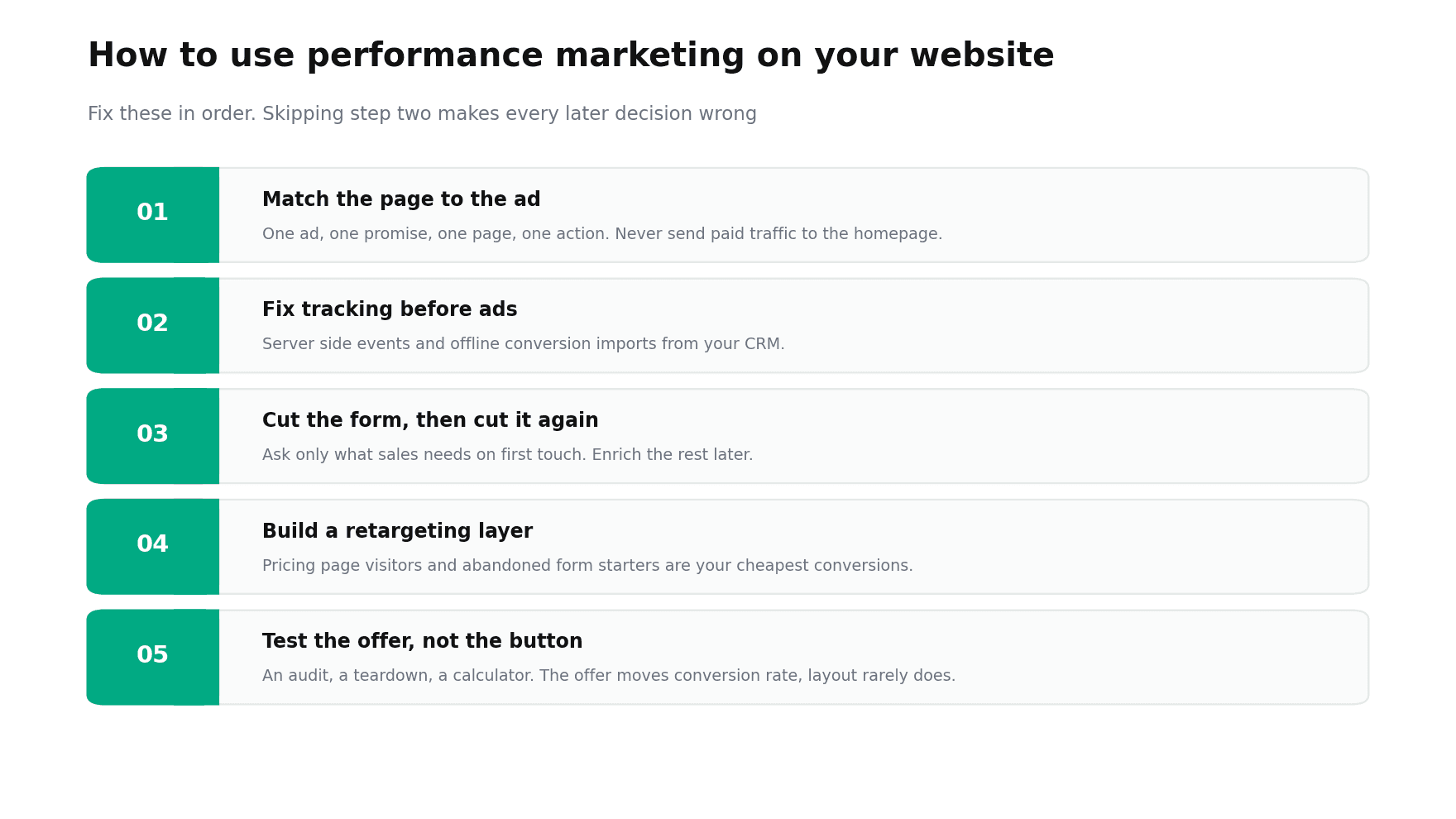
How to use performance marketing on your website, in the order that matters
What Are the Benefits of Performance Marketing for a Lead Generation Business?
If leads are the product or the lifeblood of your business, performance marketing gives you something no other channel does, which is a dial. Spend more and get proportionally more, spend less and cut cleanly, with a known cost per outcome either way.
Predictable cost per lead you can forecast against a sales target
Fast feedback, so a weak angle is killed in days rather than after a quarter
Budget follows performance instead of following habit
Clear attribution back to source, campaign and creative
Compounding creative learning, since every test tells you something about your buyer
Scale without hiring, because volume comes from spend and creative rather than headcount
The channel work only pays off if the offer and the follow up behind it are solid. We covered the practical mechanics of that in our guide on how to generate leads, which is worth reading alongside this one if you are building a lead engine from scratch.
One caution. Performance marketing amplifies whatever your business already is. Strong offer and fast follow up, and it scales beautifully. Weak positioning and a sales team that takes three days to call back, and you are simply paying to find out faster.
How to Choose the Best Performance Marketing Agency for Your Business
Shortlisting gets easier when you stop comparing service lists, because every agency lists the same services. Compare these instead.
What to check | Green flag | Red flag |
|---|---|---|
Relevant experience | Case studies in your model and deal size | Logos with no numbers attached |
Creative capability | In house video and design output | Media buying only, creative is your job |
Reporting | Ties spend to pipeline or revenue | Impressions and engagement dashboards |
Team access | You speak to the people doing the work | Account manager relays everything |
Contract terms | Short initial term, clear exit | Long lock in, you do not own the accounts |
Honesty | Tells you what will not work | Guarantees a specific result before audit |
Always confirm you own the ad accounts, the pixels and the creative files. This is the single most common trap and it only becomes visible on the day you try to leave.
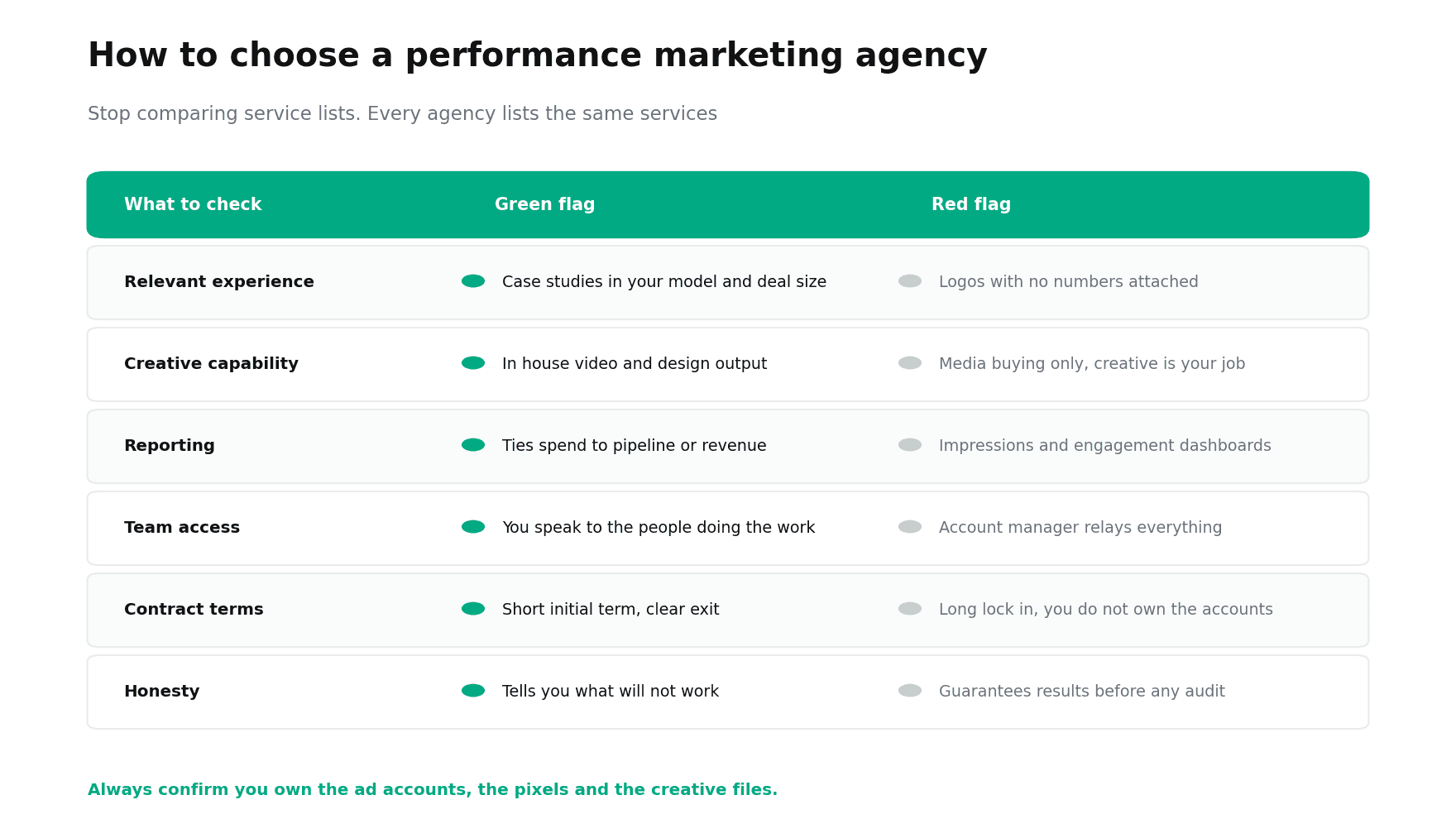
Green flags and red flags when shortlisting a performance marketing agency
How Much Do Performance Marketing Agencies Cost?
Pricing generally lands in one of four shapes. Flat monthly retainer, percentage of ad spend, hybrid of a base fee plus a performance component, or pay per lead. Retainers suit teams that need strategy and creative. Percentage of spend suits high volume ecommerce accounts. Pay per lead sounds attractive but tends to push quantity over quality unless the qualification criteria are written tightly.
A useful rule of thumb is that management and creative combined usually sit between fifteen and thirty percent of media spend at smaller budgets, dropping as spend scales. If a quote sits dramatically below that, ask who is actually doing the work and how many accounts they are running.
SEO Keyword Research
Primary and supporting keywords targeted by this article, with placement mapped to the sections above.
Keyword | Volume tier | Intent | Placement |
|---|---|---|---|
best performance marketing agencies | High | Commercial | H1 + intro |
performance marketing agency | High | Commercial | Intro + CTA |
b2b performance marketing | Medium | Commercial | H2 section |
saas performance marketing agency | Medium | Commercial | H2 section |
ecommerce performance marketing agency | Medium | Commercial | H2 section |
performance marketing services | Medium | Commercial | Body |
what is performance marketing | High | Informational | H2 section |
performance marketing vs digital marketing | Medium | Informational | Comparison table |
lead generation agency | High | Commercial | Lead gen section |
b2b lead generation services | Medium | Commercial | Lead gen section |
performance marketing for lead generation | Low | Commercial | H2 section |
paid ads agency | Medium | Commercial | Body |
google ads agency | High | Commercial | Channel table |
meta ads agency | Medium | Commercial | Channel table |
linkedin ads for b2b | Medium | Informational | B2B section |
cost per lead benchmarks | Medium | Informational | Metrics section |
customer acquisition cost | High | Informational | Metrics section |
roas optimization | Medium | Informational | Ecommerce section |
conversion rate optimization services | Medium | Commercial | Website section |
landing page optimization | Medium | Informational | Website section |
ugc ads for performance marketing | Low | Commercial | Creative section |
video ads for lead generation | Low | Commercial | Creative section |
how to choose a marketing agency | Medium | Informational | H2 section |
performance marketing agency pricing | Medium | Commercial | Pricing section |
benefits of performance marketing | Medium | Informational | H2 section |
Frequently Asked Questions
What is a performance marketing agency?
It is an agency paid to deliver measurable outcomes such as leads, trials or sales, rather than to produce brand assets or impressions. The work usually covers paid media, creative production, landing pages and conversion tracking.
Is performance marketing better than SEO?
They solve different problems. Performance marketing gives you results this month and stops when you stop paying. SEO takes longer and compounds. Most businesses that grow well run both, using paid to learn which messages work and SEO to hold the ground long term.
How long before performance marketing shows results?
Ecommerce accounts usually show a direction within two to four weeks. B2B and SaaS take longer because the sales cycle delays the signal, so plan on one full sales cycle before judging the channel properly.
What is a good cost per lead?
There is no universal number. A good cost per lead is any figure below what a lead is worth to you, which comes from your close rate and average deal size. A lead at two hundred dollars is cheap for enterprise software and ruinous for a low ticket service.
Should a small business hire a performance marketing agency?
If you have a proven offer and enough budget to gather data, yes. If you are still testing whether anyone wants what you sell, spend that money on customer conversations first. Ads make an existing signal louder, they do not create one.
What is the difference between B2B and ecommerce performance marketing?
B2B optimises to a pipeline event weeks or months after the click and relies on CRM data feeding back into the platforms. Ecommerce optimises to a purchase that often happens the same day, so the loop is faster and creative refresh becomes the main constraint.
Do we need new creativity every month?
On paid social, yes. Fatigue sets in quickly and refreshing angles is what keeps costs stable. On search, creative changes less often and the work sits more in keywords, landing pages and offer.
Where This Leaves You
The best performance marketing agencies are not the ones with the cleverest bidding. They are the ones that understand your unit economics, produce enough creativity to keep learning, and take responsibility for what happens after the click. Everything else is a dashboard.
At Motion Labs we build performance campaigns around creative volume and conversion, backed by a network of over five hundred creators producing the video and UGC that keeps accounts fresh. We work with B2B, SaaS, ecommerce and lead generation businesses across the US, UK, UAE and Europe.
Ready to fix the leak? Tell us your current cost per lead and where the drop off happens, and we will show you what we would change first. Visit motionlabs.agency to start the conversation. |
Most websites are built like brochures and then asked to behave like salespeople. Performance marketing exposes that mismatch immediately. Here is the sequence we use when a site needs to start pulling its weight.
Match the page to the ad, not to your navigation
Sending paid traffic to a homepage is the most common and most expensive mistake we see. One ad, one promise, one page, one action. If the ad talks about a specific problem, the first line of the page repeats that problem in the same words.
Fix the tracking before you fix the ads
Server side tracking, clean conversion events, and offline conversion imports back from your CRM. If the data going into the platform is wrong, every optimisation decision after that is wrong too, just with more confidence.
Cut the form, then cut it again
Every extra field costs you conversions. Ask for what sales genuinely need on the first touch and enrich the rest afterwards. Phone number requirements in particular tend to halve completion rates.
Build a retargeting layer around your best pages
Pricing page visitors, case study readers and abandoned form starters are your cheapest available conversions. Most brands never build the segments and then wonder why acquisition cost keeps climbing.
Test the offer, not just the button colour
An audit, a teardown, a sample, a calculator. Changing what someone gets in exchange for their details moves conversion rate far more than any layout test will.
How to use performance marketing on your website, in the order that matters
What Are the Benefits of Performance Marketing for a Lead Generation Business?
If leads are the product or the lifeblood of your business, performance marketing gives you something no other channel does, which is a dial. Spend more and get proportionally more, spend less and cut cleanly, with a known cost per outcome either way.
Predictable cost per lead you can forecast against a sales target
Fast feedback, so a weak angle is killed in days rather than after a quarter
Budget follows performance instead of following habit
Clear attribution back to source, campaign and creative
Compounding creative learning, since every test tells you something about your buyer
Scale without hiring, because volume comes from spend and creative rather than headcount
The channel work only pays off if the offer and the follow up behind it are solid. We covered the practical mechanics of that in our guide on how to generate leads, which is worth reading alongside this one if you are building a lead engine from scratch.
One caution. Performance marketing amplifies whatever your business already is. Strong offer and fast follow up, and it scales beautifully. Weak positioning and a sales team that takes three days to call back, and you are simply paying to find out faster.
How to Choose the Best Performance Marketing Agency for Your Business
Shortlisting gets easier when you stop comparing service lists, because every agency lists the same services. Compare these instead.
What to check | Green flag | Red flag |
|---|---|---|
Relevant experience | Case studies in your model and deal size | Logos with no numbers attached |
Creative capability | In house video and design output | Media buying only, creative is your job |
Reporting | Ties spend to pipeline or revenue | Impressions and engagement dashboards |
Team access | You speak to the people doing the work | Account manager relays everything |
Contract terms | Short initial term, clear exit | Long lock in, you do not own the accounts |
Honesty | Tells you what will not work | Guarantees a specific result before audit |
Always confirm you own the ad accounts, the pixels and the creative files. This is the single most common trap and it only becomes visible on the day you try to leave.
Green flags and red flags when shortlisting a performance marketing agency
How Much Do Performance Marketing Agencies Cost?
Pricing generally lands in one of four shapes. Flat monthly retainer, percentage of ad spend, hybrid of a base fee plus a performance component, or pay per lead. Retainers suit teams that need strategy and creative. Percentage of spend suits high volume ecommerce accounts. Pay per lead sounds attractive but tends to push quantity over quality unless the qualification criteria are written tightly.
A useful rule of thumb is that management and creative combined usually sit between fifteen and thirty percent of media spend at smaller budgets, dropping as spend scales. If a quote sits dramatically below that, ask who is actually doing the work and how many accounts they are running.
SEO Keyword Research
Primary and supporting keywords targeted by this article, with placement mapped to the sections above.
Keyword | Volume tier | Intent | Placement |
|---|---|---|---|
best performance marketing agencies | High | Commercial | H1 + intro |
performance marketing agency | High | Commercial | Intro + CTA |
b2b performance marketing | Medium | Commercial | H2 section |
saas performance marketing agency | Medium | Commercial | H2 section |
ecommerce performance marketing agency | Medium | Commercial | H2 section |
performance marketing services | Medium | Commercial | Body |
what is performance marketing | High | Informational | H2 section |
performance marketing vs digital marketing | Medium | Informational | Comparison table |
lead generation agency | High | Commercial | Lead gen section |
b2b lead generation services | Medium | Commercial | Lead gen section |
performance marketing for lead generation | Low | Commercial | H2 section |
paid ads agency | Medium | Commercial | Body |
google ads agency | High | Commercial | Channel table |
meta ads agency | Medium | Commercial | Channel table |
linkedin ads for b2b | Medium | Informational | B2B section |
cost per lead benchmarks | Medium | Informational | Metrics section |
customer acquisition cost | High | Informational | Metrics section |
roas optimization | Medium | Informational | Ecommerce section |
conversion rate optimization services | Medium | Commercial | Website section |
landing page optimization | Medium | Informational | Website section |
ugc ads for performance marketing | Low | Commercial | Creative section |
video ads for lead generation | Low | Commercial | Creative section |
how to choose a marketing agency | Medium | Informational | H2 section |
performance marketing agency pricing | Medium | Commercial | Pricing section |
benefits of performance marketing | Medium | Informational | H2 section |
Frequently Asked Questions
What is a performance marketing agency?
It is an agency paid to deliver measurable outcomes such as leads, trials or sales, rather than to produce brand assets or impressions. The work usually covers paid media, creative production, landing pages and conversion tracking.
Is performance marketing better than SEO?
They solve different problems. Performance marketing gives you results this month and stops when you stop paying. SEO takes longer and compounds. Most businesses that grow well run both, using paid to learn which messages work and SEO to hold the ground long term.
How long before performance marketing shows results?
Ecommerce accounts usually show a direction within two to four weeks. B2B and SaaS take longer because the sales cycle delays the signal, so plan on one full sales cycle before judging the channel properly.
What is a good cost per lead?
There is no universal number. A good cost per lead is any figure below what a lead is worth to you, which comes from your close rate and average deal size. A lead at two hundred dollars is cheap for enterprise software and ruinous for a low ticket service.
Should a small business hire a performance marketing agency?
If you have a proven offer and enough budget to gather data, yes. If you are still testing whether anyone wants what you sell, spend that money on customer conversations first. Ads make an existing signal louder, they do not create one.
What is the difference between B2B and ecommerce performance marketing?
B2B optimises to a pipeline event weeks or months after the click and relies on CRM data feeding back into the platforms. Ecommerce optimises to a purchase that often happens the same day, so the loop is faster and creative refresh becomes the main constraint.
Do we need new creativity every month?
On paid social, yes. Fatigue sets in quickly and refreshing angles is what keeps costs stable. On search, creative changes less often and the work sits more in keywords, landing pages and offer.
Where This Leaves You
The best performance marketing agencies are not the ones with the cleverest bidding. They are the ones that understand your unit economics, produce enough creativity to keep learning, and take responsibility for what happens after the click. Everything else is a dashboard.
At Motion Labs we build performance campaigns around creative volume and conversion, backed by a network of over five hundred creators producing the video and UGC that keeps accounts fresh. We work with B2B, SaaS, ecommerce and lead generation businesses across the US, UK, UAE and Europe.
Ready to fix the leak? Tell us your current cost per lead and where the drop off happens, and we will show you what we would change first. Visit motionlabs.agency to start the conversation. |
the call your competitor wish you would'nt take


Related Posts



Related Posts
Related Posts
Motion labs
info@motionlabs.agency


+971 55317 1706
578 Market St, San Francisco, CA 94105, USA
click to meet me :)
click to meet me :)
© All Rights Reserved | 2026


Motion labs
info@motionlabs.agency
+971 55317 1706
578 Market St, San Francisco, CA 94105, USA
Private policy
Terms & Conditions
© All Rights Reserved | 2026
click to meet me :)