/
/
4 Great Examples of User-Generated Content (UGC)
4 Great Examples of User-Generated Content (UGC)
5 min
read
4 Great Examples of User-Generated Content (UGC)
4 Great Examples of User-Generated Content (UGC)
Content
Marketing

Author

Scroll down
to read more!
Summerize with ChatGPT
Summerize with Gemini
Summerize with Claude
4 Great Examples of User-Generated Content (UGC)
4 Great Examples of User-Generated Content (UGC)
Your competitors' blurred & shaky phone clip ads are getting more views, trust & clients than your polished and expensive ads. How? Let’s break it down.
Your competitors' blurred & shaky phone clip ads are getting more views, trust & clients than your polished and expensive ads. How? Let’s break it down.
The UGC is a new marketing trust. People trust other people, and they scroll past branded content and stop for real reviews, real unboxings, and real reactions from people who actually bought the product.
What Is User-Generated Content (UGC)?
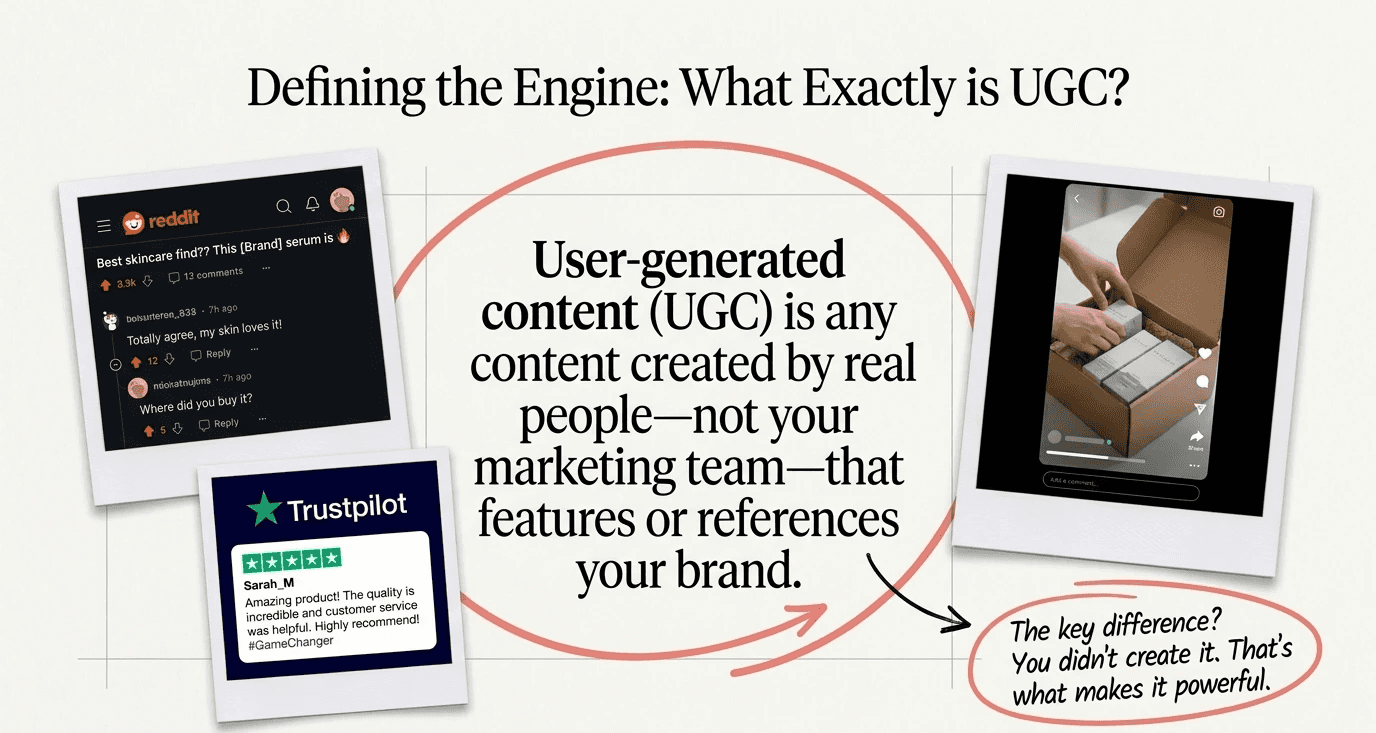
User-generated content (UGC) is any content created by real people, not your marketing team, that features or references your brand. It could be a photo, a video, a review, a social post, a blog comment, or even a Reddit thread. If a customer made it and it's about your product, it's UGC.
The key thing that makes UGC different from everything else you publish is that you didn't create it. That's what makes it powerful.
Why Should You Use UGC in Your Marketing?
It builds trust fast
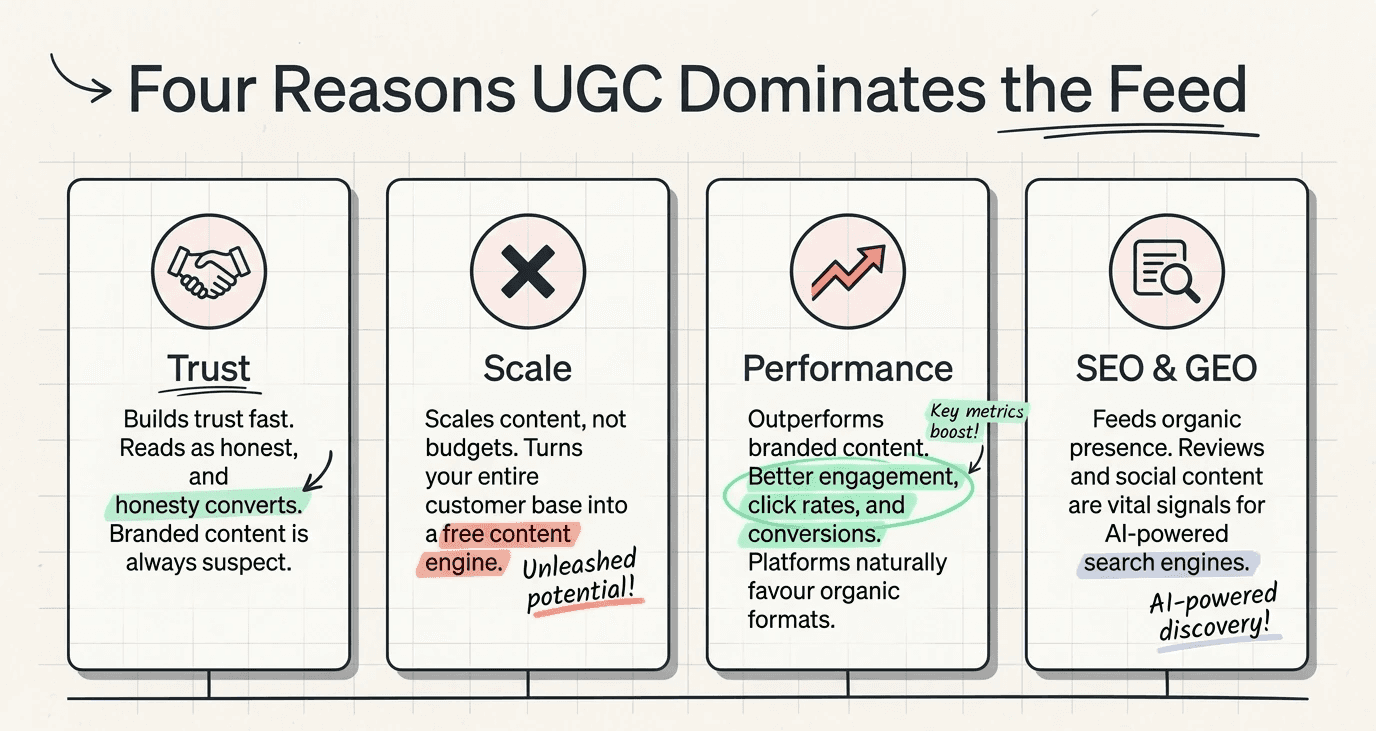
Branded content is always a little suspect; of course, the brand says their product is great. But when a random person on Instagram shows it off? That's a different story. UGC reads as honest, and honesty converts.
It scales your content without scaling your budget
Every customer who posts about your brand is creating content for you, for free. A strong UGC strategy turns your customer base into a content engine.
It performs better
UGC consistently outperforms branded content on social media: better engagement, better click rates, and better conversions. Platforms also tend to favor organic-looking content over polished ad formats, which gives UGC a natural edge.
It's great for SEO and GEO
Reviews, forum posts, and social content about your brand all feed into your organic presence. And as AI-powered search engines (Google AI Overviews, Perplexity, and ChatGPT) increasingly pull from third-party sources, authentic UGC signals matter more than ever.
Also read: How to automate social media
What's the Difference Between UGC and Influencer Marketing?
| UGC | Influencer Marketing |
Who creates it | Real customers/fans | Paid or gifted creators |
Motivation | Genuine experience | Partnership/payment |
Cost | Low/free (or small incentive) | Medium to high |
Perceived trust | Very high: unsponsored | Medium: Often disclosed |
Brand control | Low: organic | Medium to high |
Scale | Can be massive (campaigns) | Limited to the creator's reach |
The smartest brands use both. Influencers seed awareness and reach. UGC builds credibility and converts. One without the other is a missed opportunity.
There's also a newer category worth knowing, creator UGC. This is where brands hire UGC-style creators to produce authentic-looking content that can then be used in paid ads. It blends both worlds: the control of influencer marketing with the look and feel of organic UGC.
What Are the Different Types of User-Generated Content?
UGC comes in a lot of formats. Here are the main ones worth knowing:
• Photos and videos: Customer posts on Instagram, TikTok, and YouTube showing your product in real life. This is the most shareable and repurposable format.
• Reviews and ratings: Product reviews on your website, Google, Amazon, and Trustpilot. One of the highest-converting forms of UGC.
• Social media posts: Tags, mentions, hashtag posts, Stories, Reels. Great for brand awareness and community building.
• Testimonials: More polished than a raw review, these are short statements customers give about their experience. Great for landing pages.
• Blog posts and articles, Third-party write-ups, personal blogs, niche site features. Builds SEO authority.
• Unboxing and reaction videos, Massive on YouTube and TikTok. The raw, first-reaction format drives high trust and entertainment value.
• Forum posts and Q&As, Reddit threads, Quora answers, community discussions. Powerful for SEO and trust at the research stage of the buyer journey.
What Are the Best Sources of UGC for Brands?
Where does all this content actually come from? Here are the best places to find and cultivate it:
Instagram and TikTok
These are the richest sources of visual UGC. Monitor your brand hashtag, product tags, and mentions. This is where the most shareable content lives.
Review platforms
Google Reviews, Trustpilot, G2, Yelp, and your own product review section. These are your most conversion-driven UGC assets, especially for bottom-of-funnel buyers.
YouTube
Unboxings, tutorials, and honest reviews on YouTube tend to be long-form and detailed. They're gold for high-consideration products where buyers research before purchasing.
Reddit and niche forums
Unprompted, detailed discussions about your product category. High-trust because there's no commercial angle. Also excellent for SEO, Reddit threads rank well in search.
Your own customers (prompted)
Don't wait for UGC to happen organically. Ask for it. Post-purchase emails, loyalty programme incentives, hashtag campaigns, and contests are all effective ways to prompt customers to create content.
The UGC is a new marketing trust. People trust other people, and they scroll past branded content and stop for real reviews, real unboxings, and real reactions from people who actually bought the product.
What Is User-Generated Content (UGC)?
User-generated content (UGC) is any content created by real people, not your marketing team, that features or references your brand. It could be a photo, a video, a review, a social post, a blog comment, or even a Reddit thread. If a customer made it and it's about your product, it's UGC.
The key thing that makes UGC different from everything else you publish is that you didn't create it. That's what makes it powerful.
Why Should You Use UGC in Your Marketing?
It builds trust fast
Branded content is always a little suspect; of course, the brand says their product is great. But when a random person on Instagram shows it off? That's a different story. UGC reads as honest, and honesty converts.
It scales your content without scaling your budget
Every customer who posts about your brand is creating content for you, for free. A strong UGC strategy turns your customer base into a content engine.
It performs better
UGC consistently outperforms branded content on social media: better engagement, better click rates, and better conversions. Platforms also tend to favor organic-looking content over polished ad formats, which gives UGC a natural edge.
It's great for SEO and GEO
Reviews, forum posts, and social content about your brand all feed into your organic presence. And as AI-powered search engines (Google AI Overviews, Perplexity, and ChatGPT) increasingly pull from third-party sources, authentic UGC signals matter more than ever.
Also read: How to automate social media
What's the Difference Between UGC and Influencer Marketing?
| UGC | Influencer Marketing |
Who creates it | Real customers/fans | Paid or gifted creators |
Motivation | Genuine experience | Partnership/payment |
Cost | Low/free (or small incentive) | Medium to high |
Perceived trust | Very high: unsponsored | Medium: Often disclosed |
Brand control | Low: organic | Medium to high |
Scale | Can be massive (campaigns) | Limited to the creator's reach |
The smartest brands use both. Influencers seed awareness and reach. UGC builds credibility and converts. One without the other is a missed opportunity.
There's also a newer category worth knowing, creator UGC. This is where brands hire UGC-style creators to produce authentic-looking content that can then be used in paid ads. It blends both worlds: the control of influencer marketing with the look and feel of organic UGC.
What Are the Different Types of User-Generated Content?
UGC comes in a lot of formats. Here are the main ones worth knowing:
• Photos and videos: Customer posts on Instagram, TikTok, and YouTube showing your product in real life. This is the most shareable and repurposable format.
• Reviews and ratings: Product reviews on your website, Google, Amazon, and Trustpilot. One of the highest-converting forms of UGC.
• Social media posts: Tags, mentions, hashtag posts, Stories, Reels. Great for brand awareness and community building.
• Testimonials: More polished than a raw review, these are short statements customers give about their experience. Great for landing pages.
• Blog posts and articles, Third-party write-ups, personal blogs, niche site features. Builds SEO authority.
• Unboxing and reaction videos, Massive on YouTube and TikTok. The raw, first-reaction format drives high trust and entertainment value.
• Forum posts and Q&As, Reddit threads, Quora answers, community discussions. Powerful for SEO and trust at the research stage of the buyer journey.
What Are the Best Sources of UGC for Brands?
Where does all this content actually come from? Here are the best places to find and cultivate it:
Instagram and TikTok
These are the richest sources of visual UGC. Monitor your brand hashtag, product tags, and mentions. This is where the most shareable content lives.
Review platforms
Google Reviews, Trustpilot, G2, Yelp, and your own product review section. These are your most conversion-driven UGC assets, especially for bottom-of-funnel buyers.
YouTube
Unboxings, tutorials, and honest reviews on YouTube tend to be long-form and detailed. They're gold for high-consideration products where buyers research before purchasing.
Reddit and niche forums
Unprompted, detailed discussions about your product category. High-trust because there's no commercial angle. Also excellent for SEO, Reddit threads rank well in search.
Your own customers (prompted)
Don't wait for UGC to happen organically. Ask for it. Post-purchase emails, loyalty programme incentives, hashtag campaigns, and contests are all effective ways to prompt customers to create content.
4 Brands Using UGC in a Stand-Out Way
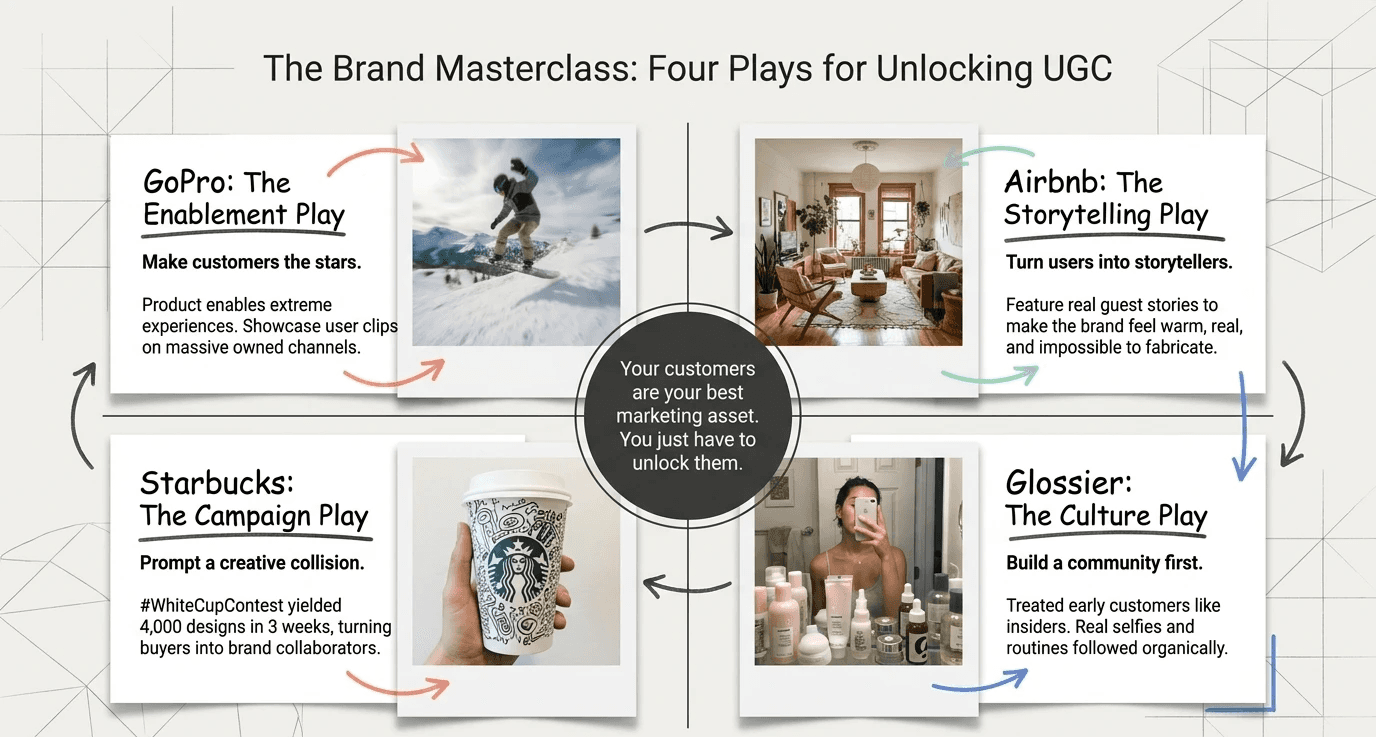
1. GoPro: Making Customers the Stars
GoPro's entire marketing model is built on UGC. Their camera is designed for extreme experiences, and their customers produce jaw-dropping footage every single day. GoPro leans into this completely.
They run regular UGC campaigns asking users to submit their best clips. The winners get featured on GoPro's own channels, which have tens of millions of subscribers. The content is breathtaking. It also costs GoPro a fraction of what traditional production would.
The lesson: If your product enables experiences, make it easy for customers to share those experiences, and showcase the best ones loudly.
2. Airbnb: Turning Hosts Into Brand Storytellers
Airbnb doesn't just sell accommodation; with it, they sell the idea that travel can be more personal, local, and interesting than a hotel stay. UGC is central to making that case.
Their platform encourages both hosts and guests to leave detailed reviews. But more than that, Airbnb actively features real guest stories and host profiles across their social channels, editorial content, and ad campaigns.
The result is a library of authentic travel stories that no marketing team could fabricate. It makes the brand feel warm, real, and deeply human.
3. Starbucks: The White Cup Contest
Back in 2014, Starbucks ran a simple campaign: customers were invited to doodle on their white Starbucks cups and post photos with the hashtag #WhiteCupContest. The winner's design would be turned into a limited-edition reusable cup.
Over 4,000 designs were submitted in just three weeks. The campaign generated massive social media engagement, tons of press coverage, and a flood of branded content Starbucks didn't have to create.
It was low-effort to run, highly creative, and it made customers feel like collaborators in the brand, not just buyers.
4. Glossier: Building a Community That Creates Content
Glossier's UGC strategy isn't really a campaign. It's a culture. From day one, Glossier treated its early customers like insiders. They asked for feedback, involved them in product development, and made them feel genuinely part of the brand.
The result? Customers became advocates. Real people posting real selfies, sharing honest skincare routines, tagging Glossier not because they were paid to, but because they wanted to. Glossier's Instagram is essentially a curation of this organic love.
They also ran a formal rep programme, turning loyal fans into micro-influencers with affiliate links. But the grassroots UGC came first; it set the tone and made the whole thing credible.
The lesson: The best UGC comes from a community that genuinely loves your brand. Invest in customer relationships, and the content will follow.
Also read: 6 best ways of brand storytelling
4 Brands Using UGC in a Stand-Out Way
1. GoPro: Making Customers the Stars
GoPro's entire marketing model is built on UGC. Their camera is designed for extreme experiences, and their customers produce jaw-dropping footage every single day. GoPro leans into this completely.
They run regular UGC campaigns asking users to submit their best clips. The winners get featured on GoPro's own channels, which have tens of millions of subscribers. The content is breathtaking. It also costs GoPro a fraction of what traditional production would.
The lesson: If your product enables experiences, make it easy for customers to share those experiences, and showcase the best ones loudly.
2. Airbnb: Turning Hosts Into Brand Storytellers
Airbnb doesn't just sell accommodation; with it, they sell the idea that travel can be more personal, local, and interesting than a hotel stay. UGC is central to making that case.
Their platform encourages both hosts and guests to leave detailed reviews. But more than that, Airbnb actively features real guest stories and host profiles across their social channels, editorial content, and ad campaigns.
The result is a library of authentic travel stories that no marketing team could fabricate. It makes the brand feel warm, real, and deeply human.
3. Starbucks: The White Cup Contest
Back in 2014, Starbucks ran a simple campaign: customers were invited to doodle on their white Starbucks cups and post photos with the hashtag #WhiteCupContest. The winner's design would be turned into a limited-edition reusable cup.
Over 4,000 designs were submitted in just three weeks. The campaign generated massive social media engagement, tons of press coverage, and a flood of branded content Starbucks didn't have to create.
It was low-effort to run, highly creative, and it made customers feel like collaborators in the brand, not just buyers.
4. Glossier: Building a Community That Creates Content
Glossier's UGC strategy isn't really a campaign. It's a culture. From day one, Glossier treated its early customers like insiders. They asked for feedback, involved them in product development, and made them feel genuinely part of the brand.
The result? Customers became advocates. Real people posting real selfies, sharing honest skincare routines, tagging Glossier not because they were paid to, but because they wanted to. Glossier's Instagram is essentially a curation of this organic love.
They also ran a formal rep programme, turning loyal fans into micro-influencers with affiliate links. But the grassroots UGC came first; it set the tone and made the whole thing credible.
The lesson: The best UGC comes from a community that genuinely loves your brand. Invest in customer relationships, and the content will follow.
Also read: 6 best ways of brand storytelling
Conclusion
The four brands above, GoPro, Airbnb, Starbucks, and Glossier, all look very different. But they share the same core insight: your customers are your best marketing asset. You just have to unlock them.
🚀 Want to Scale Your UGC Strategy with AI?
Motion Labs helps brands build and manage high-performing UGC campaigns, from AI avatar production and UGC creator sourcing to paid social distribution and influencer network activation on X and LinkedIn.
→ Visit motionlabs.agency to learn more or book a strategy call.
Frequently Asked Questions About UGC Marketing
What is the best example of user-generated content?
GoPro is the gold standard. Their entire brand is built on footage created by real users. It's authentic, high-quality, and costs a fraction of traditional production.
How do I get customers to create UGC?
The easiest ways are: ask them directly via post-purchase email, run a hashtag campaign or contest with a compelling reward, offer loyalty points for reviews or tagged posts, and make sharing easy by creating shareable moments in your packaging or product experience.
Is UGC better than influencer marketing?
For trust and authenticity, yes, UGC wins. Consumers perceive it as more credible because there's no commercial arrangement. But influencer marketing is better for reach. The smartest brands use both together.
Can I use customer UGC in my paid ads?
Yes, but you need permission first. Always get explicit consent from the content creator before using their post in paid advertising. A simple DM or an opt-in rights system handles this cleanly.
What are the main types of UGC?
The main types are photos and videos, reviews and ratings, social media posts and stories, testimonials, blog content, unboxing and reaction videos, and forum or community discussions.
How does UGC help with SEO?
UGC creates a stream of authentic, keyword-rich content about your brand, product reviews, forum threads, and social posts. This builds organic search presence, supports E-E-A-T signals, and increasingly helps with GEO (Generative Engine Optimization) as AI search tools pull from these third-party sources.
What is the difference between UGC and branded content?
Branded content is created by your marketing team and promotes your brand directly. UGC is created by real customers based on their genuine experience. The difference in perceived authenticity is why UGC consistently outperforms branded content for trust and conversions.
Conclusion
The four brands above, GoPro, Airbnb, Starbucks, and Glossier, all look very different. But they share the same core insight: your customers are your best marketing asset. You just have to unlock them.
🚀 Want to Scale Your UGC Strategy with AI?
Motion Labs helps brands build and manage high-performing UGC campaigns, from AI avatar production and UGC creator sourcing to paid social distribution and influencer network activation on X and LinkedIn.
→ Visit motionlabs.agency to learn more or book a strategy call.
Frequently Asked Questions About UGC Marketing
What is the best example of user-generated content?
GoPro is the gold standard. Their entire brand is built on footage created by real users. It's authentic, high-quality, and costs a fraction of traditional production.
How do I get customers to create UGC?
The easiest ways are: ask them directly via post-purchase email, run a hashtag campaign or contest with a compelling reward, offer loyalty points for reviews or tagged posts, and make sharing easy by creating shareable moments in your packaging or product experience.
Is UGC better than influencer marketing?
For trust and authenticity, yes, UGC wins. Consumers perceive it as more credible because there's no commercial arrangement. But influencer marketing is better for reach. The smartest brands use both together.
Can I use customer UGC in my paid ads?
Yes, but you need permission first. Always get explicit consent from the content creator before using their post in paid advertising. A simple DM or an opt-in rights system handles this cleanly.
What are the main types of UGC?
The main types are photos and videos, reviews and ratings, social media posts and stories, testimonials, blog content, unboxing and reaction videos, and forum or community discussions.
How does UGC help with SEO?
UGC creates a stream of authentic, keyword-rich content about your brand, product reviews, forum threads, and social posts. This builds organic search presence, supports E-E-A-T signals, and increasingly helps with GEO (Generative Engine Optimization) as AI search tools pull from these third-party sources.
What is the difference between UGC and branded content?
Branded content is created by your marketing team and promotes your brand directly. UGC is created by real customers based on their genuine experience. The difference in perceived authenticity is why UGC consistently outperforms branded content for trust and conversions.
the call your competitor wish you would'nt take


Related Posts





Related Posts
Related Posts
Motion labs
info@motionlabs.agency


+971 55317 1706
C-1802, ONTARIO TOWER, PLOT NO. 49-0, BUSINESS BAY, DUBAI, 00000
click to meet me :)
click to meet me :)
© All Rights Reserved | 2026


Motion labs
info@motionlabs.agency
+971 55317 1706
C-1802, ONTARIO TOWER, PLOT NO. 49-0, BUSINESS BAY, DUBAI, 00000
Private policy
Terms & Conditions
© All Rights Reserved | 2026
click to meet me :)