/
/
How to Generate Leads for Your Business Through Performance Marketing
How to Generate Leads for Your Business Through Performance Marketing
5 min
read
How to Generate Leads for Your Business Through Performance Marketing
How to Generate Leads for Your Business Through Performance Marketing
Meta & Google ads
Marketing

Author

Scroll down
to read more!
Summerize with ChatGPT
Summerize with Gemini
Summerize with Claude
How to Generate Leads for Your Business Through Performance Marketing
How to Generate Leads for Your Business Through Performance Marketing
How to generate leads through performance marketing, with current US cost per lead benchmarks Every US marketing team we talk to is having some version of the same conversation. The ad spend has not changed much. The lead count has. Somebody in the room says the word efficiency, somebody else suggests pausing a channel, and nobody in the room actually knows what a lead should cost.
How to generate leads through performance marketing, with current US cost per lead benchmarks Every US marketing team we talk to is having some version of the same conversation. The ad spend has not changed much. The lead count has. Somebody in the room says the word efficiency, somebody else suggests pausing a channel, and nobody in the room actually knows what a lead should cost.
o let us fix that first. Below are the current benchmark ranges for the US market, why costs have moved, and the specific things that still pull cost per lead down without wrecking lead quality. We run this playbook for clients across B2B, SaaS and ecommerce, so what follows is what we actually do, not a list of best practices.
The short version US lead costs are up across nearly every paid channel. The teams holding steady are not bidding smarter. They are feeding CRM outcomes back into the platforms, shipping more creative, cutting form friction, and making sure their pages answer the buying question directly enough to get quoted by AI search. |
What Does a Lead Actually Cost in the US Right Now?
Blended B2B cost per lead in the US commonly lands somewhere between one hundred and three hundred dollars, with paid channels sitting meaningfully above organic ones. Consumer and ecommerce leads run far cheaper. The spread inside any single channel is enormous, which is why a single blended average is close to useless as a target.
Here is the channel picture, based on published US advertiser benchmarks. Treat these as a starting point for a conversation with your finance team, not as a target to hit.
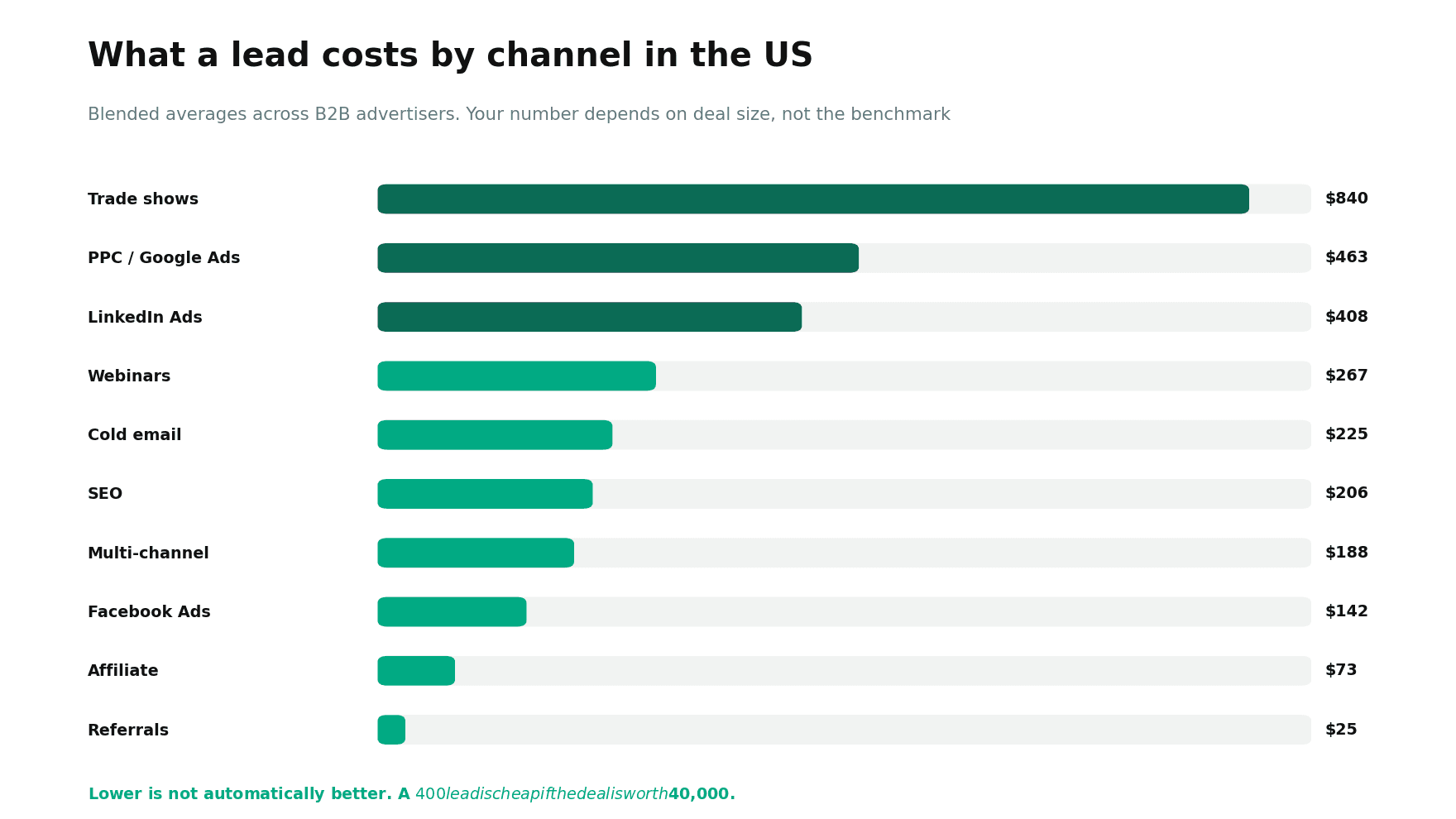
Average cost per lead by channel for US B2B advertisers
Two numbers worth calling out. Google Ads cost per lead now averages around seventy nine dollars across industries and has risen close to nineteen percent year over year, driven by denser auctions and broader matching pushing advertisers into more expensive queries. Meta sits far lower at roughly twenty six dollars but has climbed at a similar rate. Legal services on Google can exceed six hundred dollars a lead. Ecommerce sits near twenty.
Industry matters more than channel. So does deal size. A four hundred dollar lead is expensive for a service business selling a two thousand dollar package and cheap for enterprise software selling a forty thousand dollar contract.
Why Are US Acquisition Costs Rising So Fast?
Four things are pushing in the same direction at once, and only one of them is under your direct control.
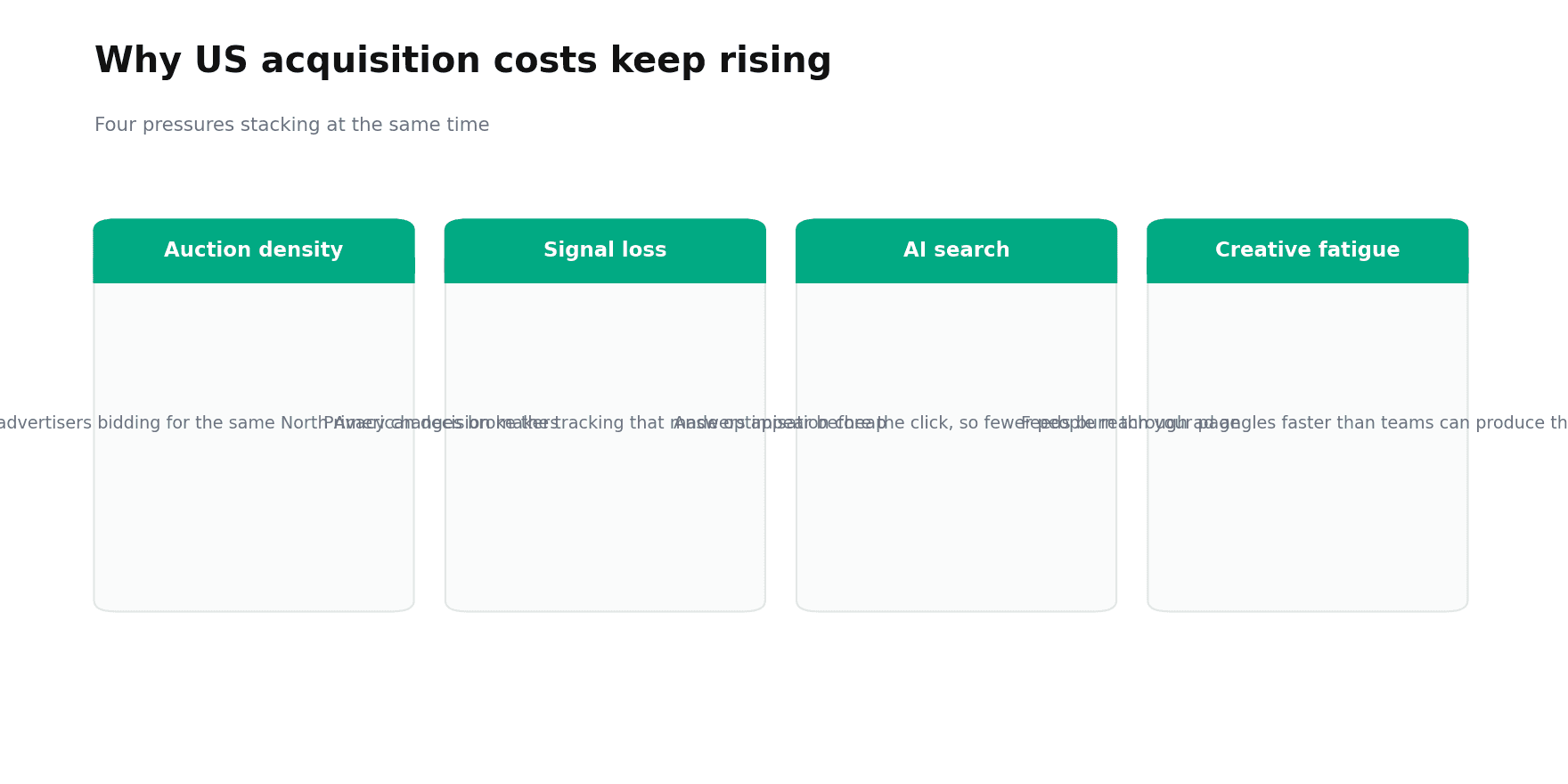
Four pressures driving up US customer acquisition costs
North American audiences carry the highest lead costs of any region simply because advertiser demand is densest here. When you target a US decision maker on LinkedIn, you are bidding against every other advertiser who wants the same person, and there are more of them than in almost any other market.
Meanwhile, privacy changes have thinned the signal that platforms rely on to find buyers. AI answer engines increasingly satisfy the research question before anyone clicks. And feed based social burns through ad angles in weeks, which means creative supply has quietly become the limiting factor for most accounts.
None of that is fixable by adjusting bids. All of it is fixable by changing what you feed into the system.
o let us fix that first. Below are the current benchmark ranges for the US market, why costs have moved, and the specific things that still pull cost per lead down without wrecking lead quality. We run this playbook for clients across B2B, SaaS and ecommerce, so what follows is what we actually do, not a list of best practices.
The short version US lead costs are up across nearly every paid channel. The teams holding steady are not bidding smarter. They are feeding CRM outcomes back into the platforms, shipping more creative, cutting form friction, and making sure their pages answer the buying question directly enough to get quoted by AI search. |
What Does a Lead Actually Cost in the US Right Now?
Blended B2B cost per lead in the US commonly lands somewhere between one hundred and three hundred dollars, with paid channels sitting meaningfully above organic ones. Consumer and ecommerce leads run far cheaper. The spread inside any single channel is enormous, which is why a single blended average is close to useless as a target.
Here is the channel picture, based on published US advertiser benchmarks. Treat these as a starting point for a conversation with your finance team, not as a target to hit.
Average cost per lead by channel for US B2B advertisers
Two numbers worth calling out. Google Ads cost per lead now averages around seventy nine dollars across industries and has risen close to nineteen percent year over year, driven by denser auctions and broader matching pushing advertisers into more expensive queries. Meta sits far lower at roughly twenty six dollars but has climbed at a similar rate. Legal services on Google can exceed six hundred dollars a lead. Ecommerce sits near twenty.
Industry matters more than channel. So does deal size. A four hundred dollar lead is expensive for a service business selling a two thousand dollar package and cheap for enterprise software selling a forty thousand dollar contract.
Why Are US Acquisition Costs Rising So Fast?
Four things are pushing in the same direction at once, and only one of them is under your direct control.
Four pressures driving up US customer acquisition costs
North American audiences carry the highest lead costs of any region simply because advertiser demand is densest here. When you target a US decision maker on LinkedIn, you are bidding against every other advertiser who wants the same person, and there are more of them than in almost any other market.
Meanwhile, privacy changes have thinned the signal that platforms rely on to find buyers. AI answer engines increasingly satisfy the research question before anyone clicks. And feed based social burns through ad angles in weeks, which means creative supply has quietly become the limiting factor for most accounts.
None of that is fixable by adjusting bids. All of it is fixable by changing what you feed into the system.

Benchmarks tell you where the market is. They cannot tell you whether you have a problem. That comes from your own economics, and the maths takes about two minutes.
Take your target acquisition cost and multiply it by your lead to customer rate. That is your ceiling. If a channel comes in under it and the leads convert at your normal rate, you do not have a cost problem, you have a scaling opportunity.
A few diagnostic patterns worth knowing. Rising cost per lead with a flat acquisition cost usually means lead quality improved, which is a win. Flat cost per lead with rising acquisition cost is the dangerous one, because it points at a conversion problem deeper in the funnel that the ad account cannot see. And if your landing pages convert below roughly four percent, the page is almost certainly your real cost driver, not the auction.
Benchmarks tell you where the market is. They cannot tell you whether you have a problem. That comes from your own economics, and the maths takes about two minutes.
Take your target acquisition cost and multiply it by your lead to customer rate. That is your ceiling. If a channel comes in under it and the leads convert at your normal rate, you do not have a cost problem, you have a scaling opportunity.
A few diagnostic patterns worth knowing. Rising cost per lead with a flat acquisition cost usually means lead quality improved, which is a win. Flat cost per lead with rising acquisition cost is the dangerous one, because it points at a conversion problem deeper in the funnel that the ad account cannot see. And if your landing pages convert below roughly four percent, the page is almost certainly your real cost driver, not the auction.

Here is the sequence we use when a US account needs its cost per lead brought back under control. The order matters. Doing step three before step one just makes you fast at buying the wrong leads.
Send CRM outcomes back into the ad platforms
Optimising to form fills teaches the algorithm to find people who fill in forms. Optimising to qualified stages teaches it to find buyers. Expect cost per form fill to rise when you make this switch. Cost per opportunity typically falls, and that is the trade you want.
Shrink the form
Name, email and company is enough for a first touch in most B2B situations. Everything else can come from enrichment or the discovery call. Cutting a form from seven fields to three commonly lifts completions by a quarter to forty percent, which is a bigger swing than most bid strategy changes will ever give you.
Treat creative as a supply problem
Targeting has flattened. Creative has not. The accounts that hold cost per lead steady are the ones shipping new angles every week, not the ones with clever audience stacks. This is where a creator network earns its keep, because volume of authentic looking video is hard to produce in house at pace.
Buy the high intent terms even when they look expensive
Competitor comparison and alternative searches cost more per click and convert several times better. In the US market these terms are contested, but the customer economics almost always justify the price.
Write pages that answer the question plainly
AI search now sits between your buyer and your site. Pages that state the answer clearly near the top, with specific numbers and plain phrasing, get quoted. Pages that build to a conclusion over eight hundred words do not. This is becoming a real acquisition channel and almost nobody is optimising for it yet.
If you are building the follow up engine behind these campaigns rather than just the traffic side, our guide on how to generate leads covers the offer, capture and nurture mechanics in more detail.
What Should US B2B and SaaS Teams Do Differently?
B2B in the US has a specific problem. The buying committee is large, the cycle is long, and the ad platform gets its feedback weeks or months after the money was spent. That delay is why so many B2B accounts drift toward cheap, useless leads.
Define what a qualified lead means before launching, in writing, agreed with sales
Push qualification upstream so the ad platform learns from it, rather than leaving it to reps
Expect a higher cost per lead than the benchmarks if you qualify hard, and treat that as correct
Use LinkedIn for precision on title and company size, then retarget those audiences at lower cost elsewhere
Track pipeline created per channel, not leads per channel
SaaS teams should add one more layer. Track which acquisition sources produce trials that actually activate. A source with a higher cost per signup and double the trial to paid rate is the cheaper source, even though the ad platform will tell you otherwise.
What About Ecommerce Lead Generation in the US?
Ecommerce plays a different game. Leads here are usually email and SMS captures that feed a flow, and the value shows up over the following weeks rather than on the first order.
Focus area | What to measure | Common mistake |
|---|---|---|
Capture offer | Signup rate on entry popups | Generic discount that trains discount buyers |
Creative refresh | Days before cost per capture rises | Running the same video until it dies |
Post capture flows | Revenue per subscriber | Sending one welcome email and stopping |
Blended view | Total revenue over total spend | Judging by platform reported ROAS only |
The teams winning here fund aggressive acquisition with strong repeat purchase behaviour. If your second order rate is weak, no amount of media buying skill will make the numbers work.
How Much Do US Lead Generation Companies Charge?
Most US businesses running a serious lead generation program spend somewhere between a few thousand and low five figures a month on media, with agency fees on top. Management and creative combined typically sit between fifteen and thirty percent of media spend, falling as budgets scale.
Pay per lead arrangements look attractive on paper. They work when the qualification criteria are written tightly and disputed leads have a clear process. When they are loose, the incentive pushes volume over fit and you end up paying for names your sales team will never call twice.
How to Choose a Lead Generation Partner in the US
Ask for a case study in your model and your deal size, with the actual numbers
Confirm creative production is included rather than assumed to be your job
Ask how they define a qualified lead and who arbitrates disputes
Check that reporting connects spend to pipeline, not to impressions
Confirm you own the ad accounts, the pixels and the creative files
Ask about a month where results went the wrong way and what they changed
SEO Keyword Research
Primary and supporting keywords targeted by this article, mapped to placement.
Keyword | Volume tier | Intent | Placement |
|---|---|---|---|
lead generation companies usa | High | Commercial | H1 + intro |
b2b lead generation services usa | High | Commercial | H2 section |
lead generation agency united states | Medium | Commercial | H2 section |
cost per lead benchmarks usa | High | Informational | Benchmark section |
average cost per lead google ads | High | Informational | Channel table |
linkedin ads cost per lead b2b | Medium | Informational | Channel table |
how to reduce cost per lead | High | Informational | Playbook section |
customer acquisition cost benchmarks | High | Informational | Economics section |
b2b lead generation strategies | High | Informational | Playbook section |
saas lead generation agency usa | Medium | Commercial | Industry section |
ecommerce lead generation usa | Medium | Commercial | Industry section |
performance marketing agency usa | High | Commercial | CTA + intro |
paid ads agency united states | Medium | Commercial | Body |
demand generation vs lead generation | Medium | Informational | H2 section |
qualified lead definition b2b | Medium | Informational | Economics section |
landing page conversion rate benchmarks | Medium | Informational | Playbook section |
reduce form fields conversion | Low | Informational | Playbook section |
ugc ads lead generation | Low | Commercial | Creative section |
video ads for b2b lead generation | Low | Commercial | Creative section |
ai search impact on lead generation | Medium | Informational | AI search section |
answer engine optimization for lead gen | Low | Informational | AI search section |
outbound vs inbound lead generation | Medium | Informational | Channel mix section |
lead generation pricing usa | Medium | Commercial | Pricing section |
how to choose a lead generation company | Medium | Informational | H2 section |
ltv to cac ratio | High | Informational | Economics section |
Frequently Asked Questions
What is a good cost per lead in the US?
There is no single good number. Multiply your target acquisition cost by your lead to customer rate and that is your ceiling. Blended B2B costs commonly sit between one hundred and three hundred dollars, but ecommerce runs far lower and legal or enterprise software far higher.
Why did my cost per lead go up without changing anything?
Usually auction pressure, creative fatigue or a tracking change. Check whether your conversion rate on the landing page moved first, because a page problem shows up as a media problem in the reports.
Is Google Ads or LinkedIn better for US B2B leads?
Google captures people already searching for a solution and generally costs less per lead. LinkedIn costs more but lets you reach specific titles at specific company sizes. Most US B2B programs use both, with LinkedIn creating demand and search capturing it.
How many form fields should a B2B lead form have?
Three is a good default. Name, email and company. Cutting from seven fields to three typically lifts completion rates by a quarter or more, and the rest of the data can come from enrichment.
Does AI search reduce lead generation traffic?
It reduces top of funnel informational clicks, yes. It also creates a new referral path, since answer engines cite sources and people who arrive through those citations tend to be further along in their thinking.
Should we hire a US based agency or an offshore team?
What matters is whether the team understands your market and can produce creative at pace. Plenty of strong teams operate globally with US client bases. Ask about time zone overlap and who is actually in your account daily.
How long before a new lead generation program stabilises?
Ecommerce usually shows direction in two to four weeks. B2B needs one full sales cycle before the numbers mean anything, because the leads generated in month one do not close until month three or later.
Where This Leaves You
Costs are going up and they are not coming back down. The teams that stay efficient are not the ones with better bidding. They are the ones feeding better signal into the system, producing enough creative to keep learning, and taking responsibility for what happens after the click.
At Motion Labs we build performance and lead generation campaigns for US, UK, UAE and European clients, backed by a network of over five hundred creators producing the video and UGC that keeps accounts from going stale.
Want a second opinion on your numbers? Send us your current cost per lead, your close rate and where the drop off happens. We will tell you whether you have a media problem or a page problem, and what we would change first. Start at motionlabs.agency. |
Here is the sequence we use when a US account needs its cost per lead brought back under control. The order matters. Doing step three before step one just makes you fast at buying the wrong leads.
Send CRM outcomes back into the ad platforms
Optimising to form fills teaches the algorithm to find people who fill in forms. Optimising to qualified stages teaches it to find buyers. Expect cost per form fill to rise when you make this switch. Cost per opportunity typically falls, and that is the trade you want.
Shrink the form
Name, email and company is enough for a first touch in most B2B situations. Everything else can come from enrichment or the discovery call. Cutting a form from seven fields to three commonly lifts completions by a quarter to forty percent, which is a bigger swing than most bid strategy changes will ever give you.
Treat creative as a supply problem
Targeting has flattened. Creative has not. The accounts that hold cost per lead steady are the ones shipping new angles every week, not the ones with clever audience stacks. This is where a creator network earns its keep, because volume of authentic looking video is hard to produce in house at pace.
Buy the high intent terms even when they look expensive
Competitor comparison and alternative searches cost more per click and convert several times better. In the US market these terms are contested, but the customer economics almost always justify the price.
Write pages that answer the question plainly
AI search now sits between your buyer and your site. Pages that state the answer clearly near the top, with specific numbers and plain phrasing, get quoted. Pages that build to a conclusion over eight hundred words do not. This is becoming a real acquisition channel and almost nobody is optimising for it yet.
If you are building the follow up engine behind these campaigns rather than just the traffic side, our guide on how to generate leads covers the offer, capture and nurture mechanics in more detail.
What Should US B2B and SaaS Teams Do Differently?
B2B in the US has a specific problem. The buying committee is large, the cycle is long, and the ad platform gets its feedback weeks or months after the money was spent. That delay is why so many B2B accounts drift toward cheap, useless leads.
Define what a qualified lead means before launching, in writing, agreed with sales
Push qualification upstream so the ad platform learns from it, rather than leaving it to reps
Expect a higher cost per lead than the benchmarks if you qualify hard, and treat that as correct
Use LinkedIn for precision on title and company size, then retarget those audiences at lower cost elsewhere
Track pipeline created per channel, not leads per channel
SaaS teams should add one more layer. Track which acquisition sources produce trials that actually activate. A source with a higher cost per signup and double the trial to paid rate is the cheaper source, even though the ad platform will tell you otherwise.
What About Ecommerce Lead Generation in the US?
Ecommerce plays a different game. Leads here are usually email and SMS captures that feed a flow, and the value shows up over the following weeks rather than on the first order.
Focus area | What to measure | Common mistake |
|---|---|---|
Capture offer | Signup rate on entry popups | Generic discount that trains discount buyers |
Creative refresh | Days before cost per capture rises | Running the same video until it dies |
Post capture flows | Revenue per subscriber | Sending one welcome email and stopping |
Blended view | Total revenue over total spend | Judging by platform reported ROAS only |
The teams winning here fund aggressive acquisition with strong repeat purchase behaviour. If your second order rate is weak, no amount of media buying skill will make the numbers work.
How Much Do US Lead Generation Companies Charge?
Most US businesses running a serious lead generation program spend somewhere between a few thousand and low five figures a month on media, with agency fees on top. Management and creative combined typically sit between fifteen and thirty percent of media spend, falling as budgets scale.
Pay per lead arrangements look attractive on paper. They work when the qualification criteria are written tightly and disputed leads have a clear process. When they are loose, the incentive pushes volume over fit and you end up paying for names your sales team will never call twice.
How to Choose a Lead Generation Partner in the US
Ask for a case study in your model and your deal size, with the actual numbers
Confirm creative production is included rather than assumed to be your job
Ask how they define a qualified lead and who arbitrates disputes
Check that reporting connects spend to pipeline, not to impressions
Confirm you own the ad accounts, the pixels and the creative files
Ask about a month where results went the wrong way and what they changed
SEO Keyword Research
Primary and supporting keywords targeted by this article, mapped to placement.
Keyword | Volume tier | Intent | Placement |
|---|---|---|---|
lead generation companies usa | High | Commercial | H1 + intro |
b2b lead generation services usa | High | Commercial | H2 section |
lead generation agency united states | Medium | Commercial | H2 section |
cost per lead benchmarks usa | High | Informational | Benchmark section |
average cost per lead google ads | High | Informational | Channel table |
linkedin ads cost per lead b2b | Medium | Informational | Channel table |
how to reduce cost per lead | High | Informational | Playbook section |
customer acquisition cost benchmarks | High | Informational | Economics section |
b2b lead generation strategies | High | Informational | Playbook section |
saas lead generation agency usa | Medium | Commercial | Industry section |
ecommerce lead generation usa | Medium | Commercial | Industry section |
performance marketing agency usa | High | Commercial | CTA + intro |
paid ads agency united states | Medium | Commercial | Body |
demand generation vs lead generation | Medium | Informational | H2 section |
qualified lead definition b2b | Medium | Informational | Economics section |
landing page conversion rate benchmarks | Medium | Informational | Playbook section |
reduce form fields conversion | Low | Informational | Playbook section |
ugc ads lead generation | Low | Commercial | Creative section |
video ads for b2b lead generation | Low | Commercial | Creative section |
ai search impact on lead generation | Medium | Informational | AI search section |
answer engine optimization for lead gen | Low | Informational | AI search section |
outbound vs inbound lead generation | Medium | Informational | Channel mix section |
lead generation pricing usa | Medium | Commercial | Pricing section |
how to choose a lead generation company | Medium | Informational | H2 section |
ltv to cac ratio | High | Informational | Economics section |
Frequently Asked Questions
What is a good cost per lead in the US?
There is no single good number. Multiply your target acquisition cost by your lead to customer rate and that is your ceiling. Blended B2B costs commonly sit between one hundred and three hundred dollars, but ecommerce runs far lower and legal or enterprise software far higher.
Why did my cost per lead go up without changing anything?
Usually auction pressure, creative fatigue or a tracking change. Check whether your conversion rate on the landing page moved first, because a page problem shows up as a media problem in the reports.
Is Google Ads or LinkedIn better for US B2B leads?
Google captures people already searching for a solution and generally costs less per lead. LinkedIn costs more but lets you reach specific titles at specific company sizes. Most US B2B programs use both, with LinkedIn creating demand and search capturing it.
How many form fields should a B2B lead form have?
Three is a good default. Name, email and company. Cutting from seven fields to three typically lifts completion rates by a quarter or more, and the rest of the data can come from enrichment.
Does AI search reduce lead generation traffic?
It reduces top of funnel informational clicks, yes. It also creates a new referral path, since answer engines cite sources and people who arrive through those citations tend to be further along in their thinking.
Should we hire a US based agency or an offshore team?
What matters is whether the team understands your market and can produce creative at pace. Plenty of strong teams operate globally with US client bases. Ask about time zone overlap and who is actually in your account daily.
How long before a new lead generation program stabilises?
Ecommerce usually shows direction in two to four weeks. B2B needs one full sales cycle before the numbers mean anything, because the leads generated in month one do not close until month three or later.
Where This Leaves You
Costs are going up and they are not coming back down. The teams that stay efficient are not the ones with better bidding. They are the ones feeding better signal into the system, producing enough creative to keep learning, and taking responsibility for what happens after the click.
At Motion Labs we build performance and lead generation campaigns for US, UK, UAE and European clients, backed by a network of over five hundred creators producing the video and UGC that keeps accounts from going stale.
Want a second opinion on your numbers? Send us your current cost per lead, your close rate and where the drop off happens. We will tell you whether you have a media problem or a page problem, and what we would change first. Start at motionlabs.agency. |


Related Posts



Related Posts
Related Posts
Motion labs
info@motionlabs.agency


+971 55317 1706
578 Market St, San Francisco, CA 94105, USA
click to meet me :)
click to meet me :)
© All Rights Reserved | 2026


Motion labs
info@motionlabs.agency
+971 55317 1706
578 Market St, San Francisco, CA 94105, USA
Private policy
Terms & Conditions
© All Rights Reserved | 2026
click to meet me :)