5 min
read
How to Increase Social Media Engagement
How to Increase Social Media Engagement
Marketing
Content

Author
Scroll down
to read more!
Summerize with ChatGPT
Summerize with Gemini
Summerize with Claude
How to Increase Social Media Engagement
How to Increase Social Media Engagement
Why Your Posts Get Ignored, and How to Fix it.
Why Your Posts Get Ignored, and How to Fix it.
You're posting. You're showing up. You're doing everything the gurus told you to do. And still; barely a like, maybe a comment from your cousin, and a whole lot of silence.
You're not alone. Founders and small brand teams are some of the most consistent posters on the internet, and some of the most ignored.
The frustrating truth is that consistency alone doesn't move the needle. Posting every day without understanding why people stop and engage is just noise. The algorithm doesn't reward volume; it rewards behavior.
Quick Fact Engagement goes up when you create content people want to respond to, post it when they're actually online, and match the format each platform rewards. It's not about posting more; it's about posting smarter. |
How the Social Media Algorithm Decides Who Sees Your Posts
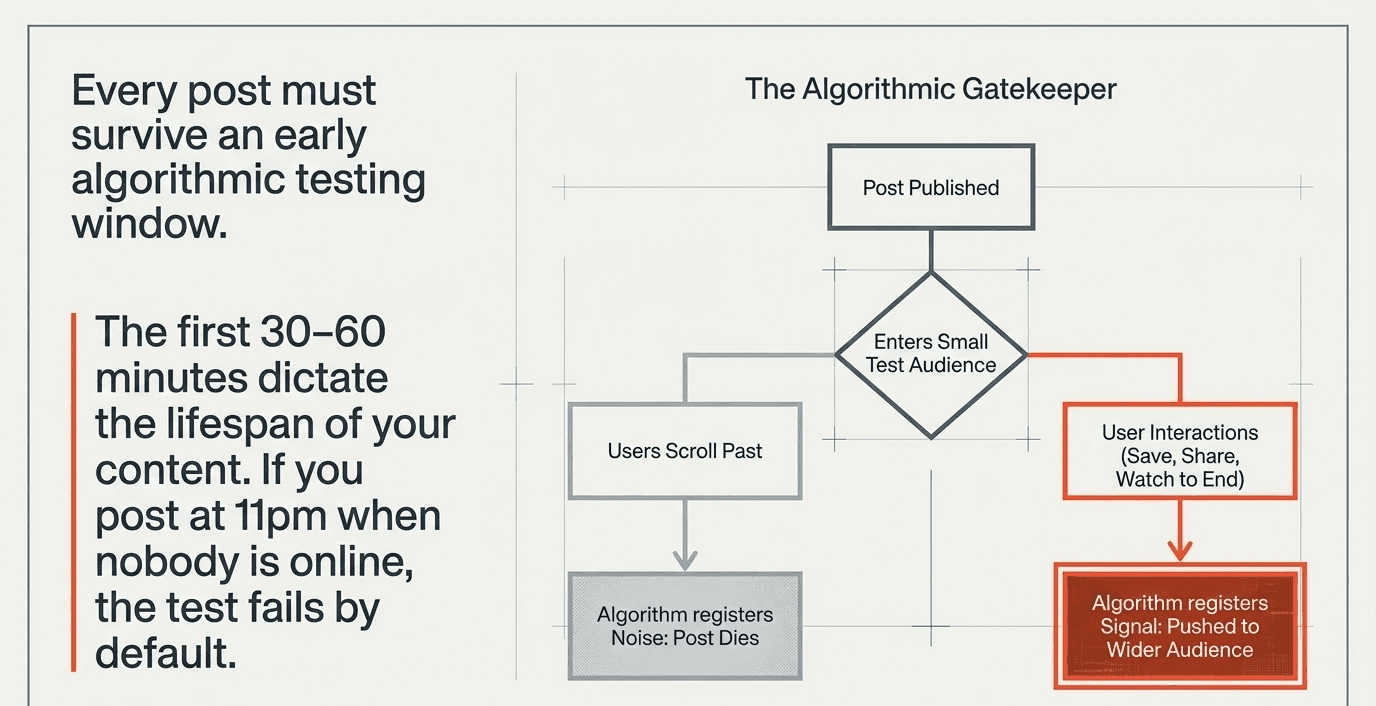
Every platform has its own formula, but they all share the same basic idea: they measure early engagement and use that to decide how wide to push the content.
Here's what that means practically:
• When you post, the platform shows your content to a small test audience, usually a slice of your followers.
• If that audience interacts, comments, saves, shares, watches to the end, the algorithm treats it as a signal that the content is worth showing to more people.
• If the first audience scrolls past, the post dies right there.
The first 30-60 minutes after you post matter a lot. That's your testing window. If you post at 11pm when nobody's online, the test fails by default.
Saves and shares carry more weight than most people realize. Likes and comments still count, but a save means someone wants to come back to your content. A share means they think someone else needs to see it. Both tell the algorithm the content has real value.
Platform | Weights Heavily | Secondary Signal | Key Window |
Saves + Shares | Comments | First 60 mins | |
TikTok | Watch time | Shares | First 30 mins |
Comments + Dwell time | Reposts | First 2 hours | |
X (Twitter) | Replies + Reposts | Link clicks | First 20 mins |
Shares + Comments | Reactions | First 2 hours |
Also read: Micro-influencer vs Macro influencer which is best for you
Content Types That Get the Most Social Media Engagement
Format matters more than message. You can have the best idea in the world, but if it's a plain text post with a stock photo, it's going to underperform compared to the same idea in a short video or a carousel.
Here's what's actually performing across platforms right now:
Short-Form Video
Nothing beats short videos for raw reach and engagement. On TikTok, Instagram Reels, and YouTube Shorts, a 30-60 second video from an account with 200 followers can hit 50,000 views. That doesn't happen with any other format.
What works: a fast hook in the first 2 seconds, visible text overlay (most people watch with sound off), and a clear reason to stick around until the end. Completion rate is a top signal, so the ending matters almost as much as the beginning.
Carousels and Multi-Slide Posts
On Instagram and LinkedIn, carousels are one of the highest-engagement formats available. They work because people swipe through, which counts as repeated interaction. The algorithm reads that as genuine interest.
The format works best as a quick-teach: a problem on slide 1, the solution broken into steps across slides 2-7, and a clear takeaway on the last slide. Keep each slide simple, one idea, minimal text.
Behind-the-Scenes and Process Content
Founders who show their work get more engagement than founders who only show their results. People are naturally curious about how things get made, how decisions happen, and what it actually looks like to build something.
A 45-second video of you building a feature, writing a proposal, or having a team call will almost always outperform a polished product promo. It feels real. And real content gets responses.
Opinion and Perspective Posts
Taking a clear stance on something in your industry drives comments. Not controversy for its own sake, but a genuine point of view that someone might disagree with or want to build on.
On LinkedIn especially, posts that open with a contrarian idea and follow it up with reasoning tend to generate long comment threads. Long comment threads tell the algorithm the post is worth amplifying.
What to Avoid Promotional posts with zero value, overly polished graphics that look like ads, and posts that don't invite any kind of response. If someone can consume your post and have no natural reason to react, it won't perform. |
Also Read: What’s Social Media SEO
You're posting. You're showing up. You're doing everything the gurus told you to do. And still; barely a like, maybe a comment from your cousin, and a whole lot of silence.
You're not alone. Founders and small brand teams are some of the most consistent posters on the internet, and some of the most ignored.
The frustrating truth is that consistency alone doesn't move the needle. Posting every day without understanding why people stop and engage is just noise. The algorithm doesn't reward volume; it rewards behavior.
Quick Fact Engagement goes up when you create content people want to respond to, post it when they're actually online, and match the format each platform rewards. It's not about posting more; it's about posting smarter. |
How the Social Media Algorithm Decides Who Sees Your Posts
Every platform has its own formula, but they all share the same basic idea: they measure early engagement and use that to decide how wide to push the content.
Here's what that means practically:
• When you post, the platform shows your content to a small test audience, usually a slice of your followers.
• If that audience interacts, comments, saves, shares, watches to the end, the algorithm treats it as a signal that the content is worth showing to more people.
• If the first audience scrolls past, the post dies right there.
The first 30-60 minutes after you post matter a lot. That's your testing window. If you post at 11pm when nobody's online, the test fails by default.
Saves and shares carry more weight than most people realize. Likes and comments still count, but a save means someone wants to come back to your content. A share means they think someone else needs to see it. Both tell the algorithm the content has real value.
Platform | Weights Heavily | Secondary Signal | Key Window |
Saves + Shares | Comments | First 60 mins | |
TikTok | Watch time | Shares | First 30 mins |
Comments + Dwell time | Reposts | First 2 hours | |
X (Twitter) | Replies + Reposts | Link clicks | First 20 mins |
Shares + Comments | Reactions | First 2 hours |
Also read: Micro-influencer vs Macro influencer which is best for you
Content Types That Get the Most Social Media Engagement
Format matters more than message. You can have the best idea in the world, but if it's a plain text post with a stock photo, it's going to underperform compared to the same idea in a short video or a carousel.
Here's what's actually performing across platforms right now:
Short-Form Video
Nothing beats short videos for raw reach and engagement. On TikTok, Instagram Reels, and YouTube Shorts, a 30-60 second video from an account with 200 followers can hit 50,000 views. That doesn't happen with any other format.
What works: a fast hook in the first 2 seconds, visible text overlay (most people watch with sound off), and a clear reason to stick around until the end. Completion rate is a top signal, so the ending matters almost as much as the beginning.
Carousels and Multi-Slide Posts
On Instagram and LinkedIn, carousels are one of the highest-engagement formats available. They work because people swipe through, which counts as repeated interaction. The algorithm reads that as genuine interest.
The format works best as a quick-teach: a problem on slide 1, the solution broken into steps across slides 2-7, and a clear takeaway on the last slide. Keep each slide simple, one idea, minimal text.
Behind-the-Scenes and Process Content
Founders who show their work get more engagement than founders who only show their results. People are naturally curious about how things get made, how decisions happen, and what it actually looks like to build something.
A 45-second video of you building a feature, writing a proposal, or having a team call will almost always outperform a polished product promo. It feels real. And real content gets responses.
Opinion and Perspective Posts
Taking a clear stance on something in your industry drives comments. Not controversy for its own sake, but a genuine point of view that someone might disagree with or want to build on.
On LinkedIn especially, posts that open with a contrarian idea and follow it up with reasoning tend to generate long comment threads. Long comment threads tell the algorithm the post is worth amplifying.
What to Avoid Promotional posts with zero value, overly polished graphics that look like ads, and posts that don't invite any kind of response. If someone can consume your post and have no natural reason to react, it won't perform. |
Also Read: What’s Social Media SEO
Best Times to Post on Social Media for More Engagement
There's no universal perfect time to post, it depends on your audience, your platform, and your timezone. But there are windows that consistently outperform, and there are times that are basically dead zones.
The data across platforms points to a few consistent patterns:
• Tuesday through Thursday perform better than Monday or Friday for B2B audiences on LinkedIn
• Morning windows (7-9am) and lunch (12-1pm) in your target timezone tend to catch people during natural scroll sessions
• For TikTok and Instagram Reels, evenings (7-9pm) perform strongly because people are in leisure mode
• Avoid posting late at night unless your audience is global and you're targeting a specific region's morning
More important than the exact time is consistency. If you post at 8am on Tuesday and it performs well, do the same next week. The algorithm learns your rhythm and so do your followers.
Practical tip: use each platform's native analytics to see when your existing followers are actually online. Instagram Insights, LinkedIn Analytics, and TikTok's Creator Tools all show peak activity windows for your specific audience. That's more useful than any generic best-time chart.
Also Read: How to use AI for digital marketing
How to Write Captions and Hooks That Stop the Scroll
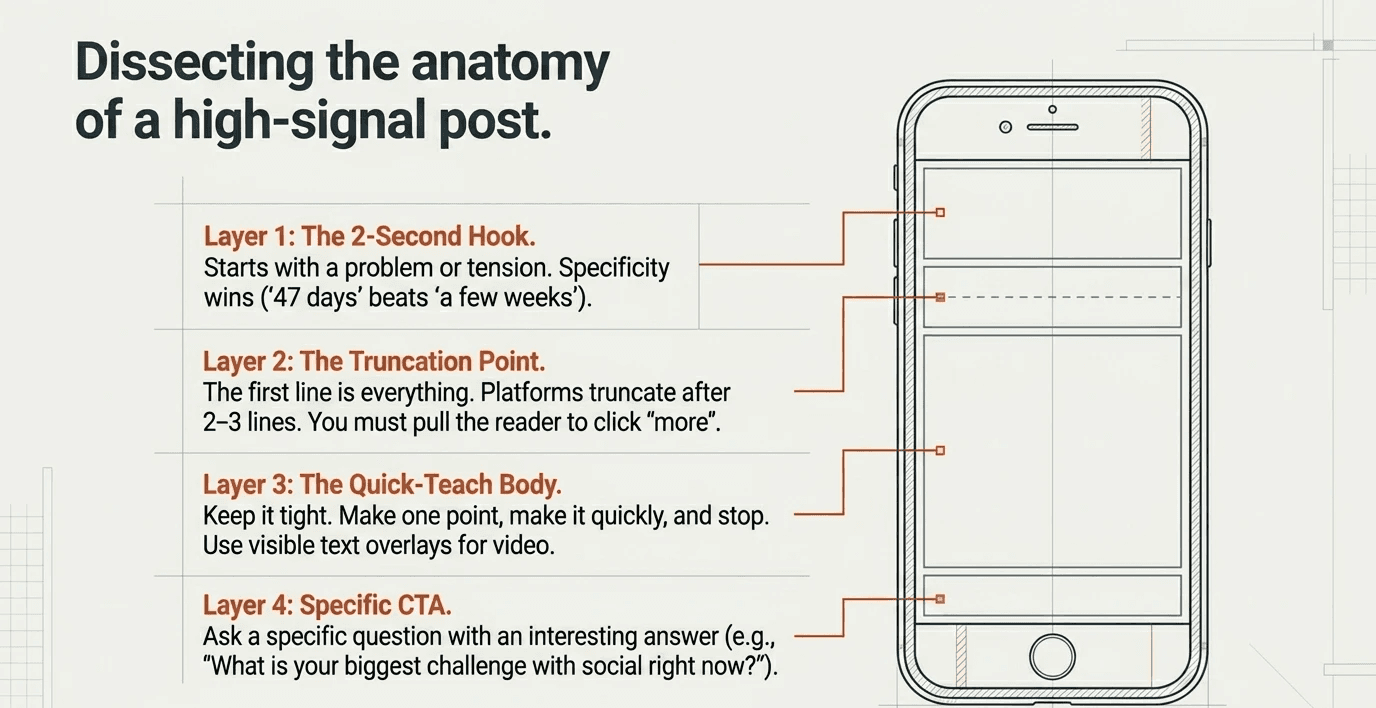
The hook is the make-or-break moment. On video, you have 2 seconds. On a text post, you have one line. That's your whole budget to get someone to keep reading or watching.
What works for hooks:
• Start with a problem or tension: 'Most founders do this wrong...' or 'Here's what nobody tells you about...'
• Use specificity: '3 things' beats 'some things'; '47 days' beats 'a few weeks'
• Make a claim that requires explanation, the reader can't stop because they need the resolution
• Ask a question your audience is already asking themselves
For captions, the first line is everything. Most platforms truncate after 2-3 lines with a 'more' button. That first line needs to pull the person to click. After that, you have room to say something useful.
Short captions with one strong idea often outperform long captions. Unless you're on LinkedIn, where longer thoughtful posts do well, keep it tight. Make your point, make it quickly, and stop.
Engagement Calls to Action That Don't Feel Desperate
Ending a post with 'drop a comment below!' feels hollow. People know what it is. What works better is a specific question that has an interesting answer.
'What's your biggest challenge with social right now?' will get more responses than 'tell me your thoughts!', because it gives someone something concrete to respond to. The more specific the ask, the more likely you get a real reply.
How Often to Post on Each Platform for Better Engagement
More posting doesn't mean more engagement. Posting mediocre content every day will hurt your account over time because low-performing posts drag down your average and signal to the algorithm that your content isn't worth pushing.
Better to post 3 times a week with content that lands than 7 times with filler.
Platform | Recommended Cadence | Priority Format |
4-5x per week | Reels + Carousels | |
TikTok | 5-7x per week | Short video (30-60s) |
3-4x per week | Text posts + Carousels | |
X (Twitter) | Daily or near-daily | Threads + Replies |
YouTube Shorts | 3-4x per week | Vertical video under 60s |
One more thing most people skip: replying to comments, especially in the first hour after posting. Every reply re-engages the person who commented, signals to the platform that there's a real conversation happening, and keeps the post alive longer.
How to Use UGC to Increase Engagement on Social Media
User-generated content, posts made by real people about your brand, product, or service, has some of the highest engagement rates of any content type. It's authentic, it's social proof, and it works.
If you have any customers at all, you can start building a UGC strategy. Ask customers to tag you when they use your product. Share their posts to your stories. Create a simple hashtag and encourage people to use it. Even a handful of genuine posts from real users builds trust faster than any branded content you can make.
For founders without a big customer base yet, micro-influencer partnerships are the next best thing. A creator with 5,000 engaged followers in your niche will drive more real engagement than a paid ad seen by 50,000 people who don't care.
UGC works so well algorithmically because it tends to generate shares. People share content that features them, or content that came from someone they trust. Shares push the algorithm harder than almost anything else.
How to Track Social Media Engagement and Know What's Working
You can't improve what you're not measuring. Most founders check likes and follower count and stop there. But those are vanity metrics. What actually tells you if your strategy is working is a different set of numbers.
The metrics worth tracking:
• Engagement rate: total interactions divided by reach. Aim for 3-6% on Instagram, 1-3% on LinkedIn, higher on TikTok.
• Saves: on Instagram especially, saves are a strong signal. If people are saving a post, it's genuinely useful content.
• Comment quality: are people asking questions, sharing opinions, tagging friends? Generic 'great post' comments don't count for much.
• Profile visits from posts: a sign that someone wanted to learn more about you after seeing the content.
• Watch time and completion rate: for video, these are the most important numbers to track.
Look at your data weekly, not daily. Daily numbers are too noisy. Weekly patterns will show you which content types, p=osting times, and topics actually drive results for your specific audience.
Practical Tracking Habit At the end of each week, note your top 2 posts and your bottom 2. Look for the pattern. Over time, it tells you exactly what your audience wants to see. |
Stop Posting Into the Void Motion Labs manages your social media end-to-end, content strategy, video production, UGC campaigns, and daily posting. So you can focus on running your business. Visit motionlabs.agency to get started |
Best Times to Post on Social Media for More Engagement
There's no universal perfect time to post, it depends on your audience, your platform, and your timezone. But there are windows that consistently outperform, and there are times that are basically dead zones.
The data across platforms points to a few consistent patterns:
• Tuesday through Thursday perform better than Monday or Friday for B2B audiences on LinkedIn
• Morning windows (7-9am) and lunch (12-1pm) in your target timezone tend to catch people during natural scroll sessions
• For TikTok and Instagram Reels, evenings (7-9pm) perform strongly because people are in leisure mode
• Avoid posting late at night unless your audience is global and you're targeting a specific region's morning
More important than the exact time is consistency. If you post at 8am on Tuesday and it performs well, do the same next week. The algorithm learns your rhythm and so do your followers.
Practical tip: use each platform's native analytics to see when your existing followers are actually online. Instagram Insights, LinkedIn Analytics, and TikTok's Creator Tools all show peak activity windows for your specific audience. That's more useful than any generic best-time chart.
Also Read: How to use AI for digital marketing
How to Write Captions and Hooks That Stop the Scroll
The hook is the make-or-break moment. On video, you have 2 seconds. On a text post, you have one line. That's your whole budget to get someone to keep reading or watching.
What works for hooks:
• Start with a problem or tension: 'Most founders do this wrong...' or 'Here's what nobody tells you about...'
• Use specificity: '3 things' beats 'some things'; '47 days' beats 'a few weeks'
• Make a claim that requires explanation, the reader can't stop because they need the resolution
• Ask a question your audience is already asking themselves
For captions, the first line is everything. Most platforms truncate after 2-3 lines with a 'more' button. That first line needs to pull the person to click. After that, you have room to say something useful.
Short captions with one strong idea often outperform long captions. Unless you're on LinkedIn, where longer thoughtful posts do well, keep it tight. Make your point, make it quickly, and stop.
Engagement Calls to Action That Don't Feel Desperate
Ending a post with 'drop a comment below!' feels hollow. People know what it is. What works better is a specific question that has an interesting answer.
'What's your biggest challenge with social right now?' will get more responses than 'tell me your thoughts!', because it gives someone something concrete to respond to. The more specific the ask, the more likely you get a real reply.
How Often to Post on Each Platform for Better Engagement
More posting doesn't mean more engagement. Posting mediocre content every day will hurt your account over time because low-performing posts drag down your average and signal to the algorithm that your content isn't worth pushing.
Better to post 3 times a week with content that lands than 7 times with filler.
Platform | Recommended Cadence | Priority Format |
4-5x per week | Reels + Carousels | |
TikTok | 5-7x per week | Short video (30-60s) |
3-4x per week | Text posts + Carousels | |
X (Twitter) | Daily or near-daily | Threads + Replies |
YouTube Shorts | 3-4x per week | Vertical video under 60s |
One more thing most people skip: replying to comments, especially in the first hour after posting. Every reply re-engages the person who commented, signals to the platform that there's a real conversation happening, and keeps the post alive longer.
How to Use UGC to Increase Engagement on Social Media
User-generated content, posts made by real people about your brand, product, or service, has some of the highest engagement rates of any content type. It's authentic, it's social proof, and it works.
If you have any customers at all, you can start building a UGC strategy. Ask customers to tag you when they use your product. Share their posts to your stories. Create a simple hashtag and encourage people to use it. Even a handful of genuine posts from real users builds trust faster than any branded content you can make.
For founders without a big customer base yet, micro-influencer partnerships are the next best thing. A creator with 5,000 engaged followers in your niche will drive more real engagement than a paid ad seen by 50,000 people who don't care.
UGC works so well algorithmically because it tends to generate shares. People share content that features them, or content that came from someone they trust. Shares push the algorithm harder than almost anything else.
How to Track Social Media Engagement and Know What's Working
You can't improve what you're not measuring. Most founders check likes and follower count and stop there. But those are vanity metrics. What actually tells you if your strategy is working is a different set of numbers.
The metrics worth tracking:
• Engagement rate: total interactions divided by reach. Aim for 3-6% on Instagram, 1-3% on LinkedIn, higher on TikTok.
• Saves: on Instagram especially, saves are a strong signal. If people are saving a post, it's genuinely useful content.
• Comment quality: are people asking questions, sharing opinions, tagging friends? Generic 'great post' comments don't count for much.
• Profile visits from posts: a sign that someone wanted to learn more about you after seeing the content.
• Watch time and completion rate: for video, these are the most important numbers to track.
Look at your data weekly, not daily. Daily numbers are too noisy. Weekly patterns will show you which content types, p=osting times, and topics actually drive results for your specific audience.
Practical Tracking Habit At the end of each week, note your top 2 posts and your bottom 2. Look for the pattern. Over time, it tells you exactly what your audience wants to see. |
Stop Posting Into the Void Motion Labs manages your social media end-to-end, content strategy, video production, UGC campaigns, and daily posting. So you can focus on running your business. Visit motionlabs.agency to get started |
Conclusion
The gap between founders who get engagement and those who don't isn't about budget or talent. It's about understanding how the platforms actually work and building content to match.
The algorithm isn't your enemy; it just needs proof that people care about your content before it takes a risk on you. Give it that proof early, consistently, and in the formats each platform rewards.
Start with one platform. Pick the format that fits your audience. Post at the right time. Engage with every comment. Check your numbers weekly and adjust. It's not complicated; it just requires doing the right things consistently.
And if you'd rather focus on running your business than figuring out the algorithm, Motion Labs handles the whole thing. Strategy, content, video, posting, and reporting, all done for you.
Frequently Asked Questions
What is a good social media engagement rate?
It depends on the platform. On Instagram, anything above 3% is solid. On LinkedIn, 1-2% is healthy because reach tends to be lower. On TikTok, video views are the primary signal so engagement reads differently. A better benchmark than industry averages is your own historical average, are you trending up or down over time?
How long does it take to see more social media engagement?
Most accounts see measurable improvement within 4-8 weeks of consistently applying the right strategy. That means posting quality content in the right formats, at the right times, and actively engaging with every comment you get. Don't judge results on a single post; judge them on monthly trends.
Does posting more frequently increase engagement?
Not automatically. Posting more often with low-quality content signals to the algorithm that your posts don't earn responses, and it pulls back on your reach. A smarter approach is fewer posts with stronger hooks, better formats, and active comment engagement. Quality beats volume every time.
What type of content gets the most engagement on Instagram?
Reels are the top reach driver, and carousels consistently generate high save and share rates. Behind-the-scenes content and educational carousels tend to outperform purely promotional posts. If you're just starting out, short video is the fastest way to get in front of new people.
Do hashtags still affect social media engagement?
Yes, but they're less of a lever than they used to be. On Instagram, using 3-5 highly relevant hashtags works better than stuffing 30 generic ones. On LinkedIn, 2-3 hashtags per post is the sweet spot. On TikTok, hashtags help with topic categorization but watch time is still the main driver.
Should I reply to every comment on my posts?
Yes, especially in the first hour after posting. Replies count as engagement, which signals to the platform that there's an active conversation. They also bring the original commenter back to the post, which can restart the engagement cycle. Even a short genuine reply beats no reply at all.
What is the difference between reach and engagement?
Reach is how many people saw your post. Engagement is how many of those people actually did something, liked, commented, saved, shared, or clicked. High reach with low engagement means people saw your post and kept scrolling. High engagement relative to reach means your content is connected. Engagement rate is the number worth optimizing.
Conclusion
The gap between founders who get engagement and those who don't isn't about budget or talent. It's about understanding how the platforms actually work and building content to match.
The algorithm isn't your enemy; it just needs proof that people care about your content before it takes a risk on you. Give it that proof early, consistently, and in the formats each platform rewards.
Start with one platform. Pick the format that fits your audience. Post at the right time. Engage with every comment. Check your numbers weekly and adjust. It's not complicated; it just requires doing the right things consistently.
And if you'd rather focus on running your business than figuring out the algorithm, Motion Labs handles the whole thing. Strategy, content, video, posting, and reporting, all done for you.
Frequently Asked Questions
What is a good social media engagement rate?
It depends on the platform. On Instagram, anything above 3% is solid. On LinkedIn, 1-2% is healthy because reach tends to be lower. On TikTok, video views are the primary signal so engagement reads differently. A better benchmark than industry averages is your own historical average, are you trending up or down over time?
How long does it take to see more social media engagement?
Most accounts see measurable improvement within 4-8 weeks of consistently applying the right strategy. That means posting quality content in the right formats, at the right times, and actively engaging with every comment you get. Don't judge results on a single post; judge them on monthly trends.
Does posting more frequently increase engagement?
Not automatically. Posting more often with low-quality content signals to the algorithm that your posts don't earn responses, and it pulls back on your reach. A smarter approach is fewer posts with stronger hooks, better formats, and active comment engagement. Quality beats volume every time.
What type of content gets the most engagement on Instagram?
Reels are the top reach driver, and carousels consistently generate high save and share rates. Behind-the-scenes content and educational carousels tend to outperform purely promotional posts. If you're just starting out, short video is the fastest way to get in front of new people.
Do hashtags still affect social media engagement?
Yes, but they're less of a lever than they used to be. On Instagram, using 3-5 highly relevant hashtags works better than stuffing 30 generic ones. On LinkedIn, 2-3 hashtags per post is the sweet spot. On TikTok, hashtags help with topic categorization but watch time is still the main driver.
Should I reply to every comment on my posts?
Yes, especially in the first hour after posting. Replies count as engagement, which signals to the platform that there's an active conversation. They also bring the original commenter back to the post, which can restart the engagement cycle. Even a short genuine reply beats no reply at all.
What is the difference between reach and engagement?
Reach is how many people saw your post. Engagement is how many of those people actually did something, liked, commented, saved, shared, or clicked. High reach with low engagement means people saw your post and kept scrolling. High engagement relative to reach means your content is connected. Engagement rate is the number worth optimizing.
the call your competitor wish you would'nt take


Related Posts





Related Posts
Related Posts
Motion labs
info@motionlabs.agency


+971 55317 1706
C-1802, ONTARIO TOWER, PLOT NO. 49-0, BUSINESS BAY, DUBAI, 00000
click to meet me :)
click to meet me :)
© All Rights Reserved | 2026


Motion labs
info@motionlabs.agency
+971 55317 1706
C-1802, ONTARIO TOWER, PLOT NO. 49-0, BUSINESS BAY, DUBAI, 00000
Private policy
Terms & Conditions
© All Rights Reserved | 2026
click to meet me :)