/
/
How to Measure the ROI of Paid Advertising
How to Measure the ROI of Paid Advertising
5 min
read
How to Measure the ROI of Paid Advertising
How to Measure the ROI of Paid Advertising
Ads
Marketing

Author

Scroll down
to read more!
Summerize with ChatGPT
Summerize with Gemini
Summerize with Claude
How to Measure the ROI of Paid Advertising
How to Measure the ROI of Paid Advertising
What if the ₹20,000 you spent on ads last month actually cost you more than it made? How do you measure it? This is how you should ideally do it. Measuring paid advertising ROI isn't as complicated as most people make it sound. You need the right metrics, a clear formula, the right tools, and a few good habits.
What if the ₹20,000 you spent on ads last month actually cost you more than it made? How do you measure it? This is how you should ideally do it. Measuring paid advertising ROI isn't as complicated as most people make it sound. You need the right metrics, a clear formula, the right tools, and a few good habits.
What Is ROI in Paid Advertising?
ROI is Return on Investment. In the context of paid advertising, it tells you how much money you made compared to how much you spent on ads.
Take an example, if you spend $1,353 on ads and generate $5,410 in revenue from those ads, your ROI is positive. If you spend $1,353 and generate $1,082 back..." your ROI is negative, and you have a problem.
But ROI in paid advertising goes deeper than just revenue. It captures things like whether your ad spend is actually driving business outcomes, not just clicks and impressions, but real sales, real customers, and real profit.
What Is ROI in Paid Advertising?
ROI is Return on Investment. In the context of paid advertising, it tells you how much money you made compared to how much you spent on ads.
Take an example, if you spend $1,353 on ads and generate $5,410 in revenue from those ads, your ROI is positive. If you spend $1,353 and generate $1,082 back..." your ROI is negative, and you have a problem.
But ROI in paid advertising goes deeper than just revenue. It captures things like if your ad spend is actually driving business outcomes, not just clicks and impressions, but real sales, real customers, and real profit.
Why Measuring Paid Advertising ROI is Important?
A lot of businesses are running paid ads at a loss and don't know it. They see clicks going up, traffic increasing, maybe even revenue growing, but the profit isn't there because they're not accounting for all the costs.
Measuring ROI properly solves that. Here's what it provides you:
Budget control
When you know which campaigns are generating positive ROI and which aren't, you can reallocate budget intelligently. You stop funding underperformers and double down on what works.
Smarter decision-making
ROI data removes gut-feel from the equation. Instead of arguing about whether to run Facebook ads or Google ads, you have actual numbers that tell you where your money goes furthest.
Better conversations with stakeholders
Whether you're reporting to a founder, a board, or a client, ROI is the language they speak. Impressions and click-through rates don't move the needle in the boardroom. Profit does.
Continuous improvement
Once you're measuring ROI consistently, you can test, iterate, and improve. Every campaign teaches you something. Every tweak builds toward better results.
Also read: How to choose an AI digital strategy
Key Metrics for Measuring ROI in Paid Campaigns
Metric | What It Measures | Why It Matters |
ROAS | Revenue generated per $1 of ad spend | Fast campaign-level health check |
CPA (Cost Per Acquisition) | How much you pay to get one customer or conversion | Core profitability metric |
CTR (Click-Through Rate) | % of people who click your ad after seeing it | Measures ad creative relevance |
Conversion Rate | % of clicks that turn into purchases or leads | Measures landing page effectiveness |
CLV (Customer Lifetime Value) | Total revenue a customer generates over time | Tells you how much a lead is really worth |
Impression Share | % of available impressions your ads are capturing | Reveals missed reach opportunities |
Quality Score / Ad Relevance | Platform score for ad quality and relevance | Impacts CPC and ad placement |
MER (Marketing Efficiency Ratio) | Total revenue / total marketing spend | Blended profitability across all channels |
How to Calculate Advertising ROI
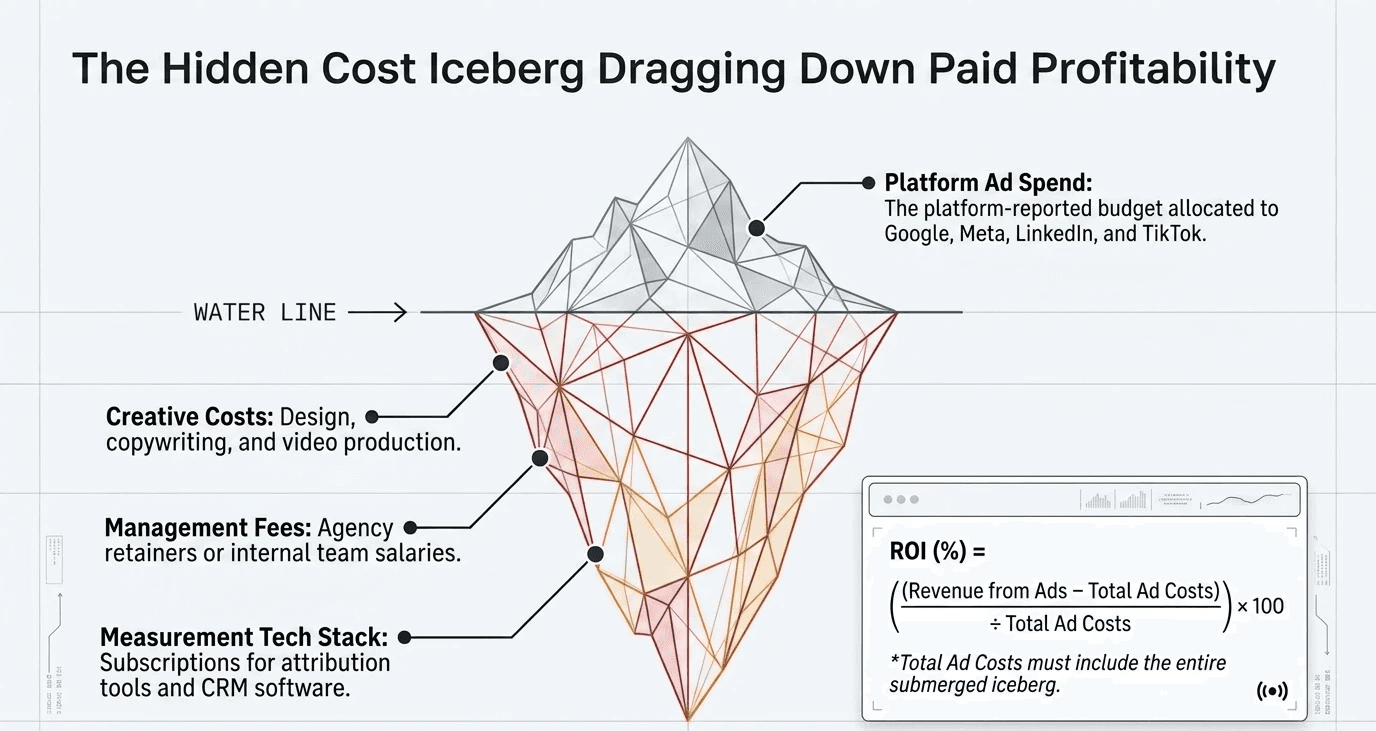
Here's the core ROI formula:
ROI (%) = ((Revenue from Ads − Total Ad Costs) ÷ Total Ad Costs) × 100
Step 1: Define what counts as a conversion
Before you measure anything, get crystal clear on what success looks like. Is it a purchase? A lead form submission? A phone call? A free trial sign-up? Define your primary conversion event first.
Step 2: Calculate your total ad costs
Don't just count ad spend. Your real investment includes:
• Platform spend (Google, Meta, LinkedIn, TikTok, etc.)
• Creative costs: design, copywriting, video production
• Agency or management fees
• Tools and software used to run the campaigns
Adding all of these together gives you your true investment figure.
Step 3: Track revenue generated from ads
This is where a proper tracking setup matters. You need to be able to attribute revenue to specific campaigns, which means UTM parameters on all your ad links, conversion tracking set up in Google Analytics 4 or your platform's native tracker, and ideally a CRM that ties leads to revenue.
Step 4: Factor in customer lifetime value
If you're tracking ROI at the first-purchase level, you're likely undervaluing your campaigns. Take that same £5,000 investment; if those customers go on to spend an average of $600 each over two years, and you acquired 30 of them, your real revenue is closer to $18,000, not just the initial purchase value.
What Are the Common Mistakes When Measuring Advertising ROI?
Only counting ad spend, not total costs
If you're only plugging your platform spend into the ROI formula, you're getting a falsely optimistic number. Creative costs, management fees, and tools all count. Include everything.
Ignoring the attribution problem
Most customers don't convert on the first ad they see. They might see your Facebook ad, then search Google, then click a retargeting ad before buying. If you're using last-click attribution, you're giving all the credit to that final click and none to the earlier touchpoints that built the relationship.
Measuring too early
Some campaigns, especially those targeting cold audiences or longer sales cycles, need time to pay off. Measuring ROI after two weeks of a brand awareness campaign will almost always look bad. Match your measurement window to your sales cycle.
Treating all conversions as equal
A $50 purchase and a $5,000 purchase are both conversions. But they're not equally valuable. Make sure your ROI calculation is weighted by revenue value, not just conversion volume.
Not segmenting by campaign, audience, or channel
Blended ROI across all your campaigns hides the truth. A single strong campaign can mask three underperforming ones. Always drill down to campaign and audience level before making budget decisions.
Forgetting organic influence
Paid ads don't operate in isolation. Brand search volume, email performance, and organic traffic all influence your paid conversion rates. A holistic view, including Marketing Efficiency Ratio across all channels, prevents you from either over-crediting or under-crediting your paid media.
Also read: 5 effective ways of marketing strategies
What Is ROI in Paid Advertising?
ROI is Return on Investment. In the context of paid advertising, it tells you how much money you made compared to how much you spent on ads.
Take an example, if you spend $1,353 on ads and generate $5,410 in revenue from those ads, your ROI is positive. If you spend $1,353 and generate $1,082 back..." your ROI is negative, and you have a problem.
But ROI in paid advertising goes deeper than just revenue. It captures things like whether your ad spend is actually driving business outcomes, not just clicks and impressions, but real sales, real customers, and real profit.
What Is ROI in Paid Advertising?
ROI is Return on Investment. In the context of paid advertising, it tells you how much money you made compared to how much you spent on ads.
Take an example, if you spend $1,353 on ads and generate $5,410 in revenue from those ads, your ROI is positive. If you spend $1,353 and generate $1,082 back..." your ROI is negative, and you have a problem.
But ROI in paid advertising goes deeper than just revenue. It captures things like if your ad spend is actually driving business outcomes, not just clicks and impressions, but real sales, real customers, and real profit.
Why Measuring Paid Advertising ROI is Important?
A lot of businesses are running paid ads at a loss and don't know it. They see clicks going up, traffic increasing, maybe even revenue growing, but the profit isn't there because they're not accounting for all the costs.
Measuring ROI properly solves that. Here's what it provides you:
Budget control
When you know which campaigns are generating positive ROI and which aren't, you can reallocate budget intelligently. You stop funding underperformers and double down on what works.
Smarter decision-making
ROI data removes gut-feel from the equation. Instead of arguing about whether to run Facebook ads or Google ads, you have actual numbers that tell you where your money goes furthest.
Better conversations with stakeholders
Whether you're reporting to a founder, a board, or a client, ROI is the language they speak. Impressions and click-through rates don't move the needle in the boardroom. Profit does.
Continuous improvement
Once you're measuring ROI consistently, you can test, iterate, and improve. Every campaign teaches you something. Every tweak builds toward better results.
Also read: How to choose an AI digital strategy
Key Metrics for Measuring ROI in Paid Campaigns
Metric | What It Measures | Why It Matters |
ROAS | Revenue generated per $1 of ad spend | Fast campaign-level health check |
CPA (Cost Per Acquisition) | How much you pay to get one customer or conversion | Core profitability metric |
CTR (Click-Through Rate) | % of people who click your ad after seeing it | Measures ad creative relevance |
Conversion Rate | % of clicks that turn into purchases or leads | Measures landing page effectiveness |
CLV (Customer Lifetime Value) | Total revenue a customer generates over time | Tells you how much a lead is really worth |
Impression Share | % of available impressions your ads are capturing | Reveals missed reach opportunities |
Quality Score / Ad Relevance | Platform score for ad quality and relevance | Impacts CPC and ad placement |
MER (Marketing Efficiency Ratio) | Total revenue / total marketing spend | Blended profitability across all channels |
How to Calculate Advertising ROI
Here's the core ROI formula:
ROI (%) = ((Revenue from Ads − Total Ad Costs) ÷ Total Ad Costs) × 100
Step 1: Define what counts as a conversion
Before you measure anything, get crystal clear on what success looks like. Is it a purchase? A lead form submission? A phone call? A free trial sign-up? Define your primary conversion event first.
Step 2: Calculate your total ad costs
Don't just count ad spend. Your real investment includes:
• Platform spend (Google, Meta, LinkedIn, TikTok, etc.)
• Creative costs: design, copywriting, video production
• Agency or management fees
• Tools and software used to run the campaigns
Adding all of these together gives you your true investment figure.
Step 3: Track revenue generated from ads
This is where a proper tracking setup matters. You need to be able to attribute revenue to specific campaigns, which means UTM parameters on all your ad links, conversion tracking set up in Google Analytics 4 or your platform's native tracker, and ideally a CRM that ties leads to revenue.
Step 4: Factor in customer lifetime value
If you're tracking ROI at the first-purchase level, you're likely undervaluing your campaigns. Take that same £5,000 investment; if those customers go on to spend an average of $600 each over two years, and you acquired 30 of them, your real revenue is closer to $18,000, not just the initial purchase value.
What Are the Common Mistakes When Measuring Advertising ROI?
Only counting ad spend, not total costs
If you're only plugging your platform spend into the ROI formula, you're getting a falsely optimistic number. Creative costs, management fees, and tools all count. Include everything.
Ignoring the attribution problem
Most customers don't convert on the first ad they see. They might see your Facebook ad, then search Google, then click a retargeting ad before buying. If you're using last-click attribution, you're giving all the credit to that final click and none to the earlier touchpoints that built the relationship.
Measuring too early
Some campaigns, especially those targeting cold audiences or longer sales cycles, need time to pay off. Measuring ROI after two weeks of a brand awareness campaign will almost always look bad. Match your measurement window to your sales cycle.
Treating all conversions as equal
A $50 purchase and a $5,000 purchase are both conversions. But they're not equally valuable. Make sure your ROI calculation is weighted by revenue value, not just conversion volume.
Not segmenting by campaign, audience, or channel
Blended ROI across all your campaigns hides the truth. A single strong campaign can mask three underperforming ones. Always drill down to campaign and audience level before making budget decisions.
Forgetting organic influence
Paid ads don't operate in isolation. Brand search volume, email performance, and organic traffic all influence your paid conversion rates. A holistic view, including Marketing Efficiency Ratio across all channels, prevents you from either over-crediting or under-crediting your paid media.
Also read: 5 effective ways of marketing strategies
Tools and Platforms to Track Paid Media Performance
The right tools make accurate ROI measurement vastly easier. Here's what most serious paid media setups use:
Google Analytics 4 (GA4)
The essential baseline. GA4 tracks conversions across all your traffic sources, supports multi-channel funnel reporting, and integrates directly with Google Ads. Set up conversion events properly and use UTM parameters on every paid link, without this, your attribution data is unreliable.
Google Ads and Meta Ads Manager
Each platform has its own native analytics. Google Ads gives you Quality Score, search impression share, and conversion tracking. Meta Ads Manager offers detailed audience breakdowns and ROAS at the ad level. Use both, but treat platform-reported data as directional, not gospel. Each platform tends to take more credit than it deserves.
A CRM (HubSpot, Salesforce, Pipedrive)
Essential for B2B or longer sales cycles where leads don't convert immediately. A CRM tracks the full customer journey from ad click to closed deal, and lets you tie final revenue back to the original campaign source.
Triple Whale / Northbeam (for e-commerce)
These are dedicated attribution tools built for e-commerce brands running multi-channel paid campaigns. They aggregate data across platforms, apply modelled attribution, and give you a cleaner read on true ROAS and ROI than any individual platform can offer.
Looker Studio (formerly Google Data Studio)
Great for building custom dashboards that pull together data from multiple sources, Google Ads, GA4, Meta, and your CRM into a single view. Useful for reporting to clients or leadership without toggling between five different platforms.
Best Practices to Improve Your Advertising ROI
Measuring ROI is only the first step. Here's how you can improve your ROI:
Know your audience.
Broad audiences burn the budget. The more precisely you can target people who actually want what you're selling, by intent signal, job role, behaviour, or lookalike profile, the lower your CPA and the higher your ROI. Regularly prune underperforming audience segments.
Improve your landing pages
A great ad with a weak landing page is a guaranteed ROI killer. The page a user lands on after clicking your ad should match the ad's message exactly, load fast, and make conversion easy. A 1% increase in conversion rate can transform a campaign from break-even to highly profitable without changing a single ad.
Test everything
A/B testing is the single most reliable way to improve paid performance over time. Test one variable at a time: headline, creative, CTA, audience, and landing page, and run tests long enough to reach statistical significance. Gut feeling wins in creative brainstorming. Data wins in optimization.
Use retargeting to close the gap
Most people don't convert the first time they see your ad. Retargeting campaigns, targeting people who visited your site, watched your video, or engaged with your content, consistently deliver higher conversion rates and better ROI than cold audience campaigns. Build retargeting into every campaign structure.
Watch your frequency
Ad fatigue is real. When the same audience sees your ad too many times, click rates drop, CPMs rise, and ROI tanks. Monitor frequency across your campaigns, especially on Meta, and refresh creative regularly.
Align paid spend with your sales cycle
If your average sale takes 30 days from first touch to closed deal, don't judge a campaign after two weeks. Set your measurement window to match reality, and use view-through and assisted conversion data to see the full picture.
Set ROI targets before you spend
This sounds obvious, but most advertisers skip it. Before launching a campaign, decide what ROI you need to make it worth running. Work backwards from your target CPA and CLV to set a maximum acceptable CPC and ad spend. This gives you a clear framework for when to scale, pause, or kill a campaign.
Tools and Platforms to Track Paid Media Performance
The right tools make accurate ROI measurement vastly easier. Here's what most serious paid media setups use:
Google Analytics 4 (GA4)
The essential baseline. GA4 tracks conversions across all your traffic sources, supports multi-channel funnel reporting, and integrates directly with Google Ads. Set up conversion events properly and use UTM parameters on every paid link, without this, your attribution data is unreliable.
Google Ads and Meta Ads Manager
Each platform has its own native analytics. Google Ads gives you Quality Score, search impression share, and conversion tracking. Meta Ads Manager offers detailed audience breakdowns and ROAS at the ad level. Use both, but treat platform-reported data as directional, not gospel. Each platform tends to take more credit than it deserves.
A CRM (HubSpot, Salesforce, Pipedrive)
Essential for B2B or longer sales cycles where leads don't convert immediately. A CRM tracks the full customer journey from ad click to closed deal, and lets you tie final revenue back to the original campaign source.
Triple Whale / Northbeam (for e-commerce)
These are dedicated attribution tools built for e-commerce brands running multi-channel paid campaigns. They aggregate data across platforms, apply modelled attribution, and give you a cleaner read on true ROAS and ROI than any individual platform can offer.
Looker Studio (formerly Google Data Studio)
Great for building custom dashboards that pull together data from multiple sources, Google Ads, GA4, Meta, and your CRM into a single view. Useful for reporting to clients or leadership without toggling between five different platforms.
Best Practices to Improve Your Advertising ROI
Measuring ROI is only the first step. Here's how you can improve your ROI:
Know your audience.
Broad audiences burn the budget. The more precisely you can target people who actually want what you're selling, by intent signal, job role, behaviour, or lookalike profile, the lower your CPA and the higher your ROI. Regularly prune underperforming audience segments.
Improve your landing pages
A great ad with a weak landing page is a guaranteed ROI killer. The page a user lands on after clicking your ad should match the ad's message exactly, load fast, and make conversion easy. A 1% increase in conversion rate can transform a campaign from break-even to highly profitable without changing a single ad.
Test everything
A/B testing is the single most reliable way to improve paid performance over time. Test one variable at a time: headline, creative, CTA, audience, and landing page, and run tests long enough to reach statistical significance. Gut feeling wins in creative brainstorming. Data wins in optimization.
Use retargeting to close the gap
Most people don't convert the first time they see your ad. Retargeting campaigns, targeting people who visited your site, watched your video, or engaged with your content, consistently deliver higher conversion rates and better ROI than cold audience campaigns. Build retargeting into every campaign structure.
Watch your frequency
Ad fatigue is real. When the same audience sees your ad too many times, click rates drop, CPMs rise, and ROI tanks. Monitor frequency across your campaigns, especially on Meta, and refresh creative regularly.
Align paid spend with your sales cycle
If your average sale takes 30 days from first touch to closed deal, don't judge a campaign after two weeks. Set your measurement window to match reality, and use view-through and assisted conversion data to see the full picture.
Set ROI targets before you spend
This sounds obvious, but most advertisers skip it. Before launching a campaign, decide what ROI you need to make it worth running. Work backwards from your target CPA and CLV to set a maximum acceptable CPC and ad spend. This gives you a clear framework for when to scale, pause, or kill a campaign.
Frequently Asked Questions: Measuring Paid Advertising ROI
What is a good ROI for paid advertising?
It depends on your industry, margins, and goals, but as a general benchmark, a 100%+ ROI (meaning you double your investment) is considered healthy for most paid campaigns. On Google Search, a 200–400% ROI is achievable for well-optimized accounts. The key is setting a target based on your own cost of goods and customer lifetime value before you start spending.
What is the difference between ROI and ROAS in advertising?
ROAS (Return on Ad Spend) measures revenue divided by ad spend; it only looks at your platform costs. ROI is broader: it factors in all your costs (creative, management fees, and tools) and focuses on profit rather than just revenue. ROAS is great for campaign-level decisions. ROI tells you whether the overall investment is profitable.
How do you track ROI from paid ads?
Start with Google Analytics. 4 set up with proper conversion tracking. Add UTM parameters to every paid link, so GA4 knows which campaign drove which traffic. Connect your CRM to track leads from ad click to closed sale. Use platform-native analytics (Google Ads, Meta Ads Manager) as a secondary reference, but always tie data back to actual revenue, not just clicks.
Why is my ROAS high but my ROI low?
This is a common situation. ROAS only looks at ad spend vs. revenue. If your creative costs, management fees, product costs, and fulfillment costs are high, your profit margin after all expenses can be much lower than your ROAS suggests. Always calculate ROI using your full investment, not just what you paid the platform.
What are the most important metrics for paid ad ROI?
The core metrics are ROAS, CPA (Cost Per Acquisition), conversion rate, customer lifetime value (CLV), and your blended MER (Marketing Efficiency Ratio). Secondary metrics, CTR, Quality Score, and impression share help diagnose performance but shouldn't be mistaken for the main event.
How do I improve my paid advertising ROI?
Focus on four levers: tighten your audience targeting to reduce wasted spend, improve your landing page conversion rate, refresh creative regularly to avoid ad fatigue, and use retargeting to capture people who already showed interest. Even small improvements to each of these, 10–15% each, can compound into a dramatically better ROI.
Frequently Asked Questions: Measuring Paid Advertising ROI
What is a good ROI for paid advertising?
It depends on your industry, margins, and goals, but as a general benchmark, a 100%+ ROI (meaning you double your investment) is considered healthy for most paid campaigns. On Google Search, a 200–400% ROI is achievable for well-optimized accounts. The key is setting a target based on your own cost of goods and customer lifetime value before you start spending.
What is the difference between ROI and ROAS in advertising?
ROAS (Return on Ad Spend) measures revenue divided by ad spend; it only looks at your platform costs. ROI is broader: it factors in all your costs (creative, management fees, and tools) and focuses on profit rather than just revenue. ROAS is great for campaign-level decisions. ROI tells you whether the overall investment is profitable.
How do you track ROI from paid ads?
Start with Google Analytics. 4 set up with proper conversion tracking. Add UTM parameters to every paid link, so GA4 knows which campaign drove which traffic. Connect your CRM to track leads from ad click to closed sale. Use platform-native analytics (Google Ads, Meta Ads Manager) as a secondary reference, but always tie data back to actual revenue, not just clicks.
Why is my ROAS high but my ROI low?
This is a common situation. ROAS only looks at ad spend vs. revenue. If your creative costs, management fees, product costs, and fulfillment costs are high, your profit margin after all expenses can be much lower than your ROAS suggests. Always calculate ROI using your full investment, not just what you paid the platform.
What are the most important metrics for paid ad ROI?
The core metrics are ROAS, CPA (Cost Per Acquisition), conversion rate, customer lifetime value (CLV), and your blended MER (Marketing Efficiency Ratio). Secondary metrics, CTR, Quality Score, and impression share help diagnose performance but shouldn't be mistaken for the main event.
How do I improve my paid advertising ROI?
Focus on four levers: tighten your audience targeting to reduce wasted spend, improve your landing page conversion rate, refresh creative regularly to avoid ad fatigue, and use retargeting to capture people who already showed interest. Even small improvements to each of these, 10–15% each, can compound into a dramatically better ROI.
the call your competitor wish you would'nt take


Related Posts





Related Posts
Related Posts
Motion labs
info@motionlabs.agency


+971 55317 1706
C-1802, ONTARIO TOWER, PLOT NO. 49-0, BUSINESS BAY, DUBAI, 00000
click to meet me :)
click to meet me :)
© All Rights Reserved | 2026


Motion labs
info@motionlabs.agency
+971 55317 1706
C-1802, ONTARIO TOWER, PLOT NO. 49-0, BUSINESS BAY, DUBAI, 00000
Private policy
Terms & Conditions
© All Rights Reserved | 2026
click to meet me :)