5 min
read
The Impact of AI on SEO
The Impact of AI on SEO
SEO
Ai

Author

Scroll down
to read more!
Summerize with ChatGPT
Summerize with Gemini
Summerize with Claude
The Impact of AI on SEO
The Impact of AI on SEO
Is AI improving your SEO or destroying it? Here is how you can measure and fix it.
Is AI improving your SEO or destroying it? Here is how you can measure and fix it.
If you run a website, a blog, or any kind of online presence, you've probably noticed something feels different about search. You're doing the same things you always did. Targeting the right keywords. Publishing consistently.
What Is AI Doing to SEO Right Now
For the last decade, SEO was simple: get the right keywords on the page, earn backlinks, load fast, and Google would give you traffic. That still matters. But AI has added a whole new layer on top of it.
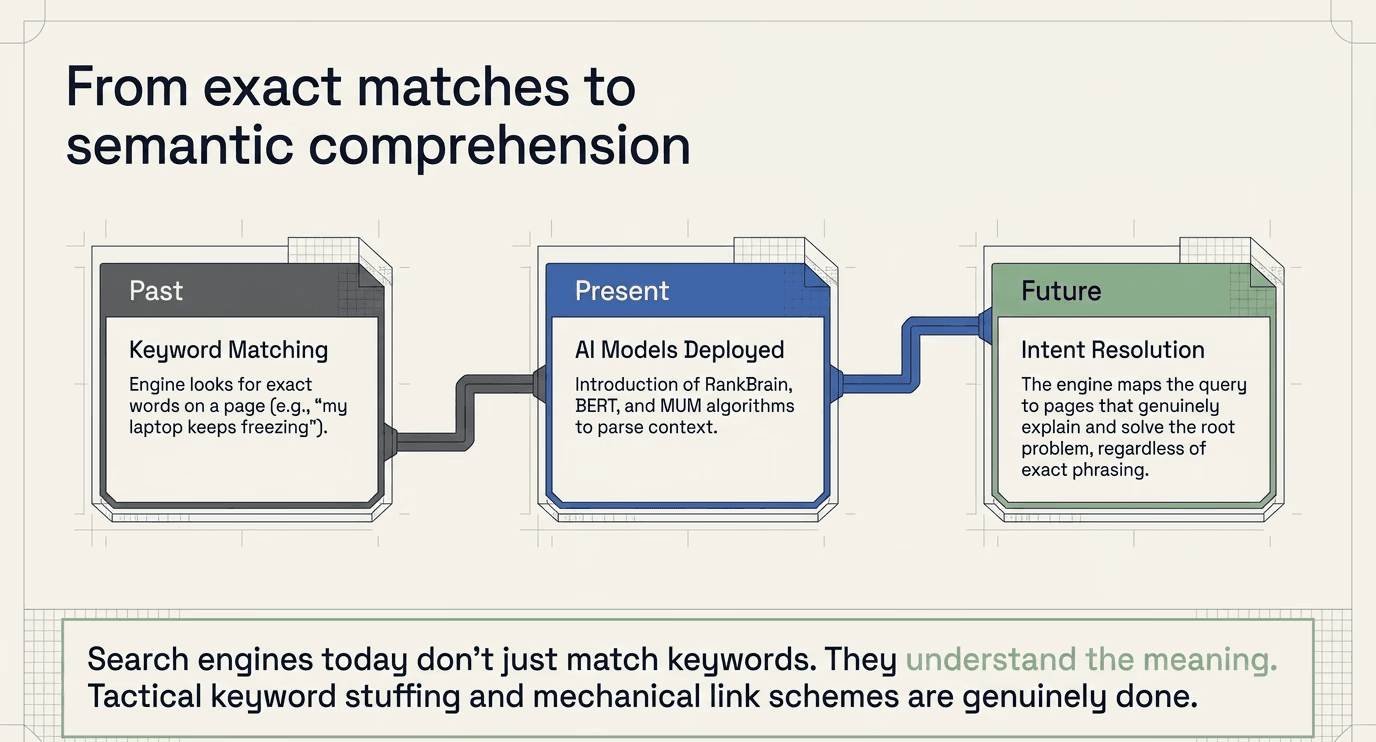
Search engines today don't just match keywords. They understand the meaning. Google uses AI models like RankBrain, BERT, and MUM to figure out what someone actually wants when they type a query, not just the words they used. So if someone searches 'my laptop keeps freezing,' Google doesn't look for pages that contain those exact words. It looks for pages that genuinely explain and solve that problem.
AI Overviews pull a summary answer straight into the results page. So even if you rank number one, you might not get the click because Google already told the user what they needed to know. That 58% drop in CTR isn't a bug. That's the design now.
📊 Stat to Know AI Overviews now appear in at least 16% of all Google searches, and significantly more for comparison and high-intent queries. For some topics, that number is much higher. |
What this means practically: optimising for rankings alone isn't enough anymore. You need to show up inside those AI-generated answers, too. That's a different kind of optimisation, and we'll get into exactly how to do it.
Is SEO Dead Because of AI?
No. The people who are asking this question are usually the ones who haven't updated their strategy since 2019.
SEO isn't going anywhere. People still search. Google still ranks pages. Backlinks still matter. Content still needs to be optimised. But the tactics that were used to move the needle, keyword stuffing, thin content, mechanical link schemes, those are genuinely done. And some brands are still depending on them.
AI traffic is growing fast, but Google is still where most of the action is. So anyone telling you to abandon traditional SEO is getting ahead of themselves.
What is shifting is the definition of good SEO. It's less about hitting keyword density targets and more about becoming the source that both Google and AI tools trust enough to cite. That's a higher bar, but it's also a better long-term position to be in.
💡 Pro Tip Experts now describe the next generation of SEO practitioners as 'relevance engineers', people who craft content optimised not just for search rankings, but for AI-driven discovery. That shift is real, and it's happening now. |
How AI Is Changing Keyword Research
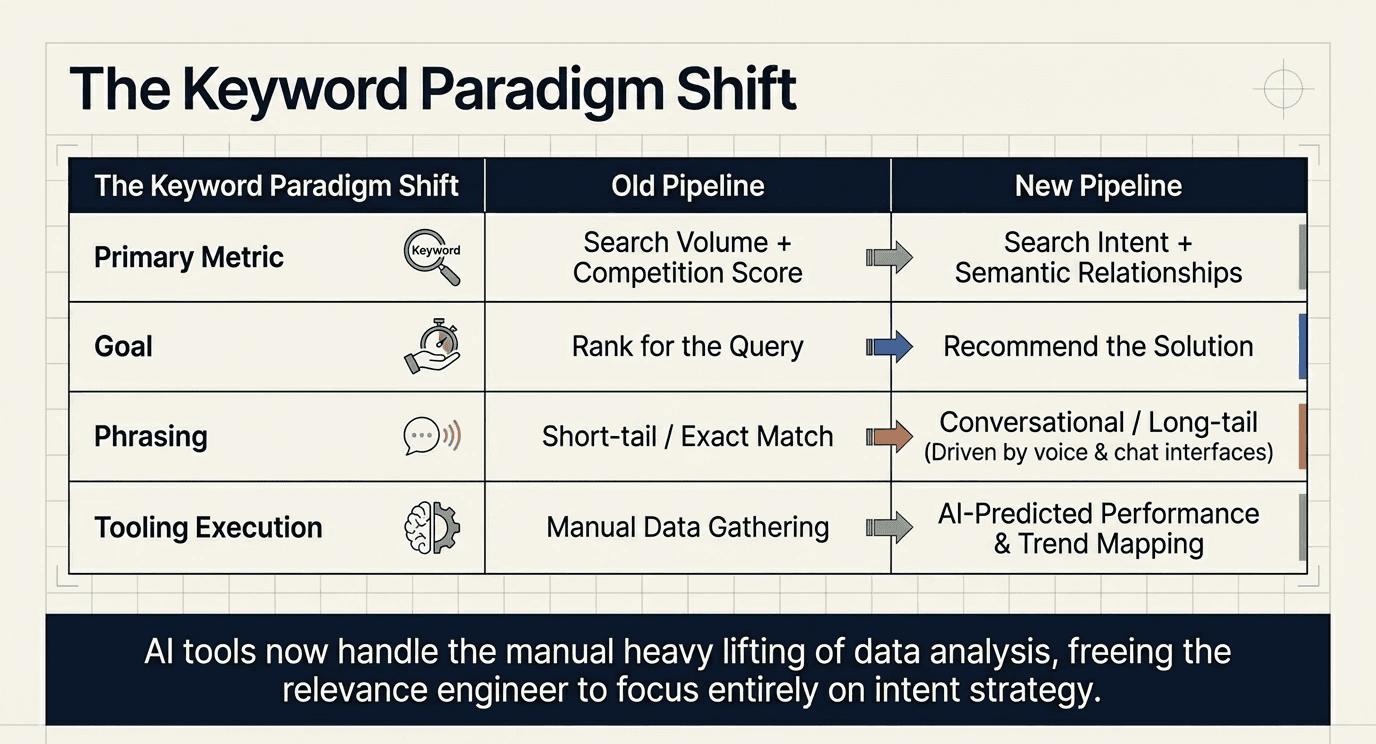
Keyword research used to be a fairly manual process. You opened a tool, looked for search volume and competition scores, picked your targets, and started writing. That process still exists, but AI has made it faster, deeper, and honestly a lot smarter.
Modern AI-powered keyword tools don't just show you search volume. They analyse real-time trends, detect SERP patterns, map out what competitors are ranking for, and, crucially, they understand search intent at a level that older tools never could.
Search intent is the key thing here. Knowing that someone searched for 'best project management tool' tells you they want a recommendation.
Long-tail keywords are also getting more important. Users are searching in more natural, conversational language, especially as voice search and AI chat interfaces become the norm. Queries like 'what's the easiest way to set up email marketing for a small business' are becoming common. These longer phrases are less competitive and often signal higher intent.
What has changed Old keyword research = volume + competition score. New keyword research = intent + topic clusters + semantic relationships + AI-predicted performance. AI tools now handle the heavy lifting so you can focus on the strategy. |
Also read: How to measure ROI of paid advertising.
What Is Generative Engine Optimisation, and Do You Need It?
Traditional SEO is about ranking in search results. GEO is about getting cited in AI-generated answers. Think ChatGPT, Perplexity, Google AI Overviews, Gemini. When someone asks one of these tools a question, the tool pulls together an answer from content it finds trustworthy and credible. The goal of GEO is to make sure your content is the stuff it cites.
The numbers behind this are growing fast. Nearly a third of the US population is expected to use generative AI search in the next year or two. ChatGPT reached 800 million weekly active users by late 2025, doubling in just eight months. These platforms are becoming a real part of how people find information, and if your brand isn't showing up in those answers, someone else's is.
Here's the good news: GEO and SEO aren't opposites. They overlap a lot. Strong SEO, authoritative content, proper structure, and clear expertise are the foundation for good GEO too. Nearly 40% of Google AI Overviews come from pages that already rank in the top 10 organic results. So your first job is still to rank well.
What GEO adds on top of that:
• Structured data and schema markup; content with proper schema shows 30-40% higher visibility in AI-generated answers
• Citing your claims with data, research, and sources; AI tools prefer content that backs up what it says
• Fresher content; AI platforms favour content that's about 25% more recently updated than what ranks in traditional search
• Clear, direct answers, AI systems need to extract your answer cleanly, so a well-structured Q&A format helps a lot.
If you run a website, a blog, or any kind of online presence, you've probably noticed something feels different about search. You're doing the same things you always did. Targeting the right keywords. Publishing consistently.
What Is AI Doing to SEO Right Now
For the last decade, SEO was simple: get the right keywords on the page, earn backlinks, load fast, and Google would give you traffic. That still matters. But AI has added a whole new layer on top of it.
Search engines today don't just match keywords. They understand the meaning. Google uses AI models like RankBrain, BERT, and MUM to figure out what someone actually wants when they type a query, not just the words they used. So if someone searches 'my laptop keeps freezing,' Google doesn't look for pages that contain those exact words. It looks for pages that genuinely explain and solve that problem.
AI Overviews pull a summary answer straight into the results page. So even if you rank number one, you might not get the click because Google already told the user what they needed to know. That 58% drop in CTR isn't a bug. That's the design now.
📊 Stat to Know AI Overviews now appear in at least 16% of all Google searches, and significantly more for comparison and high-intent queries. For some topics, that number is much higher. |
What this means practically: optimising for rankings alone isn't enough anymore. You need to show up inside those AI-generated answers, too. That's a different kind of optimisation, and we'll get into exactly how to do it.
Is SEO Dead Because of AI?
No. The people who are asking this question are usually the ones who haven't updated their strategy since 2019.
SEO isn't going anywhere. People still search. Google still ranks pages. Backlinks still matter. Content still needs to be optimised. But the tactics that were used to move the needle, keyword stuffing, thin content, mechanical link schemes, those are genuinely done. And some brands are still depending on them.
AI traffic is growing fast, but Google is still where most of the action is. So anyone telling you to abandon traditional SEO is getting ahead of themselves.
What is shifting is the definition of good SEO. It's less about hitting keyword density targets and more about becoming the source that both Google and AI tools trust enough to cite. That's a higher bar, but it's also a better long-term position to be in.
💡 Pro Tip Experts now describe the next generation of SEO practitioners as 'relevance engineers', people who craft content optimised not just for search rankings, but for AI-driven discovery. That shift is real, and it's happening now. |
How AI Is Changing Keyword Research
Keyword research used to be a fairly manual process. You opened a tool, looked for search volume and competition scores, picked your targets, and started writing. That process still exists, but AI has made it faster, deeper, and honestly a lot smarter.
Modern AI-powered keyword tools don't just show you search volume. They analyse real-time trends, detect SERP patterns, map out what competitors are ranking for, and, crucially, they understand search intent at a level that older tools never could.
Search intent is the key thing here. Knowing that someone searched for 'best project management tool' tells you they want a recommendation.
Long-tail keywords are also getting more important. Users are searching in more natural, conversational language, especially as voice search and AI chat interfaces become the norm. Queries like 'what's the easiest way to set up email marketing for a small business' are becoming common. These longer phrases are less competitive and often signal higher intent.
What has changed Old keyword research = volume + competition score. New keyword research = intent + topic clusters + semantic relationships + AI-predicted performance. AI tools now handle the heavy lifting so you can focus on the strategy. |
Also read: How to measure ROI of paid advertising.
What Is Generative Engine Optimisation, and Do You Need It?
Traditional SEO is about ranking in search results. GEO is about getting cited in AI-generated answers. Think ChatGPT, Perplexity, Google AI Overviews, Gemini. When someone asks one of these tools a question, the tool pulls together an answer from content it finds trustworthy and credible. The goal of GEO is to make sure your content is the stuff it cites.
The numbers behind this are growing fast. Nearly a third of the US population is expected to use generative AI search in the next year or two. ChatGPT reached 800 million weekly active users by late 2025, doubling in just eight months. These platforms are becoming a real part of how people find information, and if your brand isn't showing up in those answers, someone else's is.
Here's the good news: GEO and SEO aren't opposites. They overlap a lot. Strong SEO, authoritative content, proper structure, and clear expertise are the foundation for good GEO too. Nearly 40% of Google AI Overviews come from pages that already rank in the top 10 organic results. So your first job is still to rank well.
What GEO adds on top of that:
• Structured data and schema markup; content with proper schema shows 30-40% higher visibility in AI-generated answers
• Citing your claims with data, research, and sources; AI tools prefer content that backs up what it says
• Fresher content; AI platforms favour content that's about 25% more recently updated than what ranks in traditional search
• Clear, direct answers, AI systems need to extract your answer cleanly, so a well-structured Q&A format helps a lot.
How to Rank in Google AI Overviews
Write in a way that answers the question directly
AI systems are looking for content that can give a clean, accurate answer. Long, winding introductions and buried conclusions work against you. The direct answer should come early, ideally in the first few paragraphs, and again in a structured way further down the page.
Build topical authority, not just individual pages
Google isn't just evaluating your article in isolation. It's evaluating how comprehensively your site covers a topic. A site with ten well-written, interconnected pieces on email marketing will outperform a site with one great email marketing article. This is what topical authority means, and AI rewards it heavily.
Use structured data
Schema markup helps AI systems understand what your content is about, who created it, and what claims it makes. FAQ schema, How-to schema, and Article schema are all worth implementing if you haven't already. The uplift in AI visibility can be significant, and a 30-40% higher citation rate isn't a small number.
Make sure your E-E-A-T signals are solid
Experience, Expertise, Authoritativeness, Trustworthiness. Google introduced this framework years ago, but it's more important than ever now that AI models are evaluating content quality at a much deeper level. Author bios, cited sources, original research, and consistent publishing history all contribute to your E-E-A-T score.
Also read: 4 examples of successful UGC
Does AI-Generated Content Rank on Google
Google has made it clear that it doesn't automatically penalize AI-generated content. What it cares about is whether the content is helpful, accurate, and trustworthy. If AI-generated content meets that bar, it can rank fine.
If you publish something that reads like it was written by a bot trying to hit a keyword count, don't expect Google to reward it. If you publish something that genuinely teaches, informs, or solves a problem, regardless of how it was produced, you've got a real shot.
What SEO Strategies Actually Work in the Age of AI
Let's bring it all together. Here's what the SEO playbook actually looks like right now, not theory, just what works.
• Plan your content in interconnected groups that cover a subject from multiple angles. One article isn't enough. Build topical clusters, not isolated articles.
• Before you write anything, ask: what does this person actually want? An answer? A comparison? A step-by-step guide? Match your content format to that intent. Target search intent, not just keywords.
• Use clear H2s and H3s. Include a proper FAQ section. Write direct answers to the questions your audience is actually asking. This is what gets you into AI Overviews. Structure your content for extraction.
• If you haven't implemented structured data yet, start now. Its one of the highest-leverage technical SEO moves you can make for AI visibility. Use schema markup.
• AI systems favour recently updated content. Build a regular review cycle into your content calendar; don't just publish and forget. Keep content fresh.
• Optimise for Perplexity, Gemini, ChatGPT plugins, and AI-powered discovery. They're smaller than Google today but growing fast. Diversify beyond Google.
• PR mentions, original research, expert quotes, and backlinks from credible sources; these are the trust signals that both Google and AI systems weigh heavily. Invest in brand authority signals.
None of this is revolutionary on its own. But the brands that are doing all of it consistently, and doing it well, are the ones that are going to win the next few years of organic search.
How to Rank in Google AI Overviews
Write in a way that answers the question directly
AI systems are looking for content that can give a clean, accurate answer. Long, winding introductions and buried conclusions work against you. The direct answer should come early, ideally in the first few paragraphs, and again in a structured way further down the page.
Build topical authority, not just individual pages
Google isn't just evaluating your article in isolation. It's evaluating how comprehensively your site covers a topic. A site with ten well-written, interconnected pieces on email marketing will outperform a site with one great email marketing article. This is what topical authority means, and AI rewards it heavily.
Use structured data
Schema markup helps AI systems understand what your content is about, who created it, and what claims it makes. FAQ schema, How-to schema, and Article schema are all worth implementing if you haven't already. The uplift in AI visibility can be significant, and a 30-40% higher citation rate isn't a small number.
Make sure your E-E-A-T signals are solid
Experience, Expertise, Authoritativeness, Trustworthiness. Google introduced this framework years ago, but it's more important than ever now that AI models are evaluating content quality at a much deeper level. Author bios, cited sources, original research, and consistent publishing history all contribute to your E-E-A-T score.
Also read: 4 examples of successful UGC
Does AI-Generated Content Rank on Google
Google has made it clear that it doesn't automatically penalize AI-generated content. What it cares about is whether the content is helpful, accurate, and trustworthy. If AI-generated content meets that bar, it can rank fine.
If you publish something that reads like it was written by a bot trying to hit a keyword count, don't expect Google to reward it. If you publish something that genuinely teaches, informs, or solves a problem, regardless of how it was produced, you've got a real shot.
What SEO Strategies Actually Work in the Age of AI
Let's bring it all together. Here's what the SEO playbook actually looks like right now, not theory, just what works.
• Plan your content in interconnected groups that cover a subject from multiple angles. One article isn't enough. Build topical clusters, not isolated articles.
• Before you write anything, ask: what does this person actually want? An answer? A comparison? A step-by-step guide? Match your content format to that intent. Target search intent, not just keywords.
• Use clear H2s and H3s. Include a proper FAQ section. Write direct answers to the questions your audience is actually asking. This is what gets you into AI Overviews. Structure your content for extraction.
• If you haven't implemented structured data yet, start now. Its one of the highest-leverage technical SEO moves you can make for AI visibility. Use schema markup.
• AI systems favour recently updated content. Build a regular review cycle into your content calendar; don't just publish and forget. Keep content fresh.
• Optimise for Perplexity, Gemini, ChatGPT plugins, and AI-powered discovery. They're smaller than Google today but growing fast. Diversify beyond Google.
• PR mentions, original research, expert quotes, and backlinks from credible sources; these are the trust signals that both Google and AI systems weigh heavily. Invest in brand authority signals.
None of this is revolutionary on its own. But the brands that are doing all of it consistently, and doing it well, are the ones that are going to win the next few years of organic search.
Conclusion
The impact of AI on SEO is so generic and basic. Before AI, the goal was only to target SEO, but now with AI, you have to follow one more term with this, that’s GEO. Just adapt this, and you are good to go.
Want to Win at AI-Era SEO? Most brands are still using SEO playbooks that were written before AI search existed. Motion Labs builds content that's engineered for both Google rankings and AI citations, video, UGC, and written, all of it. Visit motionlabs. agency to see how we do it. |
Frequently Asked Questions
Is SEO still worth investing in with AI taking over search?
Yes, absolutely. Google still dominates search traffic by a massive margin; it sends 345x more traffic than all AI search platforms combined as of 2025. SEO isn't going away; it's evolving. The fundamentals of good content, technical health, and authority building still drive results. What's changing is the bar for quality and the tactics that work.
What is the difference between SEO and GEO?
SEO (search engine optimisation) is about ranking in search results. GEO (generative engine optimisation) is about getting cited in AI-generated answers from tools like ChatGPT, Google AI Overviews, and Perplexity. Both are important now, and the good news is that strong SEO fundamentals support GEO performance; they're more complementary than they are competing strategies.
How do I get my content into Google AI Overviews?
There's no guaranteed method, but the patterns that consistently show up are content that directly answers the query in clear language, solid E-E-A-T signals, proper structured data, topical authority on the subject, and content that's kept up to date. Roughly 40% of AI Overview content already ranks in the top 10 organic results, so ranking well is still your first objective.
Will AI replace SEO professionals?
No, but it will change what great SEO work looks like. The consensus among experts is that AI amplifies SEO skills rather than replacing them. The role is evolving from keyword targeting to what some call 'relevance engineering', understanding how AI systems evaluate and surface content, and building strategies around that. The technical and strategic work still requires human judgment.
Does AI-generated content hurt my SEO?
Not automatically. Google has been clear that AI-generated content isn't penalised by default. What's penalised is low-quality, unhelpful content, regardless of how it was produced. AI-generated content that is accurate, well-structured, and genuinely useful can rank. The problem is that most AI-only content doesn't meet that bar. Human oversight and editorial judgment are still essential.
What are the most important SEO ranking factors in the age of AI?
Topical authority, search intent alignment, E-E-A-T signals, structured data/schema markup, content freshness, and technical site health. Keyword density by itself is no longer a meaningful ranking factor; in fact, studies of top-ranking pages show no consistent correlation between keyword density and rankings. Relevance and authority are what drive results now.
Conclusion
The impact of AI on SEO is so generic and basic. Before AI, the goal was only to target SEO, but now with AI, you have to follow one more term with this, that’s GEO. Just adapt this, and you are good to go.
Want to Win at AI-Era SEO? Most brands are still using SEO playbooks that were written before AI search existed. Motion Labs builds content that's engineered for both Google rankings and AI citations, video, UGC, and written, all of it. Visit motionlabs. agency to see how we do it. |
Frequently Asked Questions
Is SEO still worth investing in with AI taking over search?
Yes, absolutely. Google still dominates search traffic by a massive margin; it sends 345x more traffic than all AI search platforms combined as of 2025. SEO isn't going away; it's evolving. The fundamentals of good content, technical health, and authority building still drive results. What's changing is the bar for quality and the tactics that work.
What is the difference between SEO and GEO?
SEO (search engine optimisation) is about ranking in search results. GEO (generative engine optimisation) is about getting cited in AI-generated answers from tools like ChatGPT, Google AI Overviews, and Perplexity. Both are important now, and the good news is that strong SEO fundamentals support GEO performance; they're more complementary than they are competing strategies.
How do I get my content into Google AI Overviews?
There's no guaranteed method, but the patterns that consistently show up are content that directly answers the query in clear language, solid E-E-A-T signals, proper structured data, topical authority on the subject, and content that's kept up to date. Roughly 40% of AI Overview content already ranks in the top 10 organic results, so ranking well is still your first objective.
Will AI replace SEO professionals?
No, but it will change what great SEO work looks like. The consensus among experts is that AI amplifies SEO skills rather than replacing them. The role is evolving from keyword targeting to what some call 'relevance engineering', understanding how AI systems evaluate and surface content, and building strategies around that. The technical and strategic work still requires human judgment.
Does AI-generated content hurt my SEO?
Not automatically. Google has been clear that AI-generated content isn't penalised by default. What's penalised is low-quality, unhelpful content, regardless of how it was produced. AI-generated content that is accurate, well-structured, and genuinely useful can rank. The problem is that most AI-only content doesn't meet that bar. Human oversight and editorial judgment are still essential.
What are the most important SEO ranking factors in the age of AI?
Topical authority, search intent alignment, E-E-A-T signals, structured data/schema markup, content freshness, and technical site health. Keyword density by itself is no longer a meaningful ranking factor; in fact, studies of top-ranking pages show no consistent correlation between keyword density and rankings. Relevance and authority are what drive results now.
the call your competitor wish you would'nt take


Related Posts





Related Posts
Related Posts
Motion labs
info@motionlabs.agency


+971 55317 1706
C-1802, ONTARIO TOWER, PLOT NO. 49-0, BUSINESS BAY, DUBAI, 00000
click to meet me :)
click to meet me :)
© All Rights Reserved | 2026


Motion labs
info@motionlabs.agency
+971 55317 1706
C-1802, ONTARIO TOWER, PLOT NO. 49-0, BUSINESS BAY, DUBAI, 00000
Private policy
Terms & Conditions
© All Rights Reserved | 2026
click to meet me :)