/
/
5 reasons why your video production sucks and how to fix it?
5 reasons why your video production sucks and how to fix it?
5 min
read
5 reasons why your video production sucks and how to fix it?
5 reasons why your video production sucks and how to fix it?
Content
Marketing

Author
Scroll down
to read more!
Summerize with ChatGPT
Summerize with Gemini
Summerize with Claude
5 reasons why your video production sucks and how to fix it?
5 reasons why your video production sucks and how to fix it?
These are the 5 reasons your video production sucks, and here is how you can fix it.
These are the 5 reasons your video production sucks, and here is how you can fix it.
This isn't about buying a better camera. It's about fixing the things that are actively killing your content right now, things your competitor fixed six months ago.
Let's get into it.
The 5 reasons why your video sucks?
#1 Bad Audio Ruins Even a Good Video |
Audio is the first thing people notice. Your viewer can ignore shaky footage or an off-colour shot, but if the sound is muffled, echo, or uneven? They are gone in under ten seconds.
Studies show viewers are 2x more likely to stop watching a video because of bad audio than because of poor video quality. Most production teams still spend 80% of their prep budget on visuals. |
The most common audio problems are also the easiest ones to ignore. Filming in a big empty room with a laptop mic. Background AC hum. Wind noise from shooting outdoors. Dialogue that cuts in and out depending on how far the speaker is from the mic.
The fix isn't complicated. A decent lavalier mic costs under 30 dollars. A shotgun mic for a studio setup is under 150. If you are recording voiceovers, even free software like Audacity can clean up background noise dramatically. What you cannot afford to do is publish audio that makes people work hard to hear you.
Also read: 4 examples of successful UGC
TIP: |
#2 |
Bad lighting is the single fastest way to make your video look like it was shot in 2009 on a flip phone. It does not matter if you are using a 4K camera; if the light is wrong, the footage looks wrong.
The most common lighting mistake isn't darkness. Its inconsistency. Mixed colour temperatures (warm yellow from a desk lamp, cool blue from a window) mess with the white balance and make skin tones look strange. Harsh direct overhead lighting creates deep shadows under the eyes. Backlight with no fill turns your subject into a silhouette.
According to production industry benchmarks, lighting issues account for nearly 40% of all reshoots in corporate and brand video production. Most of these are avoidable with basic three-point lighting. |
Three-point lighting is the standard: key light on one side, fill light on the other to soften shadows, and backlight behind the subject to separate them from the background. You can build this setup with two ring lights and a lamp.
If you are shooting near a window, use that as your key light; it is free, it is soft, and it is flattering. Just make sure the camera is facing the window, not your subject.
TIP: |
This isn't about buying a better camera. It's about fixing the things that are actively killing your content right now, things your competitor fixed six months ago.
Let's get into it.
The 5 reasons why your video sucks?
#1 Bad Audio Ruins Even a Good Video |
Audio is the first thing people notice. Your viewer can ignore shaky footage or an off-colour shot, but if the sound is muffled, echo, or uneven? They are gone in under ten seconds.
Studies show viewers are 2x more likely to stop watching a video because of bad audio than because of poor video quality. Most production teams still spend 80% of their prep budget on visuals. |
The most common audio problems are also the easiest ones to ignore. Filming in a big empty room with a laptop mic. Background AC hum. Wind noise from shooting outdoors. Dialogue that cuts in and out depending on how far the speaker is from the mic.
The fix isn't complicated. A decent lavalier mic costs under 30 dollars. A shotgun mic for a studio setup is under 150. If you are recording voiceovers, even free software like Audacity can clean up background noise dramatically. What you cannot afford to do is publish audio that makes people work hard to hear you.
Also read: 4 examples of successful UGC
TIP: |
#2 |
Bad lighting is the single fastest way to make your video look like it was shot in 2009 on a flip phone. It does not matter if you are using a 4K camera; if the light is wrong, the footage looks wrong.
The most common lighting mistake isn't darkness. Its inconsistency. Mixed colour temperatures (warm yellow from a desk lamp, cool blue from a window) mess with the white balance and make skin tones look strange. Harsh direct overhead lighting creates deep shadows under the eyes. Backlight with no fill turns your subject into a silhouette.
According to production industry benchmarks, lighting issues account for nearly 40% of all reshoots in corporate and brand video production. Most of these are avoidable with basic three-point lighting. |
Three-point lighting is the standard: key light on one side, fill light on the other to soften shadows, and backlight behind the subject to separate them from the background. You can build this setup with two ring lights and a lamp.
If you are shooting near a window, use that as your key light; it is free, it is soft, and it is flattering. Just make sure the camera is facing the window, not your subject.
TIP: |
#3 |
Most videos open with a logo animation, or someone saying, " Hi, my name is, followed by who they work for, followed by what they are going to talk about. By the time you get to the point, 60% of your audience has already left.
The hook is the first 5 to 8 seconds of your video. It is the only thing standing between your viewer and the back button. If the hook doesn't work, the rest doesn't matter.
On average, viewers decide whether to keep watching within the first 8 seconds. Videos that open with a direct pain-point or bold statement retain up to 3x more viewers past the 30-second mark. |
A good hook does one of three things. It makes a bold claim that the viewer needs to know if it is true. It calls out a specific problem the viewer has right now. Or it opens a loop, a question or a scenario that creates just enough curiosity to keep watching.
Write your hook last. Once you know everything your video covers, figure out the single most interesting or surprising thing in it, and open with that. |
#4 |
You can fix the audio, nail the lighting, write a strong hook — and still end up with a video that doesn't work. The reason? There is no strategy behind it. You are producing content in a vacuum.
This is the mistake most startup teams make. They produce videos as individual pieces instead of as parts of a system. No keyword research. No funnel thinking. No understanding of where the video fits in the buyer's journey.
82% of marketers say video is a key part of their strategy, but only 37% say they have a documented content plan that connects video to specific business goals. |
A good video content strategy starts before anyone turns a camera on. What is this video for? Who is watching? What do we want them to do after watching? Is it awareness, consideration, or conversion content? Which platform, and what format works best there?
A five-minute brand explainer on YouTube serves a different purpose than a 30-second Instagram reel showing a product in use. Treating both the same, or just reposting the same video everywhere, is one of the clearest signs a brand doesn't have a strategy.
Map every video you produce to one stage of the funnel and one audience intent. If you can't answer both in one sentence before production starts, push pause. |
Also read: How to measure ROI of paid advertising.
#5 |
Your viewer watched the whole thing. They learned something, or they were entertained. And then the video ended, and nothing happened. No next step, no offer, no direction. The viewer closed the tab and moved on.
Missing the call to action is probably the most expensive mistake on this list because it kills conversions silently. You don't see it as a drop-off in your analytics. You just see that the views aren't turning into anything.
Videos with a clear CTA generate 380% more clicks than those without one. Yet more than half of branded videos published by startups include no CTA beyond a vague subscribe button. |
A CTA does not have to be aggressive. It just has to be specific. Tell the viewer exactly what to do next and why it benefits them. Visit the link. Download the guide. Book a call. Watch the next video. One action, one reason.
Where you place the CTA matters, too. End-of-video CTAs work for buyers who are warm and engaged. But if you are producing awareness content, a mid-video CTA around the 60% mark often performs better because some viewers drop off before the end.
Write your CTA the same way you write your hook, specific to the pain or goal you addressed in the video. If your video was about video production mistakes, your CTA should be: Want someone to handle this for you? That is a logical next step. |
How to Fix Bad Video Production Without Starting Over
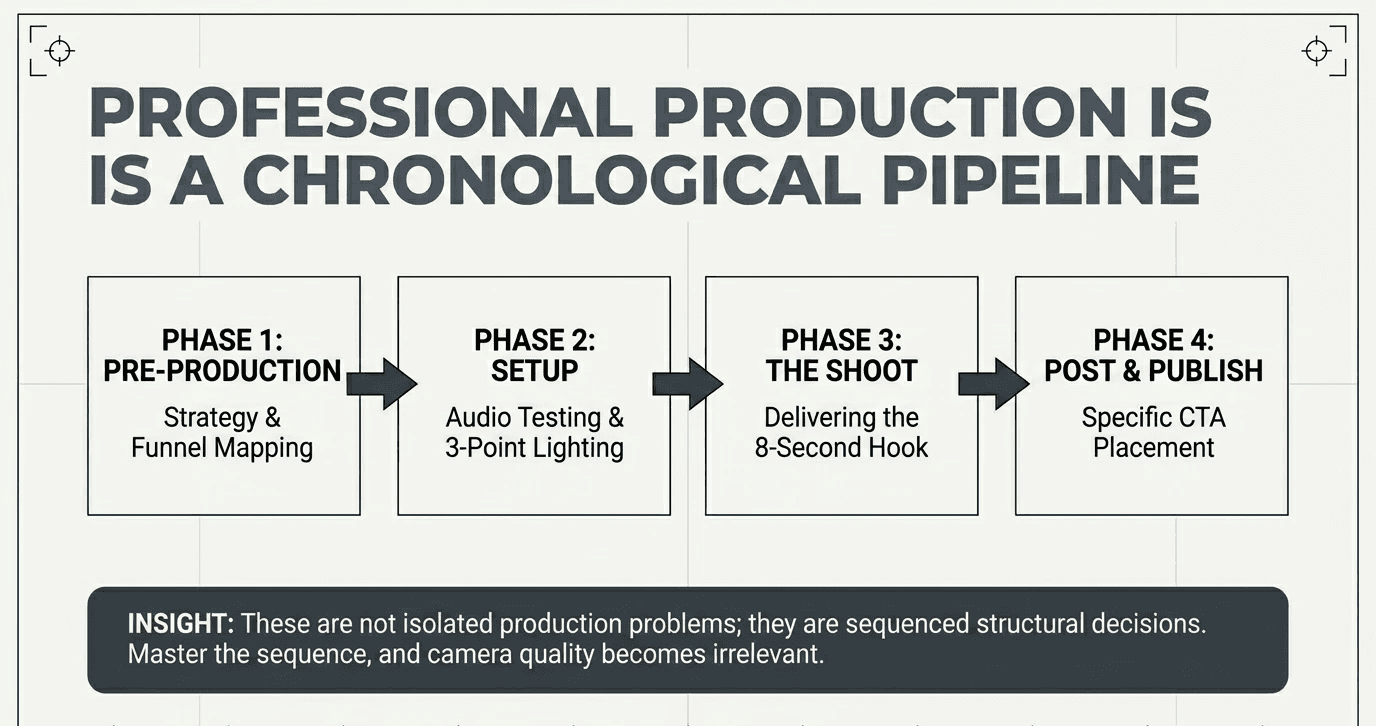
You don't need to rebuild your whole setup. You need to fix the five things above in order. Here is what a quick audit looks like:
• Listen to your last video with earphones. If you notice audio issues in the first 30 seconds, fix the mic setup before you film again.
• Watch the first 10 seconds of your last video without sound. If the lighting looks wrong, uneven, or flat, redo the test shots before the next session.
• Time your hook. If it takes more than 8 seconds to get to the actual point, rewrite the opener.
• Pull up your last five videos and write down what each one was for, who it targeted, and what the viewer was supposed to do after watching. If you can't answer all three, you need a strategy.
• Check the CTA on each video. Is it specific? Is it in the right place? If it's missing entirely, add it to the description or end screen at a minimum.
#3 |
Most videos open with a logo animation, or someone saying, " Hi, my name is, followed by who they work for, followed by what they are going to talk about. By the time you get to the point, 60% of your audience has already left.
The hook is the first 5 to 8 seconds of your video. It is the only thing standing between your viewer and the back button. If the hook doesn't work, the rest doesn't matter.
On average, viewers decide whether to keep watching within the first 8 seconds. Videos that open with a direct pain-point or bold statement retain up to 3x more viewers past the 30-second mark. |
A good hook does one of three things. It makes a bold claim that the viewer needs to know if it is true. It calls out a specific problem the viewer has right now. Or it opens a loop, a question or a scenario that creates just enough curiosity to keep watching.
Write your hook last. Once you know everything your video covers, figure out the single most interesting or surprising thing in it, and open with that. |
#4 |
You can fix the audio, nail the lighting, write a strong hook — and still end up with a video that doesn't work. The reason? There is no strategy behind it. You are producing content in a vacuum.
This is the mistake most startup teams make. They produce videos as individual pieces instead of as parts of a system. No keyword research. No funnel thinking. No understanding of where the video fits in the buyer's journey.
82% of marketers say video is a key part of their strategy, but only 37% say they have a documented content plan that connects video to specific business goals. |
A good video content strategy starts before anyone turns a camera on. What is this video for? Who is watching? What do we want them to do after watching? Is it awareness, consideration, or conversion content? Which platform, and what format works best there?
A five-minute brand explainer on YouTube serves a different purpose than a 30-second Instagram reel showing a product in use. Treating both the same, or just reposting the same video everywhere, is one of the clearest signs a brand doesn't have a strategy.
Map every video you produce to one stage of the funnel and one audience intent. If you can't answer both in one sentence before production starts, push pause. |
Also read: How to measure ROI of paid advertising.
#5 |
Your viewer watched the whole thing. They learned something, or they were entertained. And then the video ended, and nothing happened. No next step, no offer, no direction. The viewer closed the tab and moved on.
Missing the call to action is probably the most expensive mistake on this list because it kills conversions silently. You don't see it as a drop-off in your analytics. You just see that the views aren't turning into anything.
Videos with a clear CTA generate 380% more clicks than those without one. Yet more than half of branded videos published by startups include no CTA beyond a vague subscribe button. |
A CTA does not have to be aggressive. It just has to be specific. Tell the viewer exactly what to do next and why it benefits them. Visit the link. Download the guide. Book a call. Watch the next video. One action, one reason.
Where you place the CTA matters, too. End-of-video CTAs work for buyers who are warm and engaged. But if you are producing awareness content, a mid-video CTA around the 60% mark often performs better because some viewers drop off before the end.
Write your CTA the same way you write your hook, specific to the pain or goal you addressed in the video. If your video was about video production mistakes, your CTA should be: Want someone to handle this for you? That is a logical next step. |
How to Fix Bad Video Production Without Starting Over
You don't need to rebuild your whole setup. You need to fix the five things above in order. Here is what a quick audit looks like:
• Listen to your last video with earphones. If you notice audio issues in the first 30 seconds, fix the mic setup before you film again.
• Watch the first 10 seconds of your last video without sound. If the lighting looks wrong, uneven, or flat, redo the test shots before the next session.
• Time your hook. If it takes more than 8 seconds to get to the actual point, rewrite the opener.
• Pull up your last five videos and write down what each one was for, who it targeted, and what the viewer was supposed to do after watching. If you can't answer all three, you need a strategy.
• Check the CTA on each video. Is it specific? Is it in the right place? If it's missing entirely, add it to the description or end screen at a minimum.
Conclusion
These are 5 reasons your videos are not getting clicks and views. We have also talked about how you can fix these problems. And the solutions weren’t so tough, so you can’t replicate them; you just have to be more concise and manageable while making videos. Keep improving, keep creating.
Done Reading? Let Someone Else Handle the Video. Motion Labs is an AI video and content agency based in New Delhi. We handle everything from script to final edit: AI avatars, UGC campaigns, social media video, and more. Visit motionlabs. agency to see our work |
Frequently Asked Questions About Video Production Mistakes
Why does my video look bad even with a good camera?
Camera quality is rarely the problem. Bad lighting, poor audio, and weak framing affect quality far more than your gear. A well-lit, well-framed shot on a smartphone will look better than a poorly lit 4K video in most cases.
How do I fix bad audio in a video after filming?
Post-production tools like Adobe Audition, DaVinci Resolve, or even free software like Audacity can remove background noise, balance levels, and clean up echo. But prevention is always better; invest in a decent mic before relying on software fixes.
What is the biggest video production mistake startups make?
Skipping strategy. Most startups produce content without a plan, no audience clarity, no funnel mapping, no distribution logic. The result is a library of videos that get views but don't drive any measurable business outcome.
How long should a business video be?
It depends entirely on the platform and purpose. Instagram Reels: 15–60 seconds. YouTube explainers: 5–12 minutes. LinkedIn native video: 1–3 minutes. The rule is simple, as short as possible while still delivering the full value promised in the hook.
Does video quality actually affect SEO?
Yes, indirectly. Watch time, engagement rate, and click-through rate all feed into how platforms rank your content. A video with bad audio or weak structure will drive people away faster, which signals to the algorithm that the content isn't worth promoting.
What makes a good video hook?
A good hook calls out a specific problem, makes a bold statement, or opens a pattern interrupt in the first 5–8 seconds. It should give the viewer a reason to keep watching, not just introduce yourself or your brand.
Conclusion
These are 5 reasons your videos are not getting clicks and views. We have also talked about how you can fix these problems. And the solutions weren’t so tough, so you can’t replicate them; you just have to be more concise and manageable while making videos. Keep improving, keep creating.
Done Reading? Let Someone Else Handle the Video. Motion Labs is an AI video and content agency based in New Delhi. We handle everything from script to final edit: AI avatars, UGC campaigns, social media video, and more. Visit motionlabs. agency to see our work |
Frequently Asked Questions About Video Production Mistakes
Why does my video look bad even with a good camera?
Camera quality is rarely the problem. Bad lighting, poor audio, and weak framing affect quality far more than your gear. A well-lit, well-framed shot on a smartphone will look better than a poorly lit 4K video in most cases.
How do I fix bad audio in a video after filming?
Post-production tools like Adobe Audition, DaVinci Resolve, or even free software like Audacity can remove background noise, balance levels, and clean up echo. But prevention is always better; invest in a decent mic before relying on software fixes.
What is the biggest video production mistake startups make?
Skipping strategy. Most startups produce content without a plan, no audience clarity, no funnel mapping, no distribution logic. The result is a library of videos that get views but don't drive any measurable business outcome.
How long should a business video be?
It depends entirely on the platform and purpose. Instagram Reels: 15–60 seconds. YouTube explainers: 5–12 minutes. LinkedIn native video: 1–3 minutes. The rule is simple, as short as possible while still delivering the full value promised in the hook.
Does video quality actually affect SEO?
Yes, indirectly. Watch time, engagement rate, and click-through rate all feed into how platforms rank your content. A video with bad audio or weak structure will drive people away faster, which signals to the algorithm that the content isn't worth promoting.
What makes a good video hook?
A good hook calls out a specific problem, makes a bold statement, or opens a pattern interrupt in the first 5–8 seconds. It should give the viewer a reason to keep watching, not just introduce yourself or your brand.
the call your competitor wish you would'nt take


Related Posts





Related Posts
Related Posts
Motion labs
info@motionlabs.agency


+971 55317 1706
C-1802, ONTARIO TOWER, PLOT NO. 49-0, BUSINESS BAY, DUBAI, 00000
click to meet me :)
click to meet me :)
© All Rights Reserved | 2026


Motion labs
info@motionlabs.agency
+971 55317 1706
C-1802, ONTARIO TOWER, PLOT NO. 49-0, BUSINESS BAY, DUBAI, 00000
Private policy
Terms & Conditions
© All Rights Reserved | 2026
click to meet me :)