/
/
AI Video vs Human-Made Video: Which Converts Better for Social Ads?
AI Video vs Human-Made Video: Which Converts Better for Social Ads?
5 min
read
AI Video vs Human-Made Video: Which Converts Better for Social Ads?
AI Video vs Human-Made Video: Which Converts Better for Social Ads?
Ai
Ads

Author
Scroll down
to read more!
Summerize with ChatGPT
Summerize with Gemini
Summerize with Claude
AI Video vs Human-Made Video: Which Converts Better for Social Ads?
AI Video vs Human-Made Video: Which Converts Better for Social Ads?
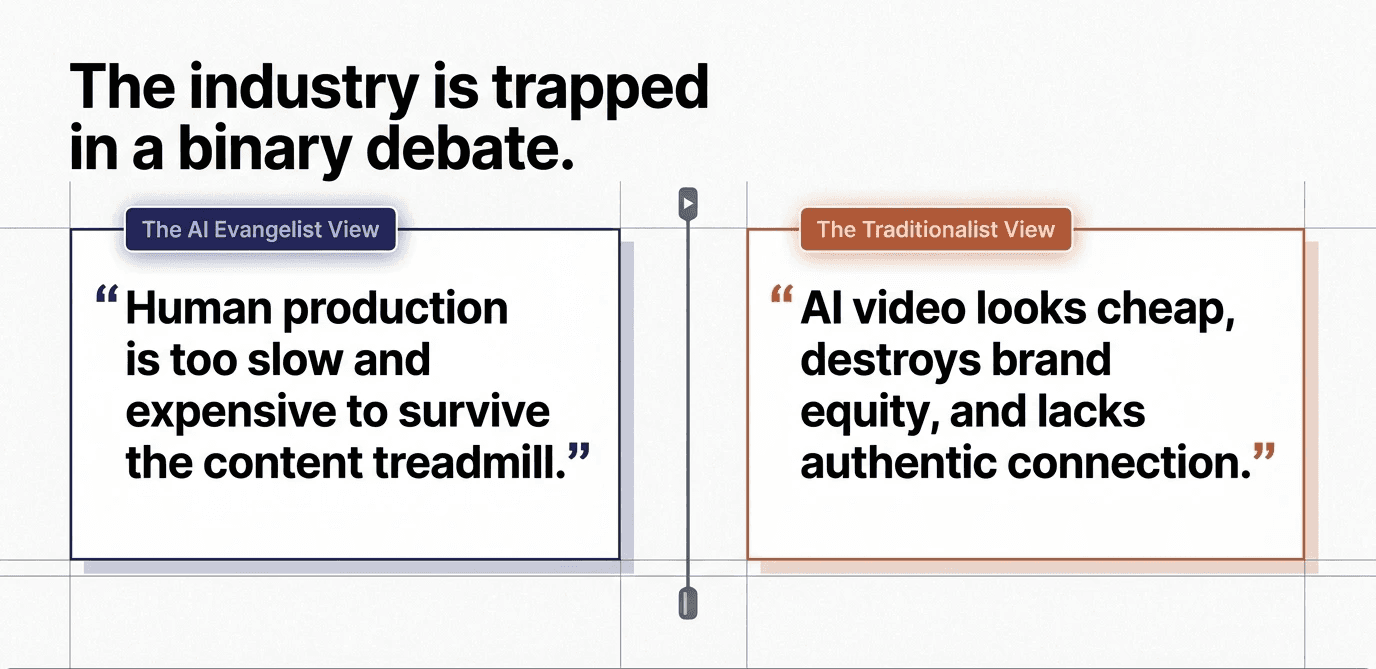
Is your low-cost AI video costing you potential clients, or is it giving you more clients? Does AI video just look cheap? Or does it prove how advanced you are with technology? Is it making or destroying your brand? AI video vs. human-made video: what’s best? Let’s talk about it.
Is your low-cost AI video costing you potential clients, or is it giving you more clients? Does AI video just look cheap? Or does it prove how advanced you are with technology? Is it making or destroying your brand? AI video vs. human-made video: what’s best? Let’s talk about it.
AI Video Ads vs Human-Made Video Ads: What is Better
Let's start with the numbers that matter most: cost, ROAS, and conversion performance.
Production Cost
This area is where AI wins decisively, and it's not close.
According to NP Digital's 2025 study across 19 companies:
• AI-only video ads cost an average of $591 to produce
• Human-only video ads cost an average of $4,874 to produce
• A hybrid approach (AI tools + human oversight) costs around $2,694
Traditional agency production for a single 30-second professional video typically runs between $15,000 and $50,000, including crew, location, talent, and post-production. AI production with agency oversight can deliver comparable quality starting around $5,000, a 60–70% reduction. And for startups using tools directly, the savings go even further.
One real example: In June 2025, prediction market Kalshi aired a fully AI-generated 30-second commercial during Game 3 of the NBA Finals. The production cost approximately $2,000 and took two days. Traditional agency quotes for the same placement were running $250,000 to $500,000. The ad got over 20 million impressions.
📊 By the Numbers 63% of businesses using AI video tools in 2025 reported a 58% reduction in average video production costs compared to traditional methods. (Sprello AI, 2025) |
ROAS: Human Still Has a Slight Edge
Here's where it gets interesting. The same NP Digital study found the following:
• AI-only video ads: 3.3x average ROAS
• Human-only video ads: 3.8x average ROAS
• AI + Human hybrid: 4.1x average ROAS
Human-made content still holds a small performance edge in pure ROAS terms. But look at what happens when you combine AI's speed and cost efficiency with human creative direction; the hybrid approach outperforms both.
The takeaway: AI doesn't make ads worse. Human input makes AI ads better. Together, they beat working alone.
Also read: How to automate your social media
CTR and Conversion Rate: AI Holds Its Own
Platform-level data from Meta shows campaigns using generative AI features deliver +11% higher CTR and +7.6% higher conversion rates compared to standard campaigns. Google and YouTube AI-optimised campaigns achieve +17% higher ROAS according to Nielsen's 2024 study.
On TikTok and Instagram Reels, where content scrolls fast, and attention is captured within the first two seconds, a well-crafted hook matters more than whether the presenter is human or AI. Field data from media buying teams shows AI UGC videos typically achieve 85% to 110% of the CTR of well-performing traditional UGC, meaning AI video is broadly competitive on click-through.
Where AI clearly wins is in volume and speed of testing. The ability to generate 20–30 ad variants instead of 2–3 changes the optimisation game entirely.
AI vs Human Video Ads: Full Comparison
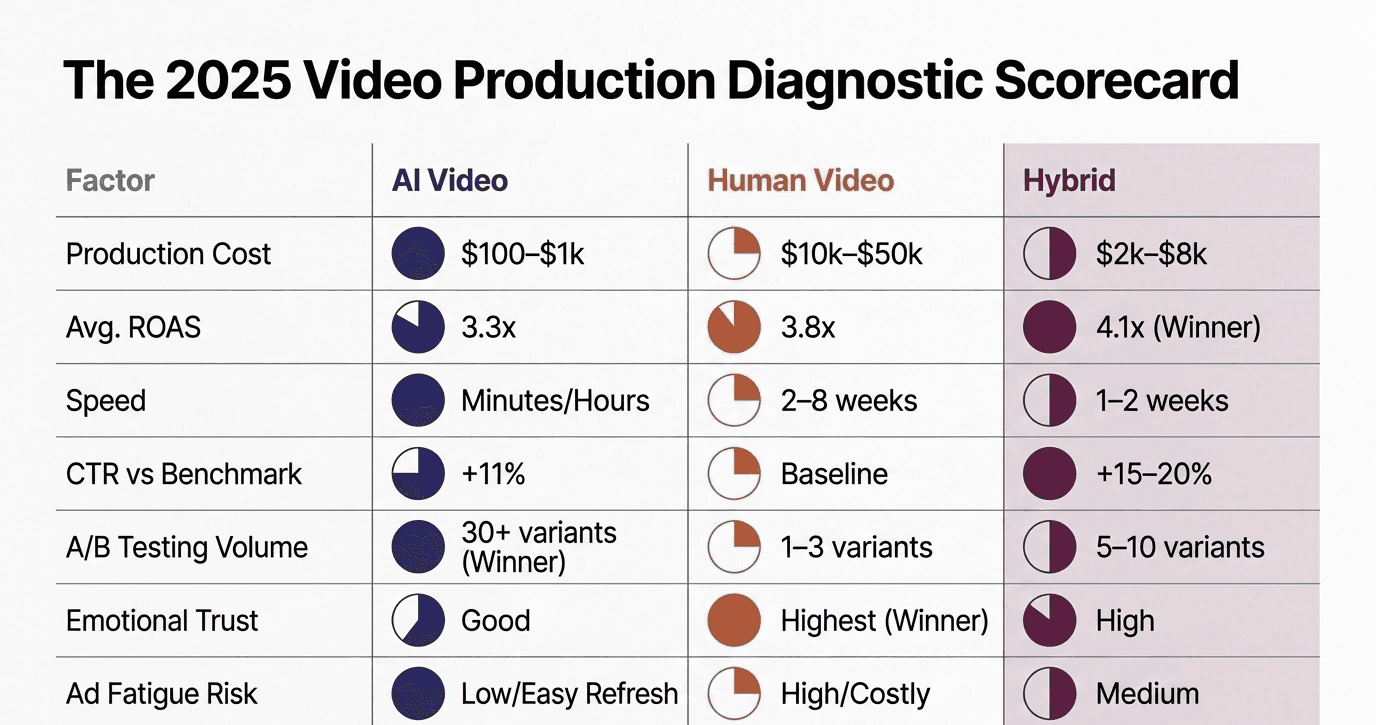
Factor | AI Video Ads | Human-Made Video Ads | Hybrid (AI + Human) |
Production Cost | $100–$1,000 | $10,000–$50,000 | $2,000–$8,000 |
Avg. ROAS | 3.3x | 3.8x | 4.1x |
Production Speed | Minutes to hours | 2–8 weeks | 1–2 weeks |
CTR vs Benchmark | +11% (Meta AI) | Baseline | +15–20% |
A/B Testing Volume | 30+ variants easily | 1–3 variants | 5–10 variants |
Emotional Trust | Good (improving) | Highest | High |
Scalability | Unlimited | Budget-limited | High |
Ad Fatigue Risk | Low (easy refresh) | High (costly reshoot) | Medium |
Best Platform Fit | TikTok, Reels, YouTube Shorts | Brand campaigns, premium | Meta, YouTube, multi-platform |
AI Video Ads vs Human-Made Video Ads: What is Better
Let's start with the numbers that matter most: cost, ROAS, and conversion performance.
Production Cost
This area is where AI wins decisively, and it's not close.
According to NP Digital's 2025 study across 19 companies:
• AI-only video ads cost an average of $591 to produce
• Human-only video ads cost an average of $4,874 to produce
• A hybrid approach (AI tools + human oversight) costs around $2,694
Traditional agency production for a single 30-second professional video typically runs between $15,000 and $50,000, including crew, location, talent, and post-production. AI production with agency oversight can deliver comparable quality starting around $5,000, a 60–70% reduction. And for startups using tools directly, the savings go even further.
One real example: In June 2025, prediction market Kalshi aired a fully AI-generated 30-second commercial during Game 3 of the NBA Finals. The production cost approximately $2,000 and took two days. Traditional agency quotes for the same placement were running $250,000 to $500,000. The ad got over 20 million impressions.
📊 By the Numbers 63% of businesses using AI video tools in 2025 reported a 58% reduction in average video production costs compared to traditional methods. (Sprello AI, 2025) |
ROAS: Human Still Has a Slight Edge
Here's where it gets interesting. The same NP Digital study found the following:
• AI-only video ads: 3.3x average ROAS
• Human-only video ads: 3.8x average ROAS
• AI + Human hybrid: 4.1x average ROAS
Human-made content still holds a small performance edge in pure ROAS terms. But look at what happens when you combine AI's speed and cost efficiency with human creative direction; the hybrid approach outperforms both.
The takeaway: AI doesn't make ads worse. Human input makes AI ads better. Together, they beat working alone.
Also read: How to automate your social media
CTR and Conversion Rate: AI Holds Its Own
Platform-level data from Meta shows campaigns using generative AI features deliver +11% higher CTR and +7.6% higher conversion rates compared to standard campaigns. Google and YouTube AI-optimised campaigns achieve +17% higher ROAS according to Nielsen's 2024 study.
On TikTok and Instagram Reels, where content scrolls fast, and attention is captured within the first two seconds, a well-crafted hook matters more than whether the presenter is human or AI. Field data from media buying teams shows AI UGC videos typically achieve 85% to 110% of the CTR of well-performing traditional UGC, meaning AI video is broadly competitive on click-through.
Where AI clearly wins is in volume and speed of testing. The ability to generate 20–30 ad variants instead of 2–3 changes the optimisation game entirely.
AI vs Human Video Ads: Full Comparison
Factor | AI Video Ads | Human-Made Video Ads | Hybrid (AI + Human) |
Production Cost | $100–$1,000 | $10,000–$50,000 | $2,000–$8,000 |
Avg. ROAS | 3.3x | 3.8x | 4.1x |
Production Speed | Minutes to hours | 2–8 weeks | 1–2 weeks |
CTR vs Benchmark | +11% (Meta AI) | Baseline | +15–20% |
A/B Testing Volume | 30+ variants easily | 1–3 variants | 5–10 variants |
Emotional Trust | Good (improving) | Highest | High |
Scalability | Unlimited | Budget-limited | High |
Ad Fatigue Risk | Low (easy refresh) | High (costly reshoot) | Medium |
Best Platform Fit | TikTok, Reels, YouTube Shorts | Brand campaigns, premium | Meta, YouTube, multi-platform |

Where Human Video Ads Still Win
AI is fast, cheap, and getting better every month. But there are still specific scenarios where human-made video outperforms AI, usually around authenticity and emotional depth.
Health, Beauty, and High-Trust Categories
In niches where human social proof is crucial, personal health products, premium skincare, and emotional before-and-after transformations, real people still create stronger connections. Audiences in these categories are actively sceptical. They want to see a real face, real emotion, and real results. AI avatars can look convincing, but they haven't fully replicated the kind of vulnerability and body language that builds trust in high-stakes purchase decisions.
Brand Films and Narrative Content
If you're building a brand story, one that's meant to live on your homepage, in a pitch deck, or run as a premium placement, traditional production still holds the edge. The cinematic quality, natural lighting, and genuine human performance in a properly produced brand film are hard to replicate with current AI tools.
Subscriber and Long-Term Community Building
Research comparing AI avatar performance to human influencer content found that human faces drive 47% higher subscriber conversion and 3.2x more emotional engagement in the context of building a recurring audience. If your goal is a loyal community, not just a one-time click, human content still has the advantage.
Where AI Video Ads Win
For the majority of direct-response social advertising, AI video is not just competitive, it's pulling ahead in several measurable ways.
Volume, Testing, and Ad Fatigue
The biggest structural advantage of AI video is the ability to test at scale. Media buying teams that can produce 30 ad variants instead of 3 can iterate faster, cut losers in 48–72 hours, and scale winners before ad fatigue sets in. This is where AI pays for itself quickly.
Brands using AI-generated UGC saw engagement rates up to 350% higher than human-made videos on TikTok, primarily because they were testing more and refreshing creative more often, not because a single AI video magically outperformed everything.
Speed to Market
The average AI-generated marketing video is 42 seconds long and takes minutes to produce. Traditional production typically takes 2–8 weeks per video. When a trend or moment hits, AI wins by default. You can have a relevant ad live before a human production team has even scheduled a shoot.
Cost Per Iteration
A startup producing 10 videos per month saves approximately $72,000 per year by using AI tools versus working with freelancers. A mid-size company producing 50 videos per month can save between $137,000 and $384,000 annually. At enterprise scale, savings of $600,000–$930,000 per year are documented.
Multi-Platform Adaptation
AI tools make it trivial to reformat and adapt the same core ad for TikTok (vertical 9:16), Instagram feed (square), YouTube pre-roll (16:9), and Facebook Stories — in minutes. Human production at that scale requires separate shoots or expensive post-production work.
Brands deploying AI-powered mobile video reformatting report a 41% reduction in creative adaptation costs.
Also read: 5 steps for a successful x campaign
The Hybrid Strategy: What High-Performing Brands Are Actually Doing
The smartest brands aren't choosing between AI and humans. They're using both strategically.
Here's the workflow that's producing the best results in 2025:
• Use AI to generate a high volume of ad variants quickly, different hooks, different avatars, different angles
• A/B test those variants on a controlled budget for 48–72 hours
• Identify the top performers, then invest human creative direction in refining and scaling those specific concepts
• Use human-made video for brand films, testimonials, and high-trust content where authenticity is non-negotiable
• Use AI for ongoing volume, refreshes, and retargeting variations
One marketing agency that adopted this model scaled video production 10x while winning 62% of competitive pitches in the second half of 2025, up from 41% before implementing AI tools. The key wasn't going all-in on AI. It was knowing when to use which.
71% of creators now say they use AI video for first drafts, then refine manually, a human-in-the-loop workflow that combines the best of both.
What to Watch Out For AI Video Ads
AI video isn't perfect. There are real limitations to know before you shift budgets.
Script Quality Drives Everything
The quality gap between a great AI video and a mediocre one almost always comes down to the script, not the tool. AI can generate visuals and voice. It can't generate insight. If your brief is vague or your hook is weak, AI will produce a polished version of a weak concept. "Garbage in, garbage out" still applies.
Platform Transparency Rules Are Evolving
Most platforms haven't enforced strict disclosure requirements for AI-generated ad content yet, but that's changing. It's worth building disclosure habits now, especially in regulated industries.
Authenticity Has a Ceiling
AI avatars have improved dramatically, but audiences, particularly in premium or emotional categories, can still detect inauthenticity. For certain campaigns, a real person filming on their phone will always outperform a polished AI avatar.
Where Human Video Ads Still Win
AI is fast, cheap, and getting better every month. But there are still specific scenarios where human-made video outperforms AI, usually around authenticity and emotional depth.
Health, Beauty, and High-Trust Categories
In niches where human social proof is crucial, personal health products, premium skincare, and emotional before-and-after transformations, real people still create stronger connections. Audiences in these categories are actively sceptical. They want to see a real face, real emotion, and real results. AI avatars can look convincing, but they haven't fully replicated the kind of vulnerability and body language that builds trust in high-stakes purchase decisions.
Brand Films and Narrative Content
If you're building a brand story, one that's meant to live on your homepage, in a pitch deck, or run as a premium placement, traditional production still holds the edge. The cinematic quality, natural lighting, and genuine human performance in a properly produced brand film are hard to replicate with current AI tools.
Subscriber and Long-Term Community Building
Research comparing AI avatar performance to human influencer content found that human faces drive 47% higher subscriber conversion and 3.2x more emotional engagement in the context of building a recurring audience. If your goal is a loyal community, not just a one-time click, human content still has the advantage.
Where AI Video Ads Win
For the majority of direct-response social advertising, AI video is not just competitive, it's pulling ahead in several measurable ways.
Volume, Testing, and Ad Fatigue
The biggest structural advantage of AI video is the ability to test at scale. Media buying teams that can produce 30 ad variants instead of 3 can iterate faster, cut losers in 48–72 hours, and scale winners before ad fatigue sets in. This is where AI pays for itself quickly.
Brands using AI-generated UGC saw engagement rates up to 350% higher than human-made videos on TikTok, primarily because they were testing more and refreshing creative more often, not because a single AI video magically outperformed everything.
Speed to Market
The average AI-generated marketing video is 42 seconds long and takes minutes to produce. Traditional production typically takes 2–8 weeks per video. When a trend or moment hits, AI wins by default. You can have a relevant ad live before a human production team has even scheduled a shoot.
Cost Per Iteration
A startup producing 10 videos per month saves approximately $72,000 per year by using AI tools versus working with freelancers. A mid-size company producing 50 videos per month can save between $137,000 and $384,000 annually. At enterprise scale, savings of $600,000–$930,000 per year are documented.
Multi-Platform Adaptation
AI tools make it trivial to reformat and adapt the same core ad for TikTok (vertical 9:16), Instagram feed (square), YouTube pre-roll (16:9), and Facebook Stories — in minutes. Human production at that scale requires separate shoots or expensive post-production work.
Brands deploying AI-powered mobile video reformatting report a 41% reduction in creative adaptation costs.
Also read: 5 steps for a successful x campaign
The Hybrid Strategy: What High-Performing Brands Are Actually Doing
The smartest brands aren't choosing between AI and humans. They're using both strategically.
Here's the workflow that's producing the best results in 2025:
• Use AI to generate a high volume of ad variants quickly, different hooks, different avatars, different angles
• A/B test those variants on a controlled budget for 48–72 hours
• Identify the top performers, then invest human creative direction in refining and scaling those specific concepts
• Use human-made video for brand films, testimonials, and high-trust content where authenticity is non-negotiable
• Use AI for ongoing volume, refreshes, and retargeting variations
One marketing agency that adopted this model scaled video production 10x while winning 62% of competitive pitches in the second half of 2025, up from 41% before implementing AI tools. The key wasn't going all-in on AI. It was knowing when to use which.
71% of creators now say they use AI video for first drafts, then refine manually, a human-in-the-loop workflow that combines the best of both.
What to Watch Out For AI Video Ads
AI video isn't perfect. There are real limitations to know before you shift budgets.
Script Quality Drives Everything
The quality gap between a great AI video and a mediocre one almost always comes down to the script, not the tool. AI can generate visuals and voice. It can't generate insight. If your brief is vague or your hook is weak, AI will produce a polished version of a weak concept. "Garbage in, garbage out" still applies.
Platform Transparency Rules Are Evolving
Most platforms haven't enforced strict disclosure requirements for AI-generated ad content yet, but that's changing. It's worth building disclosure habits now, especially in regulated industries.
Authenticity Has a Ceiling
AI avatars have improved dramatically, but audiences, particularly in premium or emotional categories, can still detect inauthenticity. For certain campaigns, a real person filming on their phone will always outperform a polished AI avatar.

Conclusion
The framing of "AI video vs human video" creates a false choice. In practice, the brands seeing the best results in 2025 are using both strategically.
If you're running social ads at any meaningful scale, you can't afford to ignore AI video production. The cost savings alone, 60–97% cheaper per video, free up budget that goes directly into ad spend and testing. And the ability to produce 30 variants instead of 3 is a measurable competitive advantage.
But human creative direction still matters. The script still matters. The hook still matters. And in high-trust categories, a real human face still converts better than any avatar.
The smartest move: start using AI for volume and testing, keep humans in the loop on creative strategy, and save premium production budget for brand content and high-stakes placements. That's the playbook. And it's working.
frequently asked questions
Q: Do AI video ads actually convert as well as human-made video ads?
A: For most social ad formats, especially on TikTok, Instagram Reels, and YouTube Shorts, AI video ads are broadly competitive, achieving 85–110% of the CTR of well-performing traditional UGC. The bigger advantage is in volume and testing speed, which leads to better overall campaign performance.
Q: What is the average ROAS for AI-generated video ads?
A: Based on NP Digital's 2025 study, AI-only video ads averaged 3.3x ROAS compared to 3.8x for human-only ads. However, hybrid campaigns combining AI production with human creative direction averaged 4.1x ROAS, outperforming both.
Q: How much does AI video ad production cost compared to traditional video?
A: AI-only video production averages around $591 per ad. Traditional human video production averages $4,874, and agency-level production can run $10,000–$50,000 for a single 30-second spot. AI represents roughly 70–96% cost savings depending on the approach.
Q: Which is better for TikTok and Instagram ads, AI or human video?
A: Both can perform well, but AI video has a structural advantage on short-form platforms because it enables rapid testing of multiple hooks and angles. Brands using AI-generated UGC saw engagement rates up to 350% higher on TikTok, largely because they were testing and refreshing creative more frequently.
Q: Should I use an AI video or a human video for a high-trust product?
A: For health, premium beauty, emotional testimonials, or any category where buyers are especially sceptical, human-made content still builds more trust. Real faces, real emotion, and real stories outperform AI avatars in these niches. Use human video for conversion-stage content and AI for awareness and testing.
Q: What is the hybrid AI + human video approach, and why does it work?
A: Hybrid means using AI tools to generate volume quickly and cheaply, then applying human creative direction to refine the best performers. It produces the highest ROAS (4.1x average) because it combines AI's speed and cost efficiency with human judgment and authenticity.
Conclusion
The framing of "AI video vs human video" creates a false choice. In practice, the brands seeing the best results in 2025 are using both strategically.
If you're running social ads at any meaningful scale, you can't afford to ignore AI video production. The cost savings alone, 60–97% cheaper per video, free up budget that goes directly into ad spend and testing. And the ability to produce 30 variants instead of 3 is a measurable competitive advantage.
But human creative direction still matters. The script still matters. The hook still matters. And in high-trust categories, a real human face still converts better than any avatar.
The smartest move: start using AI for volume and testing, keep humans in the loop on creative strategy, and save premium production budget for brand content and high-stakes placements. That's the playbook. And it's working.
frequently asked questions
Q: Do AI video ads actually convert as well as human-made video ads?
A: For most social ad formats, especially on TikTok, Instagram Reels, and YouTube Shorts, AI video ads are broadly competitive, achieving 85–110% of the CTR of well-performing traditional UGC. The bigger advantage is in volume and testing speed, which leads to better overall campaign performance.
Q: What is the average ROAS for AI-generated video ads?
A: Based on NP Digital's 2025 study, AI-only video ads averaged 3.3x ROAS compared to 3.8x for human-only ads. However, hybrid campaigns combining AI production with human creative direction averaged 4.1x ROAS, outperforming both.
Q: How much does AI video ad production cost compared to traditional video?
A: AI-only video production averages around $591 per ad. Traditional human video production averages $4,874, and agency-level production can run $10,000–$50,000 for a single 30-second spot. AI represents roughly 70–96% cost savings depending on the approach.
Q: Which is better for TikTok and Instagram ads, AI or human video?
A: Both can perform well, but AI video has a structural advantage on short-form platforms because it enables rapid testing of multiple hooks and angles. Brands using AI-generated UGC saw engagement rates up to 350% higher on TikTok, largely because they were testing and refreshing creative more frequently.
Q: Should I use an AI video or a human video for a high-trust product?
A: For health, premium beauty, emotional testimonials, or any category where buyers are especially sceptical, human-made content still builds more trust. Real faces, real emotion, and real stories outperform AI avatars in these niches. Use human video for conversion-stage content and AI for awareness and testing.
Q: What is the hybrid AI + human video approach, and why does it work?
A: Hybrid means using AI tools to generate volume quickly and cheaply, then applying human creative direction to refine the best performers. It produces the highest ROAS (4.1x average) because it combines AI's speed and cost efficiency with human judgment and authenticity.
the call your competitor wish you would'nt take


Related Posts





Related Posts
Related Posts
Motion labs
info@motionlabs.agency


+971 55317 1706
C-1802, ONTARIO TOWER, PLOT NO. 49-0, BUSINESS BAY, DUBAI, 00000
click to meet me :)
click to meet me :)
© All Rights Reserved | 2026


Motion labs
info@motionlabs.agency
+971 55317 1706
C-1802, ONTARIO TOWER, PLOT NO. 49-0, BUSINESS BAY, DUBAI, 00000
Private policy
Terms & Conditions
© All Rights Reserved | 2026
click to meet me :)