/
/
Best Content Creation & Website Design Agency in San Francisco
Best Content Creation & Website Design Agency in San Francisco
5 min
read
Best Content Creation & Website Design Agency in San Francisco
Best Content Creation & Website Design Agency in San Francisco
Content
Marketing

Author

Scroll down
to read more!
Summerize with ChatGPT
Summerize with Gemini
Summerize with Claude
Best Content Creation & Website Design Agency in San Francisco
Best Content Creation & Website Design Agency in San Francisco
Looking for a content creation website design agency in San Francisco? Here is how the two disciplines fit together, what to look for, and how to run the engagement. Best content creation agency San Francisco, website design agency San Francisco, SaaS website design agency San Francisco, AI content creation agency San Francisco
Looking for a content creation website design agency in San Francisco? Here is how the two disciplines fit together, what to look for, and how to run the engagement. Best content creation agency San Francisco, website design agency San Francisco, SaaS website design agency San Francisco, AI content creation agency San Francisco
The best content creation website design agency in San Francisco is the one that treats your site and your content as a single system rather than two separate line items. A website is only as good as the words, images and video that live inside it, and content only converts when the page it sits on is built to carry it. Agencies that split those jobs across two vendors tend to produce beautiful shells with thin copy, or strong messaging trapped in a template that buries it. The right partner in San Francisco handles strategy, design, build and ongoing content production under one roof, with a clear point of view on what your audience actually needs to see before they buy.
This guide breaks down what these agencies do, how to evaluate them, what the engagement looks like month to month, and the mistakes that quietly waste budget. If you are further along in your search and want a shortlist instead, read our roundup of the top content creator agencies in San Francisco.
Key Takeaways
|
What Does a Content Creation and Website Design Agency Actually Do?
A combined agency covers two connected workstreams. The design side handles information architecture, wireframes, visual identity applied to screen, responsive build, page speed and the technical foundations that let search engines and AI answer engines read your site properly. The content side handles messaging, copywriting, video, motion graphics, static creative, social assets and whatever else fills those pages and the channels that point back to them.
The value is in the overlap. When the same team decides that your homepage needs a 30-second product explainer above the fold, that team also scripts, produces and edits the video, sizes it correctly, and builds the section around it. There is no handoff where the design agency ships a placeholder and the content vendor delivers something that does not fit.
The typical scope breaks into five buckets
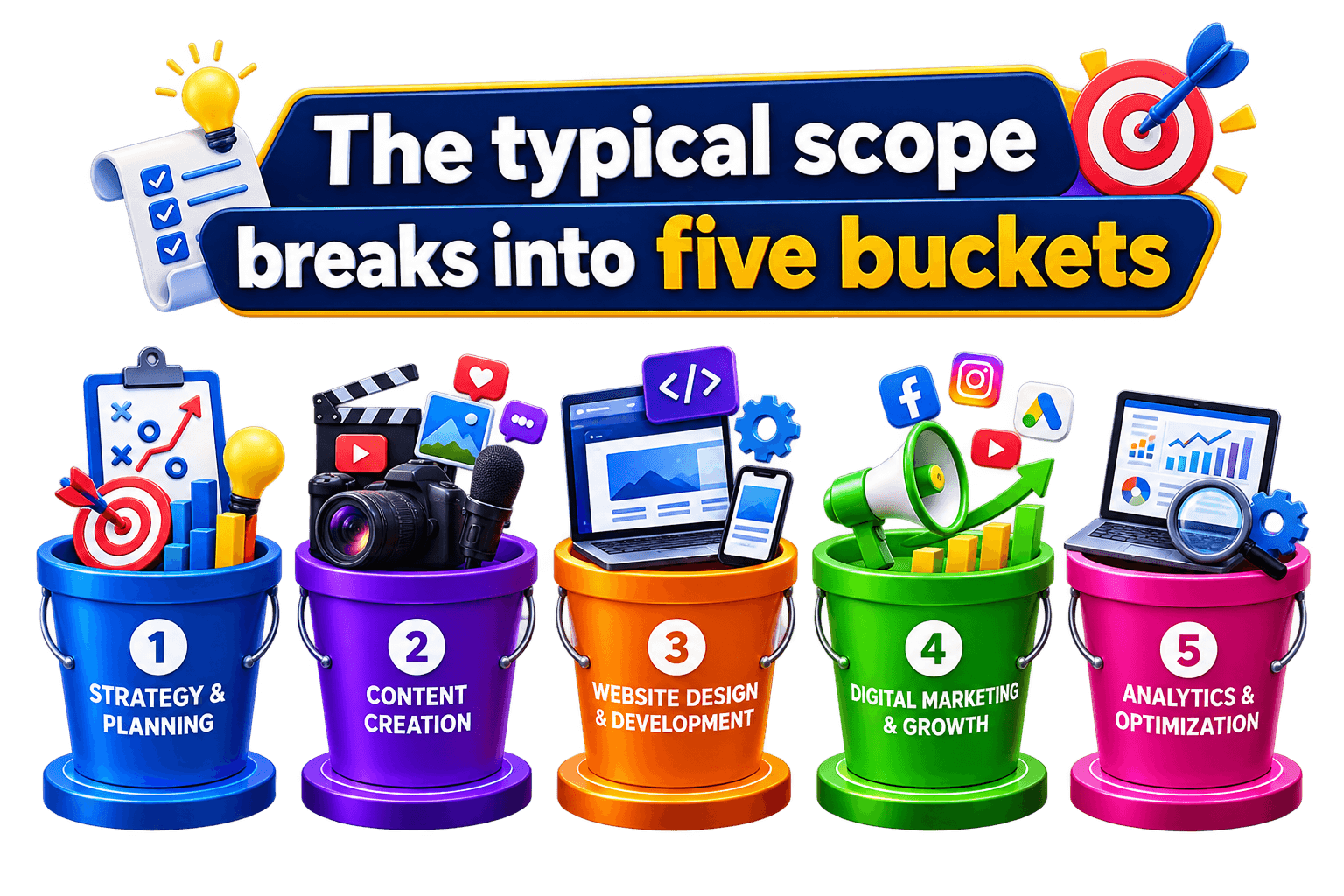
Strategy and positioning: audience research, competitor teardown, messaging hierarchy, and the decision about what each page is supposed to do.
Website design and build: sitemap, wireframes, UI design, responsive implementation, CMS setup, and technical SEO groundwork.
Content production: landing page copy, blog and SEO content, product video, UGC-style creator content, AI avatar video, social creative and graphic design.
Distribution: social media management, influencer and creator campaigns, email, and paid media creative built for each placement.
Measurement: analytics setup, conversion tracking, creative performance reporting, and a feedback loop that changes what gets made next.
Not every agency does all five well. Some are design-led with content bolted on. Some are content-led and outsource the build. Both models can work if you know which one you are hiring and where the gaps are.
The best content creation website design agency in San Francisco is the one that treats your site and your content as a single system rather than two separate line items. A website is only as good as the words, images and video that live inside it, and content only converts when the page it sits on is built to carry it. Agencies that split those jobs across two vendors tend to produce beautiful shells with thin copy, or strong messaging trapped in a template that buries it. The right partner in San Francisco handles strategy, design, build and ongoing content production under one roof, with a clear point of view on what your audience actually needs to see before they buy.
This guide breaks down what these agencies do, how to evaluate them, what the engagement looks like month to month, and the mistakes that quietly waste budget. If you are further along in your search and want a shortlist instead, read our roundup of the top content creator agencies in San Francisco.
Key Takeaways
|
What Does a Content Creation and Website Design Agency Actually Do?
A combined agency covers two connected workstreams. The design side handles information architecture, wireframes, visual identity applied to screen, responsive build, page speed and the technical foundations that let search engines and AI answer engines read your site properly. The content side handles messaging, copywriting, video, motion graphics, static creative, social assets and whatever else fills those pages and the channels that point back to them.
The value is in the overlap. When the same team decides that your homepage needs a 30-second product explainer above the fold, that team also scripts, produces and edits the video, sizes it correctly, and builds the section around it. There is no handoff where the design agency ships a placeholder and the content vendor delivers something that does not fit.
The typical scope breaks into five buckets
Strategy and positioning: audience research, competitor teardown, messaging hierarchy, and the decision about what each page is supposed to do.
Website design and build: sitemap, wireframes, UI design, responsive implementation, CMS setup, and technical SEO groundwork.
Content production: landing page copy, blog and SEO content, product video, UGC-style creator content, AI avatar video, social creative and graphic design.
Distribution: social media management, influencer and creator campaigns, email, and paid media creative built for each placement.
Measurement: analytics setup, conversion tracking, creative performance reporting, and a feedback loop that changes what gets made next.
Not every agency does all five well. Some are design-led with content bolted on. Some are content-led and outsource the build. Both models can work if you know which one you are hiring and where the gaps are.

San Francisco skews heavily toward technology, and technology buyers are unusually fast at forming judgments. A prospect evaluating a B2B SaaS product often lands on the homepage, scans for a clear statement of what the product does, checks whether the proof looks real, and leaves. If the design is polished but the copy is vague, they leave. If the copy is sharp but the page looks like a template from three years ago, they discount it. Both signals have to land.
There is also a practical hiring reason. Bay Area in-house teams tend to be small and stretched, with a designer and a marketer covering work that would sit across six roles at a larger company. Bringing in one partner who can produce a site refresh in one quarter and a steady stream of video and social content in the next is simpler to manage than coordinating a design studio, a video production house, a copywriter and a paid social freelancer.
The cost of splitting the work
When content and design sit with different vendors, three things reliably go wrong. Timelines slip because each team waits on the other. Revision cycles multiply because neither vendor owns the final result. And the message drifts, because the copywriter who wrote the homepage was never in the room when the video script was approved. None of these show up on an invoice, which is why they get overlooked in vendor comparisons.
What Should You Look for in a Content Creation Website Design Agency in San Francisco?

Portfolios are the least useful part of an agency evaluation because everyone shows their best three projects. The signals below are harder to fake.
Ask for the reasoning, not the result
Pick a case study and ask why the homepage is structured the way it is. A strong team will tell you what the audience research showed, what the previous site got wrong, and what they measured afterwards. A weak team will describe the visual choices. This one question separates agencies that think from agencies that decorate.
Check whether they produce content in-house
Many agencies subcontract video and creator content. That is not automatically a problem, but it changes your turnaround times and your revision leverage. Ask directly who shoots, who edits, and who writes. If the answer involves three names you will never meet, factor that into your timeline expectations.
Look at how they handle the unglamorous work
Alt text, heading structure, internal linking, page speed, schema markup and CMS hygiene decide whether your site is legible to search engines and AI answer engines. Ask what their handover documentation looks like and whether your team can edit pages without engineering help. Agencies that skip this leave you with a site you cannot maintain.
Match the vertical, or at least the buying motion
An agency that has only ever worked with consumer ecommerce will need a ramp to write for a fintech compliance audience. Vertical experience matters less than familiarity with the buying motion. Long sales cycles with multiple stakeholders need different content than an impulse purchase does.
Understand how they use AI
Generative tools have genuinely changed production economics for video variants, avatar-led explainers, image generation and iteration speed on ad creative. What they have not changed is the judgment about what to make and why. Ask the agency where AI sits in their workflow and where a human still decides. If the answer is vague in either direction, that is a flag. Our breakdown of the AI content creation tools worth using covers what these tools do well and where they still fall short, which is useful context before you sit in a pitch meeting.
How Do Agency Models Compare?
The label on the website rarely tells you what you are buying. This comparison covers the four models you will run into in San Francisco.
Model | Best For | Strengths | Watch Out For |
|---|---|---|---|
Full-service creative and performance agency | Teams that need site, content and distribution handled together | One strategy across every touchpoint, faster turnaround, single point of accountability | Depth varies by service, so pressure test the weakest pillar |
Design studio | A one-off site or rebrand with strong visual ambition | High craft, distinctive visual work, strong art direction | Content usually out of scope, so you still need a writer and video partner |
Content shop or production house | Ongoing video, UGC and social output | Volume and consistency, deep production capability | Rarely owns the site, so pages may not be built for the content |
Freelance collective | Early stage teams with tight budgets and clear briefs | Flexible, cost efficient, direct access to the maker | Coordination falls on you, and continuity breaks when someone leaves |
The right answer depends on what stage you are at. A pre-launch startup with no site and no content library needs different help than a Series B company with a working site that needs a steady content engine attached to it.
San Francisco skews heavily toward technology, and technology buyers are unusually fast at forming judgments. A prospect evaluating a B2B SaaS product often lands on the homepage, scans for a clear statement of what the product does, checks whether the proof looks real, and leaves. If the design is polished but the copy is vague, they leave. If the copy is sharp but the page looks like a template from three years ago, they discount it. Both signals have to land.
There is also a practical hiring reason. Bay Area in-house teams tend to be small and stretched, with a designer and a marketer covering work that would sit across six roles at a larger company. Bringing in one partner who can produce a site refresh in one quarter and a steady stream of video and social content in the next is simpler to manage than coordinating a design studio, a video production house, a copywriter and a paid social freelancer.
The cost of splitting the work
When content and design sit with different vendors, three things reliably go wrong. Timelines slip because each team waits on the other. Revision cycles multiply because neither vendor owns the final result. And the message drifts, because the copywriter who wrote the homepage was never in the room when the video script was approved. None of these show up on an invoice, which is why they get overlooked in vendor comparisons.
What Should You Look for in a Content Creation Website Design Agency in San Francisco?
Portfolios are the least useful part of an agency evaluation because everyone shows their best three projects. The signals below are harder to fake.
Ask for the reasoning, not the result
Pick a case study and ask why the homepage is structured the way it is. A strong team will tell you what the audience research showed, what the previous site got wrong, and what they measured afterwards. A weak team will describe the visual choices. This one question separates agencies that think from agencies that decorate.
Check whether they produce content in-house
Many agencies subcontract video and creator content. That is not automatically a problem, but it changes your turnaround times and your revision leverage. Ask directly who shoots, who edits, and who writes. If the answer involves three names you will never meet, factor that into your timeline expectations.
Look at how they handle the unglamorous work
Alt text, heading structure, internal linking, page speed, schema markup and CMS hygiene decide whether your site is legible to search engines and AI answer engines. Ask what their handover documentation looks like and whether your team can edit pages without engineering help. Agencies that skip this leave you with a site you cannot maintain.
Match the vertical, or at least the buying motion
An agency that has only ever worked with consumer ecommerce will need a ramp to write for a fintech compliance audience. Vertical experience matters less than familiarity with the buying motion. Long sales cycles with multiple stakeholders need different content than an impulse purchase does.
Understand how they use AI
Generative tools have genuinely changed production economics for video variants, avatar-led explainers, image generation and iteration speed on ad creative. What they have not changed is the judgment about what to make and why. Ask the agency where AI sits in their workflow and where a human still decides. If the answer is vague in either direction, that is a flag. Our breakdown of the AI content creation tools worth using covers what these tools do well and where they still fall short, which is useful context before you sit in a pitch meeting.
How Do Agency Models Compare?
The label on the website rarely tells you what you are buying. This comparison covers the four models you will run into in San Francisco.
Model | Best For | Strengths | Watch Out For |
|---|---|---|---|
Full-service creative and performance agency | Teams that need site, content and distribution handled together | One strategy across every touchpoint, faster turnaround, single point of accountability | Depth varies by service, so pressure test the weakest pillar |
Design studio | A one-off site or rebrand with strong visual ambition | High craft, distinctive visual work, strong art direction | Content usually out of scope, so you still need a writer and video partner |
Content shop or production house | Ongoing video, UGC and social output | Volume and consistency, deep production capability | Rarely owns the site, so pages may not be built for the content |
Freelance collective | Early stage teams with tight budgets and clear briefs | Flexible, cost efficient, direct access to the maker | Coordination falls on you, and continuity breaks when someone leaves |
The right answer depends on what stage you are at. A pre-launch startup with no site and no content library needs different help than a Series B company with a working site that needs a steady content engine attached to it.

Good agency relationships run on a rhythm. Here is the shape most combined engagements take.
Weeks one to three: discovery and strategy
Stakeholder interviews, analytics review, competitor analysis, audience definition and a messaging framework. The deliverable is a document that says who you are talking to, what you are claiming, and what proof supports it. Everything downstream references this.
Weeks three to eight: design and build
Sitemap and wireframes come first, then visual design, then implementation. Content is written in parallel against the wireframes rather than poured in at the end, which is the single biggest process difference between a combined agency and two vendors.
Weeks six to ten: first content wave
Launch content gets produced alongside the build. This usually means hero video, product explainers, a set of social assets, and the first batch of SEO pages. The site launches with a content library rather than an empty blog.
Month three onward: production cadence
A shared content calendar sets the monthly output: a fixed number of videos, social posts, blog articles and creative variants for paid channels. Reporting closes the loop, and the calendar adjusts based on what performed.
Where video fits
Video has become the default format for product explanation and social distribution, and AI production methods have brought the cost per asset down considerably. If your roadmap includes avatar-led or AI-assisted video, our look at what a leading AI avatar video editing company delivers is a useful reference point for what to expect from the format.
How Do You Brief an Agency So the First Draft Lands Close?
The quality of the brief predicts the quality of round one more than the agency does. A good brief is short and specific.
Name the audience precisely. "Head of RevOps at a 200 to 1,000 person SaaS company" beats "B2B decision makers".
State the one action you want. Book a demo, start a trial, download the report. One page, one job.
Share what has already failed. Past campaigns that underperformed save the agency a discovery cycle.
Provide real proof points. Customer quotes, product screenshots, internal data you are cleared to publish.
Define the approval chain up front. Nothing slows a project like a stakeholder who appears in round four.
Vague briefs produce generic work, and then everyone blames the agency. Tight briefs let a good team show what they can actually do.
What Mistakes Cost San Francisco Teams the Most?
Launching a site with no content plan behind it
A redesign lifts perception for a quarter. Without a content engine feeding it, traffic flattens and the site becomes a brochure. Budget for the twelve months after launch, not just the launch.
Treating design and copy as sequential
Designing first and writing to fit is how you end up with headlines truncated to make a layout work. Write and design in parallel against a shared wireframe.
Optimizing only for search engines
Buyers increasingly get answers from AI systems that synthesize sources rather than list them. Content that states things plainly, answers real questions directly, and is structured cleanly gets pulled into those answers. Padding and keyword stuffing do the opposite.
Producing content nobody distributes
An article with no distribution plan is a private document. Decide where each asset goes before it is made, and build the variants for those placements into the same production cycle.
Changing direction every six weeks
Content compounds. Teams that rewrite their positioning quarterly never build enough surface area to see results. Commit to a direction for at least two quarters before judging it.
Is a San Francisco Agency Worth It If Your Team Is Remote?
Location matters less than it used to for production, but it still matters for context. An agency embedded in the Bay Area technology market has seen the competitive landscape you are operating in, understands how technical audiences read marketing claims, and can meet in person when a project needs it.
That said, plenty of strong teams operate across multiple markets. If you are comparing options across cities, our overview of the top content creation agencies in New York, LA, Chicago, Austin and San Francisco lays out how each market differs and what that means for the kind of work you get.
Frequently Asked Questions
What does a content creation and website design agency in San Francisco typically handle?
Strategy, website design and build, and ongoing content production across copy, video, social creative and design. Many also run distribution through paid media, organic social and creator partnerships. The exact mix varies, so confirm which services are in-house and which are subcontracted before signing.
Should I hire one agency for both, or separate specialists?
One agency reduces coordination overhead and keeps the message consistent from the homepage through to a paid social ad. Separate specialists can deliver higher craft in a single discipline if you have someone internally who can own the connective tissue between them. If you do not have that person, the combined model usually produces a better result.
How long does a website and content engagement take?
A site redesign with launch content commonly runs eight to twelve weeks from kickoff, depending on page count, approval speed and how much content is produced alongside it. Ongoing content retainers start after launch and run on a monthly cadence. Timelines stretch mainly because of internal approvals, not agency capacity.
How much should I budget?
Pricing varies widely by scope, so treat any single number with suspicion. What matters more is the structure. Project pricing suits a defined deliverable like a site build. Retainers suit ongoing content where the output is a monthly volume rather than a fixed artifact. Ask for both and compare what you get per month rather than the headline figure.
Does using AI in production reduce content quality?
It depends entirely on where AI sits in the workflow. Used for iteration, variant production, editing and asset generation, it increases output without touching quality. Used to replace strategy and judgment, it produces content that reads like everything else in the category. Ask any agency to be specific about which parts of their process are AI-assisted and which are not.
How do I measure whether the work is performing?
For the site, track conversion rate on key pages, time to first meaningful action, and organic visibility over a rolling period. For content, track engagement by format, assisted conversions, and which specific assets appear in the path to closed deals. Avoid judging any single asset in its first two weeks, because content compounds on a longer curve than paid media does.
What should I ask for in a pitch meeting?
Ask who will actually do the work, not who is presenting. Ask for the reasoning behind one case study rather than a tour of the portfolio. Ask what happens when something underperforms and how they decide to change course. Ask what they need from you to do their best work. The answers tell you more about the next twelve months than any deck will.
Build the Site and the Content That Fills It Motion Labs is a Gen AI-first creative and performance marketing agency working with San Francisco brands across SaaS, fintech, healthtech and ecommerce. We handle AI video production, UGC campaigns, AI avatars, social media management, influencer marketing, graphic design and performance marketing, so your website and the content that powers it come from one team with one point of view. Start a project: motionlabs.agency |
Good agency relationships run on a rhythm. Here is the shape most combined engagements take.
Weeks one to three: discovery and strategy
Stakeholder interviews, analytics review, competitor analysis, audience definition and a messaging framework. The deliverable is a document that says who you are talking to, what you are claiming, and what proof supports it. Everything downstream references this.
Weeks three to eight: design and build
Sitemap and wireframes come first, then visual design, then implementation. Content is written in parallel against the wireframes rather than poured in at the end, which is the single biggest process difference between a combined agency and two vendors.
Weeks six to ten: first content wave
Launch content gets produced alongside the build. This usually means hero video, product explainers, a set of social assets, and the first batch of SEO pages. The site launches with a content library rather than an empty blog.
Month three onward: production cadence
A shared content calendar sets the monthly output: a fixed number of videos, social posts, blog articles and creative variants for paid channels. Reporting closes the loop, and the calendar adjusts based on what performed.
Where video fits
Video has become the default format for product explanation and social distribution, and AI production methods have brought the cost per asset down considerably. If your roadmap includes avatar-led or AI-assisted video, our look at what a leading AI avatar video editing company delivers is a useful reference point for what to expect from the format.
How Do You Brief an Agency So the First Draft Lands Close?
The quality of the brief predicts the quality of round one more than the agency does. A good brief is short and specific.
Name the audience precisely. "Head of RevOps at a 200 to 1,000 person SaaS company" beats "B2B decision makers".
State the one action you want. Book a demo, start a trial, download the report. One page, one job.
Share what has already failed. Past campaigns that underperformed save the agency a discovery cycle.
Provide real proof points. Customer quotes, product screenshots, internal data you are cleared to publish.
Define the approval chain up front. Nothing slows a project like a stakeholder who appears in round four.
Vague briefs produce generic work, and then everyone blames the agency. Tight briefs let a good team show what they can actually do.
What Mistakes Cost San Francisco Teams the Most?
Launching a site with no content plan behind it
A redesign lifts perception for a quarter. Without a content engine feeding it, traffic flattens and the site becomes a brochure. Budget for the twelve months after launch, not just the launch.
Treating design and copy as sequential
Designing first and writing to fit is how you end up with headlines truncated to make a layout work. Write and design in parallel against a shared wireframe.
Optimizing only for search engines
Buyers increasingly get answers from AI systems that synthesize sources rather than list them. Content that states things plainly, answers real questions directly, and is structured cleanly gets pulled into those answers. Padding and keyword stuffing do the opposite.
Producing content nobody distributes
An article with no distribution plan is a private document. Decide where each asset goes before it is made, and build the variants for those placements into the same production cycle.
Changing direction every six weeks
Content compounds. Teams that rewrite their positioning quarterly never build enough surface area to see results. Commit to a direction for at least two quarters before judging it.
Is a San Francisco Agency Worth It If Your Team Is Remote?
Location matters less than it used to for production, but it still matters for context. An agency embedded in the Bay Area technology market has seen the competitive landscape you are operating in, understands how technical audiences read marketing claims, and can meet in person when a project needs it.
That said, plenty of strong teams operate across multiple markets. If you are comparing options across cities, our overview of the top content creation agencies in New York, LA, Chicago, Austin and San Francisco lays out how each market differs and what that means for the kind of work you get.
Frequently Asked Questions
What does a content creation and website design agency in San Francisco typically handle?
Strategy, website design and build, and ongoing content production across copy, video, social creative and design. Many also run distribution through paid media, organic social and creator partnerships. The exact mix varies, so confirm which services are in-house and which are subcontracted before signing.
Should I hire one agency for both, or separate specialists?
One agency reduces coordination overhead and keeps the message consistent from the homepage through to a paid social ad. Separate specialists can deliver higher craft in a single discipline if you have someone internally who can own the connective tissue between them. If you do not have that person, the combined model usually produces a better result.
How long does a website and content engagement take?
A site redesign with launch content commonly runs eight to twelve weeks from kickoff, depending on page count, approval speed and how much content is produced alongside it. Ongoing content retainers start after launch and run on a monthly cadence. Timelines stretch mainly because of internal approvals, not agency capacity.
How much should I budget?
Pricing varies widely by scope, so treat any single number with suspicion. What matters more is the structure. Project pricing suits a defined deliverable like a site build. Retainers suit ongoing content where the output is a monthly volume rather than a fixed artifact. Ask for both and compare what you get per month rather than the headline figure.
Does using AI in production reduce content quality?
It depends entirely on where AI sits in the workflow. Used for iteration, variant production, editing and asset generation, it increases output without touching quality. Used to replace strategy and judgment, it produces content that reads like everything else in the category. Ask any agency to be specific about which parts of their process are AI-assisted and which are not.
How do I measure whether the work is performing?
For the site, track conversion rate on key pages, time to first meaningful action, and organic visibility over a rolling period. For content, track engagement by format, assisted conversions, and which specific assets appear in the path to closed deals. Avoid judging any single asset in its first two weeks, because content compounds on a longer curve than paid media does.
What should I ask for in a pitch meeting?
Ask who will actually do the work, not who is presenting. Ask for the reasoning behind one case study rather than a tour of the portfolio. Ask what happens when something underperforms and how they decide to change course. Ask what they need from you to do their best work. The answers tell you more about the next twelve months than any deck will.
Build the Site and the Content That Fills It Motion Labs is a Gen AI-first creative and performance marketing agency working with San Francisco brands across SaaS, fintech, healthtech and ecommerce. We handle AI video production, UGC campaigns, AI avatars, social media management, influencer marketing, graphic design and performance marketing, so your website and the content that powers it come from one team with one point of view. Start a project: motionlabs.agency |


Related Posts





Related Posts
Related Posts
Motion labs
info@motionlabs.agency


+971 55317 1706
C-1802, ONTARIO TOWER, PLOT NO. 49-0, BUSINESS BAY, DUBAI, 00000
click to meet me :)
click to meet me :)
© All Rights Reserved | 2026


Motion labs
info@motionlabs.agency
+971 55317 1706
C-1802, ONTARIO TOWER, PLOT NO. 49-0, BUSINESS BAY, DUBAI, 00000
Private policy
Terms & Conditions
© All Rights Reserved | 2026
click to meet me :)