5 min
read
Is AI Damaging Your Brand or Saving It?
Is AI Damaging Your Brand or Saving It?
Ai
Branding

Author
Scroll down
to read more!
Summerize with ChatGPT
Summerize with Gemini
Summerize with Claude
Is AI Damaging Your Brand or Saving It?
Is AI Damaging Your Brand or Saving It?
Is AI actually helping your brand, or destroying it? Are you one of those brands that use AI for almost everything? Then it may destroy your brand soon, and here is the reason.
Is AI actually helping your brand, or destroying it? Are you one of those brands that use AI for almost everything? Then it may destroy your brand soon, and here is the reason.
Quick Stat 57% of consumers say they trust brands more when AI is part of the experience. But 39% say they feel negatively about AI-generated ads. Both things are true at the same time. That's the paradox every brand needs to navigate in 2025. |
How AI is Destroying your Brand?
Over the past two years, there's been a trend, a trend of brands overusing AI; they are using it in every spectrum now, from tedious and lengthy work to creative work as well, and consumers have noticed every single one.
And it’s proven. Examples: Coca-Cola remade its iconic holiday ad using generative AI. Viewers called it "soulless." McDonald's Netherlands ran an AI-generated holiday campaign that landed so badly, they pulled it. Duolingo announced it was going "AI-first", and the internet lost it, especially after people connected the announcement to recent layoffs of human translators. Selkie, a fashion brand, used AI to design a Valentine's Day collection, and their own fanbase came for them.
The Authenticity Problem
People don't reject AI because they hate technology. They reject it when it feels like a shortcut that comes at the expense of quality or human effort.
A study from the Nuremberg Institute for Market Decisions found that simply labelling content as AI-generated makes people see it as less natural and less useful, even if the content itself is objectively fine. The label alone changes perception. That's a significant challenge for any brand leaning heavily into AI-produced content.
Brands like Dove, Aerie, and DC Comics have gone the other direction, publicly committing to human-made content. Dove launched a campaign pledging to never use AI-generated images of women in their advertising. Aerie doubled down on "real people only." These weren't just feel-good PR moves. They were smart business decisions because they read the room.
The audience is watching. And 87% of consumers already believe they can spot when AI is involved.
When AI Is Actually Saving the Brand
AI is also working beautifully for a lot of brands. You just don't hear about those cases because when AI works well, it's invisible.
The best AI-powered marketing doesn't scream AI. It just performs. Campaigns land faster. Content is more relevant. SEO strategy is sharper. Customer experiences feel more personalised. Nobody watches a well-targeted email sequence and thinks, "wow, an algorithm picked this send time." They just open the email.
Where AI is genuinely adding value for brands
• SEO and content planning: AI tools help identify keyword gaps, topic clusters, and search intent patterns much faster than manual research alone.
• Personalisation at scale: AI can adjust email content, product recommendations, and ad copy based on user behaviour in real time.
• Video and creative production: AI tools are cutting production timelines significantly, especially for agencies handling social media, UGC-style content, and paid ads.
• Data and performance analysis: Instead of a human spending hours in dashboards, AI surfaces the insights that matter and lets the strategist focus on decisions.
• First-draft acceleration: Writers using AI to draft, outline, or research are often producing better work, not worse, because they spend more time on editing and thinking rather than blank-page staring.
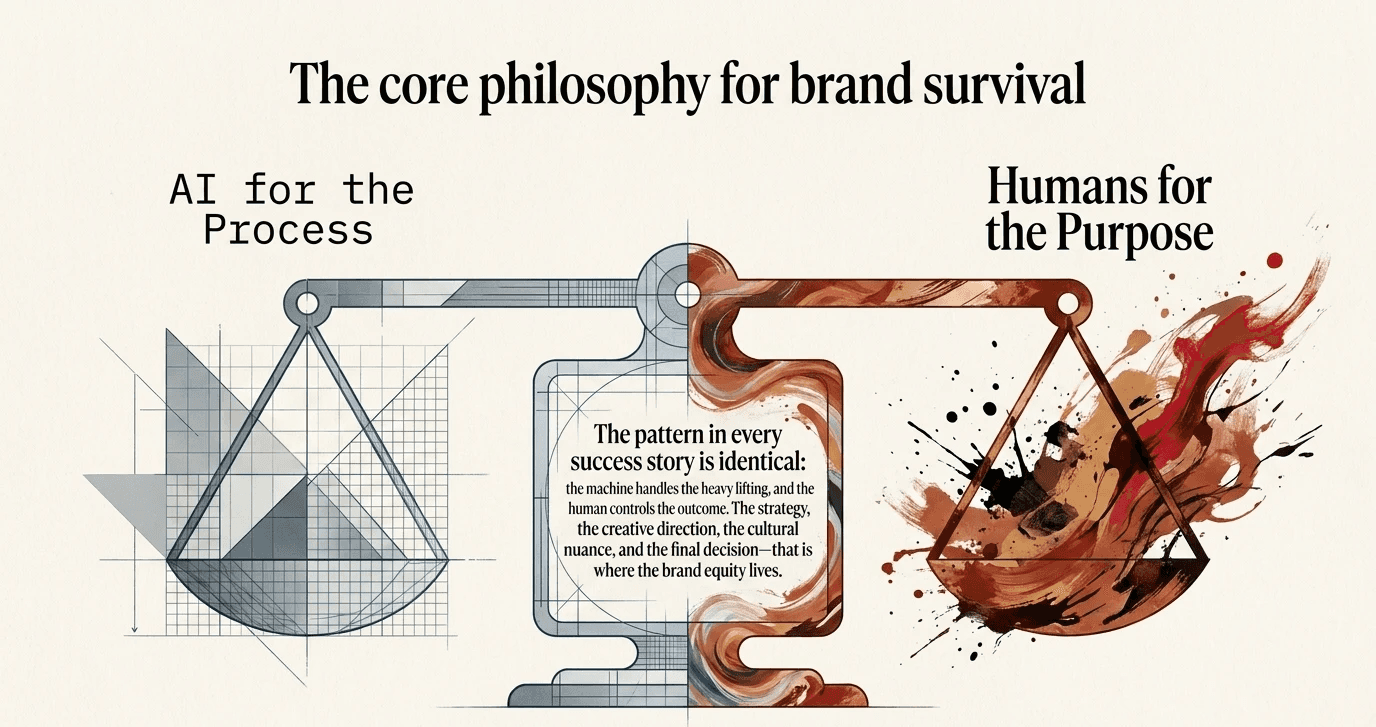
The pattern in every success story is the same: AI handles the heavy lifting, and humans control the outcome. The strategy, the creative direction, the voice, the final decision; all human. That's where the brand equity lives.
Also Read: Human-made vs AI video: Which is perfect for Social Ads
Quick Stat 57% of consumers say they trust brands more when AI is part of the experience. But 39% say they feel negatively about AI-generated ads. Both things are true at the same time. That's the paradox every brand needs to navigate in 2025. |
How AI is Destroying your Brand?
Over the past two years, there's been a trend, a trend of brands overusing AI; they are using it in every spectrum now, from tedious and lengthy work to creative work as well, and consumers have noticed every single one.
And it’s proven. Examples: Coca-Cola remade its iconic holiday ad using generative AI. Viewers called it "soulless." McDonald's Netherlands ran an AI-generated holiday campaign that landed so badly, they pulled it. Duolingo announced it was going "AI-first", and the internet lost it, especially after people connected the announcement to recent layoffs of human translators. Selkie, a fashion brand, used AI to design a Valentine's Day collection, and their own fanbase came for them.
The Authenticity Problem
People don't reject AI because they hate technology. They reject it when it feels like a shortcut that comes at the expense of quality or human effort.
A study from the Nuremberg Institute for Market Decisions found that simply labelling content as AI-generated makes people see it as less natural and less useful, even if the content itself is objectively fine. The label alone changes perception. That's a significant challenge for any brand leaning heavily into AI-produced content.
Brands like Dove, Aerie, and DC Comics have gone the other direction, publicly committing to human-made content. Dove launched a campaign pledging to never use AI-generated images of women in their advertising. Aerie doubled down on "real people only." These weren't just feel-good PR moves. They were smart business decisions because they read the room.
The audience is watching. And 87% of consumers already believe they can spot when AI is involved.
When AI Is Actually Saving the Brand
AI is also working beautifully for a lot of brands. You just don't hear about those cases because when AI works well, it's invisible.
The best AI-powered marketing doesn't scream AI. It just performs. Campaigns land faster. Content is more relevant. SEO strategy is sharper. Customer experiences feel more personalised. Nobody watches a well-targeted email sequence and thinks, "wow, an algorithm picked this send time." They just open the email.
Where AI is genuinely adding value for brands
• SEO and content planning: AI tools help identify keyword gaps, topic clusters, and search intent patterns much faster than manual research alone.
• Personalisation at scale: AI can adjust email content, product recommendations, and ad copy based on user behaviour in real time.
• Video and creative production: AI tools are cutting production timelines significantly, especially for agencies handling social media, UGC-style content, and paid ads.
• Data and performance analysis: Instead of a human spending hours in dashboards, AI surfaces the insights that matter and lets the strategist focus on decisions.
• First-draft acceleration: Writers using AI to draft, outline, or research are often producing better work, not worse, because they spend more time on editing and thinking rather than blank-page staring.
The pattern in every success story is the same: AI handles the heavy lifting, and humans control the outcome. The strategy, the creative direction, the voice, the final decision; all human. That's where the brand equity lives.
Also Read: Human-made vs AI video: Which is perfect for Social Ads
AI Saturation Is Killing Content Differentiation
There's a problem that most AI-marketing conversations aren't addressing directly. It's not about whether AI content is good or bad. It's about what happens when everyone is producing the same AI content.
When every brand is using the same AI tools, the same prompts, and the same workflows, everything starts to look and sound the same. Feeds become homogenous. Emails feel templated. Ads blur into each other.
Content differentiation, the thing that made brand voice matter, is at risk of disappearing into a sea of efficiently produced, algorithmically optimised, perfectly mediocre content.
This is the quiet crisis. Not the dramatic backlash from a bad AI ad, but the slow erosion of what made your brand sound like you.
Signs your brand is already over-automating
• Your content sounds like it could have been written by anyone, or any brand in your industry.
• Your social posts feel scheduled, not spontaneous.
• You can't remember the last time a piece of content genuinely surprised your audience.
• Engagement is technically consistent but emotionally flat.
• Your creative team is mostly reviewing AI output instead of creating.
If more than three of those sound familiar, it's worth having an honest internal conversation about where AI is pulling your content strategy, rather than pushing it.
How You Should Actually Be Using AI
This is where we get practical. Because the question isn't "AI or no AI." That conversation is over. Every serious agency is using AI. The question is how.
The agencies doing this well, the ones building brands rather than eroding them. They are following a pretty clear philosophy. AI for the process. Humans for the purpose.
What that looks like in practice
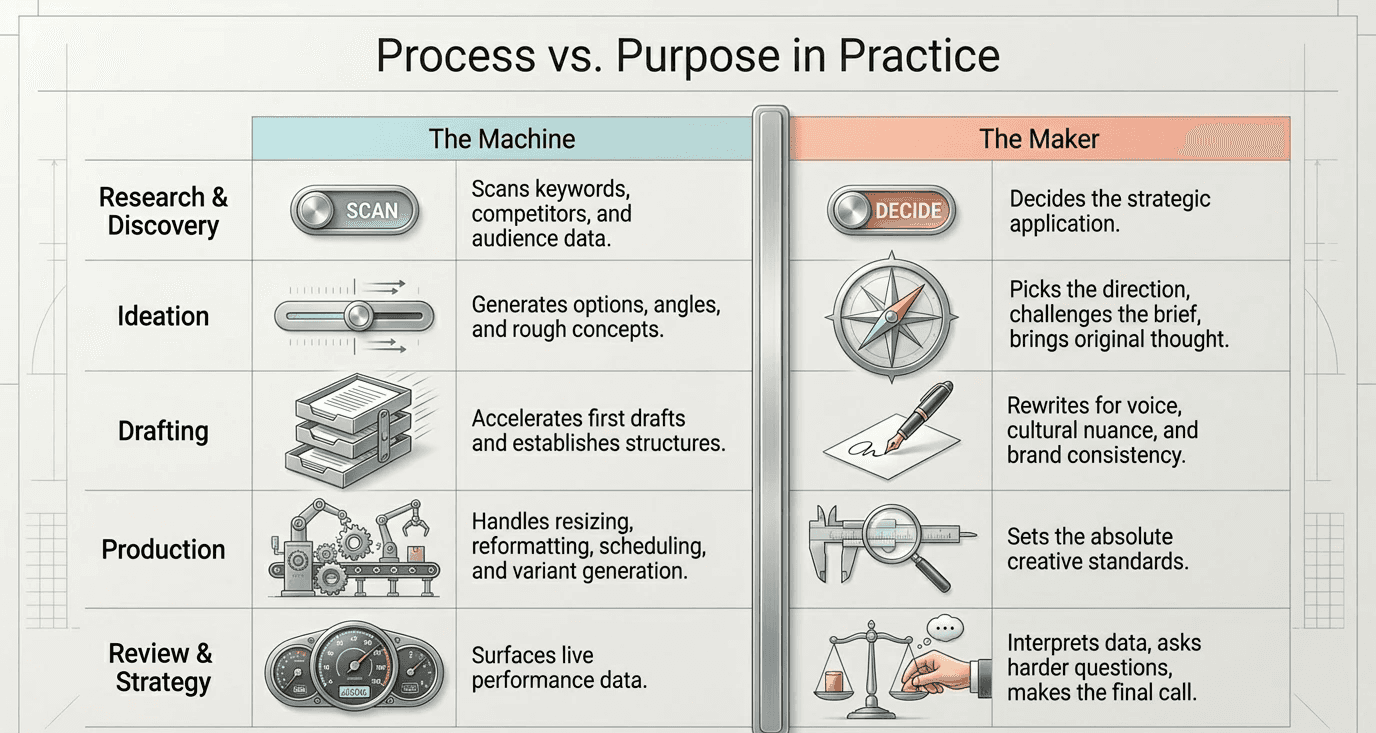
Research and discovery: AI scans keywords, competitors, trending topics, and audience data. Humans decide what to do with those insights.
Ideation: AI generates options, angles, and rough concepts. Humans pick the direction, challenge the brief, and bring original thinking.
Drafting: AI accelerates first drafts. Humans rewrite for voice, accuracy, cultural nuance, and brand consistency.
Production: AI tools handle repetitive production tasks, resizing, reformatting, scheduling, and variant generation. Humans set the creative standards.
Review and strategy: AI surfaces performance data. Humans interpret it, ask the harder questions, and make the calls.
Also Read: How to Automate your Social Media
What Brands Get Wrong About AI Transparency
One of the most misunderstood topics in AI marketing right now is whether to disclose AI use. Some brands are afraid transparency will hurt them. But the evidence suggests the opposite.
Consumers are more forgiving about AI involvement when they know about it upfront. What they can't forgive is feeling deceived. When H&M used AI digital twins of models without clear disclosure, the backlash wasn't just about AI; it was about trust. The same thing happened with Vogue's AI model campaigns and several global brands that placed AI-generated faces in ads without telling anyone.
Being clear about how you use AI, especially when it serves the audience (faster response times, better personalisation, more relevant content), actually builds confidence rather than eroding it. People trust you more when you explain the machine, not less.
This doesn't mean you need a disclaimer on every social post. It means you shouldn't hide what you're doing when someone asks, and you should lead with the human value behind every AI-assisted output.
AI and SEO: The Brand Visibility Question
No conversation about AI and brand reputation is complete without talking about search. Because how your content ranks directly affects how your brand is perceived, especially now that AI Overviews and generative engines are shaping what gets seen before a user even clicks anything.
Google's position hasn't changed: quality is the ranking factor, not origin. An AI-written page that genuinely serves the user can rank at the top. A human-written page that doesn't help anyone ranks nowhere. But here's what's changed:
• AI Overviews (AIO) are pulling answers directly from pages, meaning your content needs to be structured to be quoted, not just ranked.
• Generative Engine Optimisation (GEO) is now a real strategic layer; how your brand appears in AI-generated answers is a visibility question, not just an SEO question.
• E-E-A-T (Experience, Expertise, Authoritativeness, Trust) signals matter more than ever, and AI alone cannot generate genuine expertise. It has to be demonstrated by real people, with real context.
This is why the smartest brands are combining AI-assisted content production with genuine subject matter expertise, because that's what both Google and generative AI tools reward when they decide whose content to surface.
Also Read: How influencer marketing fails: And how to fix it
AI Saturation Is Killing Content Differentiation
There's a problem that most AI-marketing conversations aren't addressing directly. It's not about whether AI content is good or bad. It's about what happens when everyone is producing the same AI content.
When every brand is using the same AI tools, the same prompts, and the same workflows, everything starts to look and sound the same. Feeds become homogenous. Emails feel templated. Ads blur into each other.
Content differentiation, the thing that made brand voice matter, is at risk of disappearing into a sea of efficiently produced, algorithmically optimised, perfectly mediocre content.
This is the quiet crisis. Not the dramatic backlash from a bad AI ad, but the slow erosion of what made your brand sound like you.
Signs your brand is already over-automating
• Your content sounds like it could have been written by anyone, or any brand in your industry.
• Your social posts feel scheduled, not spontaneous.
• You can't remember the last time a piece of content genuinely surprised your audience.
• Engagement is technically consistent but emotionally flat.
• Your creative team is mostly reviewing AI output instead of creating.
If more than three of those sound familiar, it's worth having an honest internal conversation about where AI is pulling your content strategy, rather than pushing it.
How You Should Actually Be Using AI
This is where we get practical. Because the question isn't "AI or no AI." That conversation is over. Every serious agency is using AI. The question is how.
The agencies doing this well, the ones building brands rather than eroding them. They are following a pretty clear philosophy. AI for the process. Humans for the purpose.
What that looks like in practice
Research and discovery: AI scans keywords, competitors, trending topics, and audience data. Humans decide what to do with those insights.
Ideation: AI generates options, angles, and rough concepts. Humans pick the direction, challenge the brief, and bring original thinking.
Drafting: AI accelerates first drafts. Humans rewrite for voice, accuracy, cultural nuance, and brand consistency.
Production: AI tools handle repetitive production tasks, resizing, reformatting, scheduling, and variant generation. Humans set the creative standards.
Review and strategy: AI surfaces performance data. Humans interpret it, ask the harder questions, and make the calls.
Also Read: How to Automate your Social Media
What Brands Get Wrong About AI Transparency
One of the most misunderstood topics in AI marketing right now is whether to disclose AI use. Some brands are afraid transparency will hurt them. But the evidence suggests the opposite.
Consumers are more forgiving about AI involvement when they know about it upfront. What they can't forgive is feeling deceived. When H&M used AI digital twins of models without clear disclosure, the backlash wasn't just about AI; it was about trust. The same thing happened with Vogue's AI model campaigns and several global brands that placed AI-generated faces in ads without telling anyone.
Being clear about how you use AI, especially when it serves the audience (faster response times, better personalisation, more relevant content), actually builds confidence rather than eroding it. People trust you more when you explain the machine, not less.
This doesn't mean you need a disclaimer on every social post. It means you shouldn't hide what you're doing when someone asks, and you should lead with the human value behind every AI-assisted output.
AI and SEO: The Brand Visibility Question
No conversation about AI and brand reputation is complete without talking about search. Because how your content ranks directly affects how your brand is perceived, especially now that AI Overviews and generative engines are shaping what gets seen before a user even clicks anything.
Google's position hasn't changed: quality is the ranking factor, not origin. An AI-written page that genuinely serves the user can rank at the top. A human-written page that doesn't help anyone ranks nowhere. But here's what's changed:
• AI Overviews (AIO) are pulling answers directly from pages, meaning your content needs to be structured to be quoted, not just ranked.
• Generative Engine Optimisation (GEO) is now a real strategic layer; how your brand appears in AI-generated answers is a visibility question, not just an SEO question.
• E-E-A-T (Experience, Expertise, Authoritativeness, Trust) signals matter more than ever, and AI alone cannot generate genuine expertise. It has to be demonstrated by real people, with real context.
This is why the smartest brands are combining AI-assisted content production with genuine subject matter expertise, because that's what both Google and generative AI tools reward when they decide whose content to surface.
Also Read: How influencer marketing fails: And how to fix it
Conclusion
Most agencies are either running too hot on AI, pumping out content that sounds like nobody in particular, or refusing to touch it and falling behind on speed and scale.
At Motion Labs, we've built our workflow around a different idea. AI handles the parts of the creative process that don't require a human. The strategy, the voice, the ideas, the craft, that's all still us.
We use AI to do the research faster, structure the brief smarter, and accelerate production for video, social, and content. But every final output goes through experienced human eyes before it touches your brand. Not because we're afraid of AI, but because we respect what your brand stands for.
The result is content that moves fast and still feels real. Because that's the only version of AI in marketing that actually works long-term.
→ Learn how Motion Labs builds AI-powered content that protects your brand voice at motionlabs.agency
Frequently Asked Questions
Is AI-generated content bad for SEO?
Not automatically. Google ranks based on quality and usefulness, not origin. AI content that genuinely helps users can rank just as well as human-written content. The risk is producing low-quality, generic content at volume, which is where brands get penalised.
Can AI damage brand trust?
Yes, it can, particularly when AI is used to replace things audiences value as humans: creative craft, emotional authenticity, and personalised communication. Brands that automate without discretion often end up with content that performs technically but connects poorly.
Should brands disclose that they use AI?
Transparency tends to work better than hiding it. Audiences are increasingly aware of AI's role in marketing, and most are fine with it, as long as they don't feel deceived. Proactive disclosure in contexts where it matters (AI influencers, AI-generated imagery) protects brand reputation.
What's the best way to use AI in content marketing without losing brand voice?
Use AI for research, structure, and first drafts, then have experienced editors and strategists reshape the output to match your brand's actual voice. The final product should sound like you wrote it, even if AI helped you get there faster.
Why did brands like Coca-Cola and McDonald's face backlash for AI ads?
Both brands used AI in emotionally high-stakes contexts, holiday campaigns, where audiences expected warmth, human craft, and authenticity. The AI-generated versions were seen as efficient substitutes rather than genuine creative efforts, and audiences noticed the difference.
Is there a difference between good AI use and bad AI use in marketing?
Absolutely. Good AI use is when it makes your team faster, your insights sharper, and your content more relevant, without the audience noticing the machine. Bad AI use is when it's visible, generic, cost-cutting at the expense of quality, or replacing the human judgment that brands are built on.
How does GEO (Generative Engine Optimisation) affect brand visibility?
As AI-powered search engines generate direct answers, brands need to structure their content to be surfaced in those answers, not just ranked in traditional results. This means clear, accurate, well-attributed content with genuine expertise signals, things AI alone can't produce without human oversight.
Conclusion
Most agencies are either running too hot on AI, pumping out content that sounds like nobody in particular, or refusing to touch it and falling behind on speed and scale.
At Motion Labs, we've built our workflow around a different idea. AI handles the parts of the creative process that don't require a human. The strategy, the voice, the ideas, the craft, that's all still us.
We use AI to do the research faster, structure the brief smarter, and accelerate production for video, social, and content. But every final output goes through experienced human eyes before it touches your brand. Not because we're afraid of AI, but because we respect what your brand stands for.
The result is content that moves fast and still feels real. Because that's the only version of AI in marketing that actually works long-term.
→ Learn how Motion Labs builds AI-powered content that protects your brand voice at motionlabs.agency
Frequently Asked Questions
Is AI-generated content bad for SEO?
Not automatically. Google ranks based on quality and usefulness, not origin. AI content that genuinely helps users can rank just as well as human-written content. The risk is producing low-quality, generic content at volume, which is where brands get penalised.
Can AI damage brand trust?
Yes, it can, particularly when AI is used to replace things audiences value as humans: creative craft, emotional authenticity, and personalised communication. Brands that automate without discretion often end up with content that performs technically but connects poorly.
Should brands disclose that they use AI?
Transparency tends to work better than hiding it. Audiences are increasingly aware of AI's role in marketing, and most are fine with it, as long as they don't feel deceived. Proactive disclosure in contexts where it matters (AI influencers, AI-generated imagery) protects brand reputation.
What's the best way to use AI in content marketing without losing brand voice?
Use AI for research, structure, and first drafts, then have experienced editors and strategists reshape the output to match your brand's actual voice. The final product should sound like you wrote it, even if AI helped you get there faster.
Why did brands like Coca-Cola and McDonald's face backlash for AI ads?
Both brands used AI in emotionally high-stakes contexts, holiday campaigns, where audiences expected warmth, human craft, and authenticity. The AI-generated versions were seen as efficient substitutes rather than genuine creative efforts, and audiences noticed the difference.
Is there a difference between good AI use and bad AI use in marketing?
Absolutely. Good AI use is when it makes your team faster, your insights sharper, and your content more relevant, without the audience noticing the machine. Bad AI use is when it's visible, generic, cost-cutting at the expense of quality, or replacing the human judgment that brands are built on.
How does GEO (Generative Engine Optimisation) affect brand visibility?
As AI-powered search engines generate direct answers, brands need to structure their content to be surfaced in those answers, not just ranked in traditional results. This means clear, accurate, well-attributed content with genuine expertise signals, things AI alone can't produce without human oversight.
the call your competitor wish you would'nt take


Related Posts





Related Posts
Related Posts
Motion labs
info@motionlabs.agency


+971 55317 1706
C-1802, ONTARIO TOWER, PLOT NO. 49-0, BUSINESS BAY, DUBAI, 00000
click to meet me :)
click to meet me :)
© All Rights Reserved | 2026


Motion labs
info@motionlabs.agency
+971 55317 1706
C-1802, ONTARIO TOWER, PLOT NO. 49-0, BUSINESS BAY, DUBAI, 00000
Private policy
Terms & Conditions
© All Rights Reserved | 2026
click to meet me :)