/
/
TikTok Content Creator Agency in San Francisco | Motion Labs
TikTok Content Creator Agency in San Francisco | Motion Labs
5 min
read
TikTok Content Creator Agency in San Francisco | Motion Labs
TikTok Content Creator Agency in San Francisco | Motion Labs
Content
Marketing

Author

Scroll down
to read more!
Summerize with ChatGPT
Summerize with Gemini
Summerize with Claude
TikTok Content Creator Agency in San Francisco | Motion Labs
TikTok Content Creator Agency in San Francisco | Motion Labs
Looking for a TikTok content creator agency in San Francisco? Here is what these teams do, what they cost, how to vet them, and how to brief one properly.
Looking for a TikTok content creator agency in San Francisco? Here is what these teams do, what they cost, how to vet them, and how to brief one properly.
A TikTok content creator agency in San Francisco builds short-form video for brands, either with its own in-house creators or through a managed network of local creators. The work usually covers concepting, scripting, filming, editing, posting, and paid amplification. Most SF brands hire one because their internal team can write a good caption but cannot ship twenty native-feeling videos a month at a quality bar TikTok actually rewards.
This guide covers what these agencies actually deliver, how they price the work, what separates a good one from an expensive one, and the questions you should ask before you sign anything.
Key takeaways
|
What does a TikTok content creator agency do?
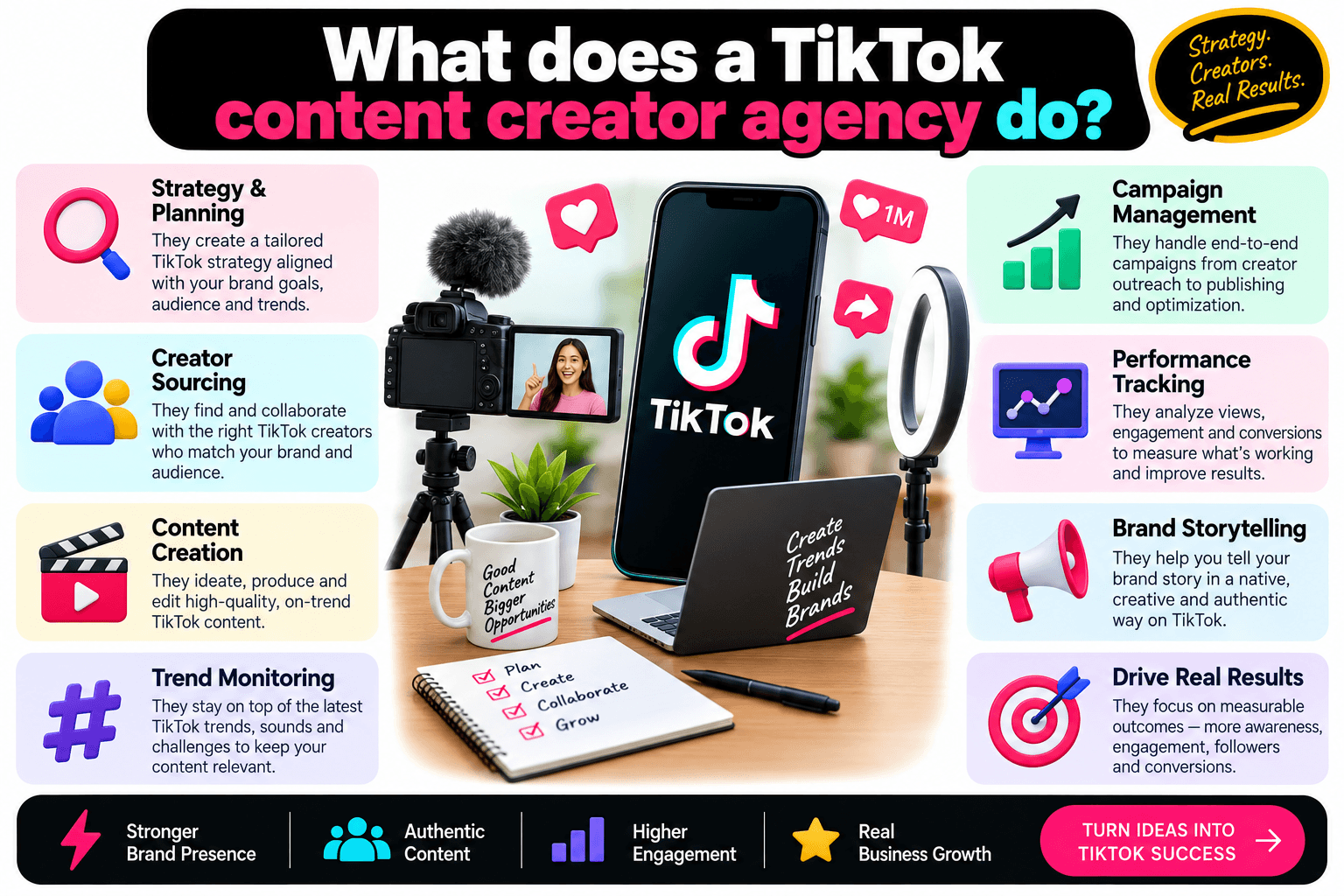
The label covers a wide range. Some shops are production houses that happen to shoot vertical. Others are creator marketplaces with a thin layer of account management. The ones worth paying for handle the full loop from insight to iteration.
Creator sourcing and matching
Finding creators is the easy part. Matching them to a brand is not. A good agency screens for audience overlap, comment quality, past brand work, and whether the creator can hit a delivery deadline. In San Francisco that pool skews toward tech reviewers, productivity creators, food and nightlife accounts, and fitness. If your product is B2B software, the agency should be pulling from the tech and productivity side, not handing you a lifestyle creator with a big follower count and no relevance.
Concepting and scripting
This is where most campaigns are won or lost. The agency should be building a concept bank of ten to twenty hook angles per month, then testing them cheaply before committing budget. Hooks get written for the first two seconds, not for a brand deck.
Production and editing
Filming can happen in a studio, on location, or entirely creator-side on a phone. Post-production is where the agency earns its retainer: captions, sound design, pacing cuts, motion graphics, and platform-native transitions. If your product is software, the demo capture and screen recording work needs a specialist. We break that down in more detail in our guide to SaaS video editing in San Francisco.
Publishing, paid, and iteration
Organic posting is only half of it. Most performance comes from Spark Ads, where the brand puts spend behind a creator post using the creator handle. The agency should be reading retention curves, cutting weak hooks, and rebuilding the winners into new variants within days rather than weeks.
A TikTok content creator agency in San Francisco builds short-form video for brands, either with its own in-house creators or through a managed network of local creators. The work usually covers concepting, scripting, filming, editing, posting, and paid amplification. Most SF brands hire one because their internal team can write a good caption but cannot ship twenty native-feeling videos a month at a quality bar TikTok actually rewards.
This guide covers what these agencies actually deliver, how they price the work, what separates a good one from an expensive one, and the questions you should ask before you sign anything.
Key takeaways
|
What does a TikTok content creator agency do?
The label covers a wide range. Some shops are production houses that happen to shoot vertical. Others are creator marketplaces with a thin layer of account management. The ones worth paying for handle the full loop from insight to iteration.
Creator sourcing and matching
Finding creators is the easy part. Matching them to a brand is not. A good agency screens for audience overlap, comment quality, past brand work, and whether the creator can hit a delivery deadline. In San Francisco that pool skews toward tech reviewers, productivity creators, food and nightlife accounts, and fitness. If your product is B2B software, the agency should be pulling from the tech and productivity side, not handing you a lifestyle creator with a big follower count and no relevance.
Concepting and scripting
This is where most campaigns are won or lost. The agency should be building a concept bank of ten to twenty hook angles per month, then testing them cheaply before committing budget. Hooks get written for the first two seconds, not for a brand deck.
Production and editing
Filming can happen in a studio, on location, or entirely creator-side on a phone. Post-production is where the agency earns its retainer: captions, sound design, pacing cuts, motion graphics, and platform-native transitions. If your product is software, the demo capture and screen recording work needs a specialist. We break that down in more detail in our guide to SaaS video editing in San Francisco.
Publishing, paid, and iteration
Organic posting is only half of it. Most performance comes from Spark Ads, where the brand puts spend behind a creator post using the creator handle. The agency should be reading retention curves, cutting weak hooks, and rebuilding the winners into new variants within days rather than weeks.
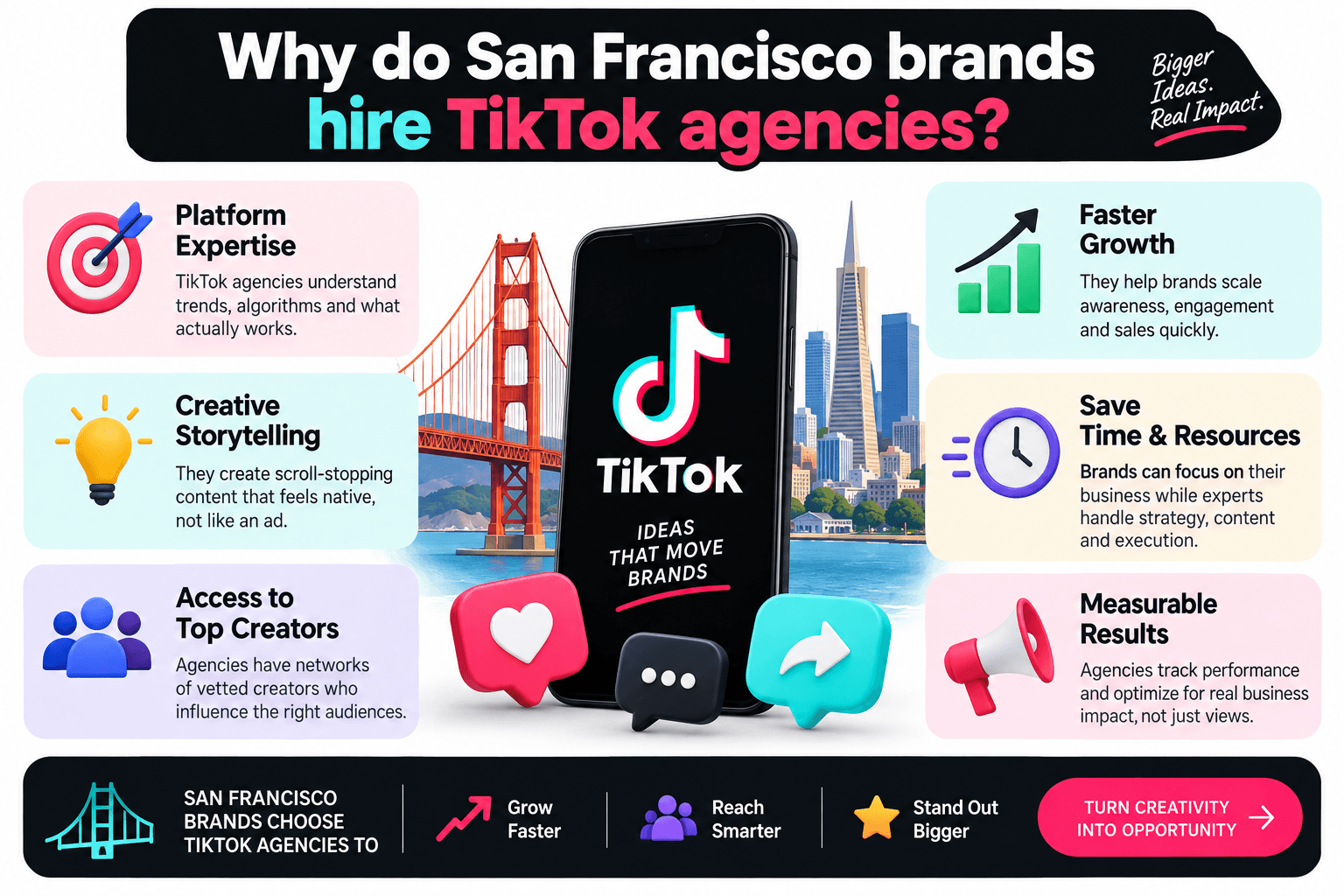
Why do San Francisco brands hire TikTok agencies?
SF has a specific problem. The city is full of companies with excellent products and no idea how to explain them in nine seconds. Series A and Series B startups here often have a strong LinkedIn presence and nothing on TikTok, then discover their buyers are watching short-form video everywhere else.
Three patterns show up repeatedly:
Technical products explained badly. Their category is technical and they default to feature lists instead of demonstrations.
Internal capacity caps out. One in-house video person cannot produce daily short-form and also cut the conference sizzle reel.
Brand teams over-polish. Founders often want a brand film. TikTok wants a person talking to a camera about a problem.
The other driver is talent cost. Hiring a full-time short-form producer, an editor, and a creator manager in the Bay Area is a serious payroll line before you have proven the channel works. An agency retainer converts that into a variable cost you can stop. If you are still comparing shops, our roundup of top content creator agencies in San Francisco is a reasonable starting shortlist.
How much does a TikTok content creator agency in San Francisco cost?
Pricing depends on who creates the content, how much of it you need, and whether paid media management is included. Rather than quote hard numbers that go stale, here is how the market is generally structured.
Model | What you get | Best for | Watch out for |
|---|---|---|---|
Per-video project | A fixed set of deliverables, one round of revisions | Testing the channel before committing | No iteration loop, so learnings do not compound |
Monthly retainer | A set volume of assets, ongoing strategy, reporting | Brands committed to TikTok for two quarters or more | Volume defined loosely, then quietly reduced |
Creator-led UGC package | Content sourced from a creator roster, lightly edited | DTC and app brands needing high ad volume | Usage rights limited to 30 days by default |
Performance or hybrid | Lower base fee plus a share of ad spend or results | Brands with real paid budget behind the content | Attribution disputes when the model is undefined |
Full-service partner | Content plus paid media plus landing page work | Teams without an internal growth function | Paying agency rates for work you could run in-house |
San Francisco rates sit above the US average. Local creator day rates, studio rental, and senior editors all cost more here. That premium is worth paying when the agency understands your category. It is not worth paying for a zip code.
Why do San Francisco brands hire TikTok agencies?
SF has a specific problem. The city is full of companies with excellent products and no idea how to explain them in nine seconds. Series A and Series B startups here often have a strong LinkedIn presence and nothing on TikTok, then discover their buyers are watching short-form video everywhere else.
Three patterns show up repeatedly:
Technical products explained badly. Their category is technical and they default to feature lists instead of demonstrations.
Internal capacity caps out. One in-house video person cannot produce daily short-form and also cut the conference sizzle reel.
Brand teams over-polish. Founders often want a brand film. TikTok wants a person talking to a camera about a problem.
The other driver is talent cost. Hiring a full-time short-form producer, an editor, and a creator manager in the Bay Area is a serious payroll line before you have proven the channel works. An agency retainer converts that into a variable cost you can stop. If you are still comparing shops, our roundup of top content creator agencies in San Francisco is a reasonable starting shortlist.
How much does a TikTok content creator agency in San Francisco cost?
Pricing depends on who creates the content, how much of it you need, and whether paid media management is included. Rather than quote hard numbers that go stale, here is how the market is generally structured.
Model | What you get | Best for | Watch out for |
|---|---|---|---|
Per-video project | A fixed set of deliverables, one round of revisions | Testing the channel before committing | No iteration loop, so learnings do not compound |
Monthly retainer | A set volume of assets, ongoing strategy, reporting | Brands committed to TikTok for two quarters or more | Volume defined loosely, then quietly reduced |
Creator-led UGC package | Content sourced from a creator roster, lightly edited | DTC and app brands needing high ad volume | Usage rights limited to 30 days by default |
Performance or hybrid | Lower base fee plus a share of ad spend or results | Brands with real paid budget behind the content | Attribution disputes when the model is undefined |
Full-service partner | Content plus paid media plus landing page work | Teams without an internal growth function | Paying agency rates for work you could run in-house |
San Francisco rates sit above the US average. Local creator day rates, studio rental, and senior editors all cost more here. That premium is worth paying when the agency understands your category. It is not worth paying for a zip code.

In-house team vs freelancer vs TikTok agency: which should you choose?
There is no universally correct answer, but the trade-offs are predictable.
Factor | In-house team | Freelancers | TikTok agency |
|---|---|---|---|
Speed to start | Slow, hiring takes months | Fast, days to a week | Fast, usually two weeks to first delivery |
Output volume | Limited by headcount | Scales but coordination cost rises sharply | Built for volume, that is the operating model |
Brand knowledge | Deepest, they live in the product | Shallow unless retained long term | Builds over the first 60 to 90 days |
Creator access | Requires you to build a network | Only the freelancers you know | Existing vetted roster |
Cost structure | Fixed payroll plus benefits | Variable but unpredictable | Predictable monthly line item |
Risk if it fails | Highest, you have hired people | Low | Low, contracts are usually quarterly |
Most SF brands land on a hybrid. One internal marketer owns strategy and approvals. The agency owns production volume and creator relationships. That split keeps the brand voice consistent without capping how much you can ship.
How do you vet a TikTok agency in San Francisco?
Follower counts in a pitch deck prove nothing. Ask for these instead.
Test-to-scale ratio. How many concepts did you test last quarter, and how many made it to paid? A healthy ratio means they are killing weak ideas early.
Retention data. Ask for average watch time and three-second view rate on their client work, not just view counts.
Who does the writing. Who writes the hooks? If the answer is the account manager, the hooks will be safe and forgettable.
Rights and ownership. Confirm whether you get raw files, perpetual usage, and Spark Ads codes. Thirty-day rights are common and often insufficient.
Category experience. Have they worked in your category before? B2B SaaS short-form is a different craft from beauty or food.
Turnaround commitments. Two weeks from brief to first cut is reasonable. Six weeks means the channel is not a priority for them.
Ask to see their YouTube Shorts work too. Agencies that can repurpose a TikTok library into Shorts and Reels without it feeling recycled are running a more mature production system. We covered how those workflows differ in our piece on YouTube video content creation agencies in San Francisco.
What does a good TikTok content workflow look like?
The best-run accounts follow a loop that repeats every two weeks.
Insight gathering. Pull comments, sales objections, and support tickets. These are the real hooks.
Concept bank. Ten to twenty angles written as first-two-second hooks, not as video titles.
Rapid production. Shoot the cheapest possible version of five to eight concepts.
Organic test. Post organically, watch three-second and full-watch rates for 48 to 72 hours.
Paid amplification. Put spend behind the top two or three via Spark Ads.
Variant production. Rebuild winning hooks with new openings, new creators, new formats.
Agencies that skip the organic test and go straight to paid are spending your money to learn what a free post would have told them.
Where does TikTok content fit in the rest of your funnel?
TikTok is good at attention and terrible at conversion on its own. The traffic it sends is impatient, mobile, and arrives with almost no context. If that traffic lands on a dense desktop-first homepage, the campaign will look like it failed when the real problem is downstream. Landing pages built for short-form traffic need one message, one action, and fast load times. Our overview of website design for content-led brands in San Francisco goes into what that looks like in practice.
The other half is measurement. Last-click attribution will consistently undervalue TikTok. Post-purchase surveys, branded search lift, and direct traffic movement give a more honest picture of what the channel is contributing.
Common mistakes SF brands make on TikTok
Over-producing. Cinematic quality signals advertising, and advertising gets scrolled. Native beats beautiful.
Posting too little. Four videos a month gives the algorithm nothing to learn from. Fifteen is a floor, not a stretch.
Leading with the brand. Two seconds of logo animation at the top is two seconds of lost audience.
Over-scripting creators. A creator who knows their audience will outperform your brand guidelines. Give direction, not a script to read verbatim.
Chasing views. A video with 40,000 views and no watch-through is worse than one with 6,000 views and strong retention.
Frequently asked questions
What does a TikTok content creator agency in San Francisco actually deliver?
Strategy, creator sourcing, scripting, filming, editing, publishing, and performance reporting. Some also manage the paid spend behind the content. The deliverable is usually a set number of finished videos per month plus the strategy and iteration work around them.
How long before TikTok content produces results?
Organic traction typically takes 60 to 90 days of consistent volume. Paid results move faster because you are buying distribution, so you can read hook performance within the first two weeks of spend.
Is TikTok worth it for B2B and SaaS companies?
Yes, when the content targets the practitioner rather than the buying committee. Product demos, workflow tips, and industry commentary perform well. It works as a top-of-funnel awareness channel, not a demo-booking machine.
Do I need to appear on camera as a founder?
It helps but it is not required. Founder-led content usually gets better retention because people trust faces over brands. If that is not viable, creators, employees, or a hired host all work.
What is the difference between a UGC agency and a TikTok agency?
UGC agencies primarily source creator-made assets that you use in ads. TikTok agencies typically manage the channel itself, including organic posting, community, and the paid layer. Many shops do both, so ask which side they are stronger on.
Should the agency post from my account or the creator account?
Both, usually. Brand-account posts build your owned audience. Creator posts amplified through Spark Ads perform better in paid because they carry social proof. The mix depends on whether you are optimising for audience or acquisition.
How many videos per month do I need?
Fifteen to thirty finished assets is a reasonable working range for a brand that is serious about the channel. Below ten, you rarely gather enough signal to know which hooks work.
Work with Motion Labs We build short-form video for brands that need volume without losing the plot. Concepting, creator sourcing, production, editing, and the paid layer behind it, run as one system rather than five vendors. If you are scoping TikTok for a San Francisco brand, tell us what you are selling and who you are selling to, and we will come back with a content plan and a realistic delivery cadence. |
In-house team vs freelancer vs TikTok agency: which should you choose?
There is no universally correct answer, but the trade-offs are predictable.
Factor | In-house team | Freelancers | TikTok agency |
|---|---|---|---|
Speed to start | Slow, hiring takes months | Fast, days to a week | Fast, usually two weeks to first delivery |
Output volume | Limited by headcount | Scales but coordination cost rises sharply | Built for volume, that is the operating model |
Brand knowledge | Deepest, they live in the product | Shallow unless retained long term | Builds over the first 60 to 90 days |
Creator access | Requires you to build a network | Only the freelancers you know | Existing vetted roster |
Cost structure | Fixed payroll plus benefits | Variable but unpredictable | Predictable monthly line item |
Risk if it fails | Highest, you have hired people | Low | Low, contracts are usually quarterly |
Most SF brands land on a hybrid. One internal marketer owns strategy and approvals. The agency owns production volume and creator relationships. That split keeps the brand voice consistent without capping how much you can ship.
How do you vet a TikTok agency in San Francisco?
Follower counts in a pitch deck prove nothing. Ask for these instead.
Test-to-scale ratio. How many concepts did you test last quarter, and how many made it to paid? A healthy ratio means they are killing weak ideas early.
Retention data. Ask for average watch time and three-second view rate on their client work, not just view counts.
Who does the writing. Who writes the hooks? If the answer is the account manager, the hooks will be safe and forgettable.
Rights and ownership. Confirm whether you get raw files, perpetual usage, and Spark Ads codes. Thirty-day rights are common and often insufficient.
Category experience. Have they worked in your category before? B2B SaaS short-form is a different craft from beauty or food.
Turnaround commitments. Two weeks from brief to first cut is reasonable. Six weeks means the channel is not a priority for them.
Ask to see their YouTube Shorts work too. Agencies that can repurpose a TikTok library into Shorts and Reels without it feeling recycled are running a more mature production system. We covered how those workflows differ in our piece on YouTube video content creation agencies in San Francisco.
What does a good TikTok content workflow look like?
The best-run accounts follow a loop that repeats every two weeks.
Insight gathering. Pull comments, sales objections, and support tickets. These are the real hooks.
Concept bank. Ten to twenty angles written as first-two-second hooks, not as video titles.
Rapid production. Shoot the cheapest possible version of five to eight concepts.
Organic test. Post organically, watch three-second and full-watch rates for 48 to 72 hours.
Paid amplification. Put spend behind the top two or three via Spark Ads.
Variant production. Rebuild winning hooks with new openings, new creators, new formats.
Agencies that skip the organic test and go straight to paid are spending your money to learn what a free post would have told them.
Where does TikTok content fit in the rest of your funnel?
TikTok is good at attention and terrible at conversion on its own. The traffic it sends is impatient, mobile, and arrives with almost no context. If that traffic lands on a dense desktop-first homepage, the campaign will look like it failed when the real problem is downstream. Landing pages built for short-form traffic need one message, one action, and fast load times. Our overview of website design for content-led brands in San Francisco goes into what that looks like in practice.
The other half is measurement. Last-click attribution will consistently undervalue TikTok. Post-purchase surveys, branded search lift, and direct traffic movement give a more honest picture of what the channel is contributing.
Common mistakes SF brands make on TikTok
Over-producing. Cinematic quality signals advertising, and advertising gets scrolled. Native beats beautiful.
Posting too little. Four videos a month gives the algorithm nothing to learn from. Fifteen is a floor, not a stretch.
Leading with the brand. Two seconds of logo animation at the top is two seconds of lost audience.
Over-scripting creators. A creator who knows their audience will outperform your brand guidelines. Give direction, not a script to read verbatim.
Chasing views. A video with 40,000 views and no watch-through is worse than one with 6,000 views and strong retention.
Frequently asked questions
What does a TikTok content creator agency in San Francisco actually deliver?
Strategy, creator sourcing, scripting, filming, editing, publishing, and performance reporting. Some also manage the paid spend behind the content. The deliverable is usually a set number of finished videos per month plus the strategy and iteration work around them.
How long before TikTok content produces results?
Organic traction typically takes 60 to 90 days of consistent volume. Paid results move faster because you are buying distribution, so you can read hook performance within the first two weeks of spend.
Is TikTok worth it for B2B and SaaS companies?
Yes, when the content targets the practitioner rather than the buying committee. Product demos, workflow tips, and industry commentary perform well. It works as a top-of-funnel awareness channel, not a demo-booking machine.
Do I need to appear on camera as a founder?
It helps but it is not required. Founder-led content usually gets better retention because people trust faces over brands. If that is not viable, creators, employees, or a hired host all work.
What is the difference between a UGC agency and a TikTok agency?
UGC agencies primarily source creator-made assets that you use in ads. TikTok agencies typically manage the channel itself, including organic posting, community, and the paid layer. Many shops do both, so ask which side they are stronger on.
Should the agency post from my account or the creator account?
Both, usually. Brand-account posts build your owned audience. Creator posts amplified through Spark Ads perform better in paid because they carry social proof. The mix depends on whether you are optimising for audience or acquisition.
How many videos per month do I need?
Fifteen to thirty finished assets is a reasonable working range for a brand that is serious about the channel. Below ten, you rarely gather enough signal to know which hooks work.
Work with Motion Labs We build short-form video for brands that need volume without losing the plot. Concepting, creator sourcing, production, editing, and the paid layer behind it, run as one system rather than five vendors. If you are scoping TikTok for a San Francisco brand, tell us what you are selling and who you are selling to, and we will come back with a content plan and a realistic delivery cadence. |


Related Posts





Related Posts
Related Posts
Motion labs
info@motionlabs.agency


+971 55317 1706
C-1802, ONTARIO TOWER, PLOT NO. 49-0, BUSINESS BAY, DUBAI, 00000
click to meet me :)
click to meet me :)
© All Rights Reserved | 2026


Motion labs
info@motionlabs.agency
+971 55317 1706
C-1802, ONTARIO TOWER, PLOT NO. 49-0, BUSINESS BAY, DUBAI, 00000
Private policy
Terms & Conditions
© All Rights Reserved | 2026
click to meet me :)