/
/
X Influencer Marketing: 5 Steps for a successful Campaign
X Influencer Marketing: 5 Steps for a successful Campaign
5 min
read
X Influencer Marketing: 5 Steps for a successful Campaign
X Influencer Marketing: 5 Steps for a successful Campaign
Marketing
Content

Author
Scroll down
to read more!
Summerize with ChatGPT
Summerize with Gemini
Summerize with Claude
X Influencer Marketing: 5 Steps for a successful Campaign
X Influencer Marketing: 5 Steps for a successful Campaign
X is not a dying platform. It is where deals start, opinions form, and niche communities live loud. If you are a B2B brand, a startup, or an agency and you are not running influencer campaigns on X, you are leaving real deals on the table. Let’s see how you can snatch those deals.
X is not a dying platform. It is where deals start, opinions form, and niche communities live loud. If you are a B2B brand, a startup, or an agency and you are not running influencer campaigns on X, you are leaving real deals on the table. Let’s see how you can snatch those deals.
5 Steps for a Successful X Campaign
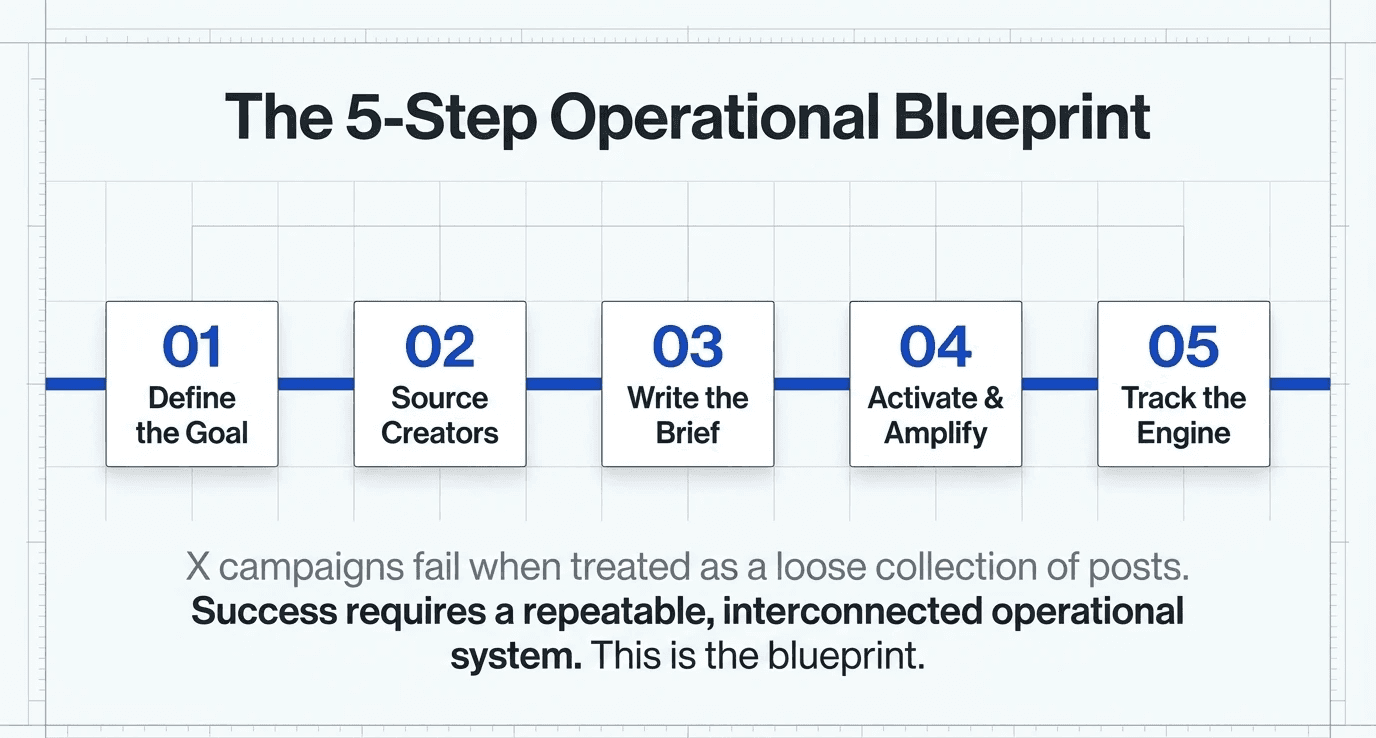
STEP 01 | Define Your Goal Before You Pick Anyone |
Every campaign that fails starts the same way: someone picks a creator first and figures out the goal later. Do it the other way around.
Before you open a spreadsheet or send a single DM, get clear on what you actually want from this campaign. That sounds obvious, but most teams skip it.
The four goals most X campaigns chase:
• Brand awareness: you want people who have never heard of you to start seeing your name
• Community growth: you want more followers, more replies, more daily engagement
• Website traffic: you want clicks that land on a landing page or a blog post
• Direct conversions: you want signups, trials, demo bookings, or sales
Each goal needs a different type of creator, different content, and different metrics. A campaign built for awareness will look completely different to a campaign built for conversions.
Quick tip Write your goal in one sentence before anything else. 'We want 500 free trial signups from X in 30 days from SaaS audience segments.' That single sentence will shape every decision that follows. |
Also read: Micro-influencer vs Macro influencer which is best for you
STEP 02 | Find the Right Creators on X |
Follower count is the most misleading metric in influencer marketing. A creator with 8,000 followers who posts daily about B2B SaaS will outperform a creator with 200,000 followers who talks about everything and nothing.
On X, reach is not about size. It is about relevance and how often the algorithm picks someone up in reply threads, quotes, and the For You feed.
What to look for when sourcing X creators:
• Engagement rate over 2% on recent posts, replies and retweets matter more than likes
• A clear niche: they post about a specific topic 80% of the time, not everything
• Real replies: actual conversations in their comments, not just emoji reactions
• Post frequency: at least 3 to 5 posts per week, ideally daily
• Audience match: the people engaging with them look like your ideal customer
For B2B brands, micro-influencers (5,000 to 50,000 followers) and mid-tier creators (50,000 to 200,000 followers) in your niche will almost always outperform mega-influencers on X. The platform rewards tight communities.
Where to find them:
• Search relevant hashtags and see who keeps showing up
• Look at who your target audience replies to and quotes regularly
• Check the following lists of your own top customers
• Use tools like SparkToro, Followerwonk, or Creator.co to filter by niche and engagement
• Look at LinkedIn crossover, creators active on both platforms carry twice the reach
Also Read: Why Influencer Marketing Fails
STEP 03 | Write a Brief That Creators Actually Want to Work With |
The brief is where most B2B campaigns fall apart. Brands send over a 12-page PDF of talking points and a list of things not to say. Creators read three lines, feel micromanaged, and produce content that sounds like a press release.
A good brief is short, clear, and gives creators room to be themselves. That is the entire point of influencer marketing; you are paying for their voice, not a sponsored advert slot.
What a strong X influencer brief includes:
• Campaign goal (in plain language): what does success look like for you?
• Key message: the one thing you want the audience to understand or feel
• Mandatory mentions: brand name, product name, or specific URL
• What not to say: only the real no-go areas, not a list of twenty restrictions
• Content format: thread, single post, poll, quote tweet, or video
• Posting timeline: when the content should go live
• Disclosure requirement: paid partnership must be clearly labelled
The most important rule Give creators creative freedom within your guardrails. Tell them the destination and let them drive. Creators who feel trusted make better content. Full stop. |
5 Steps for a Successful X Campaign
STEP 01 | Define Your Goal Before You Pick Anyone |
Every campaign that fails starts the same way: someone picks a creator first and figures out the goal later. Do it the other way around.
Before you open a spreadsheet or send a single DM, get clear on what you actually want from this campaign. That sounds obvious, but most teams skip it.
The four goals most X campaigns chase:
• Brand awareness: you want people who have never heard of you to start seeing your name
• Community growth: you want more followers, more replies, more daily engagement
• Website traffic: you want clicks that land on a landing page or a blog post
• Direct conversions: you want signups, trials, demo bookings, or sales
Each goal needs a different type of creator, different content, and different metrics. A campaign built for awareness will look completely different to a campaign built for conversions.
Quick tip Write your goal in one sentence before anything else. 'We want 500 free trial signups from X in 30 days from SaaS audience segments.' That single sentence will shape every decision that follows. |
Also read: Micro-influencer vs Macro influencer which is best for you
STEP 02 | Find the Right Creators on X |
Follower count is the most misleading metric in influencer marketing. A creator with 8,000 followers who posts daily about B2B SaaS will outperform a creator with 200,000 followers who talks about everything and nothing.
On X, reach is not about size. It is about relevance and how often the algorithm picks someone up in reply threads, quotes, and the For You feed.
What to look for when sourcing X creators:
• Engagement rate over 2% on recent posts, replies and retweets matter more than likes
• A clear niche: they post about a specific topic 80% of the time, not everything
• Real replies: actual conversations in their comments, not just emoji reactions
• Post frequency: at least 3 to 5 posts per week, ideally daily
• Audience match: the people engaging with them look like your ideal customer
For B2B brands, micro-influencers (5,000 to 50,000 followers) and mid-tier creators (50,000 to 200,000 followers) in your niche will almost always outperform mega-influencers on X. The platform rewards tight communities.
Where to find them:
• Search relevant hashtags and see who keeps showing up
• Look at who your target audience replies to and quotes regularly
• Check the following lists of your own top customers
• Use tools like SparkToro, Followerwonk, or Creator.co to filter by niche and engagement
• Look at LinkedIn crossover, creators active on both platforms carry twice the reach
Also Read: Why Influencer Marketing Fails
STEP 03 | Write a Brief That Creators Actually Want to Work With |
The brief is where most B2B campaigns fall apart. Brands send over a 12-page PDF of talking points and a list of things not to say. Creators read three lines, feel micromanaged, and produce content that sounds like a press release.
A good brief is short, clear, and gives creators room to be themselves. That is the entire point of influencer marketing; you are paying for their voice, not a sponsored advert slot.
What a strong X influencer brief includes:
• Campaign goal (in plain language): what does success look like for you?
• Key message: the one thing you want the audience to understand or feel
• Mandatory mentions: brand name, product name, or specific URL
• What not to say: only the real no-go areas, not a list of twenty restrictions
• Content format: thread, single post, poll, quote tweet, or video
• Posting timeline: when the content should go live
• Disclosure requirement: paid partnership must be clearly labelled
The most important rule Give creators creative freedom within your guardrails. Tell them the destination and let them drive. Creators who feel trusted make better content. Full stop. |
STEP 04 | Activate and Amplify the Campaign the Right Way |
Publishing the content is not the end of your job. It is the beginning. Most brands post the content and walk away. The brands that win on X treat every influencer post like the start of a conversation.
What activation actually looks like:
• Engage immediately; reply to the creator's post within the first hour. Your brand account showing up in the thread signals the algorithm that this is a real conversation worth spreading
• Boost with paid: X allows you to amplify influencer posts using Promoted Posts. Put a small budget behind top-performing content within 24 hours of it going live
• Quote tweet it: your brand account quoting the post with added context extends the reach and starts a second wave of engagement
• Cross-post to LinkedIn: if the creator has a LinkedIn presence, coordinate a cross-platform drop for double the impressions
• Share internally: your team liking and replying in the first hour matters more than you think.
The biggest mistake brands make at this stage is going silent. You paid for the post. Now treat it like the asset it is and put some energy behind it.
Amplification window The first 2 to 6 hours after a post goes live on X is the most important window. The algorithm decides in that window whether to push the post to a wider audience or let it die quietly. Be active in that window. |
Also Read: What’s Social Media SEO
STEP 05 | Track Your Results With UTM Links and Real Metrics |
If you are not tracking the campaign, you are not running a campaign. You are making a donation.
X influencer campaigns are measurable when set up properly. The trick is building your tracking infrastructure before the content goes live, not after.
Set up UTM parameters for every influencer post:
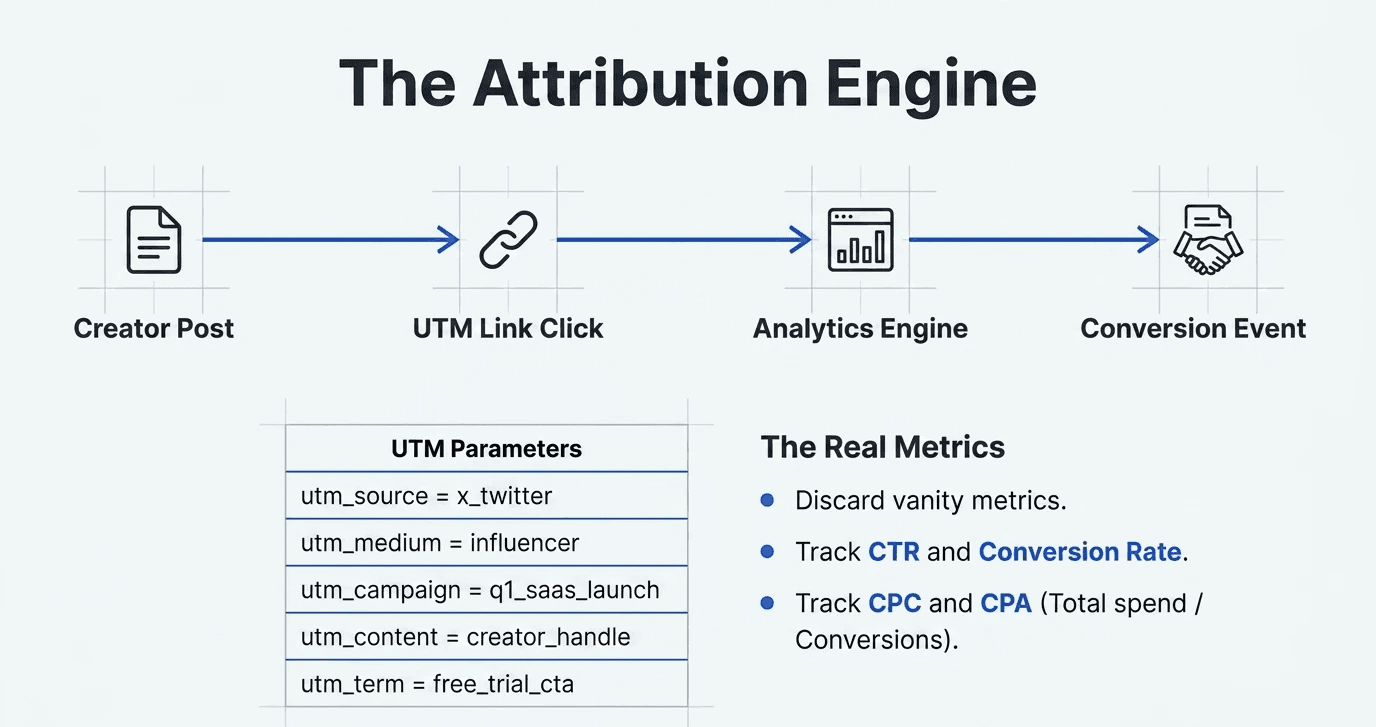
A UTM link is a URL with tracking tags added to it. When someone clicks the link and lands on your site, Google Analytics (or any analytics tool) records exactly where that click came from.
A standard UTM for an X influencer post looks like this:
UTM Parameter | Example Value |
utm_source | x_twitter |
utm_medium | influencer |
utm_campaign | q1_saas_launch |
utm_content | creator_name_or_handle |
utm_term | free_trial_cta |
The metrics that actually matter for X influencer campaigns:
• Click-through rate (CTR), how many people clicked the link vs saw the post
• Conversion rate, of those who clicked, how many completed the goal action
• Cost per click (CPC), total campaign spend divided by total clicks
• Cost per acquisition (CPA), total spend divided by conversions
• Earned media mentions, did the post trigger organic conversations or shares beyond the paid post?
• Follower growth, did your brand account grow during and after the campaign?
Vanity metrics like impressions and likes are a start, but they are not the goal. A campaign with 2 million impressions and zero conversions is not a successful campaign. Keep your eye on the metrics that connect to your original goal from Step 1.
STEP 04 | Activate and Amplify the Campaign the Right Way |
Publishing the content is not the end of your job. It is the beginning. Most brands post the content and walk away. The brands that win on X treat every influencer post like the start of a conversation.
What activation actually looks like:
• Engage immediately; reply to the creator's post within the first hour. Your brand account showing up in the thread signals the algorithm that this is a real conversation worth spreading
• Boost with paid: X allows you to amplify influencer posts using Promoted Posts. Put a small budget behind top-performing content within 24 hours of it going live
• Quote tweet it: your brand account quoting the post with added context extends the reach and starts a second wave of engagement
• Cross-post to LinkedIn: if the creator has a LinkedIn presence, coordinate a cross-platform drop for double the impressions
• Share internally: your team liking and replying in the first hour matters more than you think.
The biggest mistake brands make at this stage is going silent. You paid for the post. Now treat it like the asset it is and put some energy behind it.
Amplification window The first 2 to 6 hours after a post goes live on X is the most important window. The algorithm decides in that window whether to push the post to a wider audience or let it die quietly. Be active in that window. |
Also Read: What’s Social Media SEO
STEP 05 | Track Your Results With UTM Links and Real Metrics |
If you are not tracking the campaign, you are not running a campaign. You are making a donation.
X influencer campaigns are measurable when set up properly. The trick is building your tracking infrastructure before the content goes live, not after.
Set up UTM parameters for every influencer post:
A UTM link is a URL with tracking tags added to it. When someone clicks the link and lands on your site, Google Analytics (or any analytics tool) records exactly where that click came from.
A standard UTM for an X influencer post looks like this:
UTM Parameter | Example Value |
utm_source | x_twitter |
utm_medium | influencer |
utm_campaign | q1_saas_launch |
utm_content | creator_name_or_handle |
utm_term | free_trial_cta |
The metrics that actually matter for X influencer campaigns:
• Click-through rate (CTR), how many people clicked the link vs saw the post
• Conversion rate, of those who clicked, how many completed the goal action
• Cost per click (CPC), total campaign spend divided by total clicks
• Cost per acquisition (CPA), total spend divided by conversions
• Earned media mentions, did the post trigger organic conversations or shares beyond the paid post?
• Follower growth, did your brand account grow during and after the campaign?
Vanity metrics like impressions and likes are a start, but they are not the goal. A campaign with 2 million impressions and zero conversions is not a successful campaign. Keep your eye on the metrics that connect to your original goal from Step 1.
Conclusion
X influencer marketing is not complicated. It is just easy to do wrong when you skip the basics.
Define the goal first. Find creators who already talk to your audience. Brief them clearly without micromanaging. Amplify the content in the first hours after posting. Track everything with UTM links and focus on the metrics that connect to your business, not just the numbers that look big.
Do those five things consistently and X influencer marketing becomes one of the highest-leverage channels in your toolkit, especially for B2B brands trying to build pipeline in the places their buyers already spend time.
Ready to run your first X influencer campaign? Motion Labs manages X and LinkedIn influencer campaigns end-to-end — from creator sourcing to content delivery and performance reporting. We work with startups and B2B brands who want real results, not just impressions. → Book a free strategy call at motionlabs.agency |
Frequently Asked Questions About X Influencer Marketing
How much does X influencer marketing cost in 2025?
It varies a lot depending on creator size. Micro-influencers (under 50K followers) typically charge $150 to $800 per post. Mid-tier creators (50K to 200K) usually range from $800 to $5,000. Larger accounts charge more. For B2B campaigns, micro and mid-tier creators almost always deliver better ROI because their audiences are tighter and more engaged.
What types of content work best for X influencer campaigns?
Threads tend to perform best for education and awareness. Single posts with a strong hook work well for conversion-focused campaigns. Polls are good for engagement and brand visibility. Short video is growing fast on X and often gets priority in the algorithm. For B2B brands, long-form threads that teach something tend to outperform posts that just promote.
How do I disclose paid partnerships on X?
X requires creators to clearly label paid content. The standard approach is adding 'Ad', 'Sponsored', or 'Paid partnership' to the post. Many brands and creators use the hashtag #ad or #sponsored. This is also an FTC requirement in the US, so it is not optional. Build disclosure language into your brief from the start.
How many influencers should I use in one campaign?
For a first campaign, start with three to five creators. This gives you enough data to see what is working without spreading your budget too thin. Once you know which creators and which content types are driving results, scale up with the best performers. Running one creator at a time makes it hard to learn anything useful.
How long should an X influencer campaign run?
A minimum of four weeks gives you enough data to make decisions. Six to eight weeks is better for brand awareness goals. For product launches or time-sensitive campaigns, a two-week burst with multiple creators posting across the window can work well. Avoid campaigns shorter than two weeks, you will not collect enough meaningful data.
Can B2B brands really use X influencer marketing?
Yes, and it often works better for B2B than it does for consumer brands. X is where a huge percentage of tech buyers, founders, VCs, marketers, and decision-makers spend time. The niche communities on X are tight, and the right creator can put your product in front of exactly the right people. LinkedIn has larger B2B reach overall, but X often delivers faster word-of-mouth for the right industries.
What is the difference between X influencer marketing and LinkedIn influencer marketing?
X is faster, more conversational, and better for real-time trends and brand awareness. LinkedIn is more formal, has better targeting for job title and industry, and tends to drive higher-quality leads but at slower pace. Many brands run both in parallel for maximum B2B reach. Motion Labs manages creator campaigns across both platforms if you want to run them together.
Conclusion
X influencer marketing is not complicated. It is just easy to do wrong when you skip the basics.
Define the goal first. Find creators who already talk to your audience. Brief them clearly without micromanaging. Amplify the content in the first hours after posting. Track everything with UTM links and focus on the metrics that connect to your business, not just the numbers that look big.
Do those five things consistently and X influencer marketing becomes one of the highest-leverage channels in your toolkit, especially for B2B brands trying to build pipeline in the places their buyers already spend time.
Ready to run your first X influencer campaign? Motion Labs manages X and LinkedIn influencer campaigns end-to-end — from creator sourcing to content delivery and performance reporting. We work with startups and B2B brands who want real results, not just impressions. → Book a free strategy call at motionlabs.agency |
Frequently Asked Questions About X Influencer Marketing
How much does X influencer marketing cost in 2025?
It varies a lot depending on creator size. Micro-influencers (under 50K followers) typically charge $150 to $800 per post. Mid-tier creators (50K to 200K) usually range from $800 to $5,000. Larger accounts charge more. For B2B campaigns, micro and mid-tier creators almost always deliver better ROI because their audiences are tighter and more engaged.
What types of content work best for X influencer campaigns?
Threads tend to perform best for education and awareness. Single posts with a strong hook work well for conversion-focused campaigns. Polls are good for engagement and brand visibility. Short video is growing fast on X and often gets priority in the algorithm. For B2B brands, long-form threads that teach something tend to outperform posts that just promote.
How do I disclose paid partnerships on X?
X requires creators to clearly label paid content. The standard approach is adding 'Ad', 'Sponsored', or 'Paid partnership' to the post. Many brands and creators use the hashtag #ad or #sponsored. This is also an FTC requirement in the US, so it is not optional. Build disclosure language into your brief from the start.
How many influencers should I use in one campaign?
For a first campaign, start with three to five creators. This gives you enough data to see what is working without spreading your budget too thin. Once you know which creators and which content types are driving results, scale up with the best performers. Running one creator at a time makes it hard to learn anything useful.
How long should an X influencer campaign run?
A minimum of four weeks gives you enough data to make decisions. Six to eight weeks is better for brand awareness goals. For product launches or time-sensitive campaigns, a two-week burst with multiple creators posting across the window can work well. Avoid campaigns shorter than two weeks, you will not collect enough meaningful data.
Can B2B brands really use X influencer marketing?
Yes, and it often works better for B2B than it does for consumer brands. X is where a huge percentage of tech buyers, founders, VCs, marketers, and decision-makers spend time. The niche communities on X are tight, and the right creator can put your product in front of exactly the right people. LinkedIn has larger B2B reach overall, but X often delivers faster word-of-mouth for the right industries.
What is the difference between X influencer marketing and LinkedIn influencer marketing?
X is faster, more conversational, and better for real-time trends and brand awareness. LinkedIn is more formal, has better targeting for job title and industry, and tends to drive higher-quality leads but at slower pace. Many brands run both in parallel for maximum B2B reach. Motion Labs manages creator campaigns across both platforms if you want to run them together.
the call your competitor wish you would'nt take


Related Posts





Related Posts
Related Posts
Motion labs
info@motionlabs.agency


+971 55317 1706
C-1802, ONTARIO TOWER, PLOT NO. 49-0, BUSINESS BAY, DUBAI, 00000
click to meet me :)
click to meet me :)
© All Rights Reserved | 2026


Motion labs
info@motionlabs.agency
+971 55317 1706
C-1802, ONTARIO TOWER, PLOT NO. 49-0, BUSINESS BAY, DUBAI, 00000
Private policy
Terms & Conditions
© All Rights Reserved | 2026
click to meet me :)