/
/
How to Optimise Content for AI Search and Discovery
How to Optimise Content for AI Search and Discovery
5 min
read
How to Optimise Content for AI Search and Discovery
How to Optimise Content for AI Search and Discovery
SEO
Ai

Author
Scroll down
to read more!
Summerize with ChatGPT
Summerize with Gemini
Summerize with Claude
How to Optimise Content for AI Search and Discovery
How to Optimise Content for AI Search and Discovery
Why is your competitor showing up on AI, and you're not? AI just recommended your competitor. To your customer. And not you. Let’s see the core problem and the solution.
Why is your competitor showing up on AI, and you're not? AI just recommended your competitor. To your customer. And not you. Let’s see the core problem and the solution.
What Is AI Search Optimisation?
Before talking about AI search optimisation, let’s take a look at our old fundamentals. For most of the last decade, SEO meant only one thing: get your page to rank on page one of Google. Keyword research, backlinks, meta tags, the whole playbook was built around that goal.
But now the game has changed. AI search works differently. Instead of showing users a list of links and letting them choose, AI platforms compose a direct answer. They pull the most relevant, clearly written, well-structured content from across the web, and they cite it as part of their response.
This new practice has a name: Generative Engine Optimisation, or GEO. It sits alongside traditional SEO, not against it. Most of what makes good SEO still applies, but GEO adds a specific focus on making your content easy for AI models to read, extract, and trust.
If you practise solid SEO already, you're about two-thirds of the way there. The rest is about structure, authority signals, and making sure AI crawlers can actually access your content.
Traditional SEO vs. AI Search Optimisation (GEO)
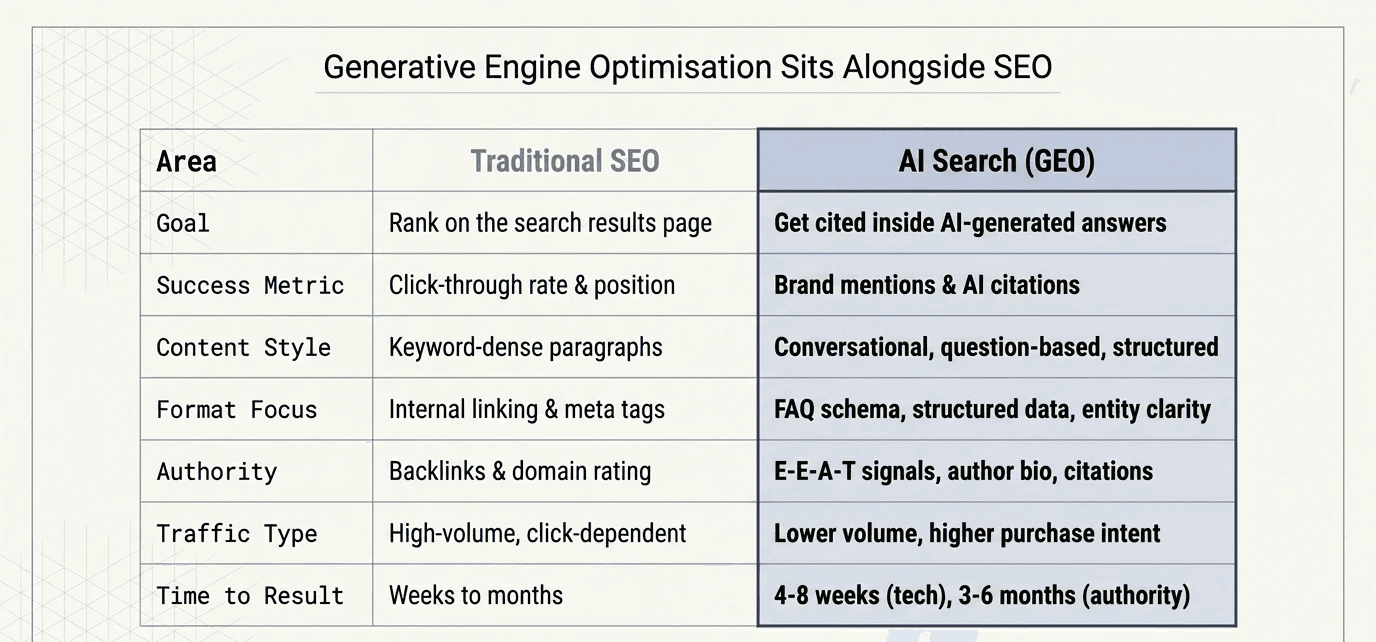
Area | Traditional SEO | AI Search (GEO) |
Goal | Rank on the search results page | Get cited inside AI-generated answers |
Success metric | Click-through rate & position | Brand mentions & AI citations |
Content style | Keyword-dense paragraphs | Conversational, question-based, structured |
Format focus | Internal linking & meta tags | FAQ schema, structured data, entity clarity |
Authority | Backlinks & domain rating | E-E-A-T signals, author bio, citations |
Traffic type | High-volume, click-dependent | Lower volume, higher purchase intent |
Time to result | Weeks to months | 4–8 weeks for technical; 3–6 months for authority |
How AI Search Engines Read and Rank Your Content
Before you can optimise for AI search, let’s break down how these systems actually process your content. They're not scanning the way a human does. They're breaking down the content in chunks, building a semantic understanding of what your page is about, and deciding whether it's trustworthy enough to cite.
Here are the main things AI optimisation is looking for:
• Clarity: Is the content easy to parse? Are headings descriptive? Do paragraphs start with the main point?
• Fact density: Does the page back up its claims with specific data, stats, or examples?
• Structure: Is information organized so a reader (or AI) can skim it and extract the answer quickly?
• Authority signals: Who wrote this? Is the author credible? Is the content cited elsewhere?
• Technical accessibility: Can AI bots actually crawl the page, or is content hidden behind JavaScript or paywalls?
Keyword stuffing actively hurts you in AI search. Research on Perplexity.ai showed that keyword-stuffed content underperformed plain, unoptimized content by 10%. AI models are trained on natural language, so they don’t understand and choose clumsy, forced phrasing.
How to Structure Content So AI Search Engines Can Find It Easily
Structure is where most sites fall when it comes to AI visibility. If your content is filled with dense paragraphs with no signposting, AI will skip it for a cleaner source.
Also read: Is AI damaging or saving your brand?
Use the Answer-First Structure
Start every section by directly answering the question the heading poses. Don't build up to the answer; read with it. AI systems extract the first clear, direct statement that addresses a query. Pages that use this structure see a 2.3x lift in citation rates compared to pages that bury the answer in context.
Write Headings That Match Real Search Queries
Your H2 and H3 headings need to sound like something a person would actually type or ask. Think in questions: 'How does X work?', 'What is the best Y for Z?', 'Why does A matter for B?'. These natural, question-based formats align with how AI search interprets intent.
Keep Paragraphs Short and Purposeful
Long walls of text signal low extractability to AI engines. Aim for two to four sentences per paragraph. If a human can't skim the page in five seconds, AI can't summarise it in two. Short paragraphs, clear subheadings, and logical flow are what you're after.
Use Comparison Tables and Lists for Data
Structured formats, tables, bullet lists, and numbered steps are easier for AI to parse and quote. If you have information that can be presented as a comparison or a list, do it that way rather than writing it out as prose.
What Is AI Search Optimisation?
Before talking about AI search optimisation, let’s take a look at our old fundamentals. For most of the last decade, SEO meant only one thing: get your page to rank on page one of Google. Keyword research, backlinks, meta tags, the whole playbook was built around that goal.
But now the game has changed. AI search works differently. Instead of showing users a list of links and letting them choose, AI platforms compose a direct answer. They pull the most relevant, clearly written, well-structured content from across the web, and they cite it as part of their response.
This new practice has a name: Generative Engine Optimisation, or GEO. It sits alongside traditional SEO, not against it. Most of what makes good SEO still applies, but GEO adds a specific focus on making your content easy for AI models to read, extract, and trust.
If you practise solid SEO already, you're about two-thirds of the way there. The rest is about structure, authority signals, and making sure AI crawlers can actually access your content.
Traditional SEO vs. AI Search Optimisation (GEO)
Area | Traditional SEO | AI Search (GEO) |
Goal | Rank on the search results page | Get cited inside AI-generated answers |
Success metric | Click-through rate & position | Brand mentions & AI citations |
Content style | Keyword-dense paragraphs | Conversational, question-based, structured |
Format focus | Internal linking & meta tags | FAQ schema, structured data, entity clarity |
Authority | Backlinks & domain rating | E-E-A-T signals, author bio, citations |
Traffic type | High-volume, click-dependent | Lower volume, higher purchase intent |
Time to result | Weeks to months | 4–8 weeks for technical; 3–6 months for authority |
How AI Search Engines Read and Rank Your Content
Before you can optimise for AI search, let’s break down how these systems actually process your content. They're not scanning the way a human does. They're breaking down the content in chunks, building a semantic understanding of what your page is about, and deciding whether it's trustworthy enough to cite.
Here are the main things AI optimisation is looking for:
• Clarity: Is the content easy to parse? Are headings descriptive? Do paragraphs start with the main point?
• Fact density: Does the page back up its claims with specific data, stats, or examples?
• Structure: Is information organized so a reader (or AI) can skim it and extract the answer quickly?
• Authority signals: Who wrote this? Is the author credible? Is the content cited elsewhere?
• Technical accessibility: Can AI bots actually crawl the page, or is content hidden behind JavaScript or paywalls?
Keyword stuffing actively hurts you in AI search. Research on Perplexity.ai showed that keyword-stuffed content underperformed plain, unoptimized content by 10%. AI models are trained on natural language, so they don’t understand and choose clumsy, forced phrasing.
How to Structure Content So AI Search Engines Can Find It Easily
Structure is where most sites fall when it comes to AI visibility. If your content is filled with dense paragraphs with no signposting, AI will skip it for a cleaner source.
Also read: Is AI damaging or saving your brand?
Use the Answer-First Structure
Start every section by directly answering the question the heading poses. Don't build up to the answer; read with it. AI systems extract the first clear, direct statement that addresses a query. Pages that use this structure see a 2.3x lift in citation rates compared to pages that bury the answer in context.
Write Headings That Match Real Search Queries
Your H2 and H3 headings need to sound like something a person would actually type or ask. Think in questions: 'How does X work?', 'What is the best Y for Z?', 'Why does A matter for B?'. These natural, question-based formats align with how AI search interprets intent.
Keep Paragraphs Short and Purposeful
Long walls of text signal low extractability to AI engines. Aim for two to four sentences per paragraph. If a human can't skim the page in five seconds, AI can't summarise it in two. Short paragraphs, clear subheadings, and logical flow are what you're after.
Use Comparison Tables and Lists for Data
Structured formats, tables, bullet lists, and numbered steps are easier for AI to parse and quote. If you have information that can be presented as a comparison or a list, do it that way rather than writing it out as prose.
Why Schema Markup Is Non-Negotiable for AI Content Visibility
Structured data (or schema markup) is the nutrition label for your website. It tells AI exactly what it's looking at, without making it work through the fluff to figure it out.
The numbers here are hard to ignore. Nearly two-thirds of pages that earn citations in Google's AI Mode have implemented some form of Schema.org markup. For ChatGPT, pages with schema are substantially overrepresented among cited sources. The FAQPage schema alone has a 67% citation rate in AI responses for relevant queries.
Here's which schema types to prioritise:
• FAQPage: Directly maps questions to answers. One of the highest-performing schema types for AI citation.
• Article: Helps AI understand authorship, publication date, and topic focus. Essential for editorial content.
• HowTo: Step-by-step structure that AI engines can decompose and reassemble cleanly.
• Product & Review: Critical for e-commerce and comparison content.
• LocalBusiness: Supports local discovery across AI platforms.
One important rule: your schema must match what's actually visible on the page. AI engines cross-reference schema claims against the live content. Mismatches can get you penalised or ignored. Validate every implementation using Google's Rich Results Test tool before you publish.
How to Build Authority So AI Tools Trust and Cite You
Demonstrate E-E-A-T Across Your Content
Experience, Expertise, Authoritativeness, and Trustworthiness- these signals still matter, and they've become more important in AI search. Add proper author bios. Link to credentials. Cite your sources inline. Pages with clear attribution get cited 3.1x more often in AI responses than unattributed content.
Build Your Brand Presence Beyond Your Website
AI tools don't just look at your site. They pull from across the web, social media, press mentions, niche directories, Reddit, LinkedIn, and podcasts. If your brand only exists on your own domain, AI has less to work with. Show up in the places your audience goes, and make sure your messaging is consistent.
Get Mentioned and Cited by Other Sources
In traditional SEO, backlinks are the currency of authority. In AI search, it mentions citations. When credible sources reference your brand or content, AI systems treat that as a trust signal. Contributing to industry publications, being featured in roundups, and guest posting on authoritative sites all help here.
Publish Original Data and Research
Content that includes original statistics and proprietary data earns 30 to 40% higher visibility in AI-generated results. If you can run a survey, compile an industry dataset, or produce a findings report, do it. AI systems love content that gives them new, citable facts they can't get anywhere else.
Also read: What's social media SEO?
Technical Fixes That Let AI Sites Access Your Content
Great content with solid schema still won't get cited if AI bots can't reach it. This is the often-overlooked side of GEO, and it's fixable in a few hours if you know what to check.
• Check your robots.txt: Make sure you're not accidentally blocking AI crawlers like GPTBot, PerplexityBot, or Google-Extended. Many sites block them without realising it.
• Ensure server-side rendering: If your main content is loaded via JavaScript after the initial page load, AI bots may miss it entirely. Critical content should be in the HTML from the start.
• Don't lock content behind logins or paywalls: AI systems can't access what they can't crawl. If your best content is gated, create accessible equivalents for discovery purposes.
• Add an llms.txt file: This is a newer signal that helps AI systems understand your site structure and what content is most relevant. It's the equivalent of a sitemap for LLMs.
• Use fast load times and clean page structure: Slow, cluttered pages are harder for AI to parse efficiently. Trim the fat.
How to Track AI Search Visibility and Measure What's Working
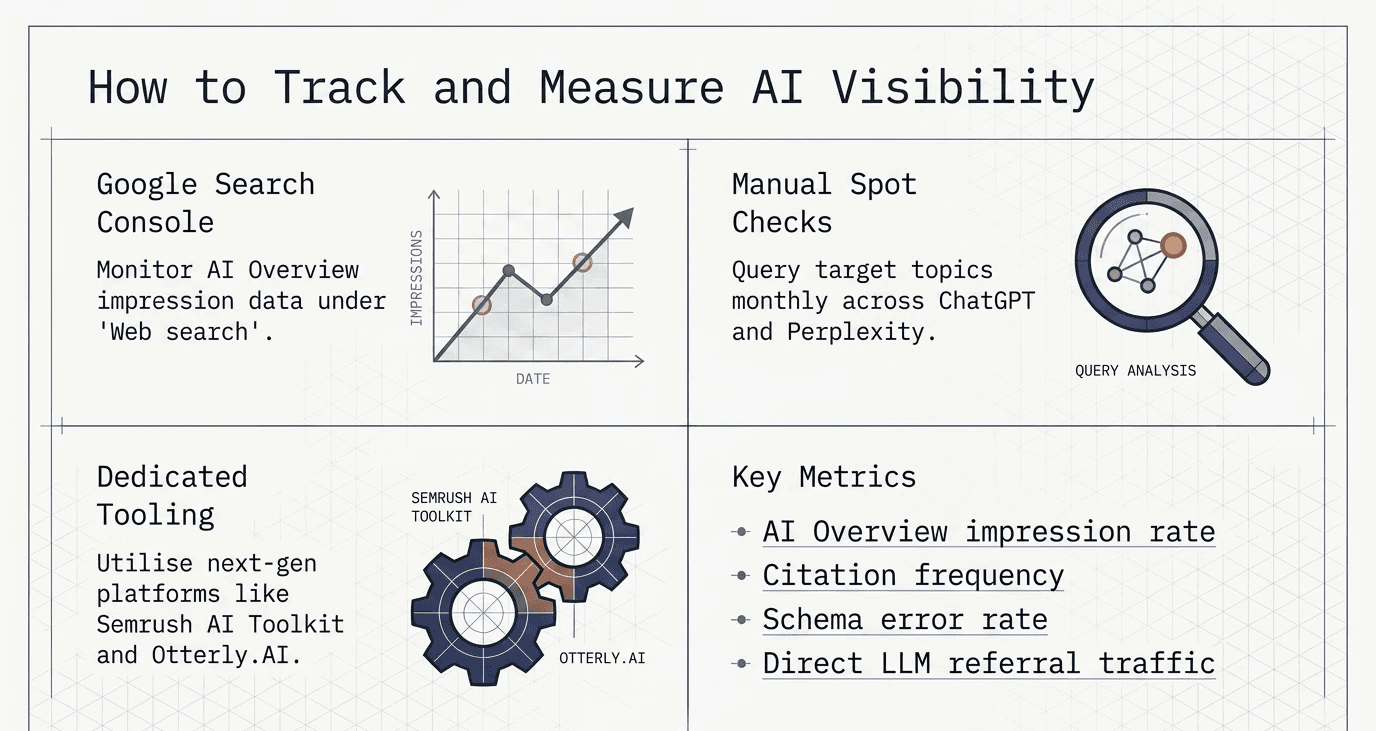
Measuring GEO performance is still evolving, but there are clear signals you can track right now.
Monitor AI Overviews in Google Search Console
As of mid-2025, Google Search Console includes AI Overview data under the Web search type filter. It doesn't separate AI impressions from organic ones cleanly yet, but you can see when your pages are generating impressions around queries where AI Overviews are active.
Run Manual Spot Checks
The most direct way to know if you're getting cited is to ask. Query ChatGPT, Perplexity, and Google AI Mode for your target topics and check whether your brand or content appears in the responses. Do this monthly for your top 10 to 15 target queries.
Use Dedicated AI Visibility Tools
Tools like Semrush's AI Toolkit, Otterly.AI, and Profound are built specifically to track brand mentions and citations across AI platforms. These give you a clearer picture than traditional analytics, which can't distinguish AI-referred visits from organic ones.
Track the Right Metrics
• AI Overview impression rate: What percentage of your impressions come from AI features?
• Citation frequency: How often do AI tools reference your content for target queries?
• Schema error rate: Monitor this in Search Console under Enhancements.
• LLM referral traffic: Set up UTM parameters and check direct traffic sources for AI platform referrals.
Most brands see measurable citation improvements within 90 days of implementing systematic GEO, especially if foundation work like schema and content restructuring is done early.
Why Schema Markup Is Non-Negotiable for AI Content Visibility
Structured data (or schema markup) is the nutrition label for your website. It tells AI exactly what it's looking at, without making it work through the fluff to figure it out.
The numbers here are hard to ignore. Nearly two-thirds of pages that earn citations in Google's AI Mode have implemented some form of Schema.org markup. For ChatGPT, pages with schema are substantially overrepresented among cited sources. The FAQPage schema alone has a 67% citation rate in AI responses for relevant queries.
Here's which schema types to prioritise:
• FAQPage: Directly maps questions to answers. One of the highest-performing schema types for AI citation.
• Article: Helps AI understand authorship, publication date, and topic focus. Essential for editorial content.
• HowTo: Step-by-step structure that AI engines can decompose and reassemble cleanly.
• Product & Review: Critical for e-commerce and comparison content.
• LocalBusiness: Supports local discovery across AI platforms.
One important rule: your schema must match what's actually visible on the page. AI engines cross-reference schema claims against the live content. Mismatches can get you penalised or ignored. Validate every implementation using Google's Rich Results Test tool before you publish.
How to Build Authority So AI Tools Trust and Cite You
Demonstrate E-E-A-T Across Your Content
Experience, Expertise, Authoritativeness, and Trustworthiness- these signals still matter, and they've become more important in AI search. Add proper author bios. Link to credentials. Cite your sources inline. Pages with clear attribution get cited 3.1x more often in AI responses than unattributed content.
Build Your Brand Presence Beyond Your Website
AI tools don't just look at your site. They pull from across the web, social media, press mentions, niche directories, Reddit, LinkedIn, and podcasts. If your brand only exists on your own domain, AI has less to work with. Show up in the places your audience goes, and make sure your messaging is consistent.
Get Mentioned and Cited by Other Sources
In traditional SEO, backlinks are the currency of authority. In AI search, it mentions citations. When credible sources reference your brand or content, AI systems treat that as a trust signal. Contributing to industry publications, being featured in roundups, and guest posting on authoritative sites all help here.
Publish Original Data and Research
Content that includes original statistics and proprietary data earns 30 to 40% higher visibility in AI-generated results. If you can run a survey, compile an industry dataset, or produce a findings report, do it. AI systems love content that gives them new, citable facts they can't get anywhere else.
Also read: What's social media SEO?
Technical Fixes That Let AI Sites Access Your Content
Great content with solid schema still won't get cited if AI bots can't reach it. This is the often-overlooked side of GEO, and it's fixable in a few hours if you know what to check.
• Check your robots.txt: Make sure you're not accidentally blocking AI crawlers like GPTBot, PerplexityBot, or Google-Extended. Many sites block them without realising it.
• Ensure server-side rendering: If your main content is loaded via JavaScript after the initial page load, AI bots may miss it entirely. Critical content should be in the HTML from the start.
• Don't lock content behind logins or paywalls: AI systems can't access what they can't crawl. If your best content is gated, create accessible equivalents for discovery purposes.
• Add an llms.txt file: This is a newer signal that helps AI systems understand your site structure and what content is most relevant. It's the equivalent of a sitemap for LLMs.
• Use fast load times and clean page structure: Slow, cluttered pages are harder for AI to parse efficiently. Trim the fat.
How to Track AI Search Visibility and Measure What's Working
Measuring GEO performance is still evolving, but there are clear signals you can track right now.
Monitor AI Overviews in Google Search Console
As of mid-2025, Google Search Console includes AI Overview data under the Web search type filter. It doesn't separate AI impressions from organic ones cleanly yet, but you can see when your pages are generating impressions around queries where AI Overviews are active.
Run Manual Spot Checks
The most direct way to know if you're getting cited is to ask. Query ChatGPT, Perplexity, and Google AI Mode for your target topics and check whether your brand or content appears in the responses. Do this monthly for your top 10 to 15 target queries.
Use Dedicated AI Visibility Tools
Tools like Semrush's AI Toolkit, Otterly.AI, and Profound are built specifically to track brand mentions and citations across AI platforms. These give you a clearer picture than traditional analytics, which can't distinguish AI-referred visits from organic ones.
Track the Right Metrics
• AI Overview impression rate: What percentage of your impressions come from AI features?
• Citation frequency: How often do AI tools reference your content for target queries?
• Schema error rate: Monitor this in Search Console under Enhancements.
• LLM referral traffic: Set up UTM parameters and check direct traffic sources for AI platform referrals.
Most brands see measurable citation improvements within 90 days of implementing systematic GEO, especially if foundation work like schema and content restructuring is done early.
Conclusion
AI search isn't a future trend. It's the channel your audience is using right now to find answers, discover brands, and make buying decisions.
The brands that show up in those AI-generated responses, as a citation, a mention, or a direct recommendation, have a serious advantage. And the gap between businesses that have optimised for this and those that haven't is only going to get wider.
The good news is that the fundamentals aren't complicated. Structure your content to answer questions directly. Implement schema markup. Build your authority across channels. Make sure AI crawlers can reach your pages. Track your visibility and keep improving.
Do those things consistently, and you'll be showing up where your audience is looking.
Want to Show Up in AI Search? Motion Labs is a full-service digital marketing agency that optimises your content for AI search and discovery, from GEO strategy to schema implementation, content restructuring, and brand authority building. |
Frequently Asked Questions About Optimising Content for AI Search
What is the difference between SEO and GEO?
SEO (Search Engine Optimisation) focuses on ranking your web pages in traditional search results like Google's blue links. GEO (Generative Engine Optimisation) focuses on getting your content cited inside AI-generated answers from tools like ChatGPT, Perplexity, and Google AI Overviews. Both matter, but they require slightly different approaches to content structure and authority building.
Does traditional SEO still work if I optimise for AI search?
Yes, and it's still important. Traditional organic search continues to drive the majority of referral traffic for most websites. The best approach is to maintain your existing SEO strategy while layering GEO principles on top, answer-first content structure, schema markup, and authority signals benefit both channels.
How long does it take to start appearing in AI search results?
Technical improvements like schema implementation and content restructuring typically produce results within four to eight weeks. Building the authority signals that AI systems look for brand mentions, citations, and cross-platform presence takes three to six months. Most brands see measurable AI citation improvements within 90 days of starting systematic optimisation.
What type of content gets cited most by AI search engines?
Content that performs best in AI search tends to be direct, factual, and clearly structured. Specifically: FAQ-formatted content with FAQPage schema; how-to guides with step-by-step structure; pages that include original data and statistics; and content with clear author attribution and E-E-A-T signals. Answer-first paragraphs get a 2.3x citation lift versus content that buries its main point.
Is schema markup required to show up in AI search?
It's not technically required, but the data strongly suggests it makes a major difference. Nearly two-thirds of pages cited in Google's AI Mode use some form of schema markup. The FAQPage schema has a 67% citation rate in AI responses. If you're serious about AI search visibility, schema should be a priority, not an afterthought.
Which AI search platforms should I optimize for?
The three highest-priority platforms right now are Google AI Overviews (widest reach), ChatGPT Search (fastest-growing user base), and Perplexity (strong with research-intent queries). Each platform pulls content differently, so the best strategy is to build the foundation — structured content, schema, strong authority signals, that works across all of them rather than optimising for one specifically.
Can a small or medium-sized business compete in AI search?
Yes — and in some ways it's easier than competing in traditional search. AI systems assess content quality, structure, and authority signals rather than purely relying on domain authority and backlink volume. A small business with well-structured, schema-marked, clearly authoritative content can show up ahead of larger competitors who haven't adapted their strategy yet.
Conclusion
AI search isn't a future trend. It's the channel your audience is using right now to find answers, discover brands, and make buying decisions.
The brands that show up in those AI-generated responses, as a citation, a mention, or a direct recommendation, have a serious advantage. And the gap between businesses that have optimised for this and those that haven't is only going to get wider.
The good news is that the fundamentals aren't complicated. Structure your content to answer questions directly. Implement schema markup. Build your authority across channels. Make sure AI crawlers can reach your pages. Track your visibility and keep improving.
Do those things consistently, and you'll be showing up where your audience is looking.
Want to Show Up in AI Search? Motion Labs is a full-service digital marketing agency that optimises your content for AI search and discovery, from GEO strategy to schema implementation, content restructuring, and brand authority building. |
Frequently Asked Questions About Optimising Content for AI Search
What is the difference between SEO and GEO?
SEO (Search Engine Optimisation) focuses on ranking your web pages in traditional search results like Google's blue links. GEO (Generative Engine Optimisation) focuses on getting your content cited inside AI-generated answers from tools like ChatGPT, Perplexity, and Google AI Overviews. Both matter, but they require slightly different approaches to content structure and authority building.
Does traditional SEO still work if I optimise for AI search?
Yes, and it's still important. Traditional organic search continues to drive the majority of referral traffic for most websites. The best approach is to maintain your existing SEO strategy while layering GEO principles on top, answer-first content structure, schema markup, and authority signals benefit both channels.
How long does it take to start appearing in AI search results?
Technical improvements like schema implementation and content restructuring typically produce results within four to eight weeks. Building the authority signals that AI systems look for brand mentions, citations, and cross-platform presence takes three to six months. Most brands see measurable AI citation improvements within 90 days of starting systematic optimisation.
What type of content gets cited most by AI search engines?
Content that performs best in AI search tends to be direct, factual, and clearly structured. Specifically: FAQ-formatted content with FAQPage schema; how-to guides with step-by-step structure; pages that include original data and statistics; and content with clear author attribution and E-E-A-T signals. Answer-first paragraphs get a 2.3x citation lift versus content that buries its main point.
Is schema markup required to show up in AI search?
It's not technically required, but the data strongly suggests it makes a major difference. Nearly two-thirds of pages cited in Google's AI Mode use some form of schema markup. The FAQPage schema has a 67% citation rate in AI responses. If you're serious about AI search visibility, schema should be a priority, not an afterthought.
Which AI search platforms should I optimize for?
The three highest-priority platforms right now are Google AI Overviews (widest reach), ChatGPT Search (fastest-growing user base), and Perplexity (strong with research-intent queries). Each platform pulls content differently, so the best strategy is to build the foundation — structured content, schema, strong authority signals, that works across all of them rather than optimising for one specifically.
Can a small or medium-sized business compete in AI search?
Yes — and in some ways it's easier than competing in traditional search. AI systems assess content quality, structure, and authority signals rather than purely relying on domain authority and backlink volume. A small business with well-structured, schema-marked, clearly authoritative content can show up ahead of larger competitors who haven't adapted their strategy yet.
the call your competitor wish you would'nt take


Related Posts





Related Posts
Related Posts
Motion labs
info@motionlabs.agency


+971 55317 1706
C-1802, ONTARIO TOWER, PLOT NO. 49-0, BUSINESS BAY, DUBAI, 00000
click to meet me :)
click to meet me :)
© All Rights Reserved | 2026


Motion labs
info@motionlabs.agency
+971 55317 1706
C-1802, ONTARIO TOWER, PLOT NO. 49-0, BUSINESS BAY, DUBAI, 00000
Private policy
Terms & Conditions
© All Rights Reserved | 2026
click to meet me :)